

Arizona Hard Money Fix and Flip Lender
September 23, 2026
Banking on broad appreciation across the Valley is a dead strategy. If you rely on passive market lifts to protect your margins, you’ve already lost the deal. Winning requires precision, which means identifying the best neighborhoods in Phoenix for flipping houses 2026 based on inventory velocity rather than hype.
You already know the pressure. Acquisition costs keep climbing across Maricopa County. Municipal permit delays stall your crews, and high holding costs drain your reserves while summer heat stretches your timeline. Worse, traditional financing drags its feet for weeks while aggressive competitors snap up the best distressed inventory right in front of you. You don’t need red tape; you need speed, certainty, and hyper-local clarity. In this guide, you’ll discover the highest-yield Phoenix submarkets for real profit, pinpoint realistic after-repair values, and unlock the asset-based financing strategies needed to close acquisitions in days.
Here is your roadmap to the Valley’s fastest-absorbing zip codes and the high-yield flip opportunities waiting right now.
Key Takeaways
- Target submarket transaction velocity and entry pricing to identify the best neighborhoods in Phoenix for flipping houses 2026 rather than gambling on speculative appreciation.
- Benchmark proven value-add corridors across Maryvale, Glendale, South Mountain, and the East Valley to match your renovation budget to hyper-local buyer demand.
- Master a 5-step underwriting blueprint that locks down realistic after-repair values using micro-radius comp criteria and strict 70% purchase rules.
- Protect net rehab margins from regional pitfalls like blistering desert summer schedules and pre-1975 central Phoenix cast iron plumbing failures.
- Eliminate conventional bank delays by securing asset-based fix and flip loans that fund on deal equity and close distressed acquisitions in days.
Navigating the 2026 Phoenix Fix and Flip Real Estate Market
Phoenix isn’t a speculative playground anymore. It’s an execution market. The days of buying any beat-up ranch, slapping on grey paint, and riding double-digit appreciation are gone. Inventory velocity separates winning deals from capital-draining projects in competitive Valley submarkets. If a property sits while you burn cash on debt service, your net margin evaporates. The 2026 Phoenix flipping spread is the razor-thin margin between wholesale distressed acquisition and verified after-repair value (ARV) that only disciplined execution can protect.
Economic fundamentals still favor disciplined operators. As the economic anchor of Maricopa County, Phoenix, Arizona continues drawing corporate expansions, steady job migration, and high-earning households looking for move-in-ready inventory.
To understand the economic shifts shaping current project margins, watch this breakdown of modern flipping economics:
Macro Drivers Powering the Valley of the Sun
High-paying jobs create retail buyers. Semiconductor manufacturing hubs, bioscience developments, and tech corridor expansions continue funneling qualified professionals into the Valley. Coastal transplants leaving California and the Pacific Northwest want turnkey living. They don’t want contractor disputes. They don’t want permits. They want fully renovated, modern homes right now. Because starter-home inventory remains restricted across Maricopa County, high-grade renovations in prime pockets clear the MLS rapidly.
The 2026 Investor Reality Check: Margins Over Speculation
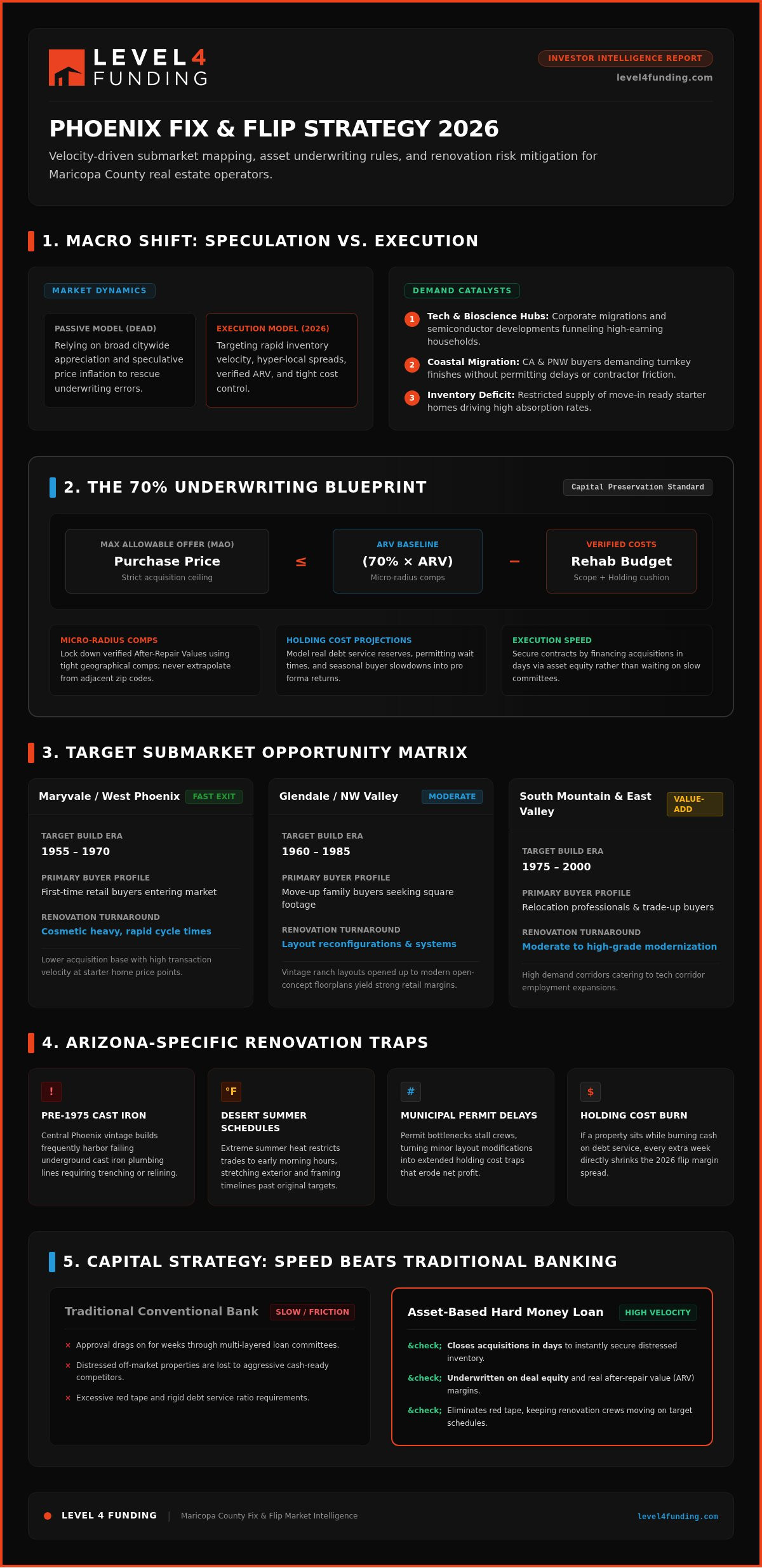
Hope is not an investment strategy. Modern investors targeting the best neighborhoods in Phoenix for flipping houses 2026 cannot bank on market inflation to rescue bad math. You must enforce the classic 70% rule: purchase price cannot exceed 70% of ARV minus verified renovation costs.
- Underwrite conservatively: Factor real holding timelines, realistic labor availability, and seasonal buyer slowdowns into every pro forma.
- Prioritize acquisition speed: Distressed inventory never sits. When off-market deals hit your desk, waiting on slow traditional approvals will cost you the contract. Asset-based capital secures the asset while slower buyers wait on committees.
Top Phoenix Neighborhoods for Fix and Flip Projects in 2026
Every submarket in Maricopa County tells a different margin story. Winning operators don’t look at citywide averages. They isolate vintage housing stock built between 1950 and 1985, where outdated mechanicals, compartmentalized layouts, and neglected finishes create real value-add potential. When evaluating the best neighborhoods in Phoenix for flipping houses 2026, focus on inventory velocity, lower acquisition bases, and strong buyer demand at the exit.
| Submarket | Target Build Era | Primary Exit Profile | Renovation Turnaround |
|---|---|---|---|
| Maryvale / West Phoenix | 1955-1970 | First-time retail buyers | Fast (Cosmetic heavy) |
| Glendale / Northwest Valley | 1960-1985 | Move-up family buyers | Moderate (Layout reconfigs) |
| South Mountain / Laveen | 1975-2000 | Urban commuter professionals | Moderate (Finishes & xeriscaping) |
| West Mesa / East Valley | 1965-1980 | Tech corridor workforce | Fast to Moderate |
Maryvale and West Phoenix: High-Volume Starter Flips
Block-construction ranch homes from the 1960s dominate this pocket. The appeal is simplicity. Concrete masonry walls mean few structural framing surprises, keeping cosmetic scopes focused on kitchens, baths, flooring, and paint. The accessible entry price point minimizes initial capital exposure. Clean retail exits move fast because local entry-level buyers actively compete for upgraded homes priced below Valley medians.
Glendale and Northwest Valley: Rapid Value-Add Corridors
Glendale provides diverse floor plans ranging from mid-century starters to large 1980s properties with two-car garages. Massive logistics hubs, regional medical centers, and industrial corridors drive steady local employment. The biggest profits here come from space optimization: opening closed-off kitchens, adding primary suites, or capturing dead living space to maximize resale value per square foot.
South Mountain and Laveen: Emerging Appreciation Pockets
Direct freeway access via the Loop 202 South Mountain corridor has transformed this submarket. Downtown Phoenix commuters get quick transit times without Central Avenue price tags. Projects here command top dollar when investors deliver modern open-concept floor plans paired with clean desert xeriscaping. When off-market deals surface in these competitive corridors, partnering with a dependable private capital partner like level4funding.com keeps your financing moving fast enough to beat all-cash competitors.
Underwriting Phoenix Deals: How to Evaluate Submarket Profitability
Automated algorithms don’t flip houses. Real estate investors do. Online valuation widgets cannot spot a cracked slab, an unpermitted patio enclosure, or a fried 100-amp electrical box. To extract reliable profit from the best neighborhoods in Phoenix for flipping houses 2026, you need a disciplined, five-step underwriting protocol that accounts for every local variable before you drop earnest money.
Step 1 & 2: Comping True ARV and Scope of Work
Precision comping saves deals. Never pull comps across major arterial thoroughfares or canal boundaries; micro-markets change block by block. Follow these strict rules to find your real exit price:
- Radius and timeline: Stick to settled sales within a half-mile radius closed inside the last 90 days.
- Construction match: Never comp a wood-frame build against an unreinforced slump block home. Phoenix buyers value thermal mass, and appraisal valuations reflect that difference.
- Mechanical triage: Check the mechanical core first. If an air conditioning unit is over 12 years old, price an immediate replacement into your preliminary scope.
Step 3 & 4: Stress-Testing the Holding Period and Carrying Costs
Carrying costs silently drain capital. Build an automatic 60-day contingency timeline into your financial model to absorb city plan-check queues and trade delays. Factor Maricopa County property taxes, comprehensive builder’s risk policies, and desert utility loads into your monthly carry. Running industrial fans, drywall dehumidifiers, and dual central AC units through a triple-digit Phoenix summer can add substantial unexpected costs to your utility budget. If you want to structure project leverage effectively, consult our in-depth guide on what is a hard money loan to keep project debt manageable.
Step 5: Establishing the Maximum Allowable Offer (MAO)
Lock down your purchase ceiling. Calculate your Maximum Allowable Offer strictly: ARV multiplied by 70%, minus your vetted construction budget. If an off-market ranch in Glendale projects a $460,000 ARV and requires $60,000 in renovations, your bidding ceiling sits at $262,000. Never nudge your underwriting numbers upward just to beat a competing bidder. Let undisciplined buyers take thin deals. Present clean purchase contracts backed by definitive asset-based financing, and stick to the numbers that protect your baseline return.
Managing Arizona-Specific Renovation Challenges and Hidden Costs
A sloppy scope of work will kill your returns faster than a soft sales market. Renovating in Maricopa County presents distinct environmental and structural hurdles that out-of-state guides completely overlook. When tackling projects in the best neighborhoods in Phoenix for flipping houses 2026, knowing what lurks behind the drywall and under the slab protects your bottom line.
Replacing an obsolete HVAC unit serves as the primary make-or-break mechanical expense on any Phoenix residential flip. Aging underground infrastructure also demands upfront diligence. Pre-1975 ranch builds across central submarkets frequently feature deteriorating cast iron sewer mains. Years of hard water and soil shifts cause severe scale buildup, channeling, and pipe collapse. Run a sewer scope during your inspection period. If lines have failed, trenchless epoxy relining or full slab trenching must enter your budget immediately.
HVAC and Energy Efficiency Demands
Extreme desert heat shapes retail buyer behavior. Units nearing 15 years of age simply won’t pass buyer inspections or appraisal conditions. Desert summers also demand strict contractor scheduling; trades must start at dawn to pour concrete, hang drywall, and spray paint before afternoon temperatures compromise material curing. To command top-of-market pricing, integrate energy efficiency upgrades directly into your finish package:
- Install high-SEER split or packaged systems with digital programmable thermostats.
- Replace aged single-pane aluminum sliders with low-E dual-pane vinyl windows.
- Blow R-38 insulation into attic spaces and apply reflective elastomeric coatings to flat roof sections.
Navigating Maricopa County Permitting and HOA Hurdles
Bureaucracy costs money every single day. The City of Phoenix Planning and Development Department relies on its ProjectDox portal, which requires clean, stamped architectural plans for any load-bearing structural removal, mechanical alteration, or square-footage addition. Incomplete submissions get bounced immediately, triggering costly plan-check delays. Historic districts like Coronado or Encanto demand additional exterior design reviews that can tie up crews for months.
Watch out for unpermitted bootleg patio conversions and garage build-outs completed by past owners. Retail buyer appraisers will flag them instantly, forcing you to either bring the work up to code or demolish it before closing. When you uncover sudden structural repairs that threaten your construction timeline, you need financing that reacts instantly. Work directly with an experienced local lender by choosing Level 4 Funding fix and flip loans to fund rehabilitation escrows and keep your subtrades moving forward without interruption.
Funding Your Phoenix Flips: Why Speed Beats Traditional Banking
Traditional banks operate on a 45-day timetable. That doesn’t work in Maricopa County. Off-market sellers facing foreclosure or probate won’t wait for a loan committee to review stacks of tax returns. They want certainty. They want speed. Traditional mortgage guidelines disqualify properties with gutted kitchens or structural damage anyway. Asset-based private lending evaluates deal equity, after-repair potential, and project viability instead of drowning you in personal W-2 paperwork. Securing dedicated fix and flip loans allows serious investors to close contracts in days. In the best neighborhoods in Phoenix for flipping houses 2026, capital velocity preserves your momentum and positions your offer at the top of the pile.
The True Cost of Financing Delays
Waiting kills profit. When an under-market property surfaces in Glendale or Maryvale, hesitation hands tens of thousands in upside directly to your competition. Wholesale deals evaporate while conventional underwriters demand employment verifications. Reviewing the streamlined hard money loan approval process shows you how simple funding should be: clear requirements, direct asset evaluation, and immediate commitments. Fast capital transforms your reputation. You stop being a speculative bidder with financing contingencies and become a reliable problem-solver who can close on demand.
Scaling Your Phoenix Portfolio with Private Capital
Locking all your liquid reserves inside a single project stalls your growth. Experienced Valley operators spread capital across simultaneous rehabs to multiply returns. Using strategic equity structures like asset based real estate loans keeps your cash liquid for material orders, contractor draws, and surprise holding costs. Partnering with a dedicated hard money lender means working with professionals who understand street-by-street valuation differences across Phoenix, Glendale, and Mesa. Don’t let bureaucratic delays stall your pipeline. Ready to take down your next high-margin flip? Partner with Level 4 Funding today and execute with confidence across the best neighborhoods in Phoenix for flipping houses 2026.
Execute Your 2026 Phoenix Flip Strategy Today
Squeezing maximum profit out of the Valley requires ruthless discipline. Speculative appreciation won’t rescue a thin deal. Real returns come down to identifying high-velocity submarkets, strictly enforcing the 70% rule, and budgeting upfront for desert-specific mechanical hazards. Pinpointing the best neighborhoods in Phoenix for flipping houses 2026 gets you into the right zip codes, but rapid capital execution gets you to the closing table.
When off-market opportunities hit your desk, waiting on traditional bank loan committees guarantees you lose the contract to aggressive competitors. You need a dedicated hard money lender that evaluates property equity and ARV, not stacks of personal tax paperwork. Protect your momentum. Slash your holding costs. Take down prime distressed inventory across Phoenix, Glendale, and Mesa before other buyers even schedule an appraisal. Fund Your Next Phoenix Deal with Level 4 Funding and scale a high-yield flipping pipeline with complete confidence.
Frequently Asked Questions
What are the most profitable neighborhoods in Phoenix for house flipping in 2026?
Maryvale, West Glendale, South Mountain, and pockets of West Mesa deliver the highest velocity and profit margins. These areas feature affordable entry points, sturdy mid-century block construction, and intense demand from first-time homebuyers. Investors pinpointing the best neighborhoods in Phoenix for flipping houses 2026 focus on starter-home price brackets where renovated inventory sells immediately, avoiding luxury zones where higher holding costs and extended days on market eat into net rehab returns.
How does the 70% rule apply to flipping houses in the Phoenix metro area?
The 70% rule establishes your Maximum Allowable Offer by taking 70% of the property’s projected after-repair value (ARV) and subtracting total renovation expenses. In competitive Maricopa County submarkets, this formula guarantees you leave enough spread to absorb holding costs, lender fees, and unexpected repairs. Never stretch your math to win a bidding war. Disciplined investors treat the 70% rule as a hard ceiling, protecting capital and securing reliable margins on every flip.
Can you flip houses in Phoenix using hard money loans instead of cash?
Yes, you can secure fix and flip loans that compete directly with cash buyers. Private hard money lenders fund acquisitions based on the property’s after-repair value and project equity rather than personal W-2 red tape. This allows active Arizona investors to close deals in days instead of waiting weeks for traditional bank approvals. Speed wins contracts on distressed properties, and asset-based financing provides the rapid leverage needed to take down deals immediately.
How long does a typical fix and flip project take in Maricopa County?
A standard cosmetic renovation takes roughly 90 to 120 days from initial acquisition to retail resale. Projects requiring structural reconfigurations, extensive plumbing overhauls, or municipal city permits usually run four to six months. Underwrite every flip with a conservative 60-day buffer. Permitting backlogs with local planning departments and extended summer marketing windows can easily stretch your holding period, so managing timeline efficiency is critical to preserving your gross profit spread.
Do you need a contractor’s license to flip houses in Arizona?
You don’t need a contractor’s license to purchase and sell real estate, but you must hire licensed, bonded Arizona Registrar of Contractors (ROC) specialists for structural, electrical, mechanical, and plumbing work. Arizona’s owner-builder exemption has strict limitations for properties intended for immediate resale. Cutting corners with unlicensed labor creates legal liability, fails municipal inspections, and kills retail deals when buyer mortgage appraisers demand certified proof of permitted repairs.
What permits are required when renovating a residential home in Phoenix?
The City of Phoenix requires permits for any work modifying structural walls, rooflines, electrical panels, rough plumbing, or central mechanical systems. Purely cosmetic updates like laying tile, hanging interior doors, replacing cabinets, or painting don’t require municipal sign-off. Always submit required plans through the city’s ProjectDox portal before demo begins. Unpermitted additions and bootleg garage conversions will trigger red-tag stop-work orders and jeopardize your resale value during retail buyer underwriting.
How does summer heat impact fix and flip construction timelines in Phoenix?
Desert temperatures exceeding 110 degrees disrupt exterior trade productivity, slow down concrete and paint drying cycles, and spike project utility bills. Smart Valley flippers shift subtrade schedules to dawn shifts and ensure interior air conditioning runs reliably so crews can work efficiently indoors. When evaluating the best neighborhoods in Phoenix for flipping houses 2026, always budget higher carrying costs for summer electrical loads and plan major exterior scopes before July heat waves arrive.

About the author
Matt has a bachelor's degree in political science from Northern Arizona University and works at Level 4 Funding, a private lending company that offers hard money and rental home loans to real estate investors in 35 states.
With Matt's leadership, the firm has financed almost $300 million in loans for investment properties. He often helps real estate investors with rental property purchases, foreclosures, refinancing, and fix-and-flip projects. Matt has extensive experience in fix-and-flip, buy-and-hold, rental properties, and real estate sales. He has lived in Arizona for 43 years and is married with three children. Matt is licensed as a mortgage broker and loan originator in Arizona, with NMLS 2062278 and NMLS 1118493.
Equal Housing Opportunity. This is not a Good Faith Estimate, and it is not a Guarantee to lend; it should not be considered as such. Costs, rates, estimates, and terms can only be determined after a full application is completed. To the extent this message includes any tax or legal advice, this message is not intended or written by the sender to be used, and cannot be used, for legal or tax purposes or advice. This is an advertisement. Copyright © 2026. All rights reserved.