

Who Are the Top Hard Money Lenders in Arizona for Investment Properties?
September 30, 2026
What if a deal that looks profitable on paper starts bleeding cash before the renovation is done? A fix and flip budget template for Phoenix properties helps you spot costs that are easy to miss when you focus only on the purchase price and contractor quote. Your budget shouldn’t be a one-time checklist. It should be a live decision tool.
Clear numbers matter before you commit, but estimates can change, timelines can stretch, and overlooked expenses can squeeze your margin. This practical, editable framework organizes acquisition, renovation, carrying, and exit costs. It also helps you separate confirmed figures from estimates and assumptions that still need checking.
Use the budget to compare Phoenix properties, test different project timelines and funding scenarios, and prepare for a focused lender conversation. The sections below cover major cost categories, ways to account for surprises, and details to verify for each property, including permit and inspection requirements. The goal is a clearer view of what the project may require before you move forward, not guesswork presented as certainty.
Key Takeaways
- Use the fix and flip budget template for Phoenix properties to track estimates, actual costs, sources, and confidence in one editable spreadsheet.
- Compare contractor bids by scope, exclusions, timing, and verification status, not just the bottom-line estimate.
- Document your contingency reserve and update it as change orders are approved so you can see how each project decision affects the funds remaining.
- Before discussing funding, review your assumptions and scenario checks, then confirm loan structure, eligibility, documentation, and terms directly with the lender.
What a Phoenix Fix-and-Flip Budget Must Capture Before You Make an Offer
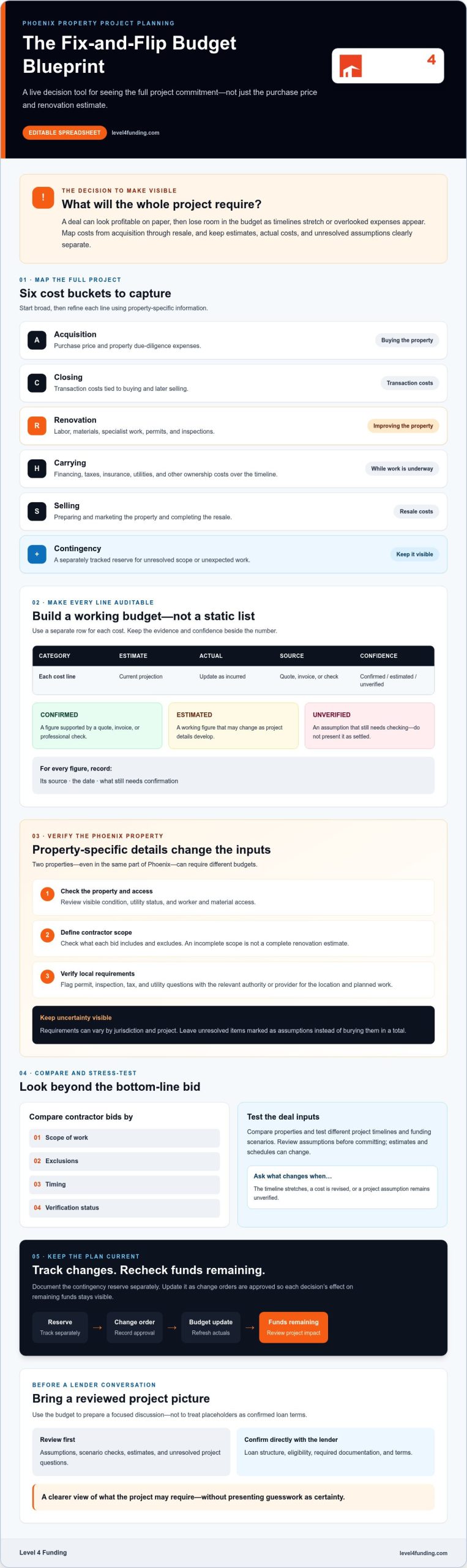
A budget should show the full project commitment before you make an offer, not just the purchase price and renovation estimate. Map each phase, from acquisition through construction, ownership, and resale. A fix and flip budget template for Phoenix properties makes those costs visible so you can compare a property’s likely demands with your available funds before committing.
Flipping involves buying a property, improving it, and reselling it, as outlined in this neutral overview of Flipping. Your budget should follow that same sequence. Start with broad cost groups, then refine each line as you gather property-specific information.
For a practical look at how a spreadsheet can track a flip’s numbers, watch this BiggerPockets project breakdown:
Which cost categories belong in a fix-and-flip budget?
Separate costs into clear categories so an attractive estimate doesn’t obscure the rest of the project’s financial commitment:
- Acquisition: Purchase price and property due-diligence expenses.
- Closing: Transaction costs tied to buying and later selling the property.
- Renovation: Labor, materials, specialist work, and any required permits or inspections.
- Carrying: Financing, taxes, insurance, utilities, and other ownership costs over the project timeline.
- Selling: Costs associated with preparing and marketing the property and completing the resale.
- Contingency: A separately tracked reserve for unresolved scope or unexpected work.
For each line, label the figure as a known quote, an estimate, or an unverified assumption. Record its source, date, and what still needs confirmation. Add financing input fields for the proposed loan structure, interest calculation, fees, and expected timeline, but leave terms blank until the lender confirms them. Don’t turn a placeholder into a fact.
Why Phoenix property due diligence changes the inputs
Two properties can need very different budgets, even in the same part of Phoenix. Before settling on assumptions, check the visible condition, utility status, worker and material access, and exactly what each contractor’s scope includes. A quote that excludes necessary work is not a complete renovation estimate.
Flag permit, inspection, tax, and utility questions for verification with the relevant authority or provider, based on the property’s location and planned work. Requirements can vary by jurisdiction and project. Keep unresolved items marked as assumptions instead of quietly burying them in a total.
Phoenix project budgets must reflect property-specific scope and verified requirements.
Build the Phoenix Fix-and-Flip Budget Template Line by Line
Turn your cost categories into a working spreadsheet, not a static list. For every line item, track category, estimate, actual, source, and confidence. Use labels such as confirmed, estimated, or unverified, and update the source as quotes, invoices, and professional checks come in. This fix and flip budget template for Phoenix properties keeps assumptions visible instead of making uncertain numbers look settled.
Start with these core rows:
- Acquisition and closing: Purchase amount, transaction expenses, inspections, title and escrow items, and other property-specific setup costs.
- Renovation: Trade-level scope, labor, materials, permits, and inspection-related costs.
- Carrying and financing: Recurring ownership expenses and separate fields for proposed loan structure, interest, fees, and timeline.
- Resale and contingency: Sale preparation and transaction assumptions, plus a separately tracked reserve.
Acquisition, closing, and project setup fields
Give each cost its own row. Don’t bury inspections inside closing costs or combine unrelated setup work in a catch-all line. Mark title, escrow, tax, and professional-service figures as pending until the relevant provider confirms them. Before a funding conversation, review the details lenders may need and confirm current requirements directly. Level 4 Funding’s fix-and-flip loans and funding guide offers related context.
Keep after-repair value (ARV) in a separate input cell. It’s an estimate of potential resale value, not a guaranteed sale result. Record the source and date behind the estimate, then test how the deal changes if the sale price or timeline differs from your assumption.
Renovation, carrying, and resale fields
Break rehab into specific trades and tasks, then record scope, labor, materials, quote status, and any permit or inspection questions. Track recurring ownership expenses and financing inputs separately. Verify amounts and terms with the relevant providers rather than relying on generic placeholders. For resale, list preparation work and transaction assumptions individually. Don’t treat an unsupported local rule of thumb as a Phoenix standard.
Use simple spreadsheet formulas: each category subtotal equals the sum of its line-item estimates, and the total project budget equals the sum of category subtotals plus the contingency reserve. Remaining contingency equals the original reserve minus approved contingency draws. Keep those draws distinct from ordinary project costs to avoid double-counting, and update actuals as invoices arrive.
Once the framework is in place, discuss your fix-and-flip project and funding needs with the lender. A clear budget supports the conversation, but loan structure, eligibility, documentation, and terms still need direct confirmation.
Compare Phoenix Rehab Estimates and Stress-Test the Deal
A contractor’s bottom-line number can look appealing while leaving essential work out of scope. Compare bids side by side, then test what happens if the work, schedule, resale assumptions, or financing inputs change. You don’t need to predict every surprise. You do need to see which assumptions carry the most risk before committing.
How to compare contractor bids without missing exclusions
Use a comparison table for each contractor, and request itemized labor, materials, allowances, exclusions, and the expected work sequence. Record when the quote was prepared and whether it’s preliminary, revised, or backed by a written proposal. Mark unclear scope and missing details for follow-up before relying on the total.
| Contractor | Scope | Exclusions | Quote date | Schedule | Verification status |
|---|---|---|---|---|---|
| Contractor name | Trades and tasks included | Work or materials not included | Date received or revised | Sequence and estimated duration | Preliminary, clarified, or documented |
An estimate is only comparable when its scope and exclusions match the other bids. If one proposal includes material allowances and another doesn’t, or one excludes cleanup or a specific trade, clarify the difference before comparing totals. Don’t fill gaps with assumptions just to make the bids look alike.
How to test uncertainty in a Phoenix flip budget
Build base, downside, and updated scenarios using your own verified inputs. Keep each change visible in the spreadsheet. A base case reflects the current scope and assumptions. A downside case tests risks you can identify. An updated case replaces assumptions with confirmed quotes, revised scope, or new project information.
- Scope: Model additional repairs separately from the original contractor scope.
- Timeline: Extend the schedule and update carrying and financing inputs using terms confirmed with the relevant providers.
- Resale: Test a weaker sale outcome against your documented resale estimate rather than treating after-repair value as certain.
- Financing: Change only the inputs the lender has confirmed; flag unconfirmed terms as assumptions.
Test one change at a time first. This shows whether the pressure comes from extra work, a longer hold, or a lower resale assumption. Then combine plausible changes to see how risks could stack. For Phoenix-area properties, including those in Scottsdale, Tucson, Glendale, Sedona, Flagstaff, Tempe, Mesa, and Buckeye, base permit, inspection, and other local requirements on the property’s location and scope, and verify them with the relevant authority. Keep the date and source for each update so your budget remains a decision tool, not a stale bid sheet.
Use the Budget to Set Contingency and Track Project Changes
A contingency reserve gives you room to respond when the property or scope differs from expectations. It isn’t a universal percentage to copy from someone else’s spreadsheet. For a fix and flip budget template for Phoenix properties, base the reserve on what you know about the specific project, and keep your reasoning visible.
Set a property-specific contingency instead of copying a rule of thumb
Consider inspection findings, the property’s age and visible condition, how complete the renovation scope is, and how reliable the contractor quotes are. A well-documented bid may reduce uncertainty in one area, while an unresolved condition or vague allowance leaves more to investigate. List open questions separately, with an owner and next step, so you can decide whether to do more due diligence before proceeding.
Contingency should respond to identified project uncertainty, not an unverified default.
Keep the reserve distinct from financing assumptions. Contingency is a project-budget allocation for uncertain or additional work. Financing inputs, such as payment timing and loan terms, are separate assumptions that need confirmation with the lender. Don’t treat available financing as a substitute for a reserve, or assume the reserve will cover financing costs.
Keep the live budget aligned with the work
Record every change, including the date, reason, requested work, approval status, revised estimate, and expected effect on remaining contingency. If a concealed issue changes the scope, capture the contractor’s updated proposal and adjust the forecast before treating the new amount as approved or paid.
Use a short weekly review to keep the numbers current. For each budget line, compare:
- Budgeted: The current approved plan.
- Committed: Costs agreed to but not yet paid.
- Paid: Actual payments recorded to date.
- Forecast: The latest expected cost to complete.
Then check what changed, what still needs approval, and how much contingency remains. Reforecast the remaining work after a new discovery, schedule change, or contractor revision. Keep supporting quotes and approvals with the budget so the figures can be reviewed and discussed clearly.
Organized project details can help structure a funding conversation, but they don’t guarantee approval or specific terms. Review the hard money loan approval process guide, and confirm current requirements directly with the lender. If project costs are changing, discuss your fix-and-flip funding needs.
Turn Your Phoenix Flip Budget Into a Funding-Ready Project Plan
A complete budget won’t guarantee a loan or make a risky deal safe. It gives you a clearer project plan to review with a lender. Before sharing it, check that every major cost has a source, every estimate has a confidence label, and open questions haven’t been mistaken for confirmed figures. Your fix and flip budget template for Phoenix properties should show both the current plan and the assumptions behind it.
What to organize before discussing financing
Bring a current, clearly dated budget version alongside the property details, purchase assumptions, renovation scope, and working timeline. Make it easy to distinguish confirmed figures from provisional estimates and items awaiting verification. Keep relevant quotes and supporting project information organized, but ask the lender which documents and budget fields apply to your specific loan request.
Loan structure, eligibility, documentation, and terms depend on the lender’s requirements and review of the project. Confirm those details directly. Don’t build a funding plan around presumed approval, loan amount, or timeline.
When to revise the budget or walk away
Revisit the deal when verified costs, scope, schedule, or resale assumptions materially differ from the original plan. Update the budget, rerun your scenarios, and compare the results with your own return threshold and comfort with risk. If the numbers no longer fit, pause. Adjust the offer, investigate further, or decide the deal isn’t right for you.
Some questions need answers before the budget can support a sound decision. Missing inspections, vague contractor scope, and resale assumptions without adequate support belong in an open-issues list, not in the confirmed column. Assign each item a next step and source of verification. If it remains unresolved, show how that uncertainty affects the downside scenario instead of treating it as settled.
Before moving forward, check that the budget includes complete line items, current quotes, source notes, financing assumptions marked for lender confirmation, and scenario checks that reflect the risks you’ve identified. That gives you a more useful basis for discussing a Phoenix-area project and financing needs with Level 4 Funding, which provides private real estate financing, including fix-and-flip loans. It doesn’t replace the lender’s review or guarantee a particular outcome.
Discuss financing for your Phoenix fix-and-flip with Level 4 Funding.
Make Your Next Phoenix Flip Decision With Clearer Numbers
A solid budget doesn’t predict every outcome. It helps you see what you know, what still needs verification, and how changes could affect the project before you commit. Use your fix and flip budget template for Phoenix properties to compare estimates, track actual costs, and test updated assumptions as the work progresses.
Keep the plan grounded in property-specific scope and verified requirements. Revisit your numbers when costs, timing, or resale assumptions shift, and confirm loan structure, eligibility, documentation, and terms directly with the lender. That discipline gives you a more useful basis for deciding whether to proceed and discussing the project’s funding needs.
Level 4 Funding provides private real estate financing for investors, with fix-and-flip loans among its primary offerings. Ready to discuss your project? Discuss financing for your Phoenix fix-and-flip project.
Build the budget, challenge the assumptions, and take your next step with a clearer view of the deal.
Frequently Asked Questions
What should a fix-and-flip budget template include?
A fix-and-flip budget template should track every major cost from purchase through resale. Include acquisition and closing expenses, inspections, renovation by trade, carrying costs, financing inputs, resale costs, and contingency. Add columns for estimate, actual, source, and confidence so confirmed quotes don’t get mixed with assumptions. A useful fix and flip budget template for Phoenix properties also records open questions about scope and property-specific requirements.
How do I estimate renovation costs for a Phoenix flip?
Estimate renovation costs by defining the work clearly, then collecting itemized contractor proposals that separate labor, materials, allowances, exclusions, and schedule. Check the property’s condition and access, and compare bids only after confirming they cover equivalent work. Mark preliminary figures as estimates, not facts. For Phoenix projects, verify permit and inspection needs for the property’s location and planned scope with the relevant authorities.
What is a contingency in a house-flipping budget?
A contingency is a documented reserve for uncertain or additional project costs, such as repairs revealed after work begins. Set it based on the property’s condition, inspection findings, completeness of the renovation scope, and confidence in contractor quotes. Keep unresolved issues visible and update the reserve as the project changes. Don’t copy an unverified default or treat contingency as a substitute for confirmed financing.
How do I calculate the maximum offer for a Phoenix fix-and-flip?
Estimate a maximum offer by starting with a supportable after-repair value, then subtracting renovation, acquisition, closing, carrying, resale, and contingency costs, along with the return you require for the project. Treat ARV as an estimate, not a promised sale price. Test weaker resale assumptions and longer timelines before deciding. The result is a decision aid, not a guarantee of profitability or a universal offer formula.
Should financing costs be included in a fix-and-flip budget?
Yes. Include financing as separate budget inputs so you can account for relevant costs over the expected project timeline. Don’t assume an interest rate, fee, loan structure, or term; confirm those directly with the lender and reflect verified details in your scenarios. Level 4 Funding provides private real estate financing, including fix-and-flip loans, but eligibility, documentation, and loan terms must be confirmed for the specific request.
How often should I update a fix-and-flip budget?
Review the budget regularly during the project, such as in a weekly check-in, and update it whenever a quote, approval, invoice, scope, or schedule changes. Compare budgeted, committed, paid, and forecast costs to see what remains and what has shifted. Record the date and source for updates. A live budget helps you spot pressure early, but it can’t remove project uncertainty.
Do Phoenix permits and inspections belong in a flip budget?
Yes. Include line items or clearly flagged placeholders for applicable permits, inspections, and related work, then verify requirements for the property’s location and project scope with the relevant authorities. Rules and costs can vary by jurisdiction and work performed. This applies to Phoenix and nearby markets, including Scottsdale, Tucson, Glendale, Sedona, Flagstaff, Tempe, Mesa, and Buckeye. Don’t treat an unverified requirement as a confirmed cost.

About the author
Matt has a bachelor's degree in political science from Northern Arizona University and works at Level 4 Funding, a private lending company that offers hard money and rental home loans to real estate investors in 35 states.
With Matt's leadership, the firm has financed almost $300 million in loans for investment properties. He often helps real estate investors with rental property purchases, foreclosures, refinancing, and fix-and-flip projects. Matt has extensive experience in fix-and-flip, buy-and-hold, rental properties, and real estate sales. He has lived in Arizona for 43 years and is married with three children. Matt is licensed as a mortgage broker and loan originator in Arizona, with NMLS 2062278 and NMLS 1118493.
Equal Housing Opportunity. This is not a Good Faith Estimate, and it is not a Guarantee to lend; it should not be considered as such. Costs, rates, estimates, and terms can only be determined after a full application is completed. To the extent this message includes any tax or legal advice, this message is not intended or written by the sender to be used, and cannot be used, for legal or tax purposes or advice. This is an advertisement. Copyright © 2026. All rights reserved.