

Phoenix Real Estate Investment Loan Calculator: Monthly Cost
November 19, 2026
Why Hard Money Lenders Are Quietly Replacing Banks for a New Generation of Real Estate Investors
November 20, 2026
A hard credit inquiry does not have to be the first conversation about hard money for mixed-use property in Phoenix. A preliminary quote can start with the property, its residential and commercial uses, and your purchase or renovation plan. Final terms depend on the deal’s valuation and structure.
It’s reasonable to want clarity on rates, fees, and timing before you commit to a property or financing plan. Mixed-use deals bring extra questions: how the lender values both parts of the building, what costs are included at closing, and how repayment fits your exit strategy.
This guide explains how quotes are shaped, what affects pricing and valuation, and what to expect through closing and repayment. You’ll also learn what information helps assess the deal and how private financing may support a time-sensitive purchase. Clear numbers and a workable plan matter, as does understanding the terms before moving forward.
Key Takeaways
- See how a mixed-use property’s value, occupancy, income, and condition can shape a lender’s quote and loan-to-value limit.
- Understand the application, valuation, and closing steps that help turn a proposed deal into a financeable loan.
- Learn what drives interest rates and origination fees, and how to read the full borrowing cost.
- Explore how private lending may fit a time-sensitive acquisition and what details help keep the financing process moving.
- Find out which loan terms to review before repaying early, including how prepayment provisions can affect your exit plan.
Can I get a loan quote in Phoenix without a hard credit inquiry?
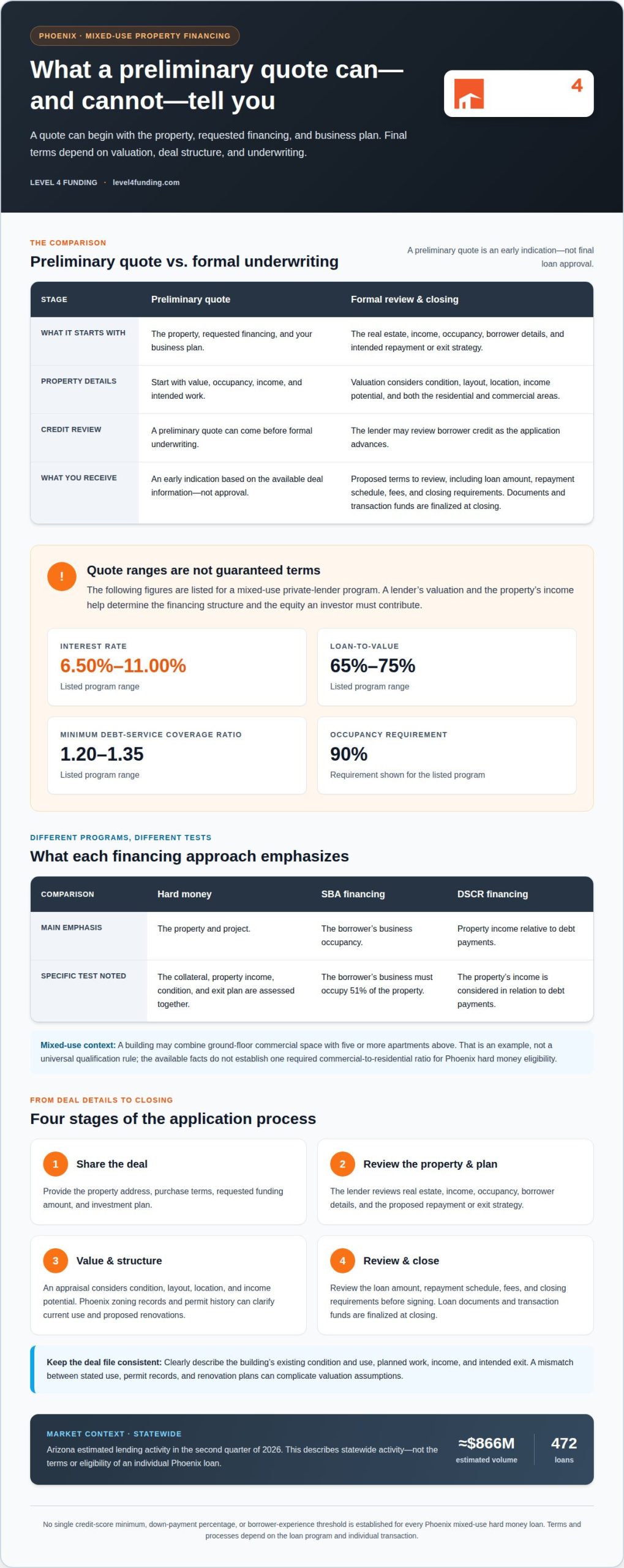
A preliminary quote can be based on the property, requested financing, and your business plan before formal underwriting. A quote is not final loan approval: the lender may review borrower credit as the application advances. For hard money for mixed-use property in Phoenix, start with the building’s value, occupancy, income, and intended work.
Private lender programs listed for mixed-use properties show interest rates from 6.50% to 11.00%, with loan-to-value ratios of 65% to 75%. These are market ranges, not guaranteed terms for a specific building. The lender’s valuation and the property’s income help determine how much equity an investor must contribute.
Debt-service coverage also matters. The listed program sets a minimum debt-service coverage ratio of 1.20 to 1.35, while its occupancy requirement is 90%. Those measures connect the property’s rental income and occupied space to its ability to support payments. A building undergoing rehabilitation or repositioning can still fit private financing, but its condition and proposed plan affect underwriting.
Mixed-use buildings often combine ground-floor commercial space with five or more apartments above. That layout is an example, not a universal qualification rule: hard money lenders assess how the commercial and residential uses fit together. The available facts don’t establish one commercial-to-residential ratio for Phoenix hard money eligibility. SBA financing has a different occupancy test: the borrower’s business must occupy 51% of the property.
Hard money, bank, SBA, and DSCR loans assess deals differently. Hard money underwriting emphasizes the property and project. SBA financing applies its business-occupancy test, while DSCR financing focuses on property income relative to debt payments. Terms and processes depend on the loan program.
There is no single credit-score minimum, down-payment percentage, or borrower-experience threshold established for every Phoenix mixed-use hard money loan. Lenders assess the proposed collateral, available equity, property income, condition, and exit plan together. A stronger property and repayment case can matter alongside the borrower’s financial profile.
Arizona’s loan activity shows an active short-term investment market: estimated lending volume was approximately $866 million across 472 loans in the second quarter of 2026. That market figure describes statewide activity, not the terms or eligibility of an individual Phoenix loan.
Arizona rules and licensing requirements depend on the transaction and the parties involved; the available facts here do not establish a specific licensing rule for every mixed-use hard money loan. Before proceeding, have the loan documents identify the lender, collateral, repayment terms, and applicable legal framework.
Application, valuation, and closing process
A clear deal file helps assess the property, requested amount, and repayment plan. In Phoenix, zoning, permits, and appraisal findings can affect how the building’s existing use and proposed work are evaluated.
Application and Closing Steps
Start by sharing the property address, purchase terms, requested funding amount, and investment plan. The lender reviews the real estate, income, occupancy, borrower details, and intended repayment or exit strategy. Complete, consistent information helps assess the application without conflicting figures across documents.
Next, the lender evaluates the property and structures proposed terms. The borrower reviews the loan amount, repayment schedule, fees, and closing requirements before signing. At closing, the loan documents and transaction funds are finalized so the purchase or project can proceed.
Valuation and Property Review
An appraisal estimates the property’s value based on its condition, layout, location, and income-producing potential. For a mixed-use building, the review needs to account for both residential and commercial areas. Phoenix zoning records and permit history can help clarify whether the appraised use aligns with the building’s current configuration and proposed renovations.
For planned work, the review can also consider the scope and how it may affect the property after completion. A mismatch between the stated use, permit records, and renovation plan can complicate valuation assumptions. Make the existing condition and proposed changes clear in the application.
Phoenix commercial loan examples show how valuation and borrower equity shape the amount financed.
These examples illustrate the mechanics, not a quote for another property. Each application is assessed individually, with proposed funding based on the specific collateral and transaction. Valuation, existing liens, property income, condition, and planned work all influence the structure.
Before closing, the borrower should understand how the final loan documents connect the amount funded with repayment obligations and any project conditions. That review ties the appraisal and application back to the investment plan. For financing secured by commercial real estate, explore commercial property financing as a next step.
Arizona hard money interest rates and origination fees
Arizona loan pricing depends on the property, financing structure, and projected repayment. For a mixed-use investment, separate the interest rate from origination charges and other closing costs.
Interest Rate Considerations
Arizona hard money interest rates are not one-size-fits-all. A lender weighs the real estate’s condition, rental income, occupancy, requested amount, and repayment plan. A bridge loan for a building needing work may be assessed differently from financing for stabilized residential and commercial space. The quote should state how interest accrues and when payments are due.
Compare the proposed interest structure with the project timeline. For example, ground-floor commercial space undergoing renovation may produce different cash flow from occupied apartments above. If the renovation delays leasing, make sure your repayment plan accounts for ongoing interest obligations. Phoenix investors should compare the expected hold period with the loan terms, rather than focusing only on the initial rate.
Ask how interest is calculated on the outstanding balance and whether payments are interest-only or include principal. These details affect monthly cash needs and the payoff amount. A clear written quote helps you compare financing structures, including how an early sale or refinance fits the planned exit.
Origination Fee Considerations
An origination fee is a loan cost associated with setting up financing. Its amount and calculation should appear in the lender’s written quote, alongside interest and other closing charges. Check whether the fee is calculated from the approved loan amount or handled another way. That distinction affects the cash needed to close and the net funding available for acquisition or work.
For a Phoenix mixed-use purchase, consider loan costs alongside property expenses and the borrower’s equity. A lower stated interest rate does not automatically mean lower overall borrowing costs if other charges differ. Review scheduled payments, any charges due at closing, and payoff terms together before choosing a structure.
Use the lender’s quote to build a project-level comparison. Include expected rental income, renovation timing, and the planned sale or refinance. If the building has residential units and commercial space, assess each income stream against the timing of payments. This puts financing costs in context with operating expenses and the intended exit.
Private lending for time-sensitive acquisitions
A tight purchase window makes coordination critical. Private capital can support an acquisition when a mixed-use property needs rehabilitation or repositioning, but speed still depends on a complete deal file, property review, and closing readiness. A hard money loan works best when the purchase price, requested amount, planned work, and repayment route tell one consistent story.
Organize the transaction around four items: signed purchase terms, property details, project scope, and exit plan. These help the lender assess the collateral and proposed funding. For a building with street-level commercial space and apartments above, explain which areas are occupied, which need work, and how each part fits the investment plan.
Time-sensitive does not mean skipping the numbers. The purchase budget should account for borrower equity, closing funds, renovation needs, and payments during the loan term. Mixed-use private loans typically carry terms of 2 to 5 years, and the described program typically offers interest-only loans. Investors should map those payments against expected rental income and the planned sale, refinance, or other repayment route.
- Before submitting: assemble purchase terms, property information, and the requested capital amount.
- During review: keep the rehabilitation or repositioning plan consistent with the building’s current condition.
- Before closing: align funding needs, payment obligations, and the exit strategy.
These steps help expose gaps early. For example, a purchase plan that depends on renovating vacant commercial space should explain how the work supports future income. If the plan relies on existing residential rent, give a clear picture of that income and any planned changes. A specific, realistic scope gives the review a firmer basis than broad renovation language.
Private lending activity in Arizona provides market context, not a promise of funding for a particular purchase. Estimated short-term investment real estate lending volume reached approximately $866 million across 472 loans in the second quarter of 2026. That statewide figure signals activity across varied deals; it does not establish a Phoenix borrower’s approval, loan amount, or closing date.
Choose a financing structure by testing the acquisition against its payment obligations and exit. A 2-to-5-year term can provide a defined runway, but the borrower’s plan must show how the debt will be repaid. For a time-sensitive Phoenix purchase, disciplined preparation matters: a complete file, coherent project scope, and workable repayment plan help the lender evaluate the opportunity without confusing urgency with certainty.
Early repayment and prepayment penalties
Plan the exit before closing, not after a sale or refinance is underway. For a Phoenix investment property, the loan agreement determines how early payoff works and whether a prepayment charge applies.
Early Repayment Options
Early repayment means paying off some or all of the loan before its scheduled maturity. The loan documents should explain how to request a payoff statement, how accrued interest is calculated, and when payment completes the payoff. For a multifamily property, a sale or refinance may provide the funds, so align that possible exit with the written terms.
At closing, compare the stated maturity date with your investment timeline. If renovations finish ahead of schedule, an early sale could change the expected interest and payoff amount. If rental income supports a longer hold, the repayment plan may look different. Account for both outcomes rather than relying on a single exit.
Prepayment Penalty Terms
A prepayment penalty is a charge the agreement may impose when the borrower pays early. The contract should say whether it applies, what triggers it, and how the charge is determined. Read the clause alongside the payoff process, including any exceptions or periods when early repayment is treated differently.
For example, an investor expecting to refinance after improving a mixed-use building needs to know whether that refinance triggers a charge. Don’t assume that selling, refinancing, or paying extra principal receives the same treatment. The signed agreement controls the calculation and timing.
Before signing, review these provisions together:
- Whether partial and full early payments are treated differently.
- How accrued interest and any penalty appear in a payoff statement.
- Whether a sale or refinance changes the amount due.
- How much notice the lender requires to process payoff.
Test the investment plan against more than one exit. A delayed refinance, earlier sale, or faster renovation can change when you repay. Estimate each scenario using the payment schedule and contractual payoff terms. This connects the property’s expected cash flow to the actual debt terms, rather than an assumed penalty-free exit.
For a mixed-use loan, discuss your repayment options before committing to the closing terms. Clear payoff expectations help keep an investment property’s financing aligned with its intended hold and exit.
Level 4 Funding: Commercial Property Loans
Level 4 Funding offers Commercial Property Loans for real estate investors evaluating mixed-use financing. Turn to this option when a property combines commercial and residential uses, or when its condition, income, or planned improvements call for a commercial lending structure. The right financing discussion starts with the property, purchase or project plan, requested amount, and repayment strategy.
If the deal centers on renovation or building work, Fix and Flip Loans or Construction Loans may suit the project. Property owners exploring financing against existing equity can consider Cash Out Loans. Each option serves a different real estate need, so match the loan type to the transaction and intended use of funds.
Contact Level 4 Funding to discuss financing for your mixed-use property.
Move your Phoenix property plan forward
Turn your investment idea into a clear financing plan. Set out what you’re acquiring, what work the property needs, how you expect it to perform, and how you plan to repay the loan. This gives the lending conversation a practical starting point, whether the deal involves a purchase, renovation, or change in strategy.
Hard money for a mixed-use property in Phoenix should fit the building and the investment plan, not force the deal into a generic template. Keep your priorities clear: the amount you need, the timing that matters, and the repayment path you can support. A focused discussion can help you evaluate the next step for your property.
Contact Level 4 Funding to discuss your loan and bring your Phoenix deal into focus. A clear plan puts you in a stronger position to move forward with purpose.
Frequently Asked Questions
How Do Hard Money Loans Work?
A hard-money loan provides private, asset-based financing for a real estate investment. The lender evaluates the property and proposed transaction, then structures terms around the collateral and repayment plan. For example, an investor purchasing a mixed-use building for renovation should explain the planned work and intended exit. The loan agreement sets the amount, payment terms, and payoff conditions the borrower must follow.
How fast can a loan close in Phoenix?
Most Level 4 Funding loans close in about 7 days, with the title report identified as the longest step. A Phoenix borrower can help keep the transaction moving by returning the application and requested information promptly and keeping purchase details consistent. The closing timeline still depends on completing the property review and title work. Build the expected closing date into the purchase contract and project schedule.
What loan scenarios are best suited for a private lender?
Private lending can suit an acquisition with a tight timeline, a property needing rehabilitation, or a project involving repositioning. It can also fit investors seeking commercial property or construction financing. For example, a Phoenix buyer acquiring a mixed-use building with vacant commercial space may need capital aligned with planned improvements. A clear repayment strategy connects the loan to the investment’s intended exit.
What are typical hard money loan rates and fees for mixed-use properties in Phoenix?
There is no single rate that applies to every mixed-use deal; terms reflect the property and financing structure. The written quote should distinguish interest, origination charges, and other loan costs, so you can assess the full obligation. Level 4 Funding states that it has no up-front or junk fees and that requesting a quote has no cost. Ask for the proposed terms in writing before deciding.
Which Phoenix lenders finance mixed-use properties with hard money loans?
Level 4 Funding is a private hard money lender serving real estate investors in Phoenix. Its Commercial Property Loans may fit investors financing a mixed-use asset, while Fix and Flip Loans or Construction Loans may suit transactions centered on renovation or building work. Match the loan type to the project itself. For a Phoenix property, the key discussion is how its use, condition, and investment plan fit the financing request.
What documents are required to apply for a mixed-use hard money loan in Arizona?
Begin with Level 4 Funding’s one-page application. Tax returns, pay stubs, income verification, seasoning, and reserve funds aren’t required. Lenders may review judgments, tax liens, or bankruptcy, so those matters can affect the transaction even without a minimum credit score requirement. For a Phoenix mixed-use property, be prepared to describe the real estate and financing purpose accurately; the application starts the review of the proposed deal.
What property types and commercial-to-residential ratios qualify for mixed-use hard money financing in Phoenix?
Mixed-use buildings commonly have ground-floor commercial space with five or more apartments above, but there is no universal commercial-to-residential ratio for Phoenix hard-money eligibility. Lenders assess how the uses fit together, along with the property’s value, occupancy, income, condition, and proposed work.
What are the minimum credit score, down payment, and borrower experience requirements?
There is no single credit-score minimum, down-payment percentage, or borrower-experience threshold for every Phoenix mixed-use hard money loan. The lender assesses the collateral, available equity, property income, condition, and exit plan together.

About the author
Matt has a bachelor's degree in political science from Northern Arizona University and works at Level 4 Funding, a private lending company that offers hard money and rental home loans to real estate investors in 35 states.
With Matt's leadership, the firm has financed almost $300 million in loans for investment properties. He often helps real estate investors with rental property purchases, foreclosures, refinancing, and fix-and-flip projects. Matt has extensive experience in fix-and-flip, buy-and-hold, rental properties, and real estate sales. He has lived in Arizona for 43 years and is married with three children. Matt is licensed as a mortgage broker and loan originator in Arizona, with NMLS 2062278 and NMLS 1118493.
Equal Housing Opportunity. This is not a Good Faith Estimate, and it is not a Guarantee to lend; it should not be considered as such. Costs, rates, estimates, and terms can only be determined after a full application is completed. To the extent this message includes any tax or legal advice, this message is not intended or written by the sender to be used, and cannot be used, for legal or tax purposes or advice. This is an advertisement. Copyright © 2026. All rights reserved.