


Why Hard Money Lenders Are Quietly Replacing Banks for a New Generation of Real Estate Investors
November 20, 2026
The Rise of Private Lending in Sun Belt Markets: What Florida and Arizona Investors Need to Know Now
November 21, 2026
The lowest-rate option isn’t automatically the best fit. Financing a gut renovation in Phoenix means matching the loan to the project scope, contractor payment schedule, and timing of the work. Build a 10-15% contingency into your budget so unexpected costs don’t immediately derail the plan.
Include architect fees and permits in your project budget. Whether loan proceeds can cover these soft costs depends on the loan’s eligible-cost rules and how funds are released. Clarifying this early can help you choose financing that fits the full project.
Compare more than the headline rate. The work plan, available equity, and current mortgage all affect whether a renovation loan, cash-out refinance, or HELOC fits best. This guide covers budgeting for overruns, matching funding to staged work or fixed-price contracts, estimating closing time, and comparing loan types and qualification requirements.
Key Takeaways
- Build a contingency into your renovation budget and account for the full project scope before settling on a loan amount.
- Match the funding structure to the contractor’s payment schedule, whether work is paid in stages or under a fixed-price contract.
- Allow time for underwriting and closing, and factor the loan timeline into the project schedule.
- Compare credit score and debt-to-income requirements alongside the loan’s costs and structure.
- Weigh renovation loans, cash-out refinancing, and HELOCs against your equity, existing mortgage, and renovation plan.
How lenders account for renovation contingencies and cost overruns
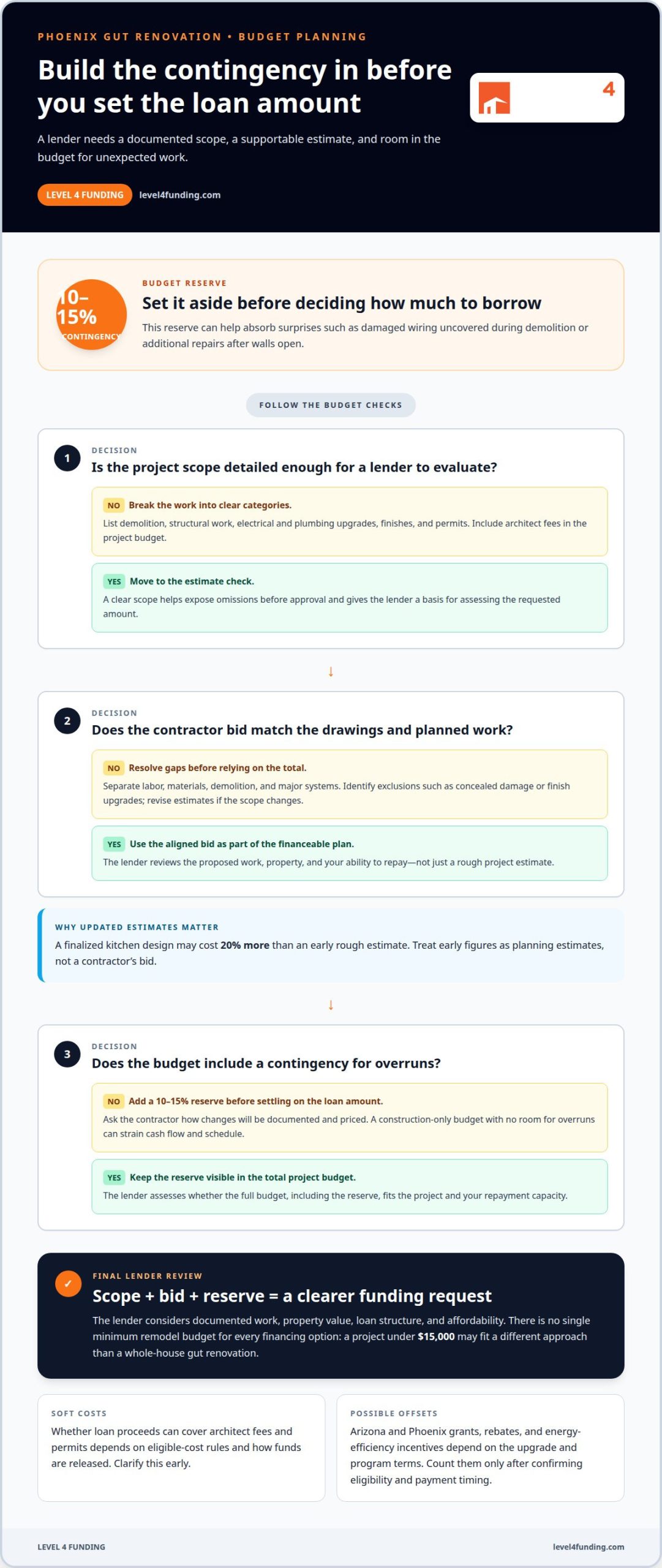
Financing a gut renovation in Phoenix starts with a detailed scope a lender can evaluate, not a rough estimate. A lender reviews the proposed work, property, and borrower’s ability to repay. Break down demolition, structural work, electrical and plumbing upgrades, finishes, and permits. This makes omissions easier to catch before approval and gives the lender a clearer basis for assessing the requested amount.
Project size changes the budget. These are planning estimates, not a contractor’s bid. The home’s condition, layout changes, and finish choices all affect the final scope.
A contractor bid turns that scope into a financeable plan. It should distinguish labor, materials, demolition, and major systems rather than burying them in one total. Compare the bid with the project drawings and identify exclusions, such as concealed damage or finish upgrades. If the initial estimate changes after design work, update the budget before relying on the earlier figure; a finalized kitchen design may cost 20% more than an early rough estimate.
Set aside a contingency before deciding how much to borrow. A 10-15% contingency can absorb surprises such as damaged wiring uncovered during demolition or additional repairs after walls open. Ask the contractor to show how changes are documented and priced. The lender assesses whether the total budget, including that reserve, fits the project and the borrower’s repayment capacity. A budget that covers construction but leaves no room for overruns can strain both cash flow and schedule.
There is no single minimum remodel budget that applies to every financing option. The lender’s minimum depends on the loan structure, collateral, and project scope. A small cosmetic job under $15,000 may fit a different financing approach than a whole-house gut renovation. For a larger project, the lender assesses whether the requested amount aligns with documented work, property value, and affordability, rather than relying on the word “remodel” alone.
Arizona’s accessory dwelling unit rules can also affect a project plan. According to the Arizona State Legislature, cities and towns with more than 75,000 residents must allow at least one attached and one detached accessory dwelling unit on lots where a single-family home is allowed. Arizona law also prohibits cities and towns from banning separate long-term rentals of a main home and its accessory dwelling unit when leases are 90 days or longer, or month-to-month.
For a Phoenix gut renovation, permit and inspection needs depend on the scope of work. Include permit coordination and inspection milestones in the contractor’s schedule and financing plan. Arizona and Phoenix grants, rebates, and energy-efficiency incentives depend on the upgrade and program terms. Treat them as possible budget offsets only after establishing eligibility and payment timing, not as funds available for the initial loan request.
How a lender matches financing to staged work or fixed-price contracts
The draw schedule should match the contractor’s payment schedule. For staged work, renovation funds may be released after inspections or completion documents rather than all at once. The lender will compare the project timeline, required deposits, and milestones when determining how funds flow. If the contractor expects payment for materials before an inspection, account for that gap in the contract and financing schedule.
A fixed-price contract gives the lender a defined total for the agreed scope, while staged billing links payments to completed phases. Either way, specify exactly what the price covers. For a kitchen remodel, separate demolition, plumbing, electrical work, cabinets, and finishes. The lender can then compare the bid with the work plan and identify exclusions that could change how much you need to borrow.
Renovation loan appraisals assess the property’s value alongside the contractor’s bid and documented work plan. The lender reviews these details to assess the requested amount. Funds may then be released in stages after inspections or completion documents. Applying before the property value and project scope are clear can leave a gap between approved funds, actual costs, and the home’s completed value.
In Arizona, renovation construction loans generally require a licensed general contractor. Contractors must be licensed with the Arizona Registrar of Contractors and carry liability and workers’ compensation insurance. These qualifications matter because the lender needs a clearly responsible party for the work. Estimates should match the proposed scope: a bid that omits structural changes or major systems can understate the funds needed.
Contractor qualifications affect more than paperwork. Relevant experience, a clear timeline, and the ability to coordinate trades help the lender assess whether the plan is workable. For example, a contractor handling a whole-house remodel should align demolition, inspections, and installation milestones with the proposed draw schedule. If the work plan changes, revised estimates and timelines help the lender reassess funding needs.
Contractor-arranged financing is a separate financing decision, not simply another line in the construction bid. Review who provides the funds, which work they cover, how payments are scheduled, and what happens if the project scope changes. Compare those terms with the renovation loan structure before signing, especially if you are planning a purchase and renovation together. A payment plan that doesn’t match construction milestones can create cash-flow pressure even when the total estimate seems workable.
Use the contract, appraisal, and timeline as one approval package. The lender can review the project more clearly when every document describes the same work, from initial demolition through completion.
3. How long does a renovation construction loan take to close?
For an Arizona renovation construction loan, plan for 30 to 45 days from application to closing. Underwriting for renovation-specific loans is also described as taking 30 to 45 days. The review involves more than a credit check: the lender needs a defined work scope, contractor bid, property information, and borrower documentation. Assemble these materials before underwriting begins. Changes or missing items can interrupt the review and push back the closing date.
A construction-to-permanent loan connects construction financing with long-term mortgage financing after renovation. Before choosing this structure, map the construction timeline against approval, draw releases, and the loan’s conversion terms. Some loan options release renovation funds in stages after inspections or completion documents, rather than all at once. The structure works best when contractor milestones, lender inspections, and payment deadlines align.
Closing schedules can slip. One Phoenix two-time-close renovation loan took eleven weeks, compared with an expected six weeks. That example is not a standard timeline, but it shows why buyers should not schedule demolition based only on an expected closing date. Allow time for the lender to review the property, project scope, contractor documents, and borrower file. A complete package helps underwriting move through each step.
HUD Title I property improvement loans offer a different scale and structure. That upper limit may make Title I worth comparing for a smaller, defined project, rather than assuming it can cover an extensive gut renovation. The loan amount, project scope, and repayment period all affect whether it fits.
Unsecured personal loans can provide faster funding for smaller remodels. A fixed-rate personal loan keeps the interest rate unchanged under its terms, making scheduled payments more predictable than with a variable-rate option. But fast funding does not mean the amount or structure suits a full gut renovation. Compare the available loan amount and repayment schedule with the project’s total funding needs.
Use the closing estimate to set a realistic start date. First, submit the application and required documentation. Next, allow the lender to review the property and renovation plan. Then coordinate closing and any draw requirements with the contractor’s timeline. For financing a large renovation, compare this sequence with faster options, such as an unsecured loan, and with Title I’s stated limits. The key is not just speed, but whether the funds arrive in time and match the work plan.
4. Credit score and debt-to-income requirements
Credit score and debt-to-income ratio shape renovation loan approval, but lenders also assess the complete application. Credit and down-payment requirements can vary by renovation loan program. Most renovation lenders want at least 620 for conventional renovation loans. These are different loan paths, not a single universal cutoff. A borrower should compare the requirements for the specific program with the project’s funding needs.
Debt-to-income ratio, or DTI, compares monthly debt obligations with income. For renovation financing, DTI should be under 43% in most cases. Some lenders may allow up to 50% when strong compensating factors support the application. Those factors can include a stronger overall financial profile, but the exact review depends on the loan program. A borrower near a threshold should understand how the proposed payment affects the complete debt picture.
Credit history tells lenders more than a score alone. An application may be assessed alongside existing mortgage payments, other debts, income, and available equity. A renovation loan adds a financial obligation, so lenders consider whether the borrower can manage its payments alongside current commitments. For example, a strong score does not erase a high DTI, just as a lower score does not tell the whole story of a borrower’s finances.
Project details also matter in the overall review. A lender considers the requested amount, renovation scope, and property information alongside credit and income. For some renovation financing, funds are released in stages after inspections or completion documents. The application must therefore support both the borrower’s ability to repay and the project’s financing structure. Aligning the requested loan with documented work makes the review more coherent.
Equity and your current mortgage also affect which financing structure makes sense. A renovation loan, cash-out refinance, and HELOC can have different qualification criteria and repayment arrangements. A HELOC or home equity loan is secured by the home, so missed payments could put the property at risk. Compare the new payment and loan terms with existing mortgage obligations, not just your credit score.
Before applying, organize income, debt, mortgage, and project records into one consistent package. Compare applicable credit thresholds and DTI expectations with your finances. If the renovation includes contractor draws or inspections, account for those requirements when considering how you will access the funds. This helps identify a loan fit based on qualification, equity, and work plan, rather than a single score.
5. Comparing renovation loans, cash-out refinancing, and HELOCs
Gut renovation financing in Phoenix can include a renovation loan, cash-out refinance, or HELOC. The best fit depends on project size, your current mortgage rate, available equity, income, and when funds need to reach the contractor. Compare these factors together. A lender can assess each option against the property, planned work, permits, and payment schedule instead of focusing on one headline feature.
A renovation loan ties funding to a defined improvement plan. FHA 203(k) financing may combine a home purchase or refinance with approved repair costs for eligible projects, subject to program rules. A typical 203(k) or HomeStyle renovation loan disburses funds in 4 to 6 draws.
Cash-out refinancing replaces the existing mortgage with a new mortgage and provides funds from available equity. It may fit Arizona renovation projects under $150,000, particularly when the borrower’s current mortgage rate and project size support that choice. The lender compares the new mortgage payment with income and existing obligations. This option changes the mortgage itself, so compare the full loan structure, not just the renovation cash available.
A HELOC lets you draw against home equity as project costs arise. Most HELOCs have variable rates, and some allow interest-only payments during the draw period or include a balloon payment at the end. A lender may freeze or reduce a HELOC in certain circumstances. A home equity loan generally provides the full amount upfront and uses equal payments. Both are secured by the home, so missed payments put the property at risk.
For a gut renovation, compare financing options by when expenses arrive. Appraisal, title, and documentation requirements can affect home equity approval and closing. Funds released in draws may suit staged work, while a lump sum may better match upfront purchases. Include permits and architect costs in the project plan, but remember that whether a loan can cover them depends on its eligible-use rules.
Make the decision with a side-by-side review: current mortgage, available equity, total project scope, fund-release timing, and repayment structure. A Scottsdale property owner with a large phased renovation may prioritize draw timing; someone with a smaller defined project may compare cash-out refinancing with home equity options. Explore renovation financing options to discuss a real estate investment project with a hard money lender.
Level 4 Funding
Level 4 Funding helps real estate investors evaluate private financing for renovation projects. If your Phoenix plan depends on matching the funding structure to the work scope and timeline, its loan options may be relevant. Fix and Flip Loans and Construction Loans can fit investment projects involving substantial renovation work; Cash Out Refinance may suit a property owner considering funding from existing equity. The right direction depends on the property, project plan, and financing needs.
Bring the project scope, contractor estimate, and expected payment schedule into the financing conversation. Those details help clarify how funding needs connect to the work, rather than treating the renovation as a standalone number. For an investment property gut renovation, contact Level 4 Funding to discuss your project and financing options.
Turn your renovation plan into a financing decision
Make your project plan useful for a financing conversation. Gather the property details, intended work, contractor estimate, and timing needs. Then compare the funding structure with when you will need money throughout the project. A clear picture of the work can help you discuss financing a gut renovation in Phoenix and identify the questions to resolve before moving ahead.
For real estate investors, Level 4 Funding offers Fix and Flip Loans, Construction Loans, and Commercial Property Loans. These options connect renovation and property plans with private financing conversations. The right discussion starts with your project, not a generic loan checklist.
Ready to talk through your renovation plans and financing options? Contact Level 4 Funding to discuss your next step. A well-framed plan gives you a stronger starting point for moving the project forward.
Frequently Asked Questions
Can I use these funds for soft costs like architects and permits?
Some renovation financing may include soft costs, but eligible expenses depend on the loan program and approved project budget. For a Phoenix project, list architect plans and permit expenses separately from construction labor and materials. This gives the lender a clear view of how much funding supports design, approvals, and physical work. Confirm these costs are included in the financing structure before relying on loan proceeds to pay them.
How long does a renovation construction loan take to close?
Plan for about 30 to 45 days from application to closing for an Arizona renovation construction loan. Build that time into your contractor schedule, especially if a deposit or material order depends on funding. Documentation, property review, and the renovation plan all influence the path to closing. A Phoenix project with a fixed construction start date should allow room for review rather than treating the estimated closing window as a guaranteed start date.
How do renovation loans such as FHA 203(k), Fannie Mae HomeStyle, and construction loans compare?
FHA 203(k) and Fannie Mae HomeStyle are renovation loan programs, while a construction loan finances building work under its own terms. FHA 203(k) may combine a home purchase or refinance with approved repairs for eligible projects. HomeStyle and 203(k) loans commonly release renovation funds in draws. A construction loan’s structure depends on its terms and project plan, so compare eligible work, fund access, and whether the financing also covers a purchase.
Can Phoenix homeowners use a HELOC or cash-out refinance to finance a major renovation?
Yes. A Phoenix homeowner can compare a HELOC or cash-out refinance when available equity and loan terms fit the renovation. A HELOC allows draws as costs arise, but usually has a variable rate. A cash-out refinance replaces the current mortgage. The deciding factors include the existing mortgage rate, equity, project size, and whether costs arrive all at once or in phases. Both options use the home as collateral.
What credit score, down payment, and income requirements apply to renovation loans?
Requirements vary by program. FHA 203(k) is described as requiring a 580+ credit score and 3.5% down; conventional renovation lenders often look for a score of at least 620. A debt-to-income ratio under 43% is typical, though some lenders may allow up to 50% with strong compensating factors. Lenders also assess income and debts together, so compare the full qualification picture, not just a score or down payment.

About the author
Matt has a bachelor's degree in political science from Northern Arizona University and works at Level 4 Funding, a private lending company that offers hard money and rental home loans to real estate investors in 35 states.
With Matt's leadership, the firm has financed almost $300 million in loans for investment properties. He often helps real estate investors with rental property purchases, foreclosures, refinancing, and fix-and-flip projects. Matt has extensive experience in fix-and-flip, buy-and-hold, rental properties, and real estate sales. He has lived in Arizona for 43 years and is married with three children. Matt is licensed as a mortgage broker and loan originator in Arizona, with NMLS 2062278 and NMLS 1118493.
Equal Housing Opportunity. This is not a Good Faith Estimate, and it is not a Guarantee to lend; it should not be considered as such. Costs, rates, estimates, and terms can only be determined after a full application is completed. To the extent this message includes any tax or legal advice, this message is not intended or written by the sender to be used, and cannot be used, for legal or tax purposes or advice. This is an advertisement. Copyright © 2026. All rights reserved.