


The Rise of Private Lending in Sun Belt Markets: What Florida and Arizona Investors Need to Know Now
November 21, 2026
You don’t have to wait for your current property to sell before pursuing the next one. A bridge loan from Level 4 Funding can provide short-term financing for a purchase, with repayment commonly tied to the sale of your existing property. It may help you move sooner, but planning for the loan’s cost and payoff from the outset is essential.
Buying before selling can feel like a race against two deadlines: securing the new property and getting the old one sold. The right financing depends on your credit, available liquidity, property equity, and how clearly you can show your repayment plan. Banks, credit unions, online lenders, and hard money lenders may approach that decision differently.
This guide explains how bridge loans work, what lenders may look at when reviewing your credit and cash reserves, and how to weigh financing options for your situation. You’ll also see why the exit plan matters, what documents typically support an application, and where real estate investment financing may fit when a short-term loan is part of a larger property strategy.
Key Takeaways
- Understand how short-term bridge financing can help you buy before selling, and what repayment plan needs to be in place.
- Prepare for lenders to assess more than credit: property equity, available liquidity, and the strength of your exit plan can also matter.
- Weigh the flexibility of moving quickly against the repayment pressure and costs that come with short-term financing.
- Compare how banks, credit unions, online lenders, and hard money lenders approach a financing request.
- Match the financing to your property strategy, whether you need purchase funding or a loan tied to renovation, construction, or commercial real estate.
What is a Bridge Loan?
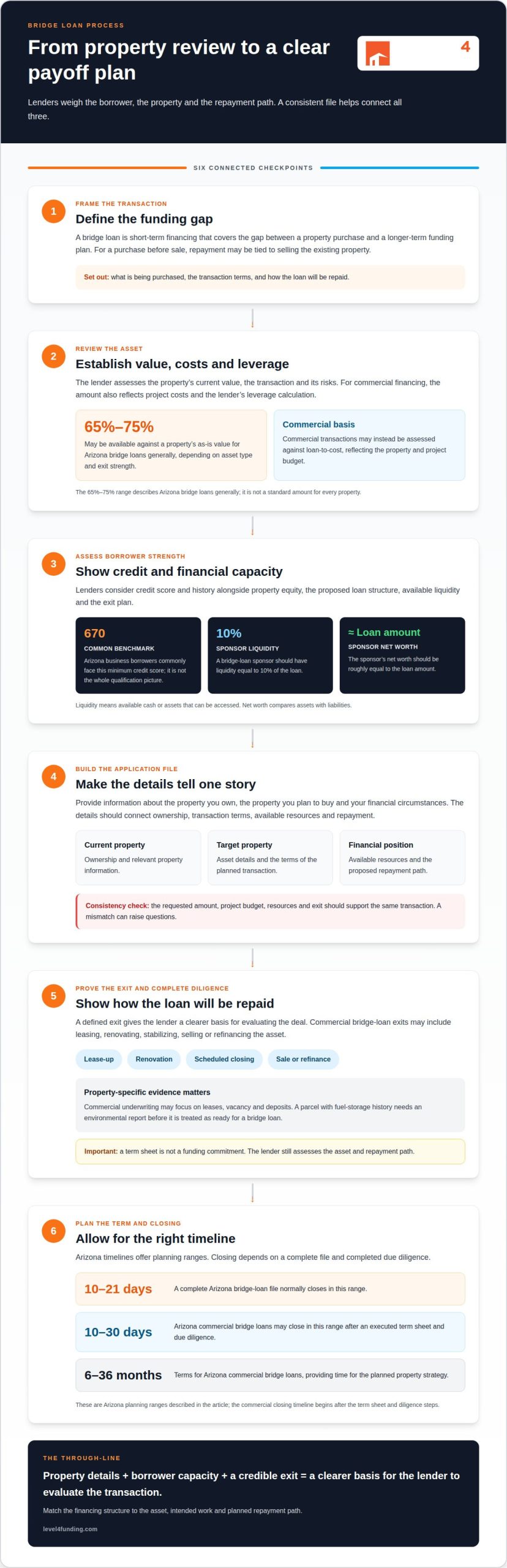
A bridge loan is short-term financing that helps cover a gap between a property purchase and a longer-term funding plan. In Kingman, the loan decision centers on the property, its current value, the transaction, and the borrower’s exit plan. Arizona commercial bridge loans may have terms of 6 to 36 months, giving borrowers time to lease, renovate, stabilize, sell, or refinance an asset.
For commercial financing, the amount depends on the property’s value, project costs, and the lender’s leverage calculation. These figures describe commercial transactions, not a standard amount for every Kingman property. The lender assesses the collateral and transaction risks before determining the financing structure.
How much can borrowers get with a Kingman bridge loan? For Arizona bridge loans generally, financing may provide 65% to 75% of a property’s as-is value, depending on asset type and exit strength. Commercial transactions may instead be assessed against loan-to-cost, so the final amount reflects both the property and the project budget.
Timing hinges on a complete file and completed due diligence. A complete Arizona bridge-loan file normally closes in 10 to 21 days; Arizona commercial bridge loans may close 10 to 30 days after an executed term sheet and due diligence. How long does bridge loan approval and funding take in Kingman? Those Arizona timelines offer a planning range, but the commercial timeline begins after the term sheet and diligence steps.
A term sheet is not a funding commitment. The lender still needs to assess the asset and the repayment path. In Kingman, commercial underwriting should focus on evidence tied to the property: leases, vacancy, and deposits matter more than Interstate 40 traffic alone. A Route 66 retail rent roll should also be evaluated across busy and ordinary periods. A parcel with fuel-storage history needs an environmental report before it is treated as ready for a bridge loan.
Arizona bridge lender rankings are no substitute for checking how a loan fits your transaction. Compare lenders by property type, basis for leverage, term, due diligence, and exit expectations. For example, buying a vacant commercial building calls for a plan that accounts for lease-up, while an income-producing property may be assessed through its leases and deposits. A defined exit, such as lease-up, renovation, or a scheduled closing, gives the lender a clearer basis for evaluating the deal.
Bridge lenders serving Arizona may evaluate transactions across different property markets, but local coverage is not the same as automatic eligibility. Kingman collateral must meet the lender’s property and underwriting criteria; Arizona location alone does not establish approval. For each transaction, confirm that the financing structure fits the asset, the intended work, and the planned exit. That is a more useful comparison than a broad ranking.
Borrower credit and liquidity requirements
A bridge-loan application weighs the borrower alongside the property. Lenders assess credit score and history as part of financial stability. Arizona business borrowers commonly face a minimum credit score of 670. That figure is a common benchmark, not the entire qualification picture. Investors also need a credible repayment plan and enough liquidity to support the transaction through closing.
Sponsor strength matters, too. A bridge-loan sponsor should have liquidity equal to 10% of the loan. The sponsor’s net worth should be roughly equal to the loan amount. Those measures help show whether the borrower can handle project obligations and unexpected pressure. Liquidity is available cash or assets that can be accessed, while net worth compares assets with liabilities.
A lender may consider financial history alongside the property’s equity, proposed loan structure, and exit plan. A strong property does not by itself resolve how the loan will be repaid. Review your available resources and repayment strategy together so you can assess whether the proposed financing fits the transaction.
What documents are needed to apply for a bridge loan in Kingman, Arizona? Applicants typically provide information about the property they own, the property they plan to buy, and their financial circumstances. These details help the lender understand ownership, transaction terms, available resources, and the proposed repayment path.
Borrower and sponsor information should connect the numbers to the project. For example, someone seeking financing for a commercial property can present details about the target asset, current property, financial position, and planned exit. This gives the lender context to assess the borrower, the property, and whether the repayment strategy fits the loan structure.
Before closing, the application should tell one consistent story. The requested amount, property details, available resources, and repayment plan need to support the same transaction. A mismatch can raise questions, such as a project budget exceeding available resources or an exit that does not fit the loan term. Clear, consistent information helps the lender evaluate the deal.
- Credit: Score and history show financial stability.
- Liquidity: The sponsor should hold 10% of the loan amount.
- Net worth: The sponsor’s net worth should roughly match the loan amount.
- Documentation: Cover the current property, target property, and finances.
- Repayment: Connect the exit strategy to the transaction structure.
For a commercial real estate transaction, commercial property financing may be relevant when the project fits that loan purpose.
Bridge loan financing for buying a home before selling another
A bridge loan can help a buyer purchase a home before selling an existing property. The key is matching the short-term financing to the planned sale, available equity, and repayment source.
Financing a home purchase before selling
Private financing can help a buyer move forward with a purchase before the current home sells. A lender may assess equity in the existing property and secure the loan against it; in some cases, the new property may serve as collateral. With bridge loans in Kingman, account for existing mortgage obligations and the sale proceeds expected to repay the loan.
Some bridge loans use interest-only payments during the term, with the principal due as a lump sum when the home sells. Terms vary, so check the proposed payoff date and repayment structure carefully. Interest-only payments can reduce payments during the term, but leave a substantial balance to repay. Consider how a delayed sale could affect your cash flow and payoff plan.
Business transitions follow a related short-term financing logic, but the transaction differs from a home purchase. Arizona bridge loans for business acquisitions typically have terms of 3 to 18 months. For an ownership transition, the financing plan needs a clear repayment source, such as a sale, refinance, or other identified takeout. The asset, purchase structure, and exit timing all shape the funding request.
Keep the purpose of each dollar clear. A property purchase, working capital, and equipment needs may belong to different parts of a transaction. If you need funds for a new home and business equipment, for example, distinguish those expenses in your financing plan. This helps the lender assess the property-backed request without assuming every cost fits the same loan structure.
Repayment Exits and Takeout Financing
Define the exit before taking out a bridge loan. Common options include selling the property or refinancing into longer-term financing after stabilization. For a homebuyer, the expected sale of the current property may provide the payoff funds. For an investor, lease-up, renovation, or a planned closing date can shape the exit strategy.
Takeout financing replaces short-term debt with longer-term financing. The future mortgage or refinance needs to suit the property’s condition and income at that point. A dated sale contract, signed takeout term sheet, or lease-up schedule supported by letters of intent can help document the exit. The plan is stronger when the funding source and repayment event are specific, not merely anticipated.
Before choosing short-term financing, map the purchase, sale, and payoff as one transaction. Identify the expected repayment source, timing, and what you would do if the sale takes longer. For real estate investors, this helps distinguish a temporary funding gap from a project that needs a different financing structure.
Advantages and disadvantages of bridge loans
A bridge loan can help secure a property before a sale or other financing is complete. That timing may protect a purchase opportunity, including for someone buying before selling an existing home. The tradeoff is a short repayment window: interest accrues, and the balance still needs to be paid off. For bridge loans in Kingman, consider the transaction timeline and payoff source from the outset.
How do bridge loans in Kingman compare with HELOCs and home equity loans? A bridge loan provides short-term funding for a transition, while a HELOC provides access to a credit line secured by home equity. Granite Bank notes that HELOCs often have variable interest rates. A home equity loan generally provides a lump sum; the suitable option depends on timing, available equity, and repayment capacity.
The main advantage is timing. A buyer may make an offer without a sale contingency, then repay the loan after the existing property sells. Some bridge loans use interest-only payments during the term, with principal due in a lump sum at sale. This can preserve cash before the sale, but concentrates repayment in one future event.
What are the risks and repayment terms of bridge loans in Kingman? Bridge loans typically last six months to a year, and repayment commonly depends on selling the property or refinancing. If the sale or takeout financing is delayed, the borrower still faces the loan’s maturity and ongoing interest. The collateral may be the existing property, so a stalled exit can put that asset under pressure.
Renovation plans add another consideration. Key One Financial says bridge loans typically don’t include renovation funds, while fix-and-flip loans include renovation financing. If you plan repairs, account for that distinction before selecting a loan structure. For example, a Kingman purchase with a separate renovation budget may call for financing that addresses both acquisition and construction work.
Compare financing against the transaction, not just the speed of funding. A Scottsdale buyer purchasing before selling faces the same core questions as a Kingman buyer: what secures the loan, what event repays it, and how much time that event needs. A sound exit plan accounts for a slower sale or a refinance that takes longer than expected.
- Potential benefit: Buy before the current property sells.
- Payment structure: Interest-only payments may leave principal due at sale.
- Key risk: A delayed sale can complicate repayment.
- Renovation: Bridge financing may not include project funds.
- Alternative: Compare a HELOC or home equity loan based on timing and equity.
A bridge loan is most suitable when the near-term purchase matters and the borrower has a realistic exit. If repayment depends on a sale, consider the property’s marketability and the time needed to sell. If refinancing is the plan, the future loan must suit the property’s condition and financial profile. Match the structure to the repayment source, not an optimistic assumption.
Banks, credit unions, online lenders, and hard money lenders
A lender’s category alone won’t tell you whether its financing suits your Kingman transaction. Compare the loan structure, approval criteria, property requirements, interest rate, and repayment plan. Use the same purchase details and exit strategy to compare options, rather than focusing on a headline rate alone.
What are alternatives to bridge loans for Kingman homebuyers? A buyer can wait until the current home sells, explore a HELOC or home equity loan, or consider a mortgage refinance. Granite Bank notes that HELOCs often have variable interest rates, so include potential payment changes in the comparison.
Banks and credit unions may be worth comparing when their financing fits the property and purchase timeline. Their names alone don’t show whether a bridge loan is available or whether its terms suit your transaction. Compare the approval process, documentation, collateral, repayment schedule, and ability to meet the purchase deadline.
Online lenders use different underwriting approaches. One application may focus on personal financial details; another may emphasize the real estate, project plan, or exit. Ask how the property is evaluated and what steps remain after an initial offer. A term sheet is not a funding commitment, so distinguish preliminary terms from completed due diligence.
A hard money lender provides private financing for real estate investors. This option may suit transactions that call for a real-estate-focused structure. Match the loan purpose to the project: a property needing renovation raises different financing questions from a purchase intended for rental income. Construction projects also require a plan for how the work and repayment fit together.
Use the same comparison criteria across lender types. That keeps your decision grounded in the deal, not assumptions about a bank, credit union, website, or lender label.
- Property: Identify the collateral and the asset’s current condition.
- Approval: Separate initial terms from remaining review and due diligence.
- Timing: Compare the funding timeline with the purchase deadline.
- Repayment: Match the loan maturity to a sale, refinance, or other exit.
- Total structure: Review interest, payment timing, and any renovation or construction funding needs.
Choose the lender whose structure addresses the transaction’s actual gap. A buyer with a signed purchase contract and a pending home sale needs a different comparison than an investor financing a renovation before refinance. For private real estate financing, explore hard money financing as one option to assess against the property, timeline, and exit.
Level 4 Funding
Level 4 Funding helps real estate investors consider financing that fits the property and project, when a bridge loan is not the only part of the plan. Its options include Fix and Flip Loans, Construction Loans, Commercial Property Loans, and Cash Out Refinance. The right fit depends on the asset, intended work, and how repayment is expected to happen.
For example, a property needing substantial renovation may call for financing structured around the improvement plan. A commercial purchase or a project moving toward refinance may need a different approach. Share the property details, transaction purpose, and planned exit so the financing can be assessed in context.
If you’re weighing real estate financing for your next move, contact Level 4 Funding to discuss your transaction.
Make Your Next Property Move With a Clear Plan
For bridge loans in Kingman, start by defining what the financing needs to make possible next. Identify the property move, the role of temporary capital, and the outcome that advances your plans. That direction can help you decide whether short-term financing fits or another real estate structure is a better match.
Bridge loans in Kingman may be one part of a larger investment strategy. Level 4 Funding also offers Fix and Flip Loans, Construction Loans, and Commercial Property Loans for different real estate projects. Focus on the transaction ahead and the type of property work involved, rather than choosing a financing label in isolation.
Ready to discuss your property plans and financing direction? Contact Level 4 Funding to start the conversation. A clear plan can help you take your next step with purpose.
Frequently Asked Questions
What bridge loan lenders serve Kingman, Arizona?
Bridge loans in Kingman may be available through banks, credit unions, online lenders, and private hard-money lenders. Level 4 Funding is an Arizona-based private lender serving real estate investors in 35 U.S. states, with Arizona focus that includes Phoenix, Scottsdale, Tucson, and Flagstaff. Compare each lender’s collateral approach, approval process, and eligible loan purpose. A lender’s location alone doesn’t establish that its financing fits a Kingman property.
What are the eligibility requirements for a bridge loan in Kingman?
Requirements vary by lender and transaction. Lenders may assess the borrower’s credit history, property equity, available liquidity, and repayment plan. For Level 4 Funding’s private hard-money loans, no minimum credit score is required, though lenders may review judgments, tax liens, or bankruptcy. A lower score may affect the down payment or interest rate. The property and proposed financing structure also shape eligibility.
How do bridge loans work for buying a home before selling in Kingman?
A bridge loan in Kingman can provide temporary funds toward a new home purchase while the buyer’s current property remains unsold. The lender reviews the properties, available equity, and planned payoff source. Proceeds from the sale may repay the short-term loan. This can let a buyer proceed before the sale closes, while making it important to plan for repayment if the sale takes longer than expected.

About the author
Matt has a bachelor's degree in political science from Northern Arizona University and works at Level 4 Funding, a private lending company that offers hard money and rental home loans to real estate investors in 35 states.
With Matt's leadership, the firm has financed almost $300 million in loans for investment properties. He often helps real estate investors with rental property purchases, foreclosures, refinancing, and fix-and-flip projects. Matt has extensive experience in fix-and-flip, buy-and-hold, rental properties, and real estate sales. He has lived in Arizona for 43 years and is married with three children. Matt is licensed as a mortgage broker and loan originator in Arizona, with NMLS 2062278 and NMLS 1118493.
Equal Housing Opportunity. This is not a Good Faith Estimate, and it is not a Guarantee to lend; it should not be considered as such. Costs, rates, estimates, and terms can only be determined after a full application is completed. To the extent this message includes any tax or legal advice, this message is not intended or written by the sender to be used, and cannot be used, for legal or tax purposes or advice. This is an advertisement. Copyright © 2026. All rights reserved.