


How to Calculate DSCR: The Debt Service Coverage Ratio Formula Every Real Estate Investor Needs
October 7, 2026
Hard Money Lending Rates Explained: What Drives Them, What to Expect, and How to Get a Better Deal
October 8, 2026
What if your Phoenix deal could make sense even when a bank’s income checklist doesn’t? That’s the appeal of asset based hard money lending: the property and project take center stage. But collateral alone doesn’t carry the deal. A lender also needs to understand how you’ll use the funds and how you expect to repay them.
It’s fair to ask how an investment property will be valued, what leverage may be workable, and how personal credit or income could factor into the review. Property-focused underwriting puts more emphasis on the deal, but borrower details still matter, and approval isn’t automatic. The property’s condition, purchase terms, renovation scope, budget, and exit plan all help tell the story.
This guide explains how asset-based underwriting can shape a lending decision, how to think about leverage, and how to prepare a clear deal package for an Arizona investment. You’ll also see how fix-and-flip, construction, commercial property, Airbnb, and cash-out refinance loans can serve different plans. Use these steps to assess your acquisition or renovation and present a stronger, more complete financing request.
Key Takeaways
- Asset based hard money lending puts the investment property at the center of the review, but collateral alone doesn’t guarantee approval.
- Property condition, comparable sales, purchase terms, and renovation scope can all shape an underwriting review.
- Loan-to-value helps explain leverage. It is not a promise of how much financing a deal will receive.
- Compare financing paths by the project’s purpose, ownership plan, and intended exit.
- Organize property, purchase, renovation, budget, and exit details into a clear package for an Arizona loan request.
What Asset-Based Hard Money Lending Means for Real Estate Investors
Asset based hard money lending is investment financing in which the real estate being financed is a central factor in underwriting. The property serves as collateral, so its value and condition help a lender assess the deal. This approach can suit an acquisition, renovation, or other investment project, but it doesn’t make approval automatic or remove consideration of the borrower.
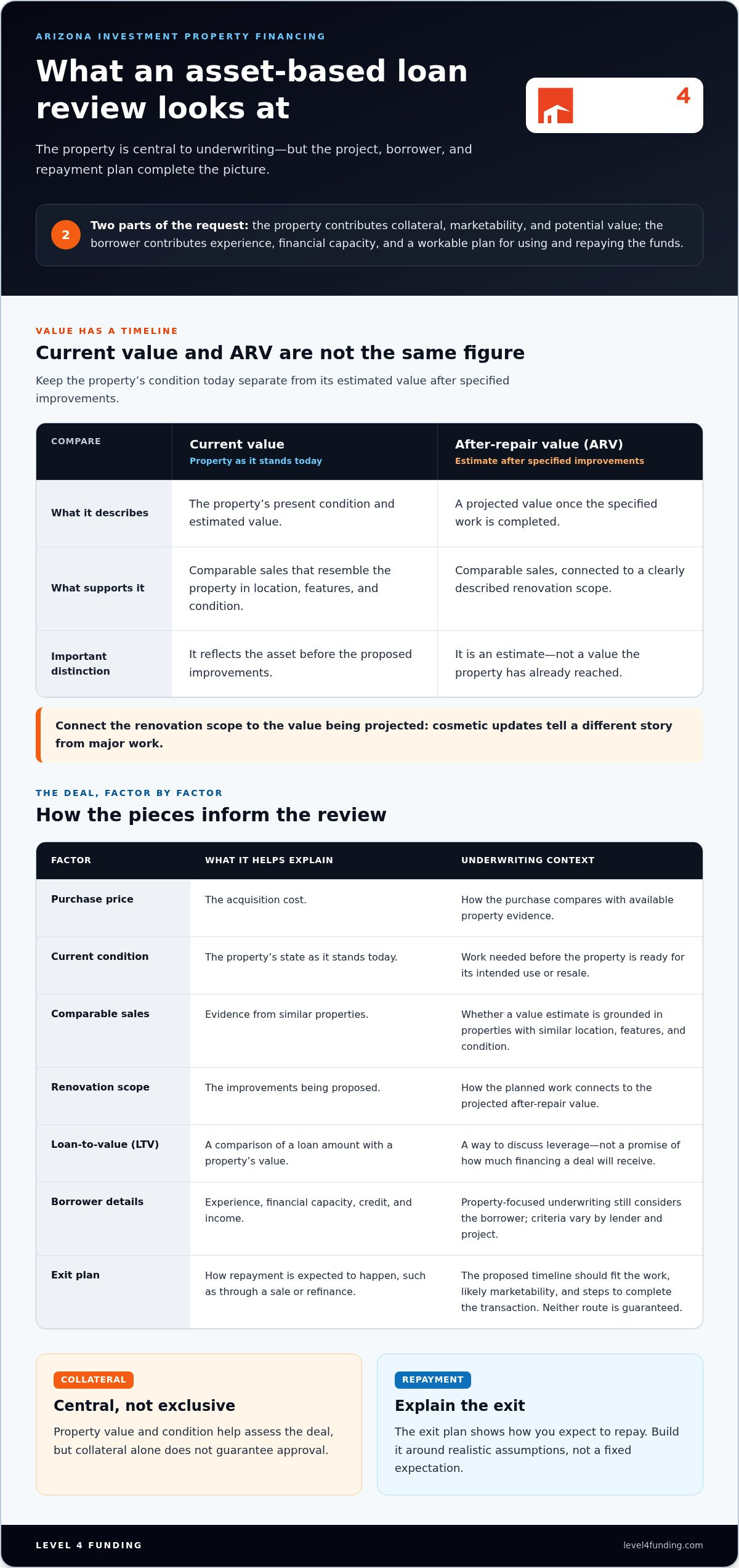
Think of the property and the investor as two parts of the request. The property contributes collateral, marketability, and potential value. The borrower contributes experience, financial capacity, and a workable plan for using and repaying the funds. A strong property can’t replace a credible plan, just as an experienced investor can’t make an unsuitable property risk-free.
What does “asset-based” mean in a property loan?
A lender may examine the property’s current condition, estimated value, and potential to attract buyers or tenants. These details help show how the asset could support the financing if the investment doesn’t go as planned. The review may also consider the purchase and proposed improvements, rather than treating the property’s address or estimated value as the whole story. For a general background on the term, see What is Asset-Based Lending?
For example, imagine an investor evaluating a Phoenix home that needs renovation before resale. The home’s condition, comparable properties, and planned work help describe both the asset and the opportunity. The investor’s relevant experience, ability to manage the project, and intended sale or refinance help explain whether the plan is credible. This is a hypothetical illustration, not a forecast of loan terms or a lending decision.
That balance matters. Collateral is central, not exclusive. Credit, income, experience, and other borrower details may still inform a lender’s review, and criteria vary by lender and project.
How does hard money lending differ from a conventional mortgage?
The purpose and structure are key distinctions. Hard money loans are commonly used for real estate investment projects, such as purchasing and renovating a property. Conventional mortgages are often structured for home purchases or longer-term financing, with underwriting that may place greater emphasis on borrower qualifications and repayment capacity. Practices differ, so neither category has one universal checklist.
Investment-purpose financing is also different from borrowing for personal or household use. The intended use of the property and funds helps frame the request; don’t assume that a loan’s label alone determines its purpose or treatment. This is a general distinction, not legal advice.
If you’re weighing the basics, a companion guide on what a hard money loan is can help clarify the loan structure. The practical takeaway is straightforward: describe the property accurately, distinguish its strengths from your own qualifications, and explain how the investment plan connects to repayment.
How Property Value, Leverage, and the Exit Plan Shape Underwriting
In asset based hard money lending, the property’s numbers need to tell a coherent story. A lender may consider the purchase price, current condition, comparable sales, planned improvements, and intended exit. No single figure tells the whole story, and an estimate is not a commitment to lend.
Loan-to-value (LTV) compares a loan amount with a property’s value. It’s a way to discuss leverage, not a promise that a borrower can access that portion of the property’s value. The value used, eligible costs, project structure, and other underwriting factors can affect the amount considered. The Office of the Comptroller of the Currency’s Regulatory Guidance on Asset-Based Lending offers broader context on collateral-based lending and risk management. It shouldn’t be read as a hard-money loan offer or as terms for a specific deal.
How do current value and after-repair value affect a deal?
Current value describes the property as it stands today. After-repair value, or ARV, is an estimate of its value after specified improvements are completed. They represent different stages, so don’t treat projected renovated value as if the work is already done.
Support the estimate with comparable sales that resemble the property in location, features, and condition. Then connect the renovation scope to the value you’re projecting. A plan based on cosmetic updates tells a different story from one requiring major work. For a deeper walkthrough of the estimate, see the article on calculating ARV for a hard money loan.
Why does the exit strategy matter alongside collateral?
Collateral describes what backs the request. The exit plan explains how you expect to repay it. A sale or refinance may be a possible route, but neither is guaranteed. The proposed timeline should fit the work required, the property’s likely marketability, and the steps needed to complete the transaction. Project-specific underwriting and terms vary, so build a plan around realistic assumptions rather than a fixed expectation.
Use this comparison to organize the key parts of a deal before presenting it:
| Factor | What it helps explain |
|---|---|
| Purchase price | The acquisition cost and how it compares with available property evidence. |
| Current condition | Work needed before the property is ready for its intended use or resale. |
| Comparable sales | Whether the value estimate is grounded in similar properties. |
| Renovation scope | What improvements are planned and how they support the projected outcome. |
| Exit strategy | How the investor expects to repay and whether the timeline fits the project. |
Clear, consistent estimates make a deal easier to understand, though they don’t guarantee approval. Arizona investors planning an acquisition or renovation can explore private real estate financing for investment projects as they shape their financing plan.
Asset-Based Hard Money vs. Other Financing: Which Deal Fits?
The right financing route depends on what the property needs and how you plan to own it. Asset based hard money lending is generally considered for investment deals where the property and project are central to the review, particularly when an acquisition or renovation needs a defined plan. Conventional bank financing and longer-term rental financing are structured for different goals. No option is automatically the best fit for every investor.
Start with what the funds need to do. Are you buying a property that needs work before it can be sold or rented? Building from the ground up? Holding a stabilized rental for ongoing income? Your answer helps frame the type of financing to consider, along with the property, your capacity, and the repayment plan.
- Asset-based hard money: Consider it for an investment purchase or renovation with a clear scope of work and planned exit. Terms and underwriting depend on the specific deal.
- Conventional bank financing: This may suit a purchase or refinance that fits the lender’s product structure and underwriting approach. Requirements and processes vary among lenders.
- Longer-term rental financing: This may align with a strategy focused on retaining a property and operating it as a rental, rather than completing a short-term project and selling.
When might hard money suit an acquisition or renovation project?
Picture an investor evaluating a property that needs repairs before it can be marketed. The purchase, renovation scope, and intended sale or refinance form one connected plan. That scenario may warrant exploring short-term project financing, but the property’s condition, budget, investor’s capacity, and exit assumptions still matter. A time-sensitive purchase is a reason to assess financing fit, not a promise of eligibility or closing speed.
For a flip, make the work specific: identify what needs repair, how the improvements support the plan, and what the expected exit depends on. The fix-and-flip loans guide can add project-focused context, while the article comparing a hard money loan versus a bank loan covers the broader distinction without replacing a deal-by-deal review.
When might another financing structure be a better match?
If the plan is to hold a property as a rental, compare the needs of long-term ownership with the structure of shorter-term project capital. A stabilized rental strategy may call for financing designed around continued ownership. If the project involves building, construction financing may be relevant; a property intended for business use may call for a commercial financing approach. Let the project’s purpose guide the comparison.
Look beyond a headline rate or a general claim about speed. Consider how the structure fits the work, ownership period, repayment plan, and likely exit. Level 4 Funding provides private real estate financing for fix-and-flip, construction, commercial property, Airbnb, and cash-out refinance projects for investors assessing Arizona properties.
How Arizona Investors Can Prepare an Asset-Based Loan Request
A clear request helps a lender understand the property, the work, and the plan behind the numbers. For asset based hard money lending, organize the deal so its details line up. Don’t rely on a single value estimate or leave the renovation and repayment plan vague.
What information helps explain the property and project?
Build your package in a consistent order. A Phoenix-area acquisition can serve as an example, but the same preparation applies to properties in Scottsdale, Tucson, Glendale, Sedona, Flagstaff, Tempe, Mesa, and Buckeye. Include the facts and documents you have, and label estimates as estimates.
- Identify the property. Provide its address, property type, current use, condition, and clear photos. Note visible repairs or features that may affect the proposed use.
- Outline the purchase. Summarize the acquisition terms and include available purchase documents. Keep the proposed price and transaction details consistent across your materials.
- Describe the renovation. List the planned work by major task. Include contractor scopes or estimates when available, plus the expected sequence of work. Separate confirmed costs from allowances or early estimates.
- Show the budget. Organize the purchase, renovation, and other project costs in one place. Explain where each figure came from, and make sure the totals match the supporting documents.
- Explain the intended exit. State whether you plan to sell or refinance, and describe the assumptions behind that plan. Include relevant comparable sales or other support for projected value when available.
How can investors make the request easier to assess?
Use one set of figures throughout. If the renovation scope changes, update the budget and projected value too. Inconsistent totals, unsupported assumptions, or unexplained gaps can make it harder to understand how the deal is expected to work.
Be candid about risks. If the property needs substantial repairs, explain how the scope addresses them. If the plan depends on completing improvements before marketing the property, show how the sequence supports that next step. A realistic timeline should reflect the actual work and anticipated exit, not a best-case assumption presented as certain.
Location and property details matter because they help describe the asset and its marketability. For example, comparable sales near a hypothetical Phoenix property may be more relevant to its value estimate than sales from a different kind of area. Use local evidence that genuinely fits the property; a citywide figure alone doesn’t establish an individual property’s value.
For process-focused context, consult the existing guide to the hard money loan approval process. Then bring your organized materials to a conversation about an Arizona investment deal. Explore financing for your Arizona investment property with Level 4 Funding, which provides private real estate financing for investors.
Explore Level 4 Funding for an Arizona Investment Property
A financing structure should match the job your property needs to do. Level 4 Funding provides private real estate financing for investors in Phoenix, Scottsdale, Tucson, Glendale, Sedona, Flagstaff, Tempe, Mesa, and Buckeye. Whether your plan centers on renovation, construction, rental use, or commercial property, start by matching the project’s purpose to the right loan category.
Which Level 4 Funding loan categories may relate to your project?
For an investment property you plan to purchase, improve, and sell, fix-and-flip loans support the acquisition-and-renovation strategy. For a building project, Level 4 Funding provides construction loans. For property intended for business use, commercial property loans serve commercial investment plans.
The intended use matters. Investors planning to operate a short-term rental can consider Airbnb loans, while owners seeking to access equity in an existing property can explore cash-out refinance financing. These categories serve different goals, so describe the property’s current status and what you intend to do with it. The category is a starting point for a project conversation, not a promise of approval or specific terms.
That distinction is central to asset based hard money lending. Property details help frame the request, while the purchase, project scope, borrower information, and intended repayment plan also inform a lender’s review. The financing conversation should address the complete deal, not just a property estimate.
What is a practical next step for an Arizona investor?
Before discussing your project, bring the essentials together:
- Property: Address, type, current condition, and available photos.
- Project: Purchase details and a clear description of planned work, if any.
- Financing purpose: What the funds are intended to support, such as a flip, construction project, rental, or commercial investment.
- Exit plan: Whether you expect to sell or refinance, along with the assumptions behind that approach.
Keep estimates distinct from confirmed figures. If your scope or assumptions change, make sure the supporting information reflects the change. A well-organized summary makes it easier to discuss the deal’s strengths, open questions, and risks without implying a guaranteed outcome.
Level 4 Funding works with real estate investors considering projects in Phoenix, Scottsdale, Tucson, Glendale, Sedona, Flagstaff, Tempe, Mesa, and Buckeye. Bring your property details and plan into the conversation. Explore Level 4 Funding’s private real estate financing for your Arizona investment property.
Put Your Arizona Investment Plan in Motion
Turn your property idea into a decision-ready project plan. Define what you’re acquiring, what needs to happen next, and how you expect the investment to reach its exit. That clarity gives a financing conversation substance, whether you’re evaluating a deal or preparing to move forward.
Asset based hard money lending is one route investors can explore when property-focused financing aligns with the project. Level 4 Funding provides private real estate financing for fix-and-flip, construction, and commercial property projects in Phoenix, Scottsdale, Tucson, Glendale, Sedona, Flagstaff, Tempe, Mesa, and Buckeye. The right fit depends on the property and project; no financing approach should be treated as an assured outcome.
Bring your plan into focus and take the next step. Explore real estate financing with Level 4 Funding and discuss how your Arizona investment goals connect to a potential financing path.
Frequently Asked Questions
Is asset-based hard money lending based only on the property?
No. The property is important, but the project plan, borrower details, and repayment approach can also shape the request. For example, two investors seeking financing for similar homes may present different plans for repairs, oversight, and resale. Those differences can affect how each deal is assessed. Treat asset-based lending as a way to frame the review, not as a promise that collateral alone will determine the outcome.
Can I get asset-based hard money financing with poor credit?
Possibly, but a property-focused approach doesn’t guarantee approval regardless of credit history. Lenders may weigh borrower and deal details differently, so don’t assume credit is either the only deciding factor or irrelevant. Be prepared to explain the property, your role in the project, and how you plan to repay the financing. If your credit history includes a recent issue, describe it accurately rather than leaving the lender to guess.
How is the loan amount determined in asset-based hard money lending?
The amount depends on underwriting for the particular property and transaction. A lender may consider the purchase terms, condition, supported value estimates, renovation plans, and intended exit. Loan-to-value expresses a loan in relation to an assessed property value, but it doesn’t establish the proceeds available for your deal. Before relying on an estimate, identify which value basis it uses and account for project costs that may not be included.
What happens if the property does not sell or refinance on schedule?
A delayed sale or refinance can leave you carrying the financing longer than planned and put pressure on repayment. Before closing, review the loan agreement for its maturity date, payment responsibilities, and any extension provisions. Build contingencies for renovation delays or a slower sale rather than relying on a single exit date. A sale or refinance is a plan, not a guaranteed result; consider qualified financial or legal guidance when assessing your obligations.
Do Arizona hard money lenders finance properties outside Phoenix?
Yes. Level 4 Funding serves Arizona markets beyond Phoenix, including Scottsdale, Tucson, Glendale, Sedona, Flagstaff, Tempe, Mesa, and Buckeye. Location is one part of the review, not a guarantee that every property or transaction will have the same terms. Share the property’s city, type, current condition, and intended use so the financing discussion can focus on the specific investment rather than broad regional assumptions.
What documents should I prepare for an asset-based hard money loan request?
Start with the property address, purchase contract or ownership details, and photos showing its current condition. For a renovation, gather the work scope and contractor estimates or bids you have. Include the basis for your value assumptions and a short explanation of whether you intend to sell or refinance. If figures change, update related documents so the purchase terms, work plan, budget, and projected outcome remain consistent.

About the author
Matt has a bachelor's degree in political science from Northern Arizona University and works at Level 4 Funding, a private lending company that offers hard money and rental home loans to real estate investors in 35 states.
With Matt's leadership, the firm has financed almost $300 million in loans for investment properties. He often helps real estate investors with rental property purchases, foreclosures, refinancing, and fix-and-flip projects. Matt has extensive experience in fix-and-flip, buy-and-hold, rental properties, and real estate sales. He has lived in Arizona for 43 years and is married with three children. Matt is licensed as a mortgage broker and loan originator in Arizona, with NMLS 2062278 and NMLS 1118493.
Equal Housing Opportunity. This is not a Good Faith Estimate, and it is not a Guarantee to lend; it should not be considered as such. Costs, rates, estimates, and terms can only be determined after a full application is completed. To the extent this message includes any tax or legal advice, this message is not intended or written by the sender to be used, and cannot be used, for legal or tax purposes or advice. This is an advertisement. Copyright © 2026. All rights reserved.