


Is the Private Lending Market Shifting? What Rising Rates and Tighter Banks Mean for Real Estate Investors in 2026
November 1, 2026
Buying first does not have to mean waiting for your current home to sell. Level 4 Funding provides short-term bridge loans for a new purchase, with repayment planned from the sale of your existing home or another defined exit. They cover a temporary funding gap, not a long-term mortgage.
The benefit is flexibility: you can pursue a property without making your offer depend on selling first. The tradeoff is repayment pressure if your current home takes longer to sell or the exit plan changes.
Before choosing this financing, consider the total borrowing cost, how the loan is assessed, and whether the term fits your purchase and repayment timeline. The key question is whether bridging the gap supports your plan without leaving too little room for overlapping property costs.
Key Takeaways
- A bridge loan can use equity in your current home to help fund a purchase before that home sells.
- Compare the interest rate, origination fee, payment structure, and any prepayment penalty to understand the full borrowing picture.
- Build a realistic sale-and-repayment plan, including what you’ll do if your current home takes longer to sell.
- Lenders may weigh your home equity, credit history, income, existing obligations, and available assets when reviewing qualification.
- Weigh the flexibility of buying before selling against carrying costs and the risk of managing two homes at once.
Arizona bridge loan interest rates and origination points
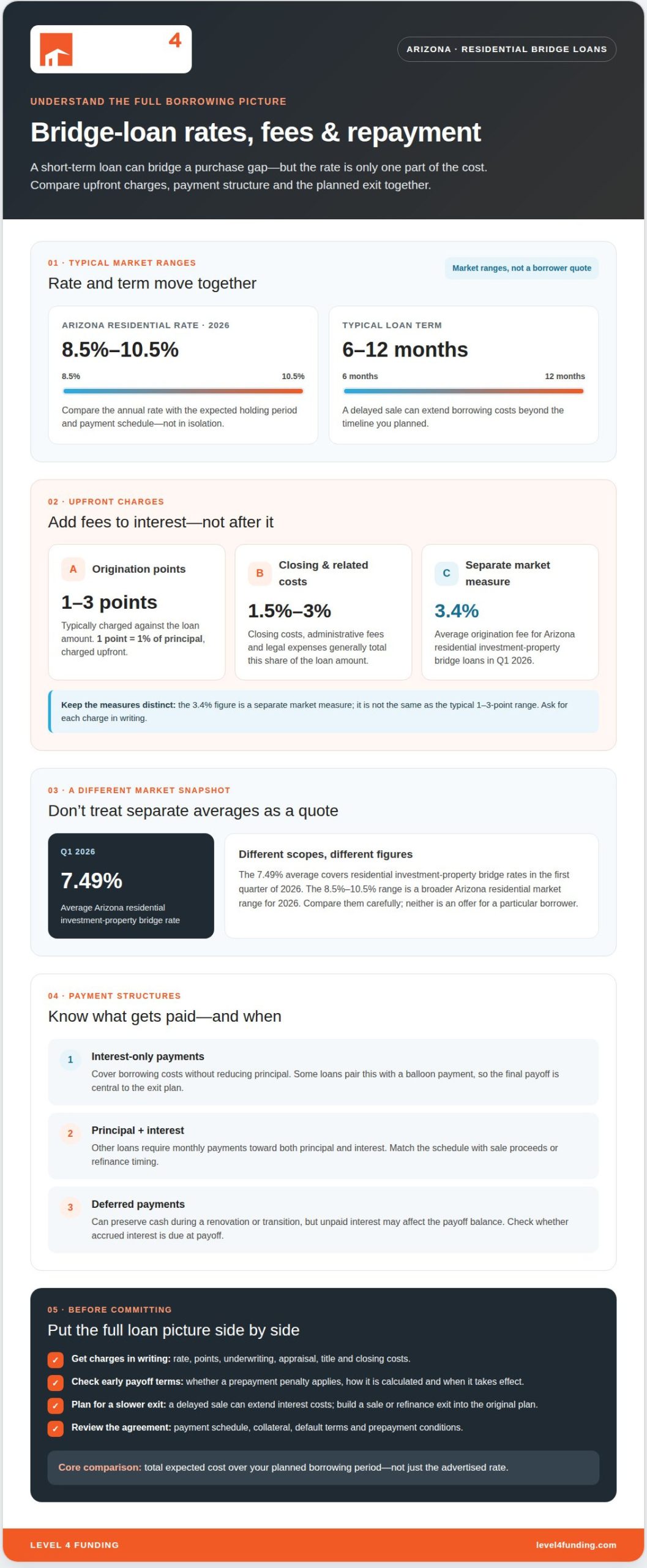
In Phoenix, bridge-loan pricing depends on the property, equity, repayment plan, and loan structure. Arizona residential bridge-loan rates typically range from 8.5% to 10.5% in 2026, and terms typically run 6 to 12 months. Treat these as market ranges, not a quote for a particular borrower. Compare the rate with the full repayment schedule, not in isolation.
Origination points are upfront charges calculated against the principal, while interest accrues over the loan term. Residential bridge-loan origination fees typically range from 1 to 3 points of the loan amount. Ask for the points, underwriting, appraisal, title, and closing charges in writing. Then compare the total expected cost across the time you plan to borrow. A lower rate can still mean a higher overall cost if upfront charges or repayment terms differ.
How do bridge loans compare with HELOCs, home equity loans, and cash-out refinancing? A bridge loan addresses a short-term purchase gap. A HELOC or home equity loan draws on home equity, while cash-out refinancing replaces an existing mortgage with a larger one. Compare how each option affects your current mortgage, payment schedule, closing timeline, and payoff plan.
For a 1031 exchange, timing matters: according to the Internal Revenue Service, investors have 45 days to identify replacement properties and 180 days to close on replacement property. Map the bridge loan’s closing and payoff plan against those deadlines before committing. A financing timeline that ignores the exchange calendar can create avoidable pressure.
Eligibility turns on available equity, credit history, repayment ability, property value, existing debt, and assets for purchase costs. Arizona hard-money and private loans commonly use loan-to-value ratios of 60%-70%. To apply, organize current-home valuation and mortgage-balance records, income and asset documentation, existing debt details, and purchase information. Lenders use these details to assess the collateral and repayment plan.
Arizona-specific requirements can depend on the loan’s purpose and structure. Review the written agreement for its rate, fees, payment schedule, collateral, default terms, and prepayment conditions before signing. A bridge loan may be repaid from proceeds when the current home sells, but a delayed sale can extend interest costs. For commercial projects, SBA 504 financing may be considered as a separate financing path, not an automatic bridge-loan payoff. Build a sale or refinance exit into the original plan.
Interest rates, origination fees, and prepayment penalties
The interest rate, any points, and payment structure all shape the cost of short-term financing. Compare the full loan timeline, not just one attractive figure.
Average Interest Rates
Arizona residential bridge-loan rates typically range from 8.5% to 10.5% in 2026. A separate market measure placed average Arizona residential investment-property bridge rates at 7.49% in the first quarter of 2026. These figures use different market scopes, so compare them carefully rather than treating them as interchangeable quotes.
Your offered rate reflects the collateral, credit profile, leverage, and exit strategy. A shorter term may reduce total interest if repayment happens as planned, but a delayed sale can extend borrowing costs. Compare the annual rate with the expected holding period and payment schedule before choosing this financing option.
Fees and Prepayment Penalties
Arizona residential bridge-loan origination fees typically range from 1 to 3 points of the loan amount. One point equals 1% of principal, charged upfront. Arizona bridge-loan closing costs, administrative fees, and legal expenses generally total 1.5% to 3% of the loan amount. Add these charges to interest when comparing term financing.
Prepayment terms matter if a sale or refinance could repay the loan early. Review whether a penalty applies, how it is calculated, and when it takes effect. Also distinguish origination points from third-party closing costs, since they are separate charges that affect the cash needed at closing.
Interest-Only and Deferred Payments
Interest-only payments cover borrowing costs without reducing principal. Some bridge loans use this structure before a balloon payment, making the final payoff a key part of the exit plan. Other loans require monthly payments toward both principal and interest. Compare the schedule with expected sale proceeds or refinance timing.
Deferred payments may preserve cash during a renovation or transition, but unpaid interest can affect the payoff balance. Before borrowing, match payment dates to project milestones and sale timing. Review how early repayment works, whether accrued interest is due at payoff, and how the plan holds up if the exit takes longer.
Put the rate, points, payment schedule, and prepayment language side by side before committing. For real-estate investment projects, investment financing options can help frame the funding conversation around the property and planned exit.
Review bridge-loan rates, origination fees, and prepayment penalties. Bridge loans have higher interest rates than traditional mortgages, depending on the borrower’s credit profile. Payments may be interest-only or deferred, depending on program structure. Arizona residential investment property bridge loans averaged an origination fee of 3.4% in the first quarter of 2026.
Bridge loans for competitive markets and relocation
Yes. In Nogales, bridge financing can help fund a real estate purchase before your current home sells. It may also support an investment-property purchase or renovation when the property, use of funds, and repayment plan fit the loan. For business-purpose projects, evaluate repayment in relation to the asset and project.
A bridge loan can let you make an offer without a sale contingency, which may help in a competitive situation. The key is timing: line up the new-property closing, the current-home listing, and the expected sale proceeds. In a competitive Arizona market, 60 to 90 days is a realistic sale timeline to consider. Build room into your transition plan for a slower sale, even when the property is ready to list.
A move can put pressure on your budget. You may need to cover a new mortgage or bridge-loan payment while still paying costs on your current home. Before making an offer, list both properties’ regular expenses, expected income, and cash available for closing. Test whether you can manage the overlap if the sale takes longer than planned.
For an investor buying a Nogales property to renovate, separate acquisition funding from the renovation budget. Map contractor milestones, expected completion, marketing, and the planned sale or refinance. Delays at any stage can push back repayment. Keep working capital available for project expenses and loan payments rather than relying entirely on an early sale.
Use this sequence to organize a move or investment purchase:
- Set a target closing date for the new property and work backward through financing and documentation steps.
- Prepare the current home for sale, including a realistic listing plan and pricing strategy.
- Estimate income and costs while both properties remain in your name.
- Choose a repayment route tied to sale proceeds or a refinance, then plan for a delayed exit.
For a homeowner, bridge financing covers the gap between buying and selling. For a business-purpose real estate project, the repayment plan should account for the asset and project. Match the financing to the transaction, whether it involves a purchase, renovation, or business property, and define how the funds will be used and repaid.
Equity, credit, and asset qualification guidelines
For an Arizona bridge loan, start with the equity available in your existing home. Most bridge-loan lenders require at least 20% equity, while some may require as much as 50%. Equity is the difference between the home’s value and the debt secured against it. A current valuation and mortgage balance help show what collateral is available.
Loan-to-value is another key measure. Arizona bridge-loan lenders commonly allow borrowing up to 80% of the combined loan-to-value ratio across the current and new properties. That calculation considers the loans against both homes relative to their values. If you already owe more than 80% of your current home’s value, securing a bridge loan may be difficult.
Credit and repayment capacity also shape qualification. A credit score above 650 can help an Arizona borrower qualify and obtain better terms. Lenders may assess credit history, stable income, existing debt, and the monthly obligations attached to both homes. Some may exclude the departing residence from the debt-to-income ratio when it is listed for sale, but the remaining payment obligations still matter to your budget.
Prepare a clear financial snapshot before applying. Gather current mortgage statements, information showing the existing home’s value, credit and income records, and details of debts and available assets. For the purchase, account for the down payment and closing costs separately from funds needed to carry both properties. This lets lenders assess collateral, cash reserves, and your ability to manage the transition.
- Equity: Compare the current home’s value with its secured debt, then estimate available equity.
- Credit: Review your credit history and score, with 650 as a useful Arizona reference point.
- Income and debt: List recurring income and monthly obligations for both properties.
- Assets: Identify funds for the purchase, closing costs, and payments during the sale period.
- Exit plan: Explain how a sale or refinance would repay the bridge loan.
A strong application connects the numbers to a workable repayment route. Substantial home equity alone does not cover purchase costs or ensure the exit plan works. Likewise, steady income should be considered alongside the carrying costs of the second property. For a Nogales investment, align the loan request with property values, existing debt, and the planned exit.
Advantages and disadvantages
A bridge loan can solve a timing problem by helping you buy a new home before selling your current one. Buyers may be able to make an offer without a home-sale contingency. The tradeoff is carrying financing obligations while both properties remain part of the plan.
For residential buyers, access to home equity can help cover a new purchase’s down payment and closing costs. A buyer using a bridge loan to make a 20% down payment can avoid private mortgage insurance (PMI). That benefit needs to be weighed against the loan amount, interest, upfront charges, and the time required to sell the existing home.
Flexibility has a cost. Bridge financing can cost more than a traditional mortgage, and fees add to the total. If a sale is delayed, you may pay for the loan longer than expected while also covering expenses on both properties. Before closing, compare the combined costs with available funds and expected sale proceeds.
The main risk is relying on a quick sale to repay the loan. If the home takes longer to sell, you may need to continue making payments or find another repayment route. Make a practical fallback plan before accepting funds:
- Estimate carrying costs for both homes during the overlap.
- Set a sale-price range that reflects the property and local market.
- Identify how sale proceeds will repay the bridge loan.
- Consider how a refinance would change the payment and remaining debt.
- Keep cash available for housing costs and closing expenses during the transition.
Bridge financing may suit buyers with sufficient equity, a clear purchase target, and a realistic sale or refinance plan. It may be a poor fit if repayment depends on an uncertain sale, overlapping costs would strain your budget, or there is no workable payoff plan if the exit takes longer. Compare total borrowing costs and the expense of holding both properties, not just funding speed.
For investors weighing project financing against a short-term purchase bridge, discuss real estate investment financing as a next step. Match the financing choice to the property, purpose, and intended exit before moving toward closing.
Level 4 Funding: Fix and Flip Loans
Level 4 Funding offers Fix and Flip Loans for investors planning to purchase, renovate, and sell real estate. If your Nogales project centers on improving a property for resale, this financing may fit better than a homeowner bridge loan designed to cover the gap between buying and selling a residence. The key is matching the funding to the property, project scope, and repayment plan.
For ground-up or major renovation work, Construction Loans may be relevant; income-producing commercial properties may call for Commercial Property Loans. Set out the property details, intended work, and planned exit before choosing a financing path. Visit Level 4 Funding to discuss your project.
Make your next property move with a clear plan
The next step is to match the financing structure to the property’s purpose and your intended exit. Buying before selling calls for a different plan than acquiring a property to renovate or develop. For investors considering bridge loans in Nogales, define what the funds will support and how the project will move toward repayment.
Level 4 Funding offers Fix and Flip Loans, Construction Loans, and Commercial Property Loans for real estate investment projects. Consider which path fits your property and project goals, then bring those details into a financing conversation. A clear plan keeps the decision centered on the work ahead, not just the urgency of closing.
Contact Level 4 Funding to discuss your real estate project and its financing needs. Take the next step with a focused plan and move forward with confidence.
Frequently Asked Questions
What is a bridge loan?
A bridge loan provides short-term financing to cover a gap between a purchase and another expected source of funds. For example, a homeowner might use one to buy a new property while preparing the current home for sale. Before borrowing, match expected sale or refinance proceeds to the payoff date and plan for a slower exit.
Are bridge loans a good idea?
Bridge financing can make sense when a time-sensitive purchase has a clear repayment route and you can handle overlapping property costs. It may be less suitable if the plan depends on a quick sale or leaves little cash for unexpected expenses. Compare the total borrowing cost with the value of securing the property sooner, then test your budget against a delayed sale.
Are there modern ways to buy a house before I sell?
Yes. Buyers may use bridge financing, a HELOC, a home equity loan, or cash-out refinancing to access funds before selling. These options differ in how they use home equity, affect an existing mortgage, and structure payments. Compare the financing timeline with the purchase closing date and consider whether the offer can proceed without a sale contingency.
Can I Buy a House Before Mine Sells in Arizona?
Yes, Arizona buyers can use short-term financing to purchase before selling their current home. The lender’s decision commonly depends on available equity, the combined debt secured by the properties, credit history, assets, and repayment ability. Plan for the possibility that both homes remain yours longer than expected, and account for each property’s regular carrying costs during that overlap.
Is there an Arizona-based commercial bridge lender?
Level 4 Funding is an Arizona-based private hard-money mortgage broker, and its offerings include Bridge Loans and Commercial Property Loans. For a commercial property purchase, the project’s purpose, collateral, and planned repayment route help shape the financing discussion. Keep the bridge period and any later refinance or sale plan tied to the property’s projected cash flow.
What are bridge loans and how do they work?
Bridge loans provide temporary capital secured by real estate, with repayment tied to an exit such as a sale or refinance. The agreement outlines the loan amount, interest calculation, payment schedule, maturity, and payoff conditions. For example, an investor might use short-term funding to acquire a property, complete planned work, and repay the loan from a sale.
Which lenders offer bridge loans in Nogales, Arizona?
Options include private real-estate lenders and hard-money mortgage brokers. Level 4 Funding offers Bridge Loans as well as other real-estate investment financing. For bridge loans in Nogales, compare how each lender evaluates the property, borrower equity, project purpose, and repayment plan. Focus on whether the written terms align with your transaction timeline and the collateral involved.
What are typical bridge loan rates and fees in Nogales?
Nogales hard-money loans average a 10.5% interest rate, and the mean origination fee is 2.9%. These market averages aren’t a quote for an individual loan. The final terms depend on factors such as collateral, loan structure, borrower profile, and repayment plan. Compare the interest, origination charge, other closing expenses, and any prepayment terms together.

About the author
Matt has a bachelor's degree in political science from Northern Arizona University and works at Level 4 Funding, a private lending company that offers hard money and rental home loans to real estate investors in 35 states.
With Matt's leadership, the firm has financed almost $300 million in loans for investment properties. He often helps real estate investors with rental property purchases, foreclosures, refinancing, and fix-and-flip projects. Matt has extensive experience in fix-and-flip, buy-and-hold, rental properties, and real estate sales. He has lived in Arizona for 43 years and is married with three children. Matt is licensed as a mortgage broker and loan originator in Arizona, with NMLS 2062278 and NMLS 1118493.
Equal Housing Opportunity. This is not a Good Faith Estimate, and it is not a Guarantee to lend; it should not be considered as such. Costs, rates, estimates, and terms can only be determined after a full application is completed. To the extent this message includes any tax or legal advice, this message is not intended or written by the sender to be used, and cannot be used, for legal or tax purposes or advice. This is an advertisement. Copyright © 2026. All rights reserved.