


DSCR Formula Decoded: How Lenders Use Debt Service Coverage Ratio to Approve Real Estate Loans
October 12, 2026
Loan-to-Value Ratio (LTV) in Real Estate: What It Means, How It’s Calculated, and Why It Matters to Hard Money Lenders
October 13, 2026
What if a lender assessed your real estate deal by looking at the property and your plan, not only your income and credit history? To define hard money lender, start with the basics: it is a private individual or company that provides short-term financing secured by real estate. The lender provides the funds; the hard money loan is the financing itself. “Private money lending” is a broader term for financing from non-bank sources.
The distinction from bank lending matters because the review may focus differently. Hard money lenders typically consider the property’s current or potential value, the project budget, and the borrower’s repayment plan. This can make hard money financing worth understanding when a Phoenix investment deal has a tight timeline or involves a property that needs work. It also has short-term terms and costs that differ from conventional bank financing.
This guide explains how a lender may assess a property and investment plan, how hard money financing compares with bank and private lending, and what to consider before pursuing it. You’ll also learn how Level 4 Funding provides hard money financing for fix-and-flips, construction, and commercial property investments in Arizona.
Key Takeaways
- To define hard money lender clearly, distinguish the lender providing the capital from the property-secured loan category.
- Understand how project details, property value, proposed terms, and documentation can shape a lender’s review.
- Compare hard money, bank, and private lending by their typical focus and relevance to investment projects.
- Assess whether the project timeline and repayment plan make property-backed financing a practical fit.
- Explore how Level 4 Funding serves Arizona investors with fix-and-flip, construction, and commercial property financing.
What does “hard money lender” mean in real estate investing?
A hard money lender provides real estate financing secured by property. The lender supplies the capital, while “hard money” describes the loan category. In practical terms, if you want to define hard money lender, focus on its role: a person or company that reviews a real estate financing request and may lend against the property as collateral.
This is asset-based lending, but the asset is not the whole story. A lender may also consider the investment purpose, the property’s condition, the planned work, and how the investor expects to repay the loan. The factors and terms depend on the lender and the deal. Collateral matters because the financing is tied to real estate, but owning a property does not by itself establish that a project is suitable for financing.
What does a hard money lender do?
A hard money lender reviews a financing request alongside the real estate and project behind it. The property and intended use help frame the request, whether the plan involves renovating a home for resale, building, or investing in commercial property. The lender does not represent a buyer or seller and does not sell the property. Its role is to consider the financing request and its terms.
For example, an investor considering a Phoenix home that needs repairs before resale could present details about the property, the renovation, and the intended resale plan. This information gives the lender context for assessing the collateral and the project. It illustrates how a financing request might be discussed, not a prediction of approval or funding.
Why is it called hard money lending?
A hard money lender provides a real estate-backed loan, with the property serving as collateral. The word “hard” commonly points to a tangible asset such as real estate, rather than a cash-only transaction or a promise that financing is guaranteed. The Hard money loan overview also describes the category and its use in real estate.
Keep the terms distinct. The lender is the source of capital; the loan is the agreement to borrow and repay it. “Private money lending” is a broader phrase for financing from non-bank sources, while hard money usually refers to property-secured real estate financing. The terms can overlap, but neither label tells you every detail of a specific loan.
For investors, the practical takeaway is to look beyond the name. Identify the property securing the request, the work involved, the proposed terms, and the expected repayment path. Those details help determine whether hard money belongs in the discussion about a particular investment.
How does a hard money lender assess a real estate deal?
Investors searching “define hard money lender” often want to know what goes into a deal review. A lender considers the property as collateral and needs to understand the investment plan around it. The project scope, schedule, and repayment strategy put the property’s value and condition into context. No single detail guarantees a lending decision.
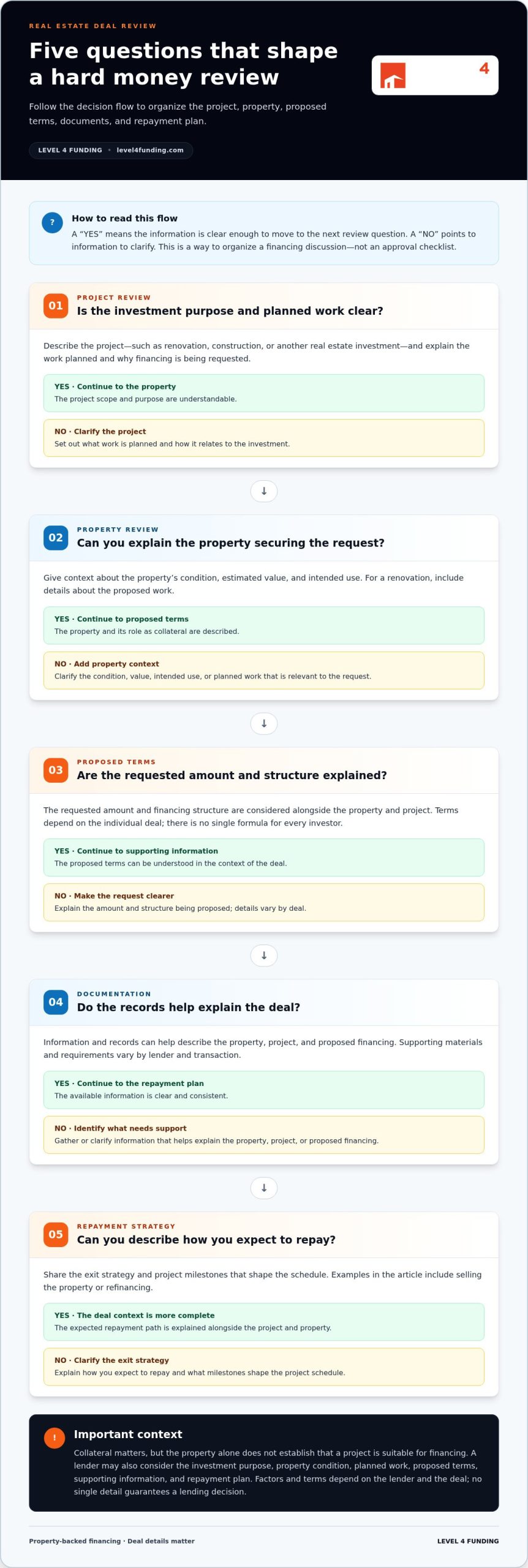
Think of the review as a series of connected questions. What is the investor planning to do? What property secures the request? How do the proposed terms and supporting information fit the project?
- Project review: The lender considers the investment purpose, such as renovation, construction, or another real estate project. A clear scope explains what work is planned and why financing is being requested.
- Property review: The property’s condition, value, and intended use help inform the collateral assessment. For a renovation, details about the proposed work provide useful context.
- Proposed terms: The requested amount and structure are considered alongside the property and project. Terms depend on the individual deal, rather than a single formula that fits every investor.
- Documentation: Information and records help explain the property, project, and proposed financing. The required materials can vary by lender and transaction.
How does property collateral factor into the review?
Collateral is the property that secures the financing. If the borrower does not meet the loan obligations, the lender’s rights relating to that property are governed by the loan documents and applicable law. The property’s condition, estimated value, and intended use can all affect the review. Assessing collateral, however, is not a promise of approval or funding.
A property may be central to a financing request, while the project plan and proposed terms still shape the overall assessment. Investors can explore hard money loan requirements to learn more about the details that may come into play.
What does the investor bring to the deal?
A clear project summary makes a proposal easier to assess. Describe the work, the property’s intended use, and the milestones that shape the schedule. Include an exit strategy, such as selling the property or refinancing, so the lender can understand how you expect to repay the financing.
There is no universal checklist for every request. Requirements and supporting documents vary by lender and deal, so do not assume that one borrower’s experience, credit profile, or equity position defines the process for all investors. Keep project information clear and consistent to give the financing discussion a solid foundation.
For Arizona investors exploring a real estate project, Level 4 Funding’s Arizona real estate financing includes options for fix-and-flip, construction, and commercial property investments.
How is a hard money lender different from a bank or private lender?
The difference comes down to the type of financing and what the lender typically emphasizes. A hard money lender is a private real estate lender offering property-secured financing. A bank is a financial institution that may offer conventional loans, while “private lender” is a broader term for a non-bank source of financing. These categories can overlap, so compare the loan structure and deal review, not just the name.
| Lender type | Typical focus | Investor context |
|---|---|---|
| Bank | May weigh borrower finances, credit, income, and the property under its lending criteria. | May suit investors whose deal fits the institution’s loan options and process. |
| Hard money lender | Property-centered real estate financing, with the asset and project considered in the review. | Can be considered for investment projects where the property and plan are central to the request. |
| Private lender | A broad category of non-bank capital sources; focus and loan structure vary. | May include hard money lenders, as well as other private financing arrangements. |
Hard money lender vs. bank: what is the practical distinction?
A conventional bank loan often involves borrower-focused underwriting, which may examine income, credit, and other financial details alongside the property. Hard money financing tends to put more emphasis on the real estate asset and the project. That distinction can matter when an investor is considering a property that needs substantial work or a deal with a tight timeline.
Speed and flexibility are possible differences, not promises. Bank processes and timelines vary by institution, loan type, and borrower. Hard money terms and timing also depend on the lender and transaction. Compare the proposed repayment terms, costs, and project fit rather than assuming one financing path is always faster or better. This hard money loan versus bank loan comparison can help clarify the trade-offs.
Is a hard money lender the same as a private lender?
Not exactly. “Private lender” describes a broad source or category of financing outside traditional banks. “Hard money lender” usually refers to a private lender providing real estate loans secured by property. A hard money lender may therefore be a private lender, but private financing can take forms beyond hard money loans.
For example, an investor might use “private lender” to describe a non-bank source, then specify “hard money lender” when discussing short-term, property-backed real estate financing. The labels help orient the conversation, but they do not establish the exact terms, review criteria, or timeline. A closer look at the private lender versus hard money lender comparison can help distinguish the categories.
If you’re evaluating property-backed financing for an Arizona investment, Level 4 Funding works with real estate investors on hard money and related project financing. Explore Level 4 Funding’s real estate financing as you consider how a lender’s approach may fit your deal.
When might a hard money lender fit an investor’s project?
A hard money loan may be worth considering when its property-backed structure, project timeline, and repayment plan align with an investment. The label alone does not make financing a good fit. Start with the deal: what are you trying to accomplish, what does the property need, and how will you repay the loan? Terms and qualifications vary by lender and project, so suitability depends on the full picture.
Which investment projects may use hard money financing?
Investors may explore this type of financing for fix-and-flips, construction, and commercial property investments. Other financing needs can include purchasing or improving a property for short-term rental use, or refinancing an existing property to access equity. These are examples of project categories, not a promise that every property or plan will qualify.
Consider the fit from several angles:
- Project: Is the plan a defined investment activity, with a clear scope and purpose for the financing?
- Property: Does the property serve as collateral, and how might its condition and intended use affect the plan?
- Timeline: Does the expected schedule leave enough room to complete the work or investment plan and reach repayment?
- Exit: Is there a realistic path to repay, such as selling or refinancing, and what could disrupt that plan?
For example, an investor planning a renovation and resale should consider whether the work schedule leaves adequate time for resale and repayment. A construction project calls for different assumptions, including how planned work and project milestones affect the repayment path. The point is not to predict the outcome, but to test whether the financing structure and project plan make sense together.
What should an investor understand before proceeding?
Read the proposed loan terms closely. Understand the repayment timing, which property secures the financing, and what the loan documents say about a project that runs behind schedule. Review the assumptions behind projected costs, completion dates, resale or rental plans, and any expected refinancing. Do not assess an opportunity on projected returns alone.
Consider a less favorable scenario. What if repairs take longer than planned, the property sells later than expected, or refinancing is unavailable on the anticipated schedule? Think through whether you could still meet the loan obligations. A sound plan accounts for setbacks, not only the best-case outcome. A lender’s review of the project and collateral does not remove the borrower’s responsibility to understand the agreement.
If you’re trying to define hard money lender in terms of project fit, focus on alignment: the investment purpose, property, timeline, and repayment strategy need to work together. No category guarantees approval or makes a particular loan right for every investor. Arizona-specific legal or lending-rule questions should be verified using current authoritative guidance, rather than assumed from general descriptions.
For Arizona investors weighing financing for a fix-and-flip, construction, or commercial property project, explore real estate financing options with Level 4 Funding.
How Level 4 Funding serves Arizona real estate investors
Level 4 Funding is a private real estate lender serving investors in Arizona, including Phoenix, Scottsdale, Tucson, Glendale, Sedona, Flagstaff, Tempe, Mesa, and Buckeye. For investors considering a property in these communities, the financing conversation starts with the project: the type of property, what the investment plan requires, and the purpose of the financing. The phrase “define hard money lender” becomes more useful when you connect the lender’s role to specific real estate projects and financing categories.
What kinds of real estate financing does Level 4 Funding offer?
Different projects call for different financing approaches. Level 4 Funding offers several categories of real estate financing for investors:
- Fix-and-flip loans: For investors pursuing a property acquisition and renovation, with a plan to improve and resell the property.
- Construction loans: For real estate projects involving construction, with a scope distinct from renovating an existing property for resale.
- Commercial property loans: For investors financing commercial real estate, where the asset and investment purpose differ from a residential renovation.
- Airbnb loans: For investors whose plans involve short-term rental property.
- Cash-out refinance: For investors looking to refinance a property and access equity.
These categories serve different investment purposes. A fix-and-flip plan centers on acquisition and renovation; a construction project is built around planned development work. Commercial property financing focuses on an investment asset used for commercial purposes. Airbnb financing and cash-out refinance address other investor objectives. The category is a starting point, not a claim that every property or plan qualifies. Project details and financing terms still matter.
What is a practical next step for an Arizona investor?
Get specific before comparing financing options. Identify the property, define the project scope, and state the financing objective. Are you planning a renovation and resale, construction, a commercial investment, a short-term rental, or a refinance? Then map the timeline and intended repayment path. A clear outline helps connect the project with a relevant financing category and makes the obligations easier to assess.
If you want to revisit the basics first, this guide to what a hard money loan is explains the property-backed financing concept in more detail. It can help you put the lender’s role, the loan, and your investment plan into context before deciding what to explore next.
Once your project and objective are clear, explore Level 4 Funding’s financing options for Arizona real estate investors. Keep the focus on fit: the property, planned work, and repayment strategy should make sense together.
Turn your financing research into a clear project plan
Now that you can define hard money lender, put your investment plan on paper. Clarify what you want the financing to accomplish, how the project will unfold, and what could affect repayment. Review the proposed loan obligations against both your expected outcome and a less favorable scenario. A strong decision is not just about getting a deal moving. It also means understanding the responsibilities attached to the financing and deciding whether they fit your strategy.
For Phoenix-area investors, the right path depends on the property and project, not on a lender label alone. Take time to understand the terms and test your assumptions before committing. If property-backed financing may fit your investment goals, explore real estate financing with Level 4 Funding and consider how your project aligns with the available options.
A well-planned deal starts with a clear view of both the opportunity and the obligations. Build that clarity first, then take your next step with confidence.
Frequently Asked Questions
Is a hard money lender the same as a mortgage lender?
Not exactly. “Mortgage lender” is a broad term for a lender that provides financing secured by real estate, while “hard money lender” describes a private real estate financing approach. A hard money loan may be secured by a mortgage or another real estate security instrument, depending on the transaction. For an investor comparing options in Phoenix, focus on who provides the funds, what secures the loan, and what the agreement requires.
Can a hard money lender finance an investment property?
Yes, hard money financing can be used for investment property, though a particular property and project are not automatically eligible. For example, an investor considering a rental in Tempe or a renovation in Mesa should understand how the proposed use fits the financing terms. Review whether the loan purpose, property, and repayment plan align before treating financing as part of the deal strategy.
Does a hard money lender only look at the property?
No. The property is important, but a lender may also consider the investment plan and the borrower’s ability to carry it out. For instance, a proposal for a commercial property in Scottsdale may be easier to assess when the intended use, project costs, timeline, and repayment path are clearly explained. The review can differ by lender and transaction, so do not assume collateral alone decides the outcome.
How much does a hard money lender require as a down payment?
There is no single down payment amount that applies to every hard money loan. The required contribution can depend on the property, requested financing, project scope, and lender’s terms. Before committing to a purchase in Tucson or Glendale, calculate how much capital you can put into the deal and what funds you’ll need for the project itself. Evaluate the complete written terms, not just the down payment.
What happens if a borrower cannot repay a hard money loan?
If repayment does not happen as agreed, the borrower may face default consequences described in the loan documents, which can include action involving the property used as collateral. The exact process and potential consequences depend on the agreement and applicable law. Review repayment deadlines and communicate promptly with the lender if the project is at risk. For a specific dispute, seek qualified legal advice.
Are hard money lenders regulated in Arizona?
Arizona requirements can depend on the lender, borrower, property use, and transaction structure, so a blanket yes-or-no answer can be misleading. An investor considering a deal in Flagstaff or Sedona should verify current requirements using authoritative Arizona resources, such as the Arizona Department of Insurance and Financial Institutions, and consult a qualified professional for transaction-specific guidance. Do not treat general descriptions of hard money lending as legal advice.
Can a new real estate investor work with a hard money lender?
A new investor may be able to seek financing, but experience is not the only consideration and approval is not assured. A first project in Buckeye, for example, should have a defined scope, a realistic schedule, and a clear repayment plan. Be prepared to explain the property and the assumptions behind your numbers. Compare the obligations with your available resources, and avoid relying on optimistic resale or rental projections alone.

About the author
Matt has a bachelor's degree in political science from Northern Arizona University and works at Level 4 Funding, a private lending company that offers hard money and rental home loans to real estate investors in 35 states.
With Matt's leadership, the firm has financed almost $300 million in loans for investment properties. He often helps real estate investors with rental property purchases, foreclosures, refinancing, and fix-and-flip projects. Matt has extensive experience in fix-and-flip, buy-and-hold, rental properties, and real estate sales. He has lived in Arizona for 43 years and is married with three children. Matt is licensed as a mortgage broker and loan originator in Arizona, with NMLS 2062278 and NMLS 1118493.
Equal Housing Opportunity. This is not a Good Faith Estimate, and it is not a Guarantee to lend; it should not be considered as such. Costs, rates, estimates, and terms can only be determined after a full application is completed. To the extent this message includes any tax or legal advice, this message is not intended or written by the sender to be used, and cannot be used, for legal or tax purposes or advice. This is an advertisement. Copyright © 2026. All rights reserved.