


Fix and Flip Budget Template for Phoenix Properties: Build a Deal Budget That Holds Up
October 1, 2026
Phoenix Private Funding: 2026 Real Estate Guide
October 3, 2026
What does hard money lender mean when a Phoenix investment deal can’t wait for a bank’s approval process? The answer starts with the property, not just your credit file. A hard money lender provides short-term, property-backed financing, evaluating the real estate and the plan for repaying the loan. The property serves as collateral, so the deal may follow a different timeline, but the risks deserve a clear-eyed review.
If bank qualification feels rigid or the clock is working against your purchase, it’s reasonable to want clarity before putting an investment property on the line. This guide explains what hard money lenders do, how asset-based financing differs from bank lending, and which deal details typically matter, including property value, project costs, and your exit strategy.
You’ll also see why repayment planning matters as much as securing the loan, and what to consider before pursuing funding in Arizona. Level 4 Funding provides private real estate financing, with a primary focus on fix-and-flip loans, making it a relevant local resource as you evaluate your next project in Phoenix, Scottsdale, Tucson, Glendale, Sedona, Flagstaff, Tempe, Mesa, or Buckeye.
Key Takeaways
- Understand what does hard money lender mean by separating the lender, loan, borrower, and property collateral.
- See how a lender may assess the property, project plan, value assumptions, requested financing, and repayment strategy.
- Learn how hard money, bank, and private lending can differ, without assuming every lender offers the same speed or terms.
- Use a practical checklist to review written obligations, collateral, timing, and risks such as renovation delays or refinancing uncertainty.
- Prepare key details about your Arizona property, project scope, budget, value assumptions, and exit plan before discussing financing.
What Does a Hard Money Lender Mean in Real Estate Investing?
A hard money lender provides property-secured capital for real estate deals. Put simply, the lender supplies funds, the borrower agrees to repay them, the loan sets the obligations, and the property secures repayment. That distinction matters: “lender” means the party providing the money, not the loan itself or the real estate pledged as collateral.
So, what does hard money lender mean when you’re evaluating an investment? It generally refers to a private individual or lending company that finances a real estate project using an asset-based approach. The property and the deal can carry significant weight in underwriting. That doesn’t mean credit, experience, or other borrower details never matter. The factors considered depend on the lender and the specific transaction. For a neutral overview of the financing structure, see Hard money loan.
Who provides the money and what secures the loan?
The lender may be a private individual or a lending company. The borrower receives funds under agreed loan terms and is responsible for repayment. The real estate serves as collateral: it’s pledged under the loan agreement to secure the obligation. If the borrower defaults, the lender’s rights and the consequences depend on the contract and applicable law. The property isn’t simply “the payment”; it’s security tied to the loan.
Why do real estate investors use hard money lenders?
Investors may consider this financing for acquisitions, renovations, construction, or other investment-property projects. A project’s structure, property, or timing may call for financing that differs from a conventional bank loan. Hard money isn’t automatically the right fit, though. The repayment obligation remains, and the borrower needs a workable plan for meeting it.
That’s why it helps to understand the full transaction: the funds provided, the property securing them, and the borrower’s plan to repay. Level 4 Funding provides private real estate financing for investors, including fix-and-flip loans. For a broader explanation of the financing itself, continue with the What Is a Hard Money Loan? pillar article.
How Does a Hard Money Lender Evaluate a Real Estate Deal?
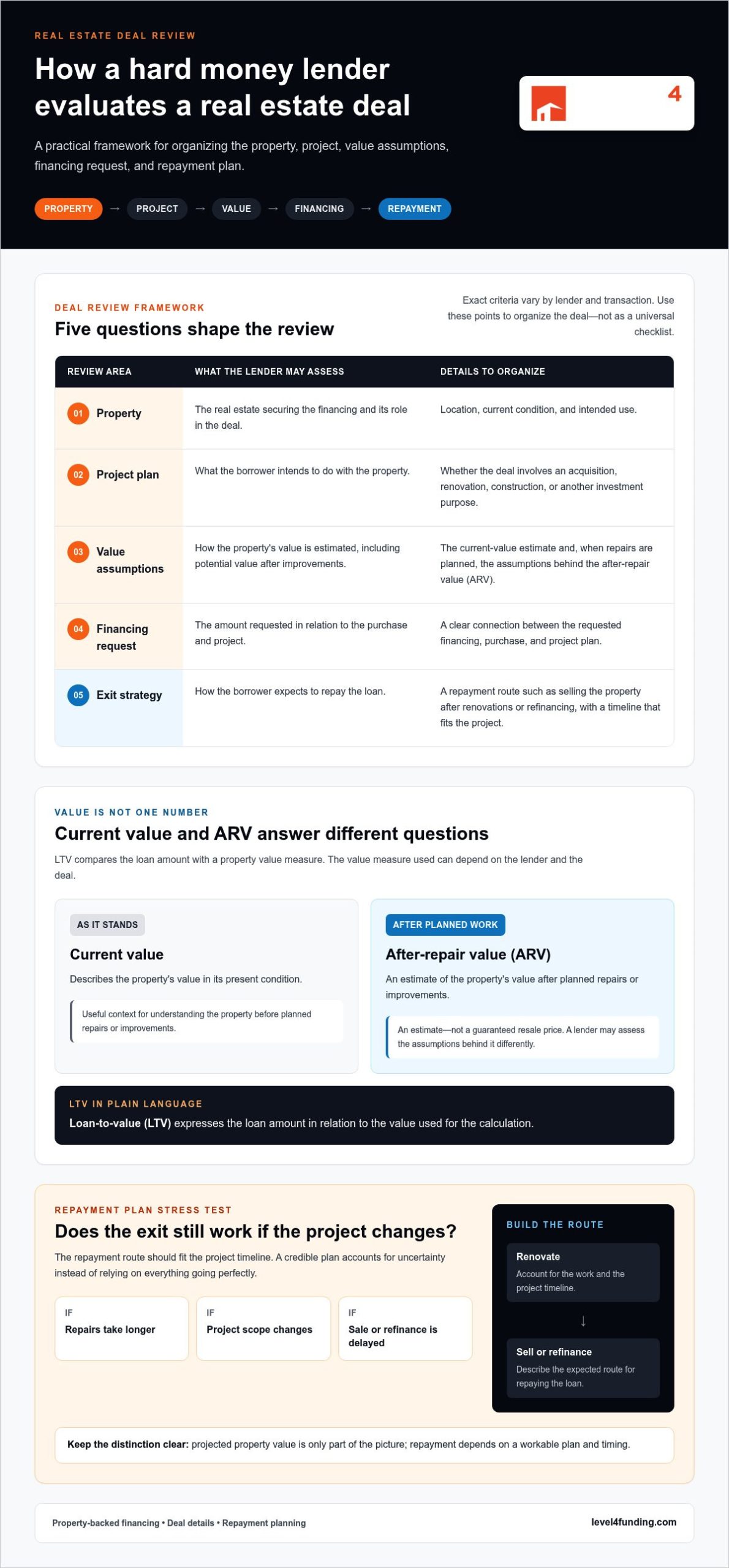
A lender’s review often follows the logic of the project: What property is involved? What will the borrower do with it? How is its value estimated? How much financing is requested? And how will the loan be repaid? The exact criteria vary by lender, so use this as a framework for organizing a deal, not as a universal checklist.
- Property: Identify the location, condition, and intended use.
- Purchase or project plan: Explain whether the deal involves an acquisition, renovation, construction, or another investment purpose.
- Value assumptions: Show how you estimate the property’s current value and, if improvements are planned, its potential value afterward.
- Requested financing: Connect the amount sought to the purchase and project plan.
- Exit strategy: Describe how you expect to repay the loan, such as through a sale or refinance.
How do collateral, LTV, and ARV relate?
The property is collateral when it’s pledged under the loan agreement to secure repayment. Loan-to-value, or LTV, compares the loan amount with a property value measure. LTV is the loan amount expressed in relation to the value used for the calculation. The value measure used can depend on the lender and deal.
Current value and after-repair value (ARV) are not the same. Current value describes the property as it stands; ARV is an estimate of its value after planned repairs or improvements. For example, a renovation plan may support an ARV estimate, but that estimate is not a guaranteed resale price. A lender may assess the assumptions behind it differently. For more on this concept, see the existing ARV Hard Money Loan article.
Why does the exit plan matter to the lender?
A property’s projected value is only part of the picture. The repayment route needs to fit the project timeline. An investor planning to sell after renovations should account for the work, marketing, and sale period when mapping out repayment. A refinance or another documented route may also form part of the plan, depending on the deal.
Pressure-test the assumptions. What if repairs take longer, the scope changes, or the expected sale or refinance is delayed? A credible exit strategy accounts for uncertainty instead of relying on everything going perfectly. For a Phoenix-area investment project, explore real estate project financing as you organize the property details, budget, value assumptions, and repayment plan.
Hard Money Lender vs. Bank or Private Lender: What Is the Difference?
These labels can blur together. A “private lender” describes a broad source of nonbank capital, while “hard money lender” commonly refers to a lender providing asset-backed real estate financing. Some hard money lenders are private lenders, so the names alone won’t tell you how a deal will be reviewed or what the loan will require.
| Typical lender | Underwriting emphasis | Potential use case | Borrower trade-offs |
|---|---|---|---|
| Traditional bank | Borrower documentation, income and credit profile, property, and fit with the bank’s loan products | A purchase or project that fits the bank’s requirements and process | May involve extensive documentation and a process that doesn’t suit every investment timeline; terms and qualification vary |
| Hard money lender | Often emphasizes the real estate collateral and the investment deal, while other borrower and project factors may also matter | An acquisition, renovation, or other real estate investment with a defined repayment plan | May involve higher costs than some bank financing and puts the pledged property at risk under the loan agreement |
| Private lender | Depends on the capital source and loan structure | Varies by lender and transaction | The label alone doesn’t establish cost, qualification, timing, or repayment terms |
Hard money lender versus traditional bank
A bank typically reviews whether the borrower and transaction fit its documentation standards and available products. Hard money financing is generally built around investment real estate, with the property and deal playing a central role in the review. Neither category guarantees approval or a particular timeline. A bank may suit a borrower whose project fits its requirements; a hard money loan may fit a different investment structure, but costs and collateral exposure deserve careful review.
Hard money lender versus private lender
“Private lender” can refer broadly to a nonbank individual or company providing capital. “Hard money lender” more specifically describes a common form of asset-backed real estate lending. Since the labels aren’t universally standardized, focus on the actual underwriting approach and written loan terms: what property secures the debt, what obligations apply, and how repayment is expected to work.
To compare the financing categories in more detail, continue with Hard Money Loan vs. Bank Loan and the article comparing hard money lenders. The key question behind what does hard money lender mean isn’t just the label. It’s whether the lender’s approach and loan terms make sense for your specific investment deal.
What Should You Check Before Working With a Hard Money Lender?
Property-backed financing still carries real risk. The asset may shape the lender’s review, but it doesn’t make repayment automatic or protect your investment if the project goes sideways. Before committing, read the agreement as closely as you review the property. Check the full obligation, collateral terms, timeline, and plan for paying off the loan.
Which loan terms and risks deserve close attention?
Get the complete terms in writing. Look beyond the interest rate and review how payments work, when the balance is due, and what happens if you can’t meet an obligation. Specific terms vary by lender and transaction, so don’t assume one deal’s structure applies to another.
- Total financing obligations: Review interest, origination points, fees, and any other charges described in the agreement. Understand when each is due.
- Payment and maturity: Know the payment structure and the date the loan must be repaid.
- Collateral and default terms: Identify the property securing the debt and understand the agreement’s default provisions and potential consequences.
- Extensions: Check whether an extension is addressed, what conditions apply, and whether it changes your obligations.
- Timing: Compare the loan timeline with the purchase, project schedule, and expected repayment date.
Make sure you understand the agreement before signing. Qualified legal or financial advice can help you assess terms and risks in light of your circumstances. The Hard Money Loan Requirements and Hard Money Loan Rates guides can also help you prepare questions and understand factors that may affect a financing structure.
Can your Arizona project support a clear repayment plan?
Put your assumptions under pressure. For a Phoenix-area renovation, consider what happens if repairs uncover unexpected work, the project takes longer than planned, or resale value differs from your estimate. If your exit plan depends on refinancing, consider what could happen if that option isn’t available on your expected schedule. These are planning scenarios, not predictions about local market performance.
Check that the repair scope, budget, projected value, and timeline all support the same repayment strategy. Build in room for setbacks rather than relying on a perfect project. Arizona legal or licensing questions can depend on the transaction and should be checked against current authoritative sources; don’t rely on a general article to determine how a rule applies to your deal.
Whether your project is in Phoenix, Scottsdale, Tucson, Glendale, Sedona, Flagstaff, Tempe, Mesa, or Buckeye, organize the details of your fix-and-flip or other Arizona investment and explore investment-property financing with Level 4 Funding.
How Can Arizona Investors Take the Next Step With a Hard Money Lender?
A productive financing discussion starts with a clear project picture, not a perfect pitch deck. If you’re still asking what does hard money lender mean for your Phoenix investment, focus on the information that connects the property, proposed work, funding request, and repayment route. Keep estimates realistic and identify assumptions that still need review.
What information helps start a productive deal conversation?
Organize the basics before discussing financing. A concise project summary helps keep the conversation focused and makes gaps in the plan easier to spot. Include:
- Property: Location, current condition, and intended use.
- Purchase plan: Whether you own the property or are evaluating an acquisition.
- Project scope: Planned repairs, renovations, or construction work.
- Value assumptions: Your estimate of current value and, where relevant, value after improvements.
- Budget and timeline: Expected purchase and project expenses, plus the schedule you’re working toward.
- Exit strategy: Your intended repayment route, such as sale or refinance, and the assumptions behind it.
Label projected values, costs, and dates as your estimates. They’re planning inputs, not final determinations. Flag what could change, such as repair scope or completion timing, so the deal can be considered with its uncertainties in view.
How does Level 4 Funding fit an investor’s financing search?
Level 4 Funding is a private real estate lender focused primarily on fix-and-flip financing. Its asset-based approach centers on real estate projects. Level 4 Funding also provides construction and commercial-property loans for investors evaluating those types of projects. A useful starting point is a clear summary of the property, planned work, budget, value assumptions, and repayment strategy.
Use your project summary to move from a general financing question to a specific discussion about the investment. Review the proposed obligations and make sure the structure aligns with the project’s risks and exit plan. Clear preparation won’t guarantee approval or funding, but it can help you assess whether the financing approach fits the deal.
Explore Level 4 Funding’s financing solutions for your real estate investment project.
Turn Your Phoenix Deal Into a Clear Financing Plan
Now you know what does hard money lender mean: a real estate financing partner provides capital secured by property, while the borrower remains responsible for repayment under the loan agreement. The property and project plan can shape the lender’s review, but the details vary. Compare written terms, understand the collateral risk, and build an exit strategy that accounts for delays or changing assumptions.
Before discussing an investment in Phoenix, Scottsdale, Tucson, Glendale, Sedona, Flagstaff, Tempe, Mesa, or Buckeye, organize the property details, planned work, budget, value estimates, timeline, and repayment route. A clearer plan helps you assess whether the financing structure fits the deal, without mistaking projected outcomes for guarantees.
Level 4 Funding provides private real estate financing, with a primary focus on fix-and-flip loans and additional financing for construction and commercial-property projects. Explore Level 4 Funding’s real estate financing solutions and take a practical next step toward evaluating your investment. Build the plan carefully, then move forward with confidence.
Frequently Asked Questions
What does a hard money lender mean?
A hard money lender is a private or nonbank source of financing that commonly lends against real estate collateral. In a transaction, the lender provides funds under an agreement, and the borrower remains responsible for repayment. The property and investment deal may carry significant weight in underwriting. The term describes a lending model, not automatic approval or standardized loan terms.
Is a hard money lender the same as a private lender?
The terms can overlap, but they aren’t always used identically. “Private lender” is a broad label for a nonbank source of capital, while “hard money lender” commonly refers to a lender making real estate loans that rely substantially on property collateral. Since terminology varies, focus on the actual underwriting approach, collateral, repayment obligations, and written agreement. The label alone doesn’t tell you the full terms or risks.
How does a hard money lender decide whether to finance a property?
A lender may review the property, its value, the requested loan amount, the project plan, and the borrower’s repayment strategy. Asset-based underwriting emphasizes the real estate, but other factors may matter too. Each lender sets its own criteria. For an Arizona investment, organize your purchase and renovation assumptions, budget, estimated values, timeline, and exit plan. Review proposed terms carefully before deciding whether the financing fits your deal.
Can a hard money lender finance a fix-and-flip project?
Yes, hard money financing is commonly used for investment-property purchases and renovations, including fix-and-flip projects. The lender’s criteria, eligible property, renovation scope, and repayment structure vary. Level 4 Funding specializes in private real estate financing, with fix-and-flip loans as its primary focus. It serves investors in Phoenix, Scottsdale, Tucson, Glendale, Sedona, Flagstaff, Tempe, Mesa, and Buckeye. Prepare a project budget, timeline, value assumptions, and exit plan.
Are hard money lenders regulated in Arizona?
Requirements can depend on the lender, transaction, and applicable state or federal rules, so don’t assume one general rule applies to every hard money loan. Arizona investors should check current requirements through authoritative state resources and qualified legal counsel before relying on a licensing or regulatory claim. A general article can’t determine how a rule applies to your specific deal. Verify relevant requirements before signing or proceeding with financing.
How quickly can a hard money lender fund a real estate deal?
Funding timing depends on the lender’s review, property and transaction details, required documentation, title work, and other closing steps. Hard money financing is often associated with a deal-focused process, but no timeline is universal or guaranteed. For a time-sensitive Phoenix purchase, organize project details early and compare the proposed schedule with your purchase obligations and repayment plan. Don’t build your investment strategy around an assumed funding date.
What happens if a borrower cannot repay a hard money loan?
The loan agreement sets the borrower’s obligations and the consequences of missed or late payments. Because real estate commonly secures the loan, default may put the collateral at risk, including possible foreclosure, subject to applicable law and process. Before signing, understand the maturity date, default provisions, and any stated remedies. If the repayment plan or agreement is unclear, seek qualified legal or financial advice before committing to the loan.

About the author
Matt has a bachelor's degree in political science from Northern Arizona University and works at Level 4 Funding, a private lending company that offers hard money and rental home loans to real estate investors in 35 states.
With Matt's leadership, the firm has financed almost $300 million in loans for investment properties. He often helps real estate investors with rental property purchases, foreclosures, refinancing, and fix-and-flip projects. Matt has extensive experience in fix-and-flip, buy-and-hold, rental properties, and real estate sales. He has lived in Arizona for 43 years and is married with three children. Matt is licensed as a mortgage broker and loan originator in Arizona, with NMLS 2062278 and NMLS 1118493.
Equal Housing Opportunity. This is not a Good Faith Estimate, and it is not a Guarantee to lend; it should not be considered as such. Costs, rates, estimates, and terms can only be determined after a full application is completed. To the extent this message includes any tax or legal advice, this message is not intended or written by the sender to be used, and cannot be used, for legal or tax purposes or advice. This is an advertisement. Copyright © 2026. All rights reserved.