


Owner-Occupied Hard Money Loans: What They Are, Who Qualifies, and Where to Find Them
September 27, 2026
7 Costly Mistakes Real Estate Investors Make When Choosing a Fix-and-Flip Lender
September 28, 2026
What if the hardest part of becoming a hard money lender isn’t finding borrowers, but protecting your capital when a deal goes sideways? Learning how to become a hard money lender takes more than money to deploy. You need a clear lending structure, disciplined underwriting, and a plan for managing default risk.
If you’re weighing how much capital to commit, how to assess collateral, or what rules may apply in Arizona, you’re asking the right questions. Private real estate lending can look straightforward from the outside, but details matter. Loan structure, borrower type, and property use can all affect your legal obligations.
This guide compares ways to enter private lending and offers a practical checklist for capital planning, deal screening, and day-to-day risk controls. It also identifies Arizona licensing and securities questions to discuss with qualified counsel before making loans. The goal is to build a responsible operation based on sound decisions, not guesswork.
Key Takeaways
- Compare lending your own capital, operating a lending company, and investing through a professionally structured fund before choosing your path.
- Separate money for loans from funds needed for operating costs, legal expenses, servicing, and reserves.
- Screen each deal by collateral value, borrower capacity, project scope, exit strategy, and documentation. No single loan-to-value or after-repair-value ratio makes every deal safe.
- Learning how to become a hard money lender in Arizona means verifying which licensing and compliance requirements apply to your specific borrower, loan purpose, and business structure.
- Start with professional review, written lending criteria, and tested processes. Keep early deal risk within defined limits before considering growth.
What Does It Mean to Become a Hard Money Lender?
Hard money lending is short-term financing secured by real estate. The property plays a central role in the credit decision, but the borrower’s experience, project plan, and ability to repay matter too. Loan structures, terms, and the lender’s role vary by transaction. For a neutral overview of the term, see Hard money loan.
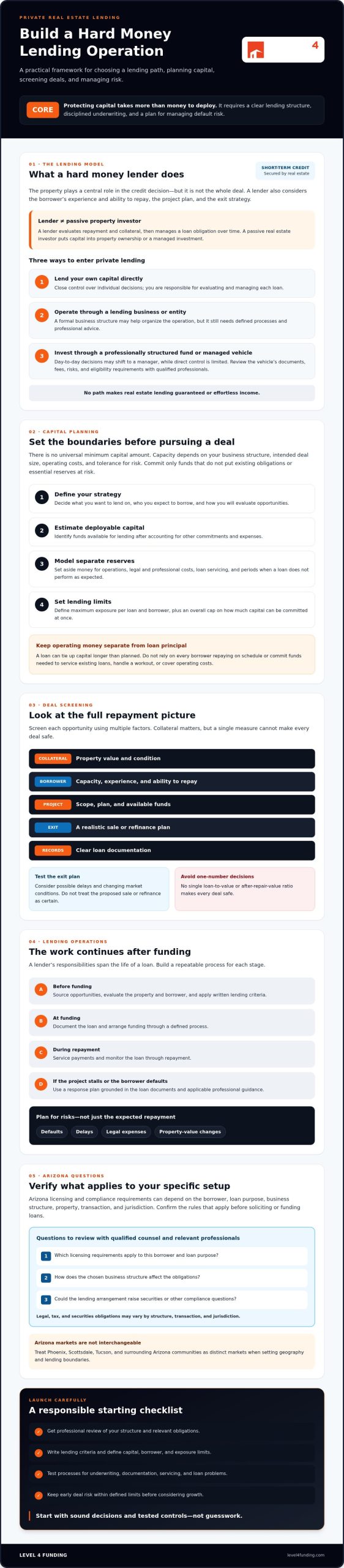
Before deciding how to become a hard money lender, distinguish among three paths: lending your own capital directly, operating through a lending business or entity, and investing through a professionally structured fund or other managed vehicle. Each involves a different balance of control, workload, capital exposure, and professional support. None makes real estate lending guaranteed or effortless income. Defaults, delays, legal expenses, and property-value changes can all affect the result.
Which private lending model fits your starting point?
Direct lending gives you close control over individual decisions, but you’re also responsible for evaluating and managing each loan. Lending through an entity may provide a formal business structure, but it still requires defined operating processes and professional advice. Participating in a managed vehicle may shift day-to-day decisions to a manager, while limiting your direct control and subjecting you to the vehicle’s documents, fees, risks, and eligibility requirements. Review those details with qualified professionals before committing capital to any pooled investment.
What hard money lenders do beyond supplying capital
A lender’s work starts before funding. It may include sourcing opportunities, evaluating the property and borrower, setting written criteria, documenting the loan, arranging funding, servicing payments, and monitoring the loan through repayment. If a project stalls or the borrower defaults, the lender needs a response plan grounded in the loan documents and applicable professional guidance.
Collateral matters, but it isn’t the whole deal. Consider the property’s condition and value alongside the borrower’s track record, project scope, available funds, and realistic exit strategy. For example, test a proposed sale or refinance against possible delays and changing market conditions rather than treating it as a certainty.
A hard money lender provides and manages real estate-backed credit; a passive real estate investor puts capital into property ownership or a managed investment. The distinction matters: lenders assess repayment and collateral, then manage an obligation over time. Legal, tax, and securities obligations can depend on the lending structure, borrower, property, transaction, and jurisdiction. Confirm what applies with qualified counsel and other relevant professionals before soliciting or funding loans.
How to Plan Capital and Build a Lending Business
Capital planning starts with a boundary, not a target loan amount. There’s no universal minimum that fits every lender. Your capacity depends on your business structure, intended deal size, operating costs, and tolerance for risk. To make a grounded plan for how to become a hard money lender, identify what you can commit without putting existing obligations or essential reserves at risk.
Use this sequence before pursuing a deal:
- Define your strategy. Decide what you want to lend on, who you expect to borrow, and how you’ll evaluate opportunities.
- Estimate deployable capital. Identify funds available for lending after accounting for other commitments and expenses.
- Model reserves. Set aside separate amounts for operations, legal and professional costs, loan servicing, and periods when a loan doesn’t perform as expected.
- Set lending limits. Establish a maximum exposure per loan and borrower, along with an overall cap on how much capital can be committed at once.
Keep loan principal separate from the money needed to run the operation. A loan can tie up capital longer than planned. If funds needed to service existing loans, address a workout, or cover operating costs are committed to another deal, one setback can strain the business. Don’t build your plan on every borrower repaying on schedule.
Choose a lending focus and define your boundaries
A narrow focus, such as a specific property type or loan purpose, can make it easier to apply consistent evaluation criteria. A broader portfolio may create more opportunities, but it also calls for wider market knowledge and more complex processes. Treat Phoenix, Scottsdale, Tucson, and surrounding Arizona communities as distinct markets, not interchangeable locations. Set clear boundaries for geography, property type, loan purpose, and concentration before reviewing deals.
Build a realistic capital and reserve plan
Map cash needs across the full loan cycle, from origination and ongoing servicing to a possible workout if payments stop or repayment is delayed. Stress-test your plan against a late sale or refinance, missed payments, and a decline in property value. Ask whether you could manage those outcomes without relying on the next loan repayment to cover current commitments.
If you’re considering outside funding or a pooled arrangement, pause before accepting or soliciting capital. Have qualified counsel review the structure, documents, and legal and contractual implications first. For industry education, the National Private Lenders Association is one potential resource. To see how an established Arizona lender approaches investor financing, explore Arizona real estate investor loans. Level 4 Funding lends to real estate investors; it doesn’t provide a lender-startup program.
How to Underwrite Hard Money Loans and Protect Your Capital
Strong underwriting isn’t a single ratio or a quick look at the property. It’s a disciplined review of the collateral, borrower, project, repayment plan, and documents as one connected deal. If you’re deciding how to become a hard money lender, create a repeatable screening process before reviewing your first application.
Use this framework to identify gaps before committing capital:
| Area | What to evaluate | Questions to ask |
|---|---|---|
| Property value | Condition, comparable sales, title, liens, and the lender’s position | Does an independent valuation support the price and resale assumptions? |
| Borrower capacity | Relevant experience, liquidity, execution ability, and contingency planning | Can the borrower manage the project if costs rise or the timeline slips? |
| Project scope | Work plan, budget, permits or approvals to verify, and contractor assumptions | Are costs and milestones documented well enough to assess feasibility? |
| Exit strategy | Proposed sale, refinance, or other repayment source | Does repayment still appear workable if the market shifts or the project is delayed? |
| Documentation | Valuation, title review, insurance, borrower records, and loan documents | Are key assumptions supported, recorded, and reviewed by appropriate professionals? |
Evaluate collateral, borrower, and exit plan together
Loan-to-value (LTV) compares the loan amount with the property’s current value. After-repair value (ARV) estimates what the property may be worth after planned work. Both help frame exposure, but neither is a safety stamp. A ratio that looks conservative can still leave you exposed if the valuation is weak, the title reveals an issue, renovation costs are underestimated, or the exit depends on optimistic resale assumptions. Use an independent valuation, title review, insurance checks, and scrutiny of project costs to reduce blind spots.
Assess the borrower alongside the asset. Review relevant experience, available liquidity, ability to complete the work, and a backup plan if costs or timing change. Then test the proposed sale or refinance against delays and market shifts. Collateral may support recovery, but it can’t replace a credible repayment plan and a tested exit strategy. To understand how does a hard money lender work through the full loan lifecycle — from property review and draws to repayment and payoff — reviewing a deal-level walkthrough can sharpen your evaluation criteria.
Set documentation, servicing, and default procedures
Before funding, have qualified professionals prepare and review promissory notes, security instruments, and applicable disclosures. Set up payment tracking, borrower communication, record retention, and escalation steps before the first loan, not after a missed payment. Assign responsibility for each task and define how concerns will be logged and reviewed.
If a loan defaults, don’t assume recovery follows the same path every time. Foreclosure and other recovery procedures depend on the facts, loan documents, and applicable law. Get qualified legal guidance before taking action, and make sure your servicing process provides a clear route for escalating problems.
Arizona Licensing and Compliance: What New Lenders Must Verify
Compliance isn’t a box to check after your first deal. Before you advertise, solicit capital, negotiate terms, or fund a loan, get advice on the specific activity you plan to conduct. The rules can vary with the loan’s purpose, borrower type, property, business model, and transaction structure. A business-purpose loan to an investor and borrowing for personal or household use may raise different questions, but don’t assume a label creates an exemption.
Use this section as an issue-spotting checklist, not legal or tax advice. Have qualified Arizona counsel review your plan and confirm requirements with the relevant regulator before you begin lending.
Which Arizona and federal questions belong on the checklist?
Give counsel a clear description of who will lend, who will solicit or negotiate loans, how the business will be structured, who the borrowers are, and where the properties are located. Ask for a written analysis of questions such as:
- Could the planned activity require lender, broker, or individual-originator licensing, or other entity-level approvals?
- Does the Arizona Department of Insurance and Financial Institutions (DIFI), another regulator, or more than one agency oversee the specific activity?
- Would raising or pooling capital create securities obligations, registration considerations, or limits on how you may approach potential investors?
- What federal or state requirements may apply to advertising, disclosures, servicing, privacy, and recordkeeping?
Get answers for your actual structure. A direct loan funded with your own capital, a lending company, and a managed investment vehicle aren’t automatically governed by identical rules. If you plan to bring in other people’s money, have counsel review the arrangement and documents before you solicit or accept funds.
Why loan purpose and borrower type can change the analysis
Clarify whether each loan is for a business-purpose real estate investment or consumer-purpose borrowing. Identify the borrower, property use, occupancy, and transaction details, then ask counsel how those facts affect licensing and other obligations. Review the entire operating workflow too: advertising claims, borrower disclosures, loan servicing, handling of borrower information, and record retention.
Licensing conclusions require fact-specific professional review, not a shortcut based on the phrase “hard money.” Confirm the analysis before launching, and revisit it if your borrowers, funding sources, loan purposes, or business model change.
For an example of investor-focused real estate financing, review Level 4 Funding’s hard money loans. The company lends to real estate investors; it doesn’t provide lender formation or compliance services.
Launch Carefully: A First-Loan Checklist and Ways to Learn from Established Lenders
A first loan should test your operation, not stretch it to the breaking point. Before taking applications or committing capital, make sure your people, procedures, and records are ready to support the full loan cycle. A staged launch keeps the focus on sound execution rather than deal volume.
Prepare before evaluating your first loan
Use this sequence to move from planning to a first deal:
- Get professional review. Ask qualified legal and accounting professionals to review your proposed business structure, documents, and operating plan.
- Write down your criteria. Document your underwriting standards, approval authority, required records, and the circumstances that would make you decline a deal.
- Test the workflow. Walk through a sample file from inquiry to repayment. Confirm who handles legal documents, title work, valuation, servicing, and borrower communication.
- Evaluate a first deal within your limits. Apply the same criteria consistently, record the decision, and don’t make exceptions just to fund a loan.
Set up back-office procedures before funding. Cover payment monitoring, borrower updates, record retention, and escalation when something goes off track. Keep auditable records of decisions, funding, payments, property updates, and any exceptions. If servicing or compliance systems don’t work in a test run, pause. Don’t scale first and try to repair the process later.
Know when to partner, pause, or pursue a different role
You don’t have to build every capability alone. Before taking applications, consider working with experienced legal, accounting, servicing, and real estate professionals. Compare the responsibilities of direct lending with learning from established firms or exploring professionally managed investment structures. Each path involves different levels of control, workload, and risk. Verify eligibility, documents, and potential obligations before joining any pooled arrangement.
Level 4 Funding offers an example of an operating private lender focused on real estate collateral and investor financing. It provides loans to real estate investors, not a lender-startup program. If your goal is to understand how to become a hard money lender, study the discipline behind an established lending operation, then build your own procedures and get advice tailored to your structure.
If you’re an investor seeking capital for an Arizona property rather than planning to lend, explore Level 4 Funding’s hard money loan options. Compare the available loan information with your project needs and confirm the terms and requirements directly.
Build Your Lending Plan Before You Fund a Deal
Learning how to become a hard money lender starts with disciplined choices, not simply having capital available. Set clear lending limits, keep operating funds and reserves separate from loan principal, and assess the property, borrower, project, and exit plan together. Have qualified Arizona counsel review your specific structure and compliance obligations before you solicit or fund loans.
Start with written criteria and tested systems for documentation, servicing, and escalation. Keep early commitments within defined risk limits, then consider growth only when your processes are working. Preparation won’t remove every risk, but it gives you a stronger basis for making decisions.
Level 4 Funding is a private real estate lender for investors, not a lender-startup service. Its loan offerings include fix and flip, construction, and commercial property financing. It serves Arizona markets including Phoenix, Scottsdale, Tucson, Glendale, Sedona, Flagstaff, Tempe, Mesa, and Buckeye. If you’re seeking financing for your own investment property, explore Level 4 Funding’s hard money loan options.
Build deliberately, seek guidance from the right professionals, and explore Level 4 Funding’s loan options if you need capital for an Arizona investment property.
Frequently Asked Questions
Do you need a license to become a hard money lender in Arizona?
It depends on your lending activity, so verify licensing before you operate. Regularly making mortgage loans for profit may require a company-level license through the Arizona Department of Insurance and Financial Institutions (DIFI), while individuals who originate, broker, or negotiate loans may need an MLO license. Some commercial loans to investor entities may qualify for exemptions. Ask qualified Arizona counsel and the relevant regulator to review your exact model before soliciting or funding loans.
How much money do you need to become a hard money lender?
There’s no universal minimum. The capital you need depends on your business structure, intended deal size, risk tolerance, and how much of your funds you can commit without compromising other obligations. Budget separately for loan principal, operating expenses, legal and professional costs, servicing, and reserves. Model delayed repayments and unexpected costs before setting lending limits. Don’t rely on a single borrower’s repayment to cover existing commitments.
Can you become a hard money lender with no experience?
You may be able to enter the business without a lending track record, but limited experience makes strong processes and professional guidance especially important. Learn to assess property value, borrower capacity, project budgets, and repayment plans before risking capital. If you’re researching how to become a hard money lender, consider support from experienced legal, accounting, real estate, and servicing professionals. Start within defined limits, and don’t treat a first deal as a training exercise.
Is hard money lending profitable?
It can generate income, but profitability isn’t guaranteed. Loan performance depends on repayment, expenses, time committed, and how well you manage defaults or delayed exits. A property-backed loan can still result in losses if the borrower can’t repay, the property value falls, or recovery costs and delays reduce what you collect. Model downside scenarios as carefully as expected income, and get professional tax and legal advice for your specific structure.
What does a hard money lender look for in a borrower?
A lender typically evaluates the borrower’s relevant experience, available liquidity, ability to complete the project, and credible repayment plan. The property also needs independent value support, clear title review, and a realistic budget. In Phoenix, Scottsdale, Tucson, Glendale, Sedona, Flagstaff, Tempe, Mesa, and Buckeye, comparable sales and market conditions can vary. Assess the borrower and collateral together, then test the proposed sale or refinance against delays and changing conditions.
Can you lend your own money without starting a lending company?
Possibly, but using personal capital doesn’t automatically remove licensing or other obligations. Requirements can depend on how regularly you lend, the loan purpose, borrower, property, and transaction structure. In Arizona, certain commercial loans to investor entities may be treated differently from other mortgage lending, but don’t assume an exemption applies. Before advertising, negotiating, or funding a loan, have qualified Arizona counsel assess your specific plan and confirm the relevant requirements.
How do hard money lenders handle borrower defaults?
They follow the loan documents and a prepared servicing and escalation process. That usually means tracking missed payments, maintaining records, communicating with the borrower, and consulting qualified counsel before deciding on next steps. Arizona foreclosure and recovery procedures depend on the loan, property, documents, and applicable law. A lender shouldn’t assume the process or timeline is the same for every default. Plan for possible delays and costs before funding the loan.

About the author
Matt has a bachelor's degree in political science from Northern Arizona University and works at Level 4 Funding, a private lending company that offers hard money and rental home loans to real estate investors in 35 states.
With Matt's leadership, the firm has financed almost $300 million in loans for investment properties. He often helps real estate investors with rental property purchases, foreclosures, refinancing, and fix-and-flip projects. Matt has extensive experience in fix-and-flip, buy-and-hold, rental properties, and real estate sales. He has lived in Arizona for 43 years and is married with three children. Matt is licensed as a mortgage broker and loan originator in Arizona, with NMLS 2062278 and NMLS 1118493.
Equal Housing Opportunity. This is not a Good Faith Estimate, and it is not a Guarantee to lend; it should not be considered as such. Costs, rates, estimates, and terms can only be determined after a full application is completed. To the extent this message includes any tax or legal advice, this message is not intended or written by the sender to be used, and cannot be used, for legal or tax purposes or advice. This is an advertisement. Copyright © 2026. All rights reserved.