


How Hard Money Lenders Evaluate a Property Before Approving Your Loan
September 24, 2026
How to Calculate the True Cost of a Hard Money Loan: Points, Rates, and Hidden Fees
September 25, 2026
Can a lender fund your Phoenix multifamily deal, or will the unit count, property condition, or project timeline derail it? If you’re researching “hard money for multi-family properties Phoenix,” the answer depends on more than the address. The property plan and repayment exit need to make sense together.
It’s fair to worry that a lender may view your building differently than you do, or that financing won’t line up with closing and repairs. A strong request gets specific: current and projected rents, a clear repair scope, realistic numbers, and a credible plan to repay or sell. No assumptions. No hand-waving.
This guide will help you assess a Phoenix multifamily opportunity, understand when short-term private financing may fit, and compare lender terms and execution requirements. You’ll also learn what property, project, and exit details to prepare before approaching lenders. Multifamily eligibility, unit limits, underwriting, and timing can vary, so confirm the fit for your specific deal before you commit.
Key Takeaways
- Hard money for multi-family properties Phoenix may fit a time-sensitive acquisition, renovation, or refinance, but confirm the lender’s eligible property types and unit counts first.
- Build a clear deal picture with purchase or refinance details, occupancy, rent records, repair scope, and a realistic project budget.
- Compare financing proposals by timing, documentation, repayment term, leverage, flexibility, costs, and exit requirements, not by headline terms alone.
- Prepare a credible repayment or sale plan before approaching lenders, and ask how it affects underwriting and project timing.
- Level 4 Funding offers commercial property and hard money financing; discuss your specific Phoenix property and exit strategy to confirm whether it may fit.
When Does Hard Money for Multi-Family Properties in Phoenix Make Sense?
Hard money is generally short-term, property-focused financing. The property and the plan behind it matter, but lenders set their own eligibility and underwriting criteria. A hard money loan may be considered for an acquisition, renovation, bridge period, or refinance, but those uses don’t guarantee a lender offers financing for your property type or situation.
For hard money for multi-family properties Phoenix, test the whole deal, not just the address. Does the purchase or refinance timeline match the financing timeline? Can the property operate as-is, or do repairs need to happen before rents and occupancy support the plan? What funds are needed for the work, and how will the loan be repaid? A sale or refinance may be an intended exit, but it needs a realistic path and a fallback if the project takes longer than expected.
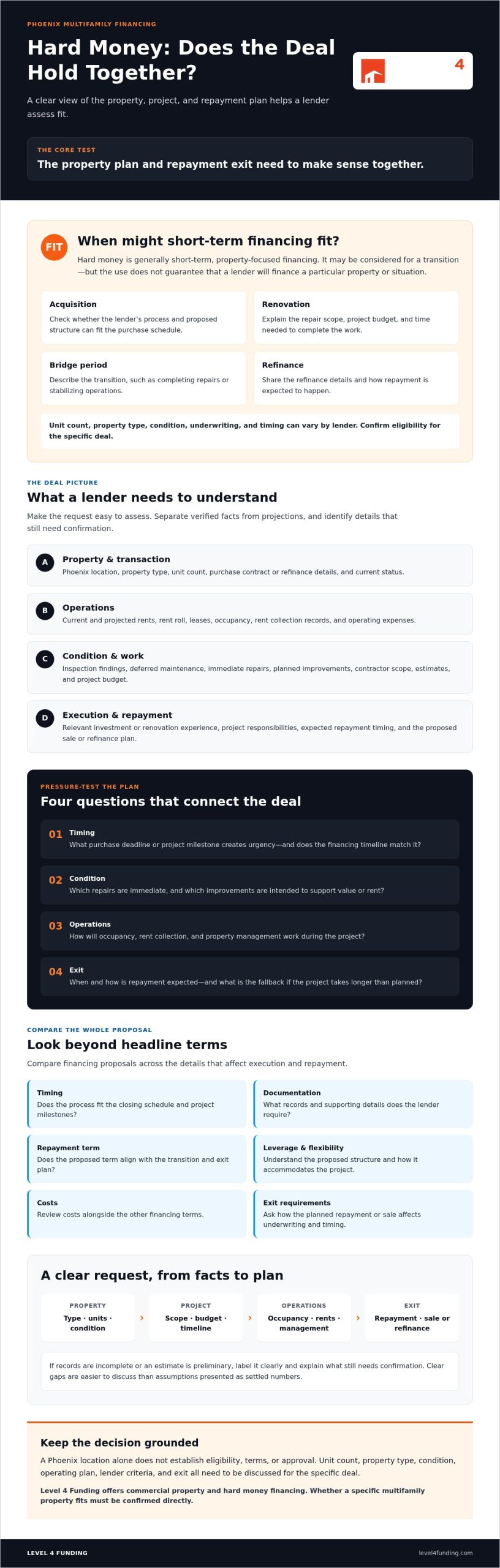
- Timing: Identify the purchase deadline or project milestones that create urgency.
- Condition: Separate immediate repairs from improvements intended to raise value or rent.
- Operations: Document occupancy, rent collection, and how the property will be managed during work.
- Exit: Explain when and how repayment is expected, and what could affect that plan.
A Phoenix location alone doesn’t establish eligibility, terms, or approval. Unit count, property type, condition, operating plan, and exit all need to be discussed with the lender. Level 4 Funding offers commercial property and hard money financing, but whether a specific multifamily deal fits must be confirmed directly.
Which Phoenix multifamily projects might warrant a lender conversation?
A stabilized acquisition may warrant discussion if the purchase plan and expected operations support a defined repayment path. A value-add property may call for closer review of repair scope, budget, and the time needed to complete the work. A time-sensitive purchase may raise a different question: can the lender’s process and proposed structure fit the closing schedule? Each lender may define eligible property types and unit counts differently. These are possible financing scenarios, not promises of available capital.
What makes short-term financing different from permanent debt?
Short-term financing is usually built around a transition, such as completing repairs, stabilizing operations, or holding a property until a planned sale or refinance. Permanent debt is generally considered for longer-term ownership. Before choosing a short-term route, test whether the exit is achievable on the proposed timeline and identify what happens if it slips. For a broader look at private financing, see the commercial hard money loans guide.
How Lenders Evaluate a Phoenix Multi-Family Hard Money Deal
A lender’s review is about more than the property’s estimated value. The purchase or refinance terms, current operations, repair needs, your ability to execute, and the repayment plan all help show whether the deal is workable. Criteria differ by lender, so ask what applies to your property type and unit count instead of treating another investor’s approval as a benchmark.
For hard money for multi-family properties Phoenix, make the request easy to assess. Present verified facts separately from projections. If rent records are incomplete or a repair estimate is preliminary, say so and explain what still needs confirmation. Clear gaps are easier to discuss than assumptions presented as settled numbers.
Which property and operating records should investors organize?
Gather the records you have, then label them clearly. A practical starting file includes:
- Property and transaction: Phoenix location, property type, unit count, purchase contract or refinance details, and current status.
- Operations: Rent roll, leases, occupancy information, rent collection records, and operating expenses.
- Condition and work: Inspection findings, deferred maintenance, contractor scope, supporting estimates, and a project budget.
- Execution: Your relevant investment or renovation experience, project responsibilities, and the proposed repayment plan.
These materials help a lender understand both the asset and the work required to reach your intended outcome. A rent roll that conflicts with leases, or a repair budget without supporting estimates, can leave important questions unanswered.
How do leverage, repairs, and exit plans shape the discussion?
Loan-to-value (LTV) is the loan amount expressed as a percentage of a property’s value. For example, a loan equal to half of the value used in the calculation represents a 50% LTV. The value basis and calculation method can vary by lender and deal, so LTV is one measure to discuss, not a universal approval formula or a stated Level 4 Funding criterion. Corporate Finance Institute explains how hard money loan amounts are determined, including the role LTV can play.
Repairs can change the risk picture. Connect each major item to a documented scope, estimate, schedule, and contingency plan. Then test the exit: a sale depends on achievable pricing and timing, while a refinance depends on qualifying for replacement financing under terms that aren’t guaranteed. Validate those assumptions independently, and explain what you’d do if the plan shifts.
Bring the property details, operating records, project numbers, and exit plan together before discussing fit. Investors can discuss a Phoenix multifamily deal with Level 4 Funding and confirm whether it may fit the lender’s commercial property or hard money financing.
Hard Money vs. Other Financing for Phoenix Multifamily: What Should You Compare?
The right financing depends on the property, the project, and how soon you need to act. Hard money may suit a time-sensitive purchase or renovation, but speed can come with trade-offs. Compare written proposals against the deal’s full economics, not an assumed timeline or a headline loan amount. Forbes discusses the role of hard-money loans in commercial real estate financing, including their potential flexibility and higher costs.
| Financing type | Possible use case | What to compare |
|---|---|---|
| Hard money | A time-sensitive acquisition, property transition, or renovation, subject to lender fit. | Decision and funding timeline, required documentation, repayment term, leverage, flexibility, and exit requirements. |
| Bank or agency debt | Potentially a longer-term ownership plan for a property that meets the provider’s criteria. | Application process, property and borrower documentation, repayment structure, leverage, and eligibility requirements. |
| Other private financing | A deal that may need a different structure or lender approach. | How the lender evaluates the asset, what terms are negotiable, required documents, maturity, and repayment plan. |
This is a framework, not a promise about any lender’s process. Timing, documentation, leverage, and flexibility vary by provider and property. Ask each lender to put the proposed terms and execution requirements in writing. For hard money for multi-family properties Phoenix, confirm that the specific property type and unit count are eligible before weighing options.
When might hard money fit better than conventional financing?
A purchase deadline or renovation plan may make a hard money conversation worthwhile, especially if property condition affects how different lenders assess the deal. That doesn’t guarantee faster funding or approval. Compare actual timelines, required borrower and property records, and the lender’s process against your contract and project schedule. For foundational terminology, read the hard money loan guide.
What trade-offs deserve attention before signing?
Review the full written proposal and loan documents, not just the expected closing date. Check the maturity date, extension conditions, payment structure, fees, collateral, and default provisions. Then stress-test your exit plan: What if repairs run late, occupancy changes, a sale takes longer, or refinance financing isn’t available on the assumptions you used?
A financing option that fits on paper can strain a project if repayment timing and execution don’t line up. Compare written terms with realistic project economics, and have qualified legal and financial professionals review the documents before you sign.
How to Prepare a Phoenix Multifamily Property for a Hard Money Request
A clear request starts before you contact a lender. Lay out the deal in a format someone else can check: where the property is, what you plan to do, what the numbers rely on, and how repayment is expected to happen. For hard money for multi-family properties Phoenix, don’t assume the local address or a polished projection answers eligibility questions. Make the specifics visible.
- Define the property and transaction. State the Phoenix location, property type, unit count, current status, and whether you’re purchasing or refinancing.
- Describe the plan. Explain the financing purpose, planned work, repair priorities, project budget, and target milestones.
- Organize operating evidence. Gather rent records, leases, occupancy information, expenses, and property details. Label confirmed figures and estimates separately, and note the source for each.
- Map the exit. Identify the intended repayment route and the conditions it depends on, such as completing work, stabilizing operations, or selling.
- Verify local project requirements. Treat zoning, permits, inspections, and other requirements as items to confirm with the relevant authorities. Don’t build the timeline around unverified assumptions.
What belongs in a lender-ready multifamily deal summary?
Keep the summary concise, but make it specific enough to review. Include the property and transaction details, requested financing purpose, planned work, proposed timeline, and repayment exit. Support rent and expense figures with records where possible. For renovation assumptions, identify estimates as estimates and attach the scope or supporting documentation available. If a figure is uncertain, flag it rather than presenting it as fact.
Then connect the numbers to execution. For example, show which repairs need to happen first, what milestones depend on them, and what must be true for a sale or refinance to repay the loan. This gives a lender a clearer basis for questions and helps you spot gaps before they become schedule problems.
How can investors compare proposals without overlooking risk?
Compare each written proposal line by line. Review total obligations, payment timing, maturity, collateral, conditions to funding, and extension language. Ask lenders to clarify their underwriting assumptions and list any outstanding approval conditions. A proposed structure is not final approval, and extension terms shouldn’t be treated as automatic.
For general process context, see the hard money loan approval process. Use that overview as background, then confirm the steps, requirements, and timing for your own deal directly. An organized package makes those conversations more concrete.
Level 4 Funding offers commercial property and hard money financing, but multifamily eligibility must be confirmed. Discuss your Phoenix property and financing fit with Level 4 Funding, including the unit count, project plan, and intended exit.
Choosing a Phoenix Lender for Multi-Family Hard Money: Your Next Step
The right lender conversation starts with a direct question: does this specific Phoenix property fit? For hard money for multi-family properties Phoenix, don’t rely on a lender’s general marketing language or another investor’s experience. Verify the property type, unit count, location, and project scope for your deal, then ask for the proposed terms and conditions in writing.
What should you ask a prospective hard money lender?
Get clear answers before making a financing plan around a lender’s initial interest. Ask:
- Eligibility: Do you consider this property type, unit count, Phoenix location, and planned project scope?
- Experience and underwriting: Have you evaluated comparable multifamily deals? What property, operating, borrower, and exit details will you review?
- Documents and conditions: What records are needed, what conditions remain, and what could affect closing?
- Costs and terms: Can you provide the proposed obligations, payment structure, maturity, collateral, and any applicable fees in writing?
- Execution and communication: If the loan includes project draws, how are they handled? Are inspections required? What are the extension, repayment, and payoff procedures, and who will communicate updates?
Don’t treat an estimate as a final commitment. Ask the lender to distinguish preliminary terms from confirmed terms and explain any dependencies that could change timing or availability. If an answer is unclear, get the explanation in writing before comparing proposals.
How can Level 4 Funding help evaluate the next step?
Level 4 Funding is a private real estate lender serving Phoenix and offers commercial property and hard money financing. Multifamily eligibility is not guaranteed, and the lender does not claim a dedicated multifamily program. Confirm directly whether your building, unit count, and proposed financing purpose fit its available options.
For a useful initial discussion, bring the property location and details, purchase or refinance context, current occupancy and rent information, planned work, project budget, target milestones, and intended repayment exit. Be ready to identify which figures are confirmed and which remain estimates. A clear package helps focus the conversation on the deal and the questions that still need answers.
Share your Phoenix property details and financing purpose to discuss potential fit. Discuss your Phoenix investment property financing options.
Make Your Next Financing Move With a Clear Plan
A stronger multifamily financing request starts with a deal you can explain clearly: the property, its current operations, the work ahead, and a realistic repayment exit. As you compare hard money for multi-family properties Phoenix, weigh the written terms and execution requirements against your project timeline, not just the initial appeal of a financing option.
Before committing, confirm the lender’s eligible property types and unit counts, clarify outstanding conditions, and check that your sale or refinance plan can withstand delays or changing assumptions. These steps won’t guarantee approval, but they can help you make a more informed decision and avoid relying on guesswork.
Level 4 Funding provides private financing for real estate investors, including commercial property loans and hard money loans. Whether a specific Phoenix multifamily property fits available financing must be confirmed directly. Share your property details, transaction purpose, project plan, and intended exit to start that conversation.
Discuss your Phoenix investment property financing options. Go forward with clear numbers, direct questions, and a plan you can stand behind.
Frequently Asked Questions
Can you get hard money for a multifamily property in Phoenix?
Yes, some private lenders consider multifamily properties in Phoenix, but eligibility depends on the lender, property, transaction, and project. Verify unit-count limits, property type, loan structure, and terms directly before relying on a financing plan. Level 4 Funding offers commercial property and hard money financing, but whether a specific Phoenix multifamily deal fits must be confirmed. Share the building’s unit count, condition, purchase or refinance purpose, and planned exit.
How do hard money lenders evaluate multifamily properties?
Lenders commonly discuss property value and condition, rents and occupancy, the requested financing, project scope, borrower experience, and the repayment exit. For example, a renovation plan may prompt questions about repair priorities, budget, and timing. No single checklist applies to every lender, and these general discussion points aren’t confirmed Level 4 Funding underwriting rules. Ask each lender which details it considers for your Phoenix property and transaction.
Can hard money finance a multifamily renovation in Phoenix?
Some private lenders may consider renovation financing, subject to property eligibility, work scope, budget, and the lender’s terms. Prepare a repair list, contractor estimates, project timeline, and contingency assumptions, clearly labeling estimates that aren’t final. Before counting on funding for the work, confirm that the lender considers your specific Phoenix property and renovation. Also ask how draws are handled, whether inspections are required, and what documentation is needed.
Is hard money better than a bank loan for a Phoenix apartment property?
Neither option is universally better. Compare timing, documentation, repayment period, total obligations, leverage, and how property condition affects each lender’s review. A financing option that appears to fit a deadline still needs to work with the project’s costs and repayment plan. Compare written offers, then test whether your planned sale or refinance remains feasible if repairs, occupancy, or closing take longer than expected.
What documents should I prepare for a multifamily hard money loan request?
Organize property details, purchase or refinance information, rent roll, leases, occupancy and expense records, repair scope, project budget, timeline, and repayment exit. Label projections and estimates clearly, and note the source of rent, expense, or renovation assumptions. Exact document requirements vary by lender and deal, so request the lender’s current checklist. For a Phoenix property, include its location, property type, unit count, and current condition.
How quickly can a hard money loan close on a Phoenix multifamily property?
There’s no single closing timeline to rely on. Timing can depend on property review, title and valuation work, documentation, underwriting, and conditions tied to the transaction. Ask the lender for a schedule based on your specific Phoenix deal, and request a clear list of what must happen before funding. Confirm who is responsible for each item and identify unresolved issues that could delay the transaction.
Does Level 4 Funding offer hard money loans for multifamily properties?
Level 4 Funding lists hard money and commercial property loans, but available information doesn’t confirm a dedicated multifamily product. Contact the lender to check whether your property and requested financing fit current options. Provide the Phoenix property’s unit count, condition, purchase or refinance purpose, project plan, and exit strategy. Level 4 Funding serves Phoenix and nearby Arizona markets, including Scottsdale, Tucson, Glendale, Sedona, Flagstaff, Tempe, Mesa, and Buckeye.

About the author
Matt has a bachelor's degree in political science from Northern Arizona University and works at Level 4 Funding, a private lending company that offers hard money and rental home loans to real estate investors in 35 states.
With Matt's leadership, the firm has financed almost $300 million in loans for investment properties. He often helps real estate investors with rental property purchases, foreclosures, refinancing, and fix-and-flip projects. Matt has extensive experience in fix-and-flip, buy-and-hold, rental properties, and real estate sales. He has lived in Arizona for 43 years and is married with three children. Matt is licensed as a mortgage broker and loan originator in Arizona, with NMLS 2062278 and NMLS 1118493.
Equal Housing Opportunity. This is not a Good Faith Estimate, and it is not a Guarantee to lend; it should not be considered as such. Costs, rates, estimates, and terms can only be determined after a full application is completed. To the extent this message includes any tax or legal advice, this message is not intended or written by the sender to be used, and cannot be used, for legal or tax purposes or advice. This is an advertisement. Copyright © 2026. All rights reserved.