


Hard Money Cash-Out Refinance vs. Traditional Refinance: Which Option Unlocks More Equity for Investors?
October 30, 2026
Private Money Lenders in California: How to Find Fast, Flexible Financing for LA, Bay Area, and Beyond
October 31, 2026
Effective Phoenix real estate investment risk management balances potential rental income against costs and risks that can reduce returns. Assess the cap rate alongside construction costs, labor availability, extreme heat, drought, and insurance exposure before committing. Diversifying across property types can also help prevent one asset from carrying the entire portfolio risk.
A promising return on paper can look very different once operating costs, repairs, and vacancy are included. Phoenix has its own mix of opportunities and pressures, so a sound decision takes more than a quick comparison of asking prices and projected rent.
This article explains how to evaluate allocation and cap rates, account for construction and labor conditions, and factor heat, water constraints, and insurance into your investment plan. You’ll have a clearer framework for weighing yield against risk before choosing a property or financing approach.
Key Takeaways
- Compare property types and cap rates against your investment goals, not just headline rent or purchase price.
- Build construction budgets around project scope and labor availability, then account for schedule pressure that can affect returns.
- Factor extreme heat, drought exposure, and insurance into property-level risk, especially when assessing long-term operating resilience.
- Evaluate neighborhood-level price trends and rental demand before relying on a market forecast to guide your purchase.
- Include taxes, insurance, maintenance, repairs, and vacancy in your calculations so projected yield reflects the costs of ownership.
Asset allocation and cap-rate considerations
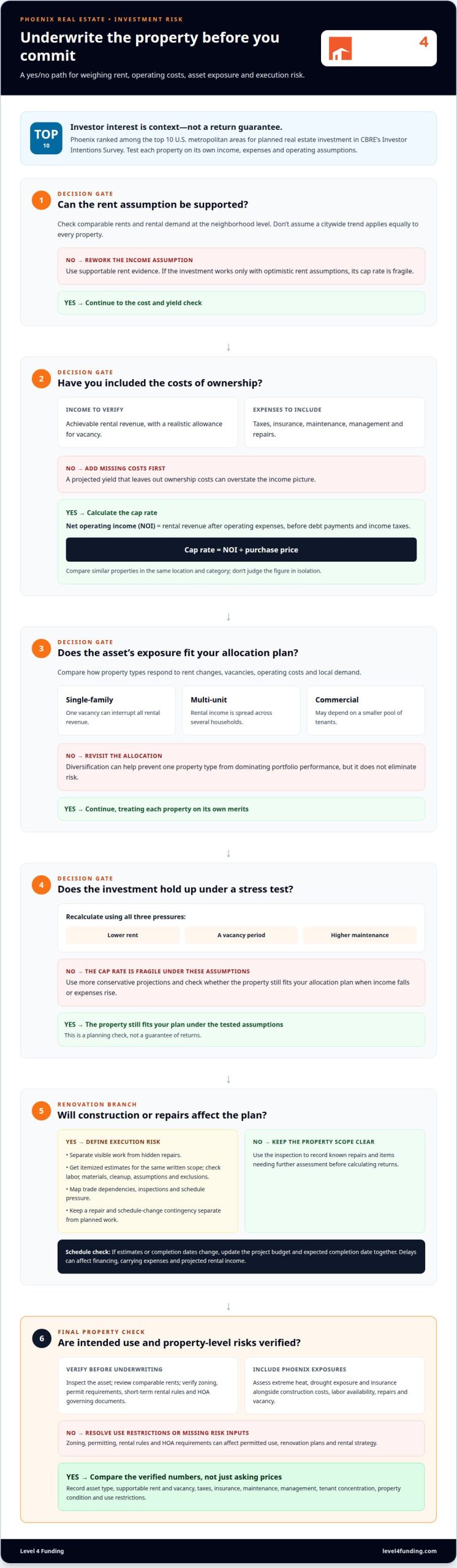
Phoenix investors can spread exposure across single-family homes, multi-unit properties, and commercial real estate. Each category responds differently to rent changes, vacancies, operating costs, and local demand. Diversification won’t eliminate risk, but it can keep one property type from dominating portfolio performance. Start by deciding how much capital and attention to allocate to each category.
Phoenix ranked among the top 10 U.S. metropolitan areas for planned real estate investment in CBRE’s Investor Intentions Survey. That signals investor interest, not a guarantee of returns for any property. Treat market attention as context, then test each acquisition on its own income, expenses, and operating assumptions.
A cap rate estimates a property’s unleveraged income yield. Divide net operating income by the purchase price. Net operating income is rental revenue after operating expenses, before debt payments and income taxes. For a Phoenix rental, estimate achievable rent, then subtract recurring costs and a realistic allowance for vacancies and repairs. Compare the result with similar properties in the same location and category, rather than judging it in isolation.
Higher projected income can come with greater exposure. A commercial property may depend on a smaller pool of tenants, while a multi-unit building spreads rental income across several households. A single-family home may be simpler to assess, but one vacancy can interrupt all rental revenue. These are trade-offs to model, not reasons to favor one asset class automatically.
Neighborhoods can differ in rental demand, potential yields, appreciation prospects, and exposure to vacancy or repair costs. Compare current rent evidence and property expenses at the neighborhood level. Don’t assume a citywide trend applies equally to every Phoenix property.
Phoenix zoning, permitting, short-term rental, and HOA rules can affect a property’s permitted use, renovation plans, and rental strategy. Before underwriting, review the parcel’s zoning, applicable permit requirements, short-term rental rules, and HOA governing documents.
Due diligence starts with the property and the numbers: inspect the asset, review comparable rents, verify zoning and intended use, and calculate net operating income. Then stress-test the cap rate using lower rent, a vacancy period, and higher maintenance expenses.
Use a consistent comparison before making an offer. For each Phoenix candidate, record:
- Asset type: Single-family, multi-unit, or commercial.
- Income: Supportable rent and expected vacancy.
- Expenses: Taxes, insurance, maintenance, and management.
- Exposure: Tenant concentration, property condition, and use restrictions.
Compare those inputs across properties, not just asking prices. If a Phoenix investment only works under optimistic rent assumptions, its cap rate is fragile. More conservative projections can show whether the property still fits your allocation plan when income falls or expenses rise.
Construction costs and labor availability
In Phoenix, a renovation budget can become inaccurate before work begins if its assumptions don’t match the property. Separate the scope into visible work, such as replacing finishes, and hidden work, such as repairing damaged systems. Then get itemized estimates for each trade. A low total can conceal exclusions that later return as change orders, schedule delays, or unfinished work.
Labor availability affects both cost and timing. A project may depend on trades working in sequence: demolition, plumbing, electrical work, inspections, and finishing. If one crew is delayed, later work may also have to move. Build the schedule around the actual sequence, and ask each contractor to identify dependencies, materials, and work included in the estimate. Don’t treat a target date as proof that the property will be ready to rent.
Use the property inspection to refine the scope before calculating returns. A cosmetic refresh and a renovation involving roof, plumbing, or electrical repairs carry different execution risks. Record each known repair, identify items that need further assessment, and tie every allowance to a defined task. If estimates change, update the total project budget and expected completion date together. This makes the effects on financing, carrying expenses, and projected rental income visible.
Compare contractor estimates against the same written scope. Check whether each estimate separates labor, materials, cleanup, and work that may arise after opening walls. A missing line item isn’t a saving if the work is still necessary. Ask for clear descriptions of assumptions and exclusions, then keep written approvals for changes. This creates a record of decisions and helps prevent a small scope change from quietly reshaping the whole project.
Before committing, stress-test the plan against execution problems. Consider what happens if materials arrive late, a trade must reschedule, or an inspection identifies additional work. Identify which costs continue during a delay, and preserve a contingency for repairs and schedule changes. Keep that reserve separate from the amount allocated to planned work. If the project only works when every task finishes on time and every estimate holds, the budget has little room for unexpected setbacks.
- Define the scope: Connect each budget line to specific work.
- Compare estimates: Match inclusions, exclusions, and assumptions.
- Map dependencies: Track how trade delays affect later tasks.
- Update projections: Recalculate carrying expenses and rental timing after changes.
Financing should fit the project type and execution plan. For an investment property requiring substantial renovation or new construction, a construction loan can be a relevant financing path to consider alongside a detailed scope and budget. Treat the financing plan and construction schedule as connected parts of the same risk assessment.
Phoenix real estate investors should include the purchase price, closing costs, property taxes, insurance, and maintenance in their investment calculations. This connects the renovation plan to the broader property budget.
Extreme heat, drought, and insurance risk
Phoenix heat and water constraints can affect property operations and future development. Heat can increase cooling demands and strain equipment, while drought can raise questions about long-term water availability. Include these exposures in the property review rather than hiding them in a vague “Arizona risk” allowance. Inspect the building, understand its water context, and model how operating needs could affect net income.
Start with the physical asset. During a walkthrough, inspect the roof, exterior shade, windows, insulation, and cooling equipment. Note visible wear and ask a qualified inspector to assess systems that are difficult to evaluate yourself. In a rental home, poor cooling performance can become a maintenance issue and an occupant concern. In a commercial building, equipment condition and the layout of cooled spaces can shape tenant use and operating demands.
Water risk also matters before buying land or a development project. New residential subdivisions in Arizona’s Active Management Areas must demonstrate a 100-year assured water supply. In mid-2023, Arizona officials paused approvals for new subdivisions in parts of metro Phoenix that relied solely on groundwater. These facts make water supply a central diligence issue for development plans, not a footnote to the construction budget.
For an existing property, distinguish immediate operating needs from future development exposure. Review the water source and service arrangements documented for the parcel. For a proposed subdivision, identify whether the site is within an Active Management Area and how its water supply is addressed. Then consider how water constraints could affect the intended use, project timing, and assumptions behind your exit plan. A parcel’s location alone doesn’t answer those questions.
Include insurance in the same property-level review. Premiums and coverage can affect cash flow, while policy terms determine which losses are covered and which remain the owner’s responsibility. Read the declarations and exclusions for the specific asset. Make sure the insured building description reflects its actual condition, systems, and planned use. Model the premium as an operating expense, and consider whether a deductible or uncovered repair would strain available reserves.
Use a consistent review for each Phoenix acquisition:
- Inspect heat exposure: Record cooling equipment condition, shade, and signs of exterior wear.
- Review water context: Identify the parcel’s water source and development constraints.
- Read coverage terms: Compare insured property details, exclusions, deductibles, and intended use.
- Stress-test cash flow: Include insurance and likely maintenance needs in operating projections.
For Phoenix real estate investment risk management, link each exposure to a decision: repairs, budget, operating plan, or acquisition terms. Heat, drought, and insurance aren’t abstract market labels. They change the costs a property must carry and the assumptions a project can support.
How have Phoenix home prices and rents changed, and what are the latest market forecasts?
Phoenix home prices and rents vary by neighborhood, property type, and local rental demand. A citywide average can hide differences between comparable homes, apartment buildings, and commercial properties. For an investment decision, compare recent sale prices and asking rents for similar properties in the same area. Use those comparisons to test the purchase price and projected income.
Start with the property’s immediate market. Review comparable sales to understand how buyers have valued similar homes, and compare rents for properties with similar size, condition, and features. Distinguish advertised rent from rent supported by comparable listings and leasing evidence. A renovated home and a property needing major repairs shouldn’t share one rent assumption simply because they’re in the same neighborhood.
Neighborhood trends matter because price growth and rental demand don’t always move together. One area may attract buyers seeking appreciation, while another may support stronger demand for rental housing. Neither pattern automatically means better returns. Compare expected rent with the full operating plan, and consider how a vacancy or repair would affect income. Property condition and tenant profile can change the result even within one neighborhood.
Treat forecasts as planning inputs, not reasons to buy. A useful Phoenix forecast connects demand, property values, rental evidence, and the costs of owning the specific asset. If a forecast assumes rising rents, test whether comparable properties support that expectation. If it assumes appreciation, compare current sale evidence and local demand rather than relying on broad market enthusiasm.
Build a practical outlook before making an offer:
- Track comparable sales: Match location, property type, condition, and features.
- Test rental assumptions: Compare achievable rent with similar properties and account for vacancy.
- Separate income from appreciation: Evaluate cash flow independently from any future resale assumption.
- Revisit the forecast: Update projections when local sale or rental evidence changes.
For example, if a Phoenix home’s projected rent exceeds rents for comparable properties, recalculate using supportable rent before deciding whether the price works. If a multi-unit property has different rents across its units, assess each unit’s income separately. These steps show whether the investment depends on a broad market forecast or evidence tied to the property.
Research current Phoenix market trends, property values, and neighborhood rental demand before investing. Record the evidence behind each assumption to establish a usable baseline for future reviews and make changes easier to spot. A forecast earns its place in your plan only when it connects to comparable properties and the income your asset can reasonably produce.
Phoenix prices and rents vary by neighborhood and property type, and price growth doesn’t necessarily move in step with rental demand. Test forecasts against comparable sales, supportable rents, vacancy, and property-specific costs.
Prices and rents vary by neighborhood, property type, and local rental demand, so compare similar properties in the same area. Account for vacancy when assessing projected rental income.
What are Phoenix property taxes, landlord insurance costs, and typical maintenance expenses?
Property taxes, insurance, and repairs can shrink a Phoenix investment’s net income. Don’t underwrite based on rent alone. Build a property-specific operating budget before deciding what the asset can support. Start with the purchase price and closing costs, then add property taxes, landlord insurance, routine maintenance, and a reserve for larger repairs. Keep each line separate so a change in one assumption doesn’t disappear inside a single expense estimate.
Arizona’s commercial property assessment ratio is around 18% of value. That ratio is not the tax rate or the final tax bill. For a commercial acquisition, review the parcel’s assessment and applicable tax information, then use the resulting property-tax expense in your projections. For a Phoenix residential property, use its property-specific tax records rather than applying a commercial assessment ratio.
Insurance costs also depend on the property and its coverage. Consider the building’s condition, intended use, insured features, deductible, and policy exclusions when assessing exposure. Read the policy documents against the actual asset. For example, a rental home with older systems may need a different maintenance plan than a recently renovated property. Include the quoted premium in cash-flow calculations, and account for the owner’s share of losses covered by a deductible.
Maintenance isn’t one predictable bill. Separate routine upkeep from repairs tied to a specific condition. A Phoenix property with aging cooling equipment may need attention that a newer building doesn’t. Roof wear, plumbing issues, and exterior damage can also become larger projects if ignored. Use inspection findings to identify likely work, set aside funds, and update the budget as repairs are completed or new issues appear.
Use a simple expense review for each property:
- Taxes: Review property-specific records and use the relevant assessment information.
- Insurance: Record premium, deductible, coverage limits, and exclusions.
- Maintenance: Separate routine tasks from condition-related repairs.
- Cash flow: Recalculate net income after each expense and reserve.
For a Phoenix commercial property, this expense picture should inform both the purchase decision and the financing plan. Explore Commercial Property Loans as a financing option while assessing the asset’s taxes, insurance, and maintenance needs. The loan structure should sit alongside a realistic operating budget, not replace one.
Finally, stress-test the property with higher expenses and weaker rental income. If the investment still fits your plan after accounting for taxes, insurance, and repairs, your projection has a sturdier foundation. If one cost pushes cash flow into negative territory, revisit your assumptions before committing. Phoenix real estate investment risk management starts with understanding the full cost of ownership, not just the acquisition price.
Finally, stress-test the operating budget and keep a contingency fund for maintenance, repairs, and vacancies. A Phoenix property manager can handle tenant screening, rent collection, maintenance, and other day-to-day responsibilities.
Level 4 Funding: Fix and Flip Loans
Level 4 Funding offers Fix and Flip Loans for investors planning to purchase and renovate Phoenix properties. They can be relevant when a project’s numbers account for acquisition, renovation scope, expected carrying costs, and a realistic resale or rental strategy. For ground-up development, Construction Loans may better match the project; Commercial Property Loans serve commercial real estate investments.
Before choosing financing, clarify your property plan and budget. Include the work required, expected timeline, and how the investment is intended to generate returns. Match the financing discussion to the project type, not just the property’s purchase price.
To discuss financing for an investment property, contact Level 4 Funding.
Make your next Phoenix investment decision with a clear plan
Your next step isn’t to predict every market shift. Make your investment decision traceable: connect each assumption to evidence, assign responsibility for each risk, and decide in advance what would make you pause or revise the plan. That discipline keeps Phoenix real estate investment risk management practical, not theoretical.
Before committing, write down the return you need, the risks you’re willing to carry, and the conditions that would change your decision. Keep that plan alongside your property analysis and financing strategy. When the numbers or project scope shift, revisit the decision instead of relying on the original forecast.
Financing should support the investment strategy you’ve built, not drive it. If you’re weighing a Phoenix real estate project and want to discuss financing options, contact Level 4 Funding. Bring your goals and project details to the conversation, then move forward with a plan you can explain and manage. Strong decisions start with clear eyes and deliberate action.
Frequently Asked Questions
What are the main risks of investing in Phoenix rental property, including heat, drought, and water restrictions?
Key risks include heat-related wear, water constraints, insurance exposure, vacancy, and unexpected repairs. For example, cooling equipment that fails during a hot period can mean urgent maintenance and interrupted rent. For a property with landscaping, assess its water needs and any applicable restrictions. Before buying, connect each exposure to an operating response: maintenance plans, reserve funds, coverage terms, and a leasing strategy that accounts for potential downtime.
What rental yield, cash-on-cash return, and vacancy assumptions are realistic for Phoenix investment properties?
Use assumptions supported by comparable rentals and the property’s actual expenses, rather than applying a single Phoenix-wide target. Estimate rental yield by comparing annual rental income with the purchase price. Calculate cash-on-cash return by dividing annual cash flow after operating costs and debt payments by the cash invested. Set vacancy assumptions using comparable leasing activity, unit condition, and expected turnover, then test how a longer vacancy would affect projected cash flow.

About the author
Matt has a bachelor's degree in political science from Northern Arizona University and works at Level 4 Funding, a private lending company that offers hard money and rental home loans to real estate investors in 35 states.
With Matt's leadership, the firm has financed almost $300 million in loans for investment properties. He often helps real estate investors with rental property purchases, foreclosures, refinancing, and fix-and-flip projects. Matt has extensive experience in fix-and-flip, buy-and-hold, rental properties, and real estate sales. He has lived in Arizona for 43 years and is married with three children. Matt is licensed as a mortgage broker and loan originator in Arizona, with NMLS 2062278 and NMLS 1118493.
Equal Housing Opportunity. This is not a Good Faith Estimate, and it is not a Guarantee to lend; it should not be considered as such. Costs, rates, estimates, and terms can only be determined after a full application is completed. To the extent this message includes any tax or legal advice, this message is not intended or written by the sender to be used, and cannot be used, for legal or tax purposes or advice. This is an advertisement. Copyright © 2026. All rights reserved.