


Private Money Lenders in California: How to Find Fast, Flexible Financing for LA, Bay Area, and Beyond
October 31, 2026
A bank isn’t the only route to property financing in Phoenix. The practical answer to how to get a real estate loan without a bank in Phoenix is to consider private-money lending, seller financing, or a loan that evaluates bank deposits instead of relying on standard income documents. Each route works differently, and the right fit depends on the property and your financing plan.
A conventional application can stall over paperwork or income documentation. Alternative financing offers another path, but you still need to review the terms, repayment plan, and risks before committing.
This guide explains how private-money loan costs are structured, what lenders consider during underwriting, and how repayment terms can vary. You’ll also learn how owner financing and bank-statement loans work, and how to compare options for a Phoenix-area project. The goal is to help you understand the choices before deciding which financing route fits.
Key Takeaways
- Compare private-money offers by looking beyond the interest rate: origination points, repayment structure, and the property’s role in the deal all matter.
- Prepare a clear picture of the property and project, since lenders assess the collateral and the plan as part of underwriting.
- Bank-statement lending can use deposits over 12 to 24 months to assess repayment ability instead of relying on standard income documents.
- Owner financing means making monthly payments to the property owner, so understand the payment terms before pursuing this route.
- Match the financing option to your project, whether you’re evaluating a private-money loan, seller financing, or a bank-statement loan.
Arizona private-money interest rates and origination points
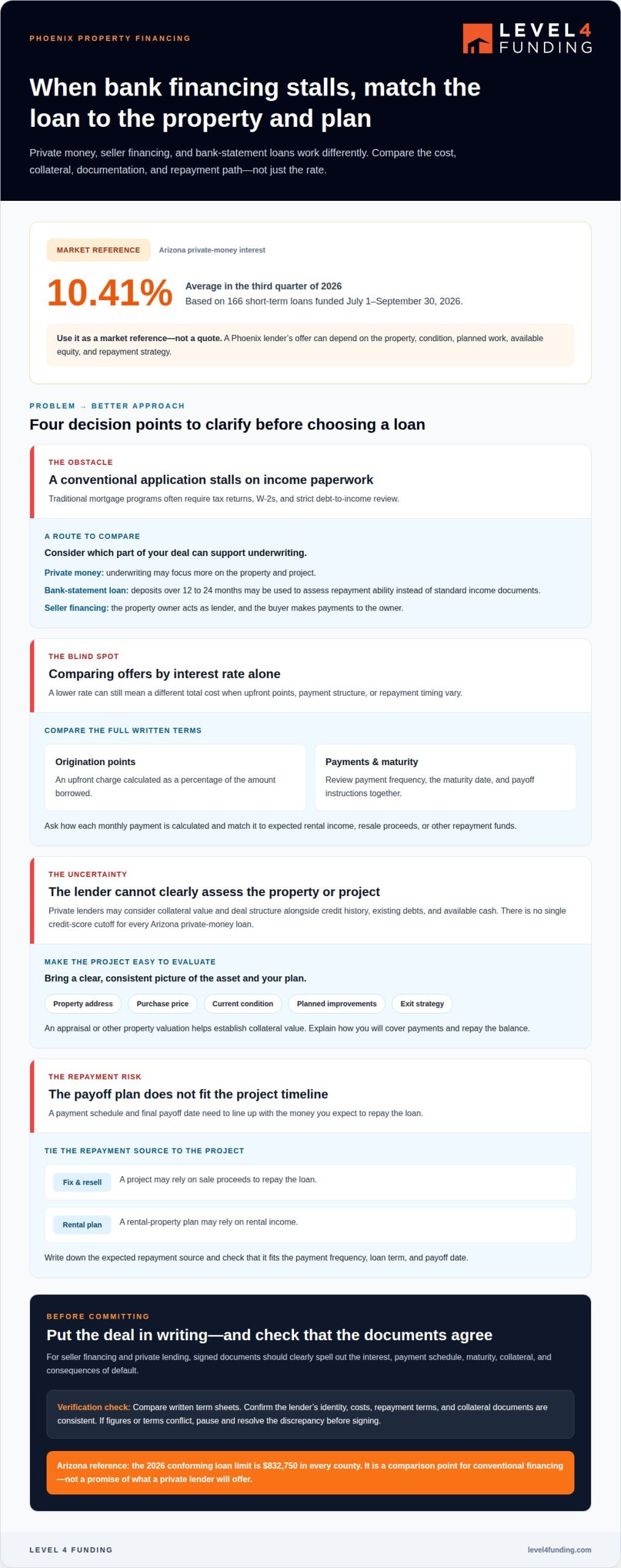
Arizona private-money interest averaged 10.41% in the third quarter of 2026. That figure reflects 166 short-term loans funded between July 1, 2026 and September 30, 2026. Treat it as a market reference, not a quote for a Phoenix property. A lender’s offer can depend on the property, its condition, the planned work, available equity, and the repayment strategy.
Interest is only one part of a loan’s cost. Origination points are an upfront charge calculated as a percentage of the amount borrowed, so compare them with the interest rate and other written costs. Then match the monthly payment to expected rental income, resale proceeds, or other repayment funds. A lower rate may still mean a different overall cost if points or repayment timing vary.
How do non-bank real estate loans compare with conventional mortgages and credit unions? Private-money underwriting may focus more on the property and project, while traditional mortgage programs often require tax returns, W-2s, and strict debt-to-income ratios. Compare the full written terms, including points, payment structure, and maturity, rather than judging financing by the interest rate alone.
Arizona’s 2026 conforming loan limit is $832,750 in every county. A conventional loan above its applicable conforming limit is commonly described as jumbo financing. Use the statewide figure as a reference when comparing conventional mortgage options with private money. Private lenders may instead assess the property’s collateral value and investment plan, so the conforming limit doesn’t tell you what a particular private lender will offer.
Alternative real estate financing in Arizona can include private-money loans, seller financing, and bank-statement loans. With seller financing, the property owner acts as the lender, and the buyer makes payments to the owner. Bank-statement loans may assess deposits instead of relying on standard income documents. Private lenders set minimum loan amounts according to their criteria, project size, and collateral, so compare the minimum with the amount your project needs.
Arizona’s applicable laws and the contract terms govern seller financing and private lending. Put the financing arrangement in signed documents, clearly spelling out the interest, payment schedule, maturity, collateral, and consequences of default before committing.
How can you find and verify a reputable private real estate lender in Arizona? Compare written term sheets from Arizona-based lenders, then check that the lender’s identity, costs, repayment terms, and collateral documents are consistent. Ask for a clear explanation of each origination point and how the monthly payment is calculated. If the figures or terms conflict across documents, pause before signing and resolve the discrepancy.
Credit-score and appraisal requirements
A private lender may assess the property and project alongside your credit profile. There is no single credit-score cutoff for every Arizona private-money loan. Lenders may consider payment history, existing debts, available cash, property condition, and your repayment plan. A lower score may raise concerns, but the property’s value and deal structure can also shape underwriting.
Start by organizing the details behind your borrowing plan: the property address, purchase price, current condition, planned improvements, and expected exit strategy. Explain how you’ll cover payments and repay the balance. An appraisal or other property valuation helps establish collateral value. The lender may compare that value with the requested amount and assess whether the property supports the proposed financing.
Describe the collateral accurately. If you’re buying a Phoenix fixer-upper, explain its current condition and the planned work. For a rental or commercial property, provide relevant property details and a realistic income or resale plan. The lender evaluates the asset securing the loan, while financial documents help show how you’ll meet the repayment terms. Clear project documentation makes both parts easier to assess.
Phoenix Open Doors is a separate homebuyer assistance program, not a private-money credit-score standard. Applicants must also complete an eight-hour pre-purchase homebuyer education course. These criteria apply to that program, not to approval requirements for a private loan.
Income review depends on the financing route. Traditional mortgage programs often examine tax returns, W-2s, and debt-to-income ratios. Bank-statement loans can instead use deposits to assess repayment ability. For private money, prepare a clear repayment explanation tied to the property, such as sale proceeds after renovation or rental income. Don’t assume an interest rate alone tells you whether the deal works; compare the payment obligation with your documented plan.
Before signing, compare the lender’s valuation with the property’s condition and your project assumptions. Ask how the appraisal affects the loan amount, what repairs could change the assessment, and which documents support the repayment plan. Keep the written offer, valuation, and property details together. If you’re evaluating financing for an investment property, explore real estate financing options as part of your comparison.
Loan repayment and forgiveness terms
Before closing, match each payment to the funds expected to repay the loan. A fix-and-resell project may rely on sale proceeds, while a rental-property plan may rely on rental income. The payment schedule and final payoff date need to fit the project timeline. Put the expected repayment source in writing, not just in your budget.
Review the loan term, payment frequency, maturity date, and payoff instructions together. Depending on the agreement, a monthly payment may cover interest, principal, or both. Some loans also require a larger final payment at maturity. Request an amortization schedule or payment breakdown so you can see how the balance changes and what remains due.
Compare the APR with the stated interest rate. The interest rate is the charge on borrowed principal; APR expresses annualized borrowing cost and may account for certain loan charges. Review both figures alongside the payment schedule and closing costs. Two offers with similar interest rates can have different APRs or payoff amounts because their charges or repayment structures differ.
Prepayment terms deserve the same attention. If a property sells earlier than planned, the agreement determines whether you can pay off the balance immediately and whether a prepayment penalty applies. Look for the exact trigger, calculation method, and time period in the written terms. If the contract is silent or unclear, ask for a revised written explanation before signing, rather than relying on a verbal summary.
Loan forgiveness is different from repayment. Don’t assume the balance disappears because a project runs late, a property sells at a loss, or payments become difficult. Treat forgiveness as applicable only when the signed agreement clearly describes its conditions and effect. Otherwise, plan to repay the amount owed under the contract, including applicable charges and any required final payment.
Owner financing has a different payment arrangement: the buyer pays the property owner. The contract should identify the amount due, due dates, interest calculation, maturity, and consequences of missed payments. For example, understand whether a final payoff is due before relying on rental income or a future sale to cover it.
Before closing, match each payment to a realistic cash source, calculate the payoff under the stated schedule, and note any early-payoff conditions. Compare the written terms across offers, including APR, maturity, payment allocation, and prepayment rules. A repayment plan works only when the dates and amounts align with your project’s actual exit strategy.
Credit approval and underwriting
Underwriting connects your financial picture to the Phoenix property and its planned use. Approval depends on how the lender assesses repayment capacity, collateral, and loan terms.
Required Documents and Qualifications
For bank-statement lending, lenders typically review 12 to 24 months of deposits to assess repayment ability. Those deposits can support qualification instead of standard income documents such as W-2s or tax returns. Traditional mortgage programs often rely on tax returns, W-2s, and strict debt-to-income ratios, so the document package depends on the financing route.
For a Phoenix investment-property application, organize the property address, purchase details, current condition, and planned use. Include financial records relevant to the loan and explain how you expect to repay it. A renovation plan, for example, should connect the proposed work to the property’s intended resale or rental strategy.
Credit review is one part of underwriting, not the whole decision. The lender also assesses the property as collateral and whether your repayment plan fits the requested terms. Present existing debts and available funds accurately, and ensure the figures align across your application, supporting documents, and project budget.
Document requirements vary among Phoenix non-bank mortgage lenders. Prepare identity and financial records, property information, and project details, then organize them around the loan type and repayment plan. For a bank-statement application, make the deposit history easy to follow across the period being reviewed.
Private Loan Application Steps
Start with a complete deal summary: identify the Phoenix property, explain its intended use, and state how you’ll repay the loan. Gather the supporting financial and property records before applying. A consistent package helps underwriting compare your requested amount with the asset and project plan.
Submit the application, then respond to document requests with records that match the details you provided. The lender reviews the borrower, collateral, and project before presenting proposed terms. Read the written offer carefully, including its payment structure, maturity, costs, and conditions for closing.
Review the property valuation and resolve any differences between it, the purchase details, and project assumptions. If planned repairs affect the property’s condition, for example, ensure the work plan is accurately reflected in the application. Clear up inconsistencies before accepting terms or proceeding to closing.
Finally, compare the approved terms with your repayment strategy and confirm that the documents reflect the agreed structure. Keep the application, valuation, and final loan documents together. This creates a practical path through underwriting: prepare, apply, respond to review questions, assess the offer, and complete the closing documents.
Phoenix private-money lender options
If you’re deciding how to get a real estate loan without a bank in Phoenix, start with the deal’s purpose. A purchase that needs renovation calls for a different approach than a stabilized rental or commercial acquisition. Private-money lenders assess real estate projects, while seller financing depends on the owner agreeing to act as lender. Bank-statement financing may suit borrowers whose deposits better demonstrate repayment ability than conventional income documents. First identify the property type and plan.
Then match the funding source to the transaction. A private lender may suit an investor seeking capital for an investment property. With seller financing, ask the owner whether they would consider carrying the financing. A bank-statement loan may fit a borrower with deposits to document. These are distinct structures: clarify who lends, what secures the loan, and how repayment is expected to work.
Build a side-by-side comparison using the same project information for each option. Include the property’s intended use, purchase or project details, available funds, repayment source, and supporting documents. Compare the written terms, collateral approach, payment schedule, maturity, and payoff conditions. Note whether the funding structure suits a purchase, renovation, rental operation, or commercial property. This keeps your decision grounded in the transaction, not a headline claim.
A practical first step toward getting a real estate loan without a bank in Phoenix is preparing a concise deal brief. Describe the property, investment objective, work or operating plan, and exit strategy. For seller financing, clearly outline the proposed arrangement for the owner. For deposit-based underwriting, organize bank statements and explain the income pattern. Focused documents help keep each financing conversation centered on the same core questions.
Choose a financing route by matching the risk and repayment timing to the project. A renovation plan should account for the time needed to complete the work and sell or rent the property. A commercial acquisition needs a clear operating or resale rationale. If seller financing is under discussion, make sure the owner’s proposed schedule fits your cash plan. The right structure supports the transaction and has written obligations you can meet.
Level 4 Funding: Fix and Flip Loans
Level 4 Funding offers Fix and Flip Loans for real estate investors financing a property renovation and resale plan. This option may fit when the project centers on improving an investment property, while Construction Loans, Commercial Property Loans, and Cash Out Refinance address other real estate financing needs. Start with the deal itself: outline the property, planned work, intended use, and repayment strategy. Clear project details help frame the financing conversation and compare terms against your investment plan.
If a fix-and-flip project is your next move, contact Level 4 Funding to discuss your financing needs.
Put Your Financing Plan Into Motion
Deciding how to get a real estate loan without a bank in Phoenix starts with your investment priorities, not just the amount you hope to borrow. Define what needs to happen for the project to succeed, what could disrupt the plan, and which repayment source you’ll rely on. That clarity helps align financing with the property instead of forcing the project around a loan.
Before moving forward, write a short deal brief covering the property’s purpose, project scope, available funds, and intended exit. Use it to compare the financing structure with your timeline and risk tolerance. If the terms don’t support the plan, pause and adjust your approach before signing. A deliberate decision can help preserve flexibility later.
Level 4 Funding can be a next conversation for investors considering real estate financing. Bring your project details and questions about the structure you’re weighing. Discuss your investment project with Level 4 Funding, and take the next step with a clearer plan.
Frequently Asked Questions
How Can You Use It?
Non-bank real estate financing can fund investment-property purchases and projects that need a property-focused loan structure. Match the funds to a defined use, such as buying a Phoenix property, renovating it, or financing a rental investment. An investor planning renovations, for example, should outline the acquisition, work, and intended exit before borrowing. That plan links the loan purpose to a practical repayment strategy.
How much down payment do I need in Phoenix?
The amount depends on the lender’s criteria and your borrower profile. Level 4 Funding states that its down payment can range from 50% to 0%, depending on experience, credit, relationship, and real-estate license. To estimate the cash you’ll need, separate the funds for the purchase from the money reserved for planned work and other transaction expenses. Keep your available funds and project budget documented.
Is collateral required to get my loan?
For an asset-based real estate loan, the property is central to the lender’s collateral review. The lender assesses the asset securing the loan, its condition, and how the requested financing relates to it. A Phoenix investor should gather purchase and property details and clearly describe any planned renovation. Before signing, identify which property secures the debt and what the agreement says about default.
What non-bank real estate loan options are available in Phoenix, Arizona?
Options include private-money loans, seller financing, and bank-statement loans. Investors may use private money for a real estate project, while seller financing involves payments to the property owner. Bank-statement lending can use deposit records to assess repayment ability. Buyers pursuing a home purchase can also explore qualifying USDA financing or Phoenix buyer-assistance programs, which serve different purposes from investment-focused private loans.
How do private money lenders in Phoenix set rates, fees, and loan terms?
Private lenders structure offers around the property, requested amount, project plan, collateral, and expected repayment source. The written terms explain interest, origination charges, payment timing, maturity, and early-payoff conditions. Compare offers line by line rather than focusing on one rate. Check whether the payment schedule, for example, allows enough time to renovate, rent, or sell the property.
Can I use seller financing to buy a home or investment property in Phoenix?
Yes. With seller financing, the property owner acts as lender, and the buyer makes payments to the owner. It may be an option for a home or investment purchase if buyer and seller agree. Put the payment schedule, interest, maturity, collateral, and default terms in the written agreement. Ensure expected income or another repayment source can cover those obligations.
What risks, prepayment penalties, and foreclosure rules apply to private real estate loans in Arizona?
Key risks include missed payments, a final payoff the project cannot cover, and contractual prepayment penalties. The signed loan documents set out payment duties, early-payoff terms, default consequences, and the foreclosure process, subject to applicable Arizona law. Before closing, identify the clauses covering late payment, acceleration, payoff, and remedies. Have an Arizona real estate attorney review unclear language before signing.
Are there Phoenix or Arizona programs that help buyers obtain non-bank or alternative home financing?
Yes. Qualifying USDA home loans may offer up to 100 percent financing. Phoenix Section 18 homes have no income limit, are sold as-is, and may need repairs, so factor property condition into your purchase plan.

About the author
Matt has a bachelor's degree in political science from Northern Arizona University and works at Level 4 Funding, a private lending company that offers hard money and rental home loans to real estate investors in 35 states.
With Matt's leadership, the firm has financed almost $300 million in loans for investment properties. He often helps real estate investors with rental property purchases, foreclosures, refinancing, and fix-and-flip projects. Matt has extensive experience in fix-and-flip, buy-and-hold, rental properties, and real estate sales. He has lived in Arizona for 43 years and is married with three children. Matt is licensed as a mortgage broker and loan originator in Arizona, with NMLS 2062278 and NMLS 1118493.
Equal Housing Opportunity. This is not a Good Faith Estimate, and it is not a Guarantee to lend; it should not be considered as such. Costs, rates, estimates, and terms can only be determined after a full application is completed. To the extent this message includes any tax or legal advice, this message is not intended or written by the sender to be used, and cannot be used, for legal or tax purposes or advice. This is an advertisement. Copyright © 2026. All rights reserved.