


Fix and Flip Loans Arizona: Fast Capital for Real Estate Investors
August 14, 2026
ARV Hard Money Loan: The Investor’s Shortcut to Maximum Leverage
August 15, 2026
Why are you still letting a slow-moving bank dictate your growth? While you’re waiting weeks for an underwriter to scrutinize your personal history, your competition is already swinging hammers. They aren’t smarter than you. They just have a faster engine. To dominate the market, you must know exactly what is a hard money loan. It isn’t a “last resort” for the desperate. It’s a tactical weapon for investors who value speed over paperwork.
You’ve likely felt the sting of a lost deal because of bureaucratic red tape or a credit score that doesn’t reflect your actual potential. It’s exhausting to watch a perfect flip slip away while a traditional mortgage application sits on a desk. We’re here to change that. This article promises to show you how to leverage asset-based lending to bypass traditional hurdles and close deals in as little as seven to ten days.
We’ll dive into the mechanics of short-term capital, the reality of interest rates in 2026, and how to use these loans to scale your portfolio at lightning speed. No more begging for approvals. No more missed opportunities. Just fast, flexible capital that works as hard as you do.
Key Takeaways
- Stop guessing what is a hard money loan. Start using it as a tactical, asset-based tool that prioritizes property value over credit scores.
- Master the mechanics of speed. Close in days, not months, while your competition is still buried under bank paperwork.
- See why custom, flexible terms win. They outperform the rigid and outdated policies of traditional mortgage lenders every single time.
- Pinpoint the exact moments to deploy capital. High-velocity fix and flips. Complex ground-up construction projects.
- Leverage local Phoenix expertise. Get direct access to decision-makers to scale your portfolio without the red tape.
Hard Money Loan Definition: Capital Based on Value, Not Credit
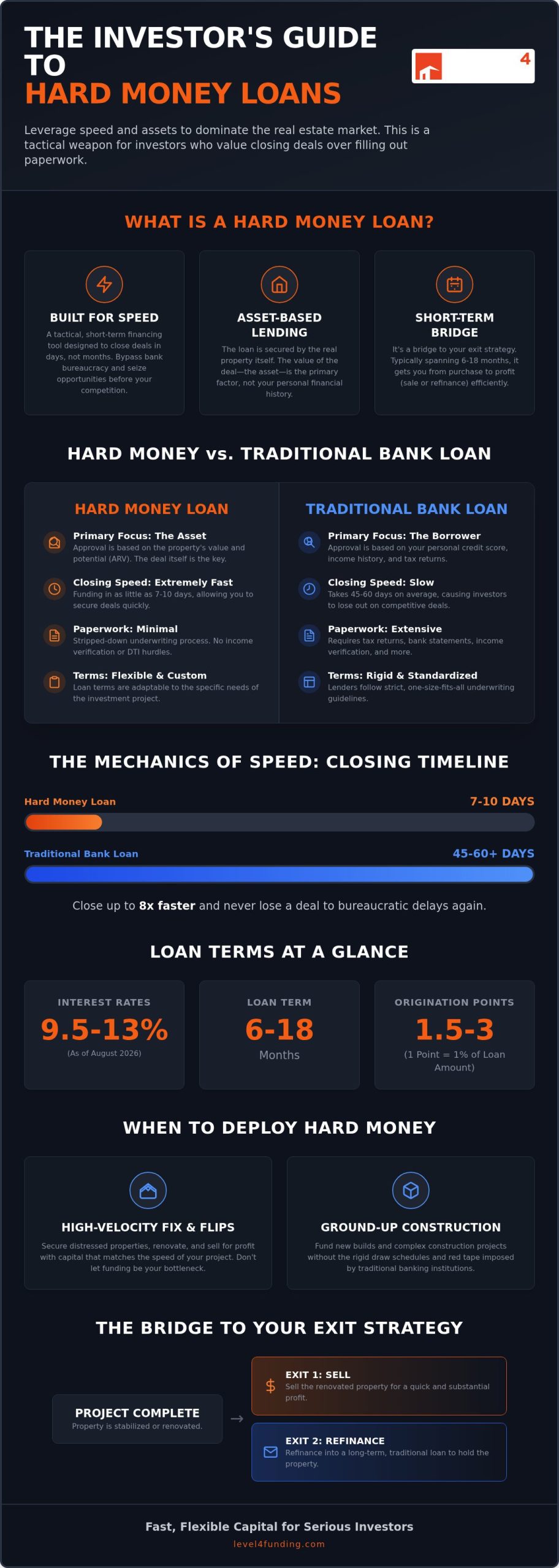
Stop thinking like a consumer and start thinking like a closer. If you’re asking what is a hard money loan, you’re likely tired of the bank’s slow-motion dance. At its core, a hard money loan is a short-term, asset-based financing tool secured by real property. It’s not a long-term commitment. It’s a tactical strike. While traditional banks spend months dissecting your personal life, private lenders look at the collateral first. This is the primary engine for fix and flip and construction projects where timing is everything. Speed is the defining characteristic here. Funding happens in days, not months. This allows you to swoop in and grab deals while other investors are still waiting for a callback. For a deeper look at the technical mechanics, this Hard money loan definition provides the historical foundation of this lending model.
The reality of the current market is simple. If you can’t move fast, you don’t win. Hard money is the shortcut that bypasses the traditional lending gauntlet. It’s about leveraging the equity in a property to secure the capital you need right now. You aren’t begging for a favor. You’re entering a business partnership where the property itself does the heavy lifting. This is why seasoned pros don’t care about the higher interest rates compared to a 30-year mortgage. They care about the profit they’ll make because they were the first ones at the closing table. When you understand what is a hard money loan, you stop seeing it as expensive debt and start seeing it as a high-performance tool for growth.
The Core Difference: Collateral vs. Credit
Traditional loans bet on your income. Hard money bets on the property. Banks want to see three years of tax returns and a perfect FICO score. We want to see a deal with meat on the bone. In this world, your credit score is secondary to the After-Repair Value (ARV). We use the concept of “equity as security.” If the property has value and your plan is sound, the money follows. It’s about the strength of the asset. This shift in focus removes the bureaucratic red tape that kills most investment deals before they even start. You don’t need a perfect pedigree. You just need a perfect deal.
Short-Term Nature: The Bridge to Your Exit Strategy
Don’t treat this like a 30-year mortgage. It isn’t. Hard money is a tool for transition, not long-term holding. Typical loan durations range from 6 to 18 months. It’s the bridge that gets you from a distressed property to a finished masterpiece. You need an exit strategy before you even sign the papers. Most investors follow one of two paths. They either sell the renovated property for a quick profit or refinance into a long-term loan once the work is done. It’s high-octane capital designed to get you in, get the job done, and get you out with your profit intact.
How Hard Money Lending Works: The Mechanics of Speed
Speed isn’t just a luxury. In real estate, it’s the difference between a massive payday and a missed opportunity. If you’re still trying to figure out what is a hard money loan in a practical sense, look at the timeline. Traditional banks take 45 to 60 days. We’re talking about closing in seven to ten days. This happens because the process is built for efficiency, not bureaucracy. How hard money lending works involves stripped-down underwriting that ignores the fluff and focuses on the facts of the deal.
The Asset-Based Underwriting Process
The property is the star of the show. You provide the address and a Pro Forma budget. We look at the current value and the potential After-Repair Value (ARV). Instead of months of financial colonoscopies, we use a Broker Price Opinion (BPO) or a targeted appraisal to verify the numbers. No income verification. No debt-to-income ratio hurdles. No endless requests for documents you already sent. The goal is simple. Does the deal make sense? If the equity is there, the capital is there. This asset-first approach is why “no income verification” is a standard feature. It isn’t a shortcut; it’s a specialized tool for active investors. Before you apply, make sure you understand the exact hard money loan requirements so you can walk in prepared and close faster.
Understanding Points and Interest Rates
Let’s talk about the cost of speed. You aren’t paying for a 30-year relationship; you’re paying for a tactical strike. As of August 2026, interest rates for these loans typically range from 9.5% to 13%. You will also see “points” on the term sheet. These are upfront origination fees, usually between 1.5 and 3 points, paid at closing. One point equals 1% of the loan amount. Don’t let the numbers scare you. Smart investors view these as a line item in their ROI calculation. If paying 2 points gets you a $50,000 profit in six months, the cost of capital is negligible. It’s a trade-off for zero red tape and the ability to scale your portfolio at will.
Once the loan is active, the money doesn’t just sit there. For rehab projects, funds are released in “draws.” You complete a phase of the work, we verify it, and the capital is released. This keeps the project moving and ensures the collateral is protected. If you’re ready to stop jumping through hoops, you can check your deal’s potential with a team that understands the Phoenix market. It’s time to move as fast as the market does.
Hard Money Loan vs. Bank Loan: Choosing the Right Ally
Stop playing small by trying to fit an investment deal into a consumer box. Traditional banks are built for 30-year homeowners, not high-velocity real estate investors. The most glaring difference is speed. A bank will drag you through a 45 to 60 day bureaucratic nightmare. In contrast, hard money lenders can fund your project in 3 to 10 days. Understanding what is a hard money loan means recognizing that it isn’t a backup plan for bad credit; it’s a front-line offensive strategy. While the bank is busy verifying your tax returns from three years ago, we’re already reviewing your property’s potential.
The approval logic is fundamentally different. Banks are borrower-focused. They want to see a perfect FICO score, stable W-2 income, and a low debt-to-income ratio. Private lenders are deal-focused. We look at the asset. If the property has the equity and the numbers work, the loan moves forward. This shift in focus allows you to leverage the deal itself rather than your personal financial history. It turns the property into the engine of your financing rather than a hurdle to overcome. For a comprehensive breakdown of exactly why speed and flexibility give private capital the decisive edge, see our full analysis of the hard money loan vs bank loan decision that separates real estate winners from those still waiting on approvals. Knowing the hard money loan requirements for 2026 gives you a decisive edge when structuring your offer and approaching lenders with confidence.
When the Bank Says “No” to Your Distressed Property
Banks have a strict “Condition Gap” that kills most investment deals. They typically require a certificate of occupancy. If a house is missing a kitchen, has a leaking roof, or lacks flooring, a traditional lender won’t touch it. They want turn-key properties. Investors want “ugly” houses with high profit potential. Hard money thrives in this gap. We provide the capital to buy and rehab the property that the bank refuses to fund. This makes it the essential first step in a BRRRR strategy. You use private capital to fix the asset, then refinance into a bank loan once the property is pretty enough for their rigid standards.
The Opportunity Cost of Waiting for a Mortgage
In a competitive market like Phoenix, waiting for a mortgage is a recipe for failure. If a foreclosure hits the market, you aren’t the only one looking at it. Sellers want certainty and speed. When you show up with hard money backing, your offer is practically “cash-like.” You can close before the bank even finishes their initial intake. If you insist on a traditional loan, you’ll lose the deal to someone who understands what is a hard money loan and how to use it. The interest paid on a short-term bridge is almost always lower than the massive profit lost by letting a prime deal slip through your fingers while waiting for a bank.
When to Use Hard Money: Scenarios for Phoenix Investors
Phoenix isn’t a market for the timid. It’s a high-stakes arena where the fast eat the slow. If you’re still wondering what is a hard money loan in the context of the Valley, think of it as your entry ticket to the most profitable deals in Arizona. Traditional financing is too slow for our sun-drenched suburbs. You need capital that moves at the speed of a desert summer. Whether you’re targeting a gut-reno in Arcadia or a commercial space in Downtown Phoenix, private capital is the only way to play the game at a high level. It’s about having the liquidity to act when the opportunity strikes.
Dominating the Phoenix Fix and Flip Market
Institutional buyers are everywhere. They have deep pockets and zero patience. To beat them, you need to be faster. Hard money allows you to make offers that look like cash. No long-winded bank approvals. No property condition requirements that stall the deal. No endless loops of paperwork. This is especially critical for “heavy lift” renovations. We’re talking about properties with structural issues, outdated systems, or missing essentials. Banks won’t touch these. We thrive on them. Use your local knowledge to evaluate a property in Maryvale or Mesa and get funded before the weekend. This isn’t just about buying a house; it’s about increasing neighborhood value while securing your own profit margin.
Bridge Loans and Cash-Out Refinancing
Success in real estate is about momentum. One deal should feed the next. A cash-out refinance is a powerful tool to pull equity from an existing project to fund your next down payment. Don’t let your capital sit idle. Use a bridge loan to secure a prime Airbnb loans Phoenix investors rely on to lock up Scottsdale short-term rental properties before the peak winter season hits. These short-term solutions provide the breathing room you need to transition into long-term DSCR funding. This logic applies to ground-up construction too. When you have the land but need the build-out capital, hard money bridges that gap. It’s the same for commercial hard money loans. Snag that retail space now, then worry about permanent financing once you’ve stabilized the tenants. You secure the asset first. You optimize the debt later.
The market doesn’t wait for anyone. If you have a deal on the table, you need a partner who knows the Phoenix landscape as well as you do. Stop letting bureaucracy hold you back from your next big win. It’s time to take action. Secure your Phoenix investment funding today and start closing deals in days, not months.
Start Your Deal with Level 4 Funding
You’ve done the research. You finally understand what is a hard money loan and why it’s the ultimate shortcut for serious investors. Now you need a lender that doesn’t blink when a complex deal hits the table. Level 4 Funding isn’t a faceless institution with a 12-person loan committee. We are the decision-makers. When you talk to us, you are talking to the people who sign the checks. No delays. No corporate runaround. Our “No-Nonsense” promise is simple. If the deal makes sense and the collateral is solid, we fund it. We don’t care about your past credit mistakes or your lack of a W-2. We care about your exit strategy and the property’s potential.
Our full suite of products is built for the modern investor. We offer Fix and Flip Loans for rapid turnarounds. We provide Construction Loans for ground-up projects. We handle Commercial Property Loans for investors scaling into commercial hard money loans for those scaling their business portfolios. We even offer Cash Out Refinance and Airbnb loans Phoenix investors use to dominate the short-term rental market without invasive income audits or weeks of waiting. This isn’t a one-size-fits-all shop. It’s a specialized toolkit for people who treat real estate like a business, not a hobby. We provide the leverage you need to beat the banks and outpace the competition.
Our Fast-Track Approval Process
Time is your most valuable asset. Don’t waste it on a mortgage application that looks like a novel. Submit your deal online through our streamlined portal and get a response in hours, not weeks. We keep the paperwork minimal because we focus on what actually matters: the property and your plan. We don’t need to see tax returns from five years ago. We need to see a project that works. This lean approach allows us to close at the speed of business. It keeps your contractors busy and your projects on track. When you work with us, you aren’t just getting a loan; you’re getting a high-velocity partner.
Partnering with a Local Phoenix Ally
Real estate is local. You need a partner who knows the difference between a block in Scottsdale and a street in Mesa. Our deep expertise in the Phoenix and Arizona real estate landscape means we understand ARV and construction costs in this specific dirt. We aren’t guessing from a skyscraper in another state. We’re on the ground in the Valley with you. This local knowledge allows for faster property evaluations and more accurate underwriting. It’s our commitment to the Arizona investor community. Ready to stop waiting and start winning? Apply for your Hard Money Loan today and see what real speed looks like.
Take Control of Your Real Estate Future
The market won’t wait for your bank’s loan committee to finish their morning coffee. You shouldn’t either. By now, you’ve mastered the reality of what is a hard money loan and how it transforms property equity into immediate action. You’ve seen how asset-based approvals prioritize the deal’s potential over your personal history. You’ve learned that closing in days is the only way to beat institutional buyers to the best Phoenix properties. Whether you are tackling heavy-lift fix and flips or ground-up construction, the right capital makes the difference between a massive profit and a missed opportunity.
Level 4 Funding is your direct Phoenix private lender. We provide the specialized funding for fix & flips and construction that traditional banks refuse to touch. We don’t do red tape. We do results. It is time to stop begging for approvals and start dictating your own success. Are you ready to scale your portfolio at the speed of business? Get Your Hard Money Loan Quote in Phoenix Now. The next great Arizona deal is out there. Make sure you’re the one who closes it. You have the tools. Now go take the market.
Frequently Asked Questions
Is a hard money loan a good idea for a first-time investor?
Yes. It is a powerful tool for beginners who lack massive cash reserves but have found a great deal. It allows you to compete with seasoned pros by providing the speed and leverage you need. You don’t need a decades-long track record. You just need a project with clear profit potential. It’s the fastest way to learn the market while protecting your own liquidity and scaling your business.
How much down payment is required for a hard money loan?
Expect to bring 20% to 30% of the purchase price to the table. Some lenders base this on the total project cost, while others focus on the loan-to-value ratio. Your skin in the game ensures everyone is aligned on the project’s success. While some programs offer lower entry points for experienced flippers, having that 20% ready shows you are serious about the execution and the asset.
Can I get a hard money loan with a 500 credit score?
Absolutely. We focus on the property, not your past mistakes. A 500 credit score won’t stop a deal that has strong equity and a clear exit strategy. This is the core of what is a hard money loan; it is a pivot away from personal financial scrutiny toward asset-based reality. If the property value is there, the funding is there. Your score is a footnote, not a deal-breaker.
What happens if I can’t pay back a hard money loan?
The lender takes the property. Because these are asset-based loans, the real estate itself serves as the collateral. If you default, the lender initiates foreclosure to recoup the capital. This is why a sound exit strategy is mandatory. We aren’t in the business of owning your house; we’re in the business of funding your success. Protect your equity by sticking to your renovation timeline and your budget.
Are hard money loans regulated like traditional mortgages?
No. Hard money loans are typically classified as business-purpose loans. They don’t fall under the same consumer protection laws as a 30-year residential mortgage. This lack of red tape is exactly why they move so fast. You are treated as a business entity making a commercial decision. It is a professional transaction that prioritizes speed and flexibility over bureaucratic hand-holding and endless, soul-crushing disclosures.
While the focus here is on the local market, understanding federal tax implications is universal for investors; AHL HardMoney, LLC offers specialized resources on how the IRS views these business-purpose loans.
How do hard money lenders calculate the ARV?
We look at comparable sales of renovated homes in the immediate area. It isn’t a guess. We analyze your Pro Forma budget and the quality of the planned upgrades. A Broker Price Opinion or a specialized appraisal confirms what the property will be worth once the work is finished. This forward-looking value is what drives the loan amount. We bet on the future of the asset, not just its current distressed state.
Can I use hard money for a primary residence?
No. These loans are strictly for investment and business purposes. You cannot use hard money to buy a home you plan to live in. Federal regulations for primary residences are too restrictive for the high-speed, flexible nature of private lending. If you’re looking for a place to hang your hat, go to a bank. If you’re looking to build a real estate empire, you are in the right place.
What are the typical interest rates for hard money in 2026?
In 2026, you will generally see interest rates between 9.5% and 13% for first-position loans. Fix and flip projects usually land in the 9.5% to 12.5% range, while ground-up construction can push toward 13%. These rates have stabilized after the peaks of previous years. Remember, you aren’t paying this for 30 years. You are paying it for a few months to secure a massive profit. It is the cost of high-performance capital.

About the author
Matt has a bachelor's degree in political science from Northern Arizona University and works at Level 4 Funding, a private lending company that offers hard money and rental home loans to real estate investors in 35 states.
With Matt's leadership, the firm has financed almost $300 million in loans for investment properties. He often helps real estate investors with rental property purchases, foreclosures, refinancing, and fix-and-flip projects. Matt has extensive experience in fix-and-flip, buy-and-hold, rental properties, and real estate sales. He has lived in Arizona for 43 years and is married with three children. Matt is licensed as a mortgage broker and loan originator in Arizona, with NMLS 2062278 and NMLS 1118493.
Equal Housing Opportunity. This is not a Good Faith Estimate, and it is not a Guarantee to lend; it should not be considered as such. Costs, rates, estimates, and terms can only be determined after a full application is completed. To the extent this message includes any tax or legal advice, this message is not intended or written by the sender to be used, and cannot be used, for legal or tax purposes or advice. This is an advertisement. Copyright © 2026. All rights reserved.