


Top Phoenix Hard Money Lender for Your Arizona Fix & Flip
October 16, 2026
Michigan Hard Money Lenders: How to Find and Qualify for Private Real Estate Financing in the Great Lakes State
October 17, 2026
What if the wholesale discount isn’t the number that gets your deal funded? For investors seeking financing for wholesale real estate deals Phoenix offers, the stronger question is whether the property and project plan make sense together. A contract may open the door, but a funding request needs to show what you’ll acquire, what work it needs, and how you plan to exit.
It’s reasonable to ask whether a wholesale contract can work with financing and whether the deal can support both acquisition and renovation. A low advertised price doesn’t tell the whole story. Repairs, carrying costs, realistic resale or refinance plans, and the transaction structure all shape the picture. Treat assignment fees and property-project funding as separate budget items unless the financing terms clearly say otherwise.
This guide will help you match financing to the property, assess the deal beyond its discount, and assemble a clear funding request. You’ll learn what to prepare about the contract, property condition, renovation scope, budget, and exit plan. For a wholesale-sourced property that needs acquisition and renovation capital, Level 4 Funding’s fix and flip financing is a private funding path to consider.
Key Takeaways
- Compare funding paths by how they address your capital needs, documentation, flexibility, and trade-offs, not by headline appeal alone.
- Strengthen your deal analysis with documented property condition, realistic renovation estimates, relevant comparable sales, and a clear exit plan.
- Prepare a focused funding request with parcel details, contract information, property access, condition evidence, and a project summary.
- Use financing for wholesale real estate deals Phoenix investors pursue to support a defined property investment plan, rather than relying on the advertised discount as proof of a strong deal.
- When a wholesale-sourced property needs renovation, consider whether fix and flip financing fits the acquisition and project scope.
Financing for Phoenix wholesale real estate deals: what the funding is meant to cover
A wholesale-sourced property can look like one deal, but its funding needs may involve several different costs. You may need capital to acquire the property, funds for renovations and closing expenses, and a separate plan for any payment tied to the contract. Financing for wholesale real estate deals Phoenix investors pursue depends on the transaction structure, property condition, and project plan, not just the advertised price.
Start by separating the contract opportunity from the property investment. A wholesaler sources a purchase agreement with a seller and may transfer contractual rights to an investor for an assignment fee. In another general structure, the wholesaler buys the property and then resells it to the investor in a separate closing. These are broad descriptions, not a substitute for reviewing the actual documents. Arizona-specific contract and disclosure questions should be reviewed by qualified local real estate professionals.
How a wholesale property transaction differs from a standard purchase
In a direct purchase, the investor typically negotiates to buy from the property owner. In a wholesale-sourced transaction, a wholesaler has helped source or control the contract, while the investor becomes the intended end buyer. The seller, investor, wholesaler, and closing professionals each have distinct roles, and the paperwork should make the parties and transfer structure clear. For general background on the concept, see Wholesaling. Don’t assume every lender or loan type supports every contract structure. Review the documents and financing terms together.
What investors may mean by wholesale deal financing
“Wholesale deal financing” can mean different things. Acquisition financing helps fund the property purchase. Renovation financing addresses planned work, while short-term transaction funding refers to capital used for a brief period around a transaction. These needs aren’t interchangeable. Your funding plan should state which project costs each source is intended to cover.
Assignment-fee treatment depends on the transaction documents and financing terms. Don’t treat a fee as part of the property purchase price or assume it will be financed. Level 4 Funding provides private real estate financing, including fix and flip loans, for investors evaluating acquisition and renovation capital for a wholesale-sourced property.
- Acquisition: Identify the purchase amount and contract structure.
- Renovation: Build a separate scope and budget based on the property’s actual condition.
- Closing: Account for transaction expenses as their own line items.
- Contract-related payments: Document what is owed, to whom, and under which agreement.
A discounted asking price alone doesn’t establish financing fit. A property discount is only an entry point; a financeable investment plan connects the contract, verified condition, renovation budget, and exit strategy. A deal with a sharp discount can still fall short if repairs are underestimated, transaction costs are missing, or the planned exit doesn’t support the full project.
How lenders assess a Phoenix wholesale property and its renovation plan
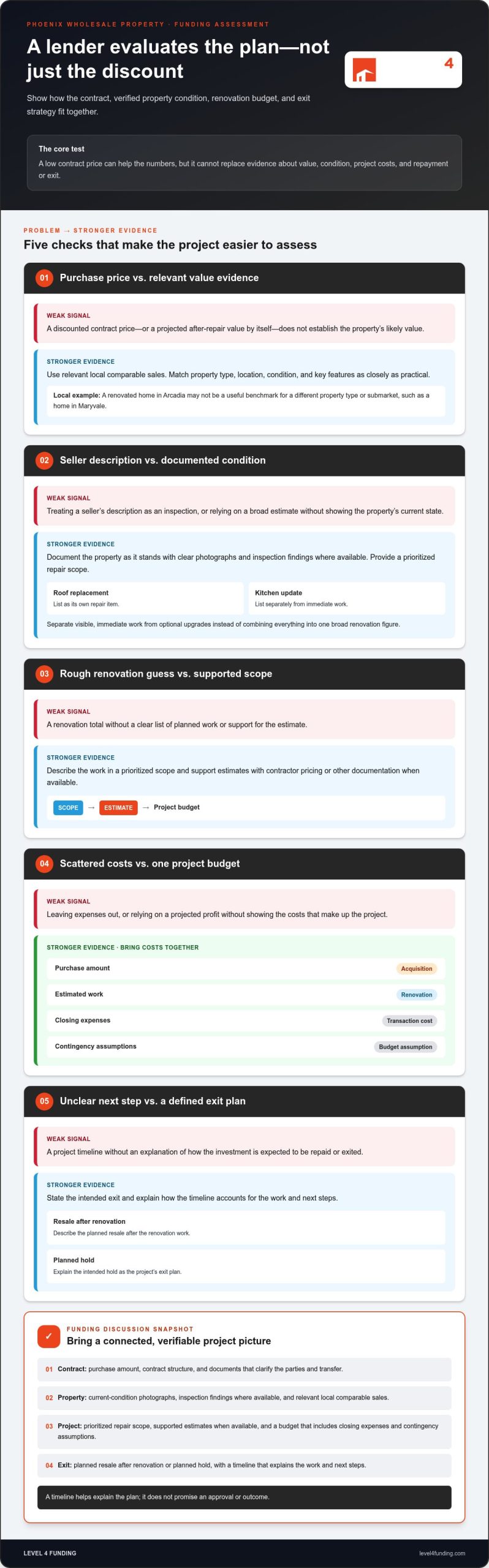
A lender’s funding discussion is built around the whole project: the purchase contract, the property’s current condition, the work planned, and how you expect to repay or exit. A low contract price can help the numbers, but it can’t replace evidence. For financing for wholesale real estate deals Phoenix investors should present verifiable details, not just a projected profit or a wholesaler’s estimate.
A lender evaluates the investment plan behind the property, not just the discount on the purchase price. Separate what you know from what you’re assuming. A seller’s description is not an inspection. An investor’s projected after-repair value is not a set of comparable sales. A rough renovation guess is not a contractor estimate.
Property value, condition, and comparable sales
Build your value estimate from relevant local comparisons. A renovated home in Arcadia may not be a useful benchmark for a different property type or submarket, such as a home in Maryvale. Match the property type, location, condition, and key features as closely as practical. For deeper guidance on after-repair value, see the published ARV hard money loan article.
Document the property as it stands now. Share clear photographs, inspection findings where available, and a prioritized repair scope. Separate visible, immediate work from optional upgrades. If the roof needs replacement and the kitchen needs updating, list those as distinct items rather than combining them in one broad renovation figure.
Project budget, borrower plan, and exit strategy
Put the purchase amount, estimated work, closing expenses, and contingency assumptions into a single project budget. Support estimates with contractor pricing or other documentation when available. Then describe the intended exit, such as resale after renovation or a planned hold. Your timeline should account for the work and next steps. It helps explain the plan but doesn’t promise an approval or outcome.
Fix and flip loans may be relevant when an acquisition includes planned renovations. A clear scope and exit plan help frame a request for this type of project financing. Learn how fix and flip financing can relate to an investor’s acquisition and renovation plan.
- Documented facts: Contract terms, property photos, inspection findings, and comparable sales.
- Project estimates: Repair scope, contractor estimates, contingency assumptions, and timeline.
- Investor plan: Intended resale or hold, with a realistic explanation of how the project reaches that exit.
Keep short-term transaction funding separate from acquisition or renovation financing. It serves a different purpose and may involve a different structure. For general background on that concept, Ramp explains transactional funding for real estate wholesalers. State clearly which costs your funding request addresses and which are covered another way.
Wholesale deal financing compared: cash, private lending, and other funding paths
A wholesale discount doesn’t automatically make a property financeable. The right capital source depends on what you’re buying, the work required, the contract structure, and how you plan to complete the project. Compare options against those needs, not against a promise that one route is always faster, cheaper, or better. For an overview of the transaction type, Wholesale Real Estate Explained provides additional context.
Cash
Capital source: The investor’s available funds.
Typical use: Property acquisition and, if resources allow, project expenses.
Documentation: No lender underwriting process, though the transaction still requires clear purchase documents and closing details.
Flexibility and trade-offs: Cash avoids a lender financing process, but using it ties up liquidity that could be needed for repairs, reserves, or other investments.
Conventional financing
Capital source: A mortgage lender using its own underwriting process.
Typical use: Property purchases that fit the lender’s program and the borrower’s qualifications.
Documentation: Expect a process that may involve borrower financial information, property details, and contract documents.
Flexibility and trade-offs: Requirements and fit depend on the specific loan and property. A wholesale contract or renovation plan may need particular attention in underwriting.
Private asset-based financing
Capital source: Private real estate financing assessed with attention to the property and investment plan.
Typical use: Investment-property acquisition, renovation, or both, depending on the project and financing terms.
Documentation: The property, contract, work scope, budget, and exit plan help explain the request.
Flexibility and trade-offs: It can be an alternative funding path for investors, but terms and fit depend on the deal. It isn’t automatic approval.
When cash or conventional financing may suit the deal
Cash can make sense when an investor wants to avoid a lender’s financing process and can preserve enough liquidity for the full project. Spending available cash on the purchase may leave less room for repairs and reserves, so plan for those costs before committing funds. Conventional financing follows a different documentation and underwriting path. Assess whether its process and property requirements fit the actual transaction. Neither route is universally superior.
Where private real estate financing may fit
Private asset-based financing may suit an investor seeking capital for an investment property or planned improvements. Fix and flip financing is relevant when acquisition includes renovation work, with the project scope and exit plan central to presenting the deal. Assignment-fee financing is a separate consideration: property acquisition funding doesn’t automatically cover a contract assignment fee. Explore private real estate financing as you compare options for your project.
For financing for wholesale real estate deals Phoenix investors are evaluating, map each funding source to a specific cost. Acquisition, renovation, closing expenses, and any contract-related payment shouldn’t be treated as one undifferentiated number. A line-item budget can reveal a funding gap before it disrupts the plan.
Phoenix wholesale deal financing checklist: prepare before pursuing the property
Organize the facts before you commit time or capital. A complete package makes it easier to see what the transaction involves, what the property needs, and how the project is meant to work. For financing for wholesale real estate deals Phoenix investors pursue, preparation starts with accurate documents, not optimistic assumptions.
Gather the property and transaction documents
Build a file for the specific parcel and contract. Keep original documents and estimates together, label them clearly, and note any information that’s still outstanding. This gives you a practical view of the deal before presenting the project.
- Review the purchase contract. Record the parties, property description, price, deadlines, and any conditions that affect the proposed transaction. Include assignment documents if the deal uses an assignment structure.
- Confirm parcel details. Collect the property address and parcel number, then use Maricopa County property records as a research source. Verify that the parcel information is current and matches the property and contract.
- Organize title and closing details. Gather available title information and identify the closing professionals involved. Have qualified professionals review the transaction documents and any Arizona-specific requirements that apply to your structure.
- Document access and condition. Write down how property access is arranged and collect current photos, inspection information, and other condition evidence. Don’t present an assumption about repairs as a verified finding.
- Support the work estimate. Create a repair scope that separates major items from optional improvements. Add contractor estimates or other supporting details where available, and identify open questions rather than hiding them in a lump-sum figure.
- Gather comparable-sale support. Choose sales that reflect the property’s type, condition, and location. Broad metro figures can obscure important differences between Phoenix neighborhoods and nearby markets.
Present a credible Phoenix investment plan
Turn the documents into a short project summary. Show the purchase assumptions, planned renovation milestones, cost categories, contingency approach, and intended exit, such as resale or a hold. Keep estimates visibly separate from confirmed facts. A realistic sequence of work helps explain how the project could progress without implying a particular financing decision or outcome.
Make the comparison local. A property in Phoenix should be assessed against relevant Phoenix submarket evidence. Tempe or Mesa sales may be useful only when they’re genuinely comparable to the property and intended buyer or rental market. Apply the same test to nearby markets such as Scottsdale, Glendale, and Buckeye, and to properties in Tucson, Sedona, or Flagstaff. Explain why each selected sale is relevant, and flag differences in condition or features instead of treating every nearby sale as equivalent.
A strong deal package brings together the contract, parcel and title details, access and condition evidence, repair scope, comparable sales, budget, and exit plan. Use that as your final completeness check before presenting the opportunity. An organized file won’t erase project risk, but it can make the plan easier to understand and evaluate.
Once your documents and project summary are ready, explore private real estate financing for investors as a potential path for an acquisition with planned improvements.
Explore Level 4 Funding for a Phoenix wholesale-sourced investment property
You’ve identified the property. Now connect the contract to a realistic plan for acquiring and improving it. Level 4 Funding provides private real estate financing for investors in Phoenix and other Arizona markets, including Scottsdale, Tucson, Glendale, Sedona, Flagstaff, Tempe, Mesa, and Buckeye. A clear project summary gives the financing conversation something solid to work from: the property, the proposed transaction, the work, and your intended exit.
Match the funding conversation to the project
If the property needs planned renovations after acquisition, fix and flip financing may be relevant to the project. The discussion should reflect the actual scope of work and how the acquisition and improvements fit together. A property requiring substantial construction may call for a different financing conversation than a light renovation, while a commercial property investment has its own project context. Loan structure depends on the deal details and applicable terms.
Level 4 Funding offers fix and flip, construction, and commercial property financing. Those options give investors different starting points for discussing a property project. The goal isn’t to force a deal into a label. Describe what you’re buying, what you plan to do with it, and how the proposed funding relates to that plan. Don’t assume a financing option covers every cost or feature of a wholesale transaction. Present the documents and distinguish property costs from other contract-related payments.
That distinction matters. A wholesale-sourced contract may have its own transaction structure, while the investment project centers on acquiring and improving the property. Keep the two clear in your summary. State what the purchase documents say, identify the renovation plan, and make your expected use of capital understandable without relying on the advertised discount as the whole case.
Take the next step with a complete deal summary
Before exploring financing for wholesale real estate deals Phoenix investors are considering, bring the moving parts into one concise package. Include the property address and parcel details, contract and transaction structure, available condition evidence, renovation scope, budget assumptions, and intended resale or hold plan. Separate confirmed information from estimates. If a figure is preliminary, label it that way.
A practical summary can also outline key renovation milestones and explain how they support the planned exit. Keep the timeline realistic, and make sure the budget and project plan tell the same story. For broader preparation guidance, consult the hard money loan approval process article alongside your project materials.
Level 4 Funding provides private real estate financing for investors. Bring a defined investment plan to the financing conversation and keep the focus on the property and project. Present the deal details clearly, without treating estimates as certainty.
Explore financing options with Level 4 Funding for your Phoenix investment project.
Turn your next Phoenix opportunity into a clear funding plan
The next move isn’t chasing every discounted property. It’s choosing an opportunity whose contract, condition, renovation plan, and exit strategy support a disciplined investment decision. Strong financing for wholesale real estate deals Phoenix investors pursue starts with a clear view of the project and the capital it may require.
Level 4 Funding provides private real estate financing for investors in Phoenix and nearby Arizona markets, including Scottsdale, Tucson, Glendale, Sedona, Flagstaff, Tempe, Mesa, and Buckeye, with fix and flip loans as its primary service. If your wholesale-sourced property includes planned improvements, bring your project details into the financing conversation. Keep your assumptions visible, your documents organized, and your goals grounded in the property itself.
Explore financing options with Level 4 Funding and take the next step toward a funding plan built around your investment project.
Frequently Asked Questions
Can you finance a wholesale real estate deal in Phoenix?
Yes, private real estate financing may help fund a wholesale-sourced property purchase and, depending on the project and loan terms, planned improvements. The contract structure and the property’s investment plan matter. For financing for wholesale real estate deals Phoenix investors are considering, distinguish costs tied to acquiring the property from separate contract-related payments. A Phoenix property with a clear transaction, documented condition, and realistic investment plan gives the funding discussion useful context.
Do hard money lenders finance wholesale assignment fees?
Assignment-fee treatment depends on the lender and loan terms, so don’t assume a fee is included in property financing. Keep the fee identified separately in your transaction budget and review how it appears in the contract documents. This distinction helps investors avoid treating the cost of acquiring contractual rights as though it were automatically part of the property purchase loan.
What documents do I need to finance a wholesale property?
Prepare the signed purchase agreement and any assignment paperwork, plus the property address, parcel details, and available title information. Add access arrangements, current photos, inspection records, a repair scope, and contractor estimates. Include relevant comparable sales and a project budget with your intended exit. Keep documents organized by topic and label estimates as estimates. For a Phoenix-area property, make sure the parcel information matches the address and transaction paperwork.
Will a wholesale discount guarantee approval for a real estate loan?
No. A discount is not a guarantee of loan approval. A low contract price may still leave important questions about the property’s condition, transaction documents, renovation costs, or the plan for repaying the loan. Don’t treat the spread between purchase price and projected resale value as confirmed profit. Build your request around supportable figures and a coherent project plan; financing decisions depend on the full deal and applicable terms.
Can I use fix and flip financing for a wholesale property in Phoenix?
Fix and flip financing may be relevant if you’re acquiring a Phoenix wholesale-sourced property with planned renovations. The project summary should make clear what work is intended, how the budget was developed, and what exit you’re planning. Level 4 Funding offers fix and flip loans for real estate investors. Whether a particular structure fits depends on the property, transaction details, and applicable loan terms, not simply on the fact that the property came through a wholesaler.
How do lenders evaluate the value of a Phoenix wholesale property?
Lenders may consider the property’s current condition and relevant comparable sales as part of evaluating an investment request. Choose sales that resemble the property in type, location, and condition; a sale in a different Phoenix submarket may not be a useful comparison. Note meaningful differences, such as renovation level or property features, rather than relying on a metro-wide average. Clear photos and inspection findings can help show how the property’s present condition relates to your estimates.
What is the difference between wholesale deal financing and transactional funding?
Wholesale deal financing is a broad term for capital used in a real estate investment, such as acquiring a property or funding renovations, subject to the loan’s terms. Transactional funding generally refers to short-term funding used to facilitate a transaction involving closely timed purchases and resales. It serves a different purpose from a renovation loan. Keep the transaction structure and the specific costs each funding source covers clearly separated in your project plan.

About the author
Matt has a bachelor's degree in political science from Northern Arizona University and works at Level 4 Funding, a private lending company that offers hard money and rental home loans to real estate investors in 35 states.
With Matt's leadership, the firm has financed almost $300 million in loans for investment properties. He often helps real estate investors with rental property purchases, foreclosures, refinancing, and fix-and-flip projects. Matt has extensive experience in fix-and-flip, buy-and-hold, rental properties, and real estate sales. He has lived in Arizona for 43 years and is married with three children. Matt is licensed as a mortgage broker and loan originator in Arizona, with NMLS 2062278 and NMLS 1118493.
Equal Housing Opportunity. This is not a Good Faith Estimate, and it is not a Guarantee to lend; it should not be considered as such. Costs, rates, estimates, and terms can only be determined after a full application is completed. To the extent this message includes any tax or legal advice, this message is not intended or written by the sender to be used, and cannot be used, for legal or tax purposes or advice. This is an advertisement. Copyright © 2026. All rights reserved.