


Short-Term vs. Long-Term Hard Money Loans: Which Structure Fits Your Investment Strategy?
September 26, 2026Owner-Occupied Hard Money Loans: What They Are, Who Qualifies, and Where to Find Them
September 27, 2026
If you’re asking, “how does hard money lending work,” the answer starts with the deal itself. A hard money lender reviews the investment property that may secure the loan, along with the project’s numbers and your plan to repay. The property matters, but it doesn’t guarantee approval or funding.
It’s reasonable to want clarity before putting an investment property on the line. Hard money financing can involve unfamiliar costs, deadlines, and repayment terms, so a quick decision isn’t always the right one. Before you proceed, understand what the lender is reviewing and whether the loan structure fits your project.
This guide follows the process from sharing property details and undergoing underwriting to reviewing terms, closing, receiving funds, and repaying the loan. You’ll learn what to prepare about the property, project budget, timeline, and exit strategy, plus what to examine before signing. The goal is to assess whether the financing and payoff plan make sense for your Arizona deal before you commit.
Key Takeaways
- Understand how hard money lending works by following the deal from property review and underwriting through closing, funding, and repayment.
- Prepare key details about the property, purchase, planned work, experience, and intended payoff strategy for lender discussions.
- Compare written terms carefully, including interest, origination charges, draw rules, maturity, and possible extension conditions.
- Review the steps and timing with the lender, since requirements vary by lender and transaction.
- Plan a realistic exit through sale or refinance, and confirm the payoff amount and coordination steps before the loan comes due.
How does hard money lending work, from property review to repayment?
From the borrower’s side, hard money lending begins with a private lender reviewing an investment deal, the property that may secure the loan, and the borrower’s plan to repay. The property matters, but it doesn’t guarantee approval or funding. The lender must assess whether the overall deal and proposed loan structure make sense.
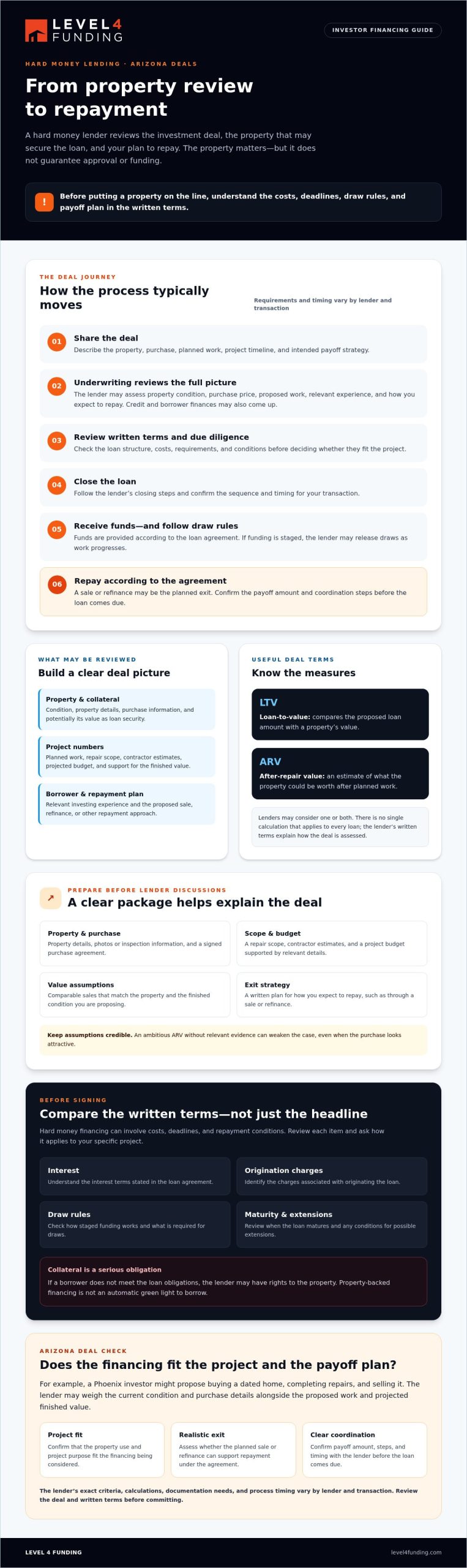
The process typically moves from an initial deal review to underwriting, written terms, due diligence, and closing. Funds are then provided according to the loan agreement. If the project uses staged funding, the lender may release draws as work progresses. Repayment follows the agreed plan, often through a sale or refinance. For a broader overview, see what a hard money loan is.
For another overview of the concept, watch this video:
What does property-backed financing mean?
Collateral is an asset pledged to secure a loan. With property-backed financing, real estate may serve as collateral. If the borrower doesn’t meet the loan obligations, the lender may have rights to the property. That’s a serious risk, not an automatic green light to borrow.
Lenders may consider loan-to-value (LTV), which compares the loan amount with a property’s value. For a renovation project, they may also look at after-repair value (ARV), an estimate of what the property could be worth after planned work. There’s no single formula every lender uses. For example, a Phoenix investor might propose buying a dated home, completing repairs, then selling it. The lender may weigh its current condition and purchase details alongside the proposed work and projected finished value. A hard money loan is still subject to review of the deal and the borrower’s repayment plan.
Who uses hard money loans, and for what deals?
Real estate investors may explore hard money financing for acquisitions, renovations, construction, or other eligible investment projects. Level 4 Funding offers fix-and-flip, construction, and commercial property financing. Whether a loan is a fit depends on the specific property, project, and proposed terms.
This is different from consumer-purpose or personal borrowing. Be clear about how the property and loan proceeds will be used, then confirm that purpose with the lender. Before proceeding, understand the full sequence: review the deal, examine written terms, close, follow any draw requirements, and repay according to the agreement.
What a hard money lender reviews before making a loan decision
Underwriting is a deal-specific review, not a universal checklist. A lender may look at the property’s condition, purchase price, proposed work, your relevant investing experience, and how you expect to repay. Credit and borrower finances may also come up, but don’t assume one factor alone decides the outcome.
A lender’s exact criteria, calculations, and documentation requirements vary. Ask what information is needed for your particular project, then prepare a clear, consistent package. A signed purchase agreement, property details, photos or inspection information, a repair scope, contractor estimates, and a written exit plan can help explain the deal. For a deeper preparation checklist, review hard money loan requirements.
How collateral and project numbers shape underwriting
LTV, or loan-to-value, compares a proposed loan with a property’s value. ARV, or after-repair value, is an estimate of what the property may be worth after planned work. Lenders may consider one or both, but there’s no single calculation for every loan. A hard money overview can help clarify the general financing concept. The lender’s written terms explain how it applies to your deal.
Support your assumptions with relevant details. If you’re buying a dated Phoenix property, show what needs repair, how the renovation scope addresses it, and how contractor estimates support the projected budget. Choose comparable sales that match the property and the finished condition you’re proposing. An ambitious ARV without credible evidence can weaken the case, even if the purchase looks attractive.
Experience may help a lender understand whether you can execute the plan, but don’t assume a universal experience or credit-score threshold. Explain your role, relevant completed projects, and who will handle the work. Clear documentation is more useful than vague promises.
Why the exit plan matters
The lender also needs to understand how the loan could be repaid. Common investor plans include selling the completed property or refinancing, if eligible and available under future conditions. Neither is guaranteed. Your projections are assumptions, not promises from a future buyer, appraiser, or refinance lender.
Pressure-test the timeline. Could permitting, contractor delays, repairs, or slower sales extend the project? Account for carrying costs throughout that period. Consider what happens if the property sells for less than projected or refinancing isn’t available on expected terms. A credible backup plan helps show whether the deal can withstand a setback.
For information about potential Arizona investment deals, review Level 4 Funding’s hard money lending information and compare the lender’s requested documents and proposed terms with your project plan.
Hard money loan terms, costs, and risks: what to assess before signing
A deal can look solid on paper and still become expensive if the loan terms don’t match the project timeline. Before signing, look beyond the headline interest rate. Understand when payments are due, how renovation funds are accessed, what happens at maturity, and what you’ll owe to repay the loan. The details belong in the written agreement, not just in a conversation.
For more background on pricing concepts, see hard money loan rates and capital costs. Your actual terms depend on the specific offer. Compare the total repayment obligation and confirm every term in the signed documents.
Which terms should investors examine?
Use this table as a review guide, not a quote. Ask the lender to explain each item and show where it appears in the proposed documents.
| Term | What to clarify |
|---|---|
| Interest | How it accrues, when payments are due, and whether payments are interest-only or include principal. |
| Points and origination charges | Whether points are charged, how they’re calculated, when they’re due, and whether they’re separate from other lender fees. |
| Lender and third-party costs | Request an itemized breakdown that distinguishes lender charges from closing expenses paid to outside providers. |
| Draw rules | Confirm whether renovation funds are advanced upfront or released in draws, and what documentation or inspections each draw requires. |
| Maturity and extensions | Check the payoff deadline, whether an extension is possible, its conditions, and any added costs. |
Also read the default and prepayment language. Find out what counts as a missed obligation, what remedies the agreement allows, and whether paying off early changes the amount due. Ask for a written payoff illustration if the calculation isn’t clear. Don’t rely on a verbal summary when the signed documents say something different.
What can go wrong if the project runs late?
Renovations can take longer than planned. Contractor availability, unexpected repairs, or approval delays can push back the schedule and add carrying costs. A lower-than-expected appraisal may also affect a refinance plan, while slower resale activity can delay the sale you’re counting on.
How does hard money lending work when the exit slips? The loan still has terms and a maturity date. A sale or refinance may not happen on your preferred timeline, and neither outcome is guaranteed. Build a contingency into the project budget and schedule, and decide what you’ll do if the original exit becomes impractical. Consider asking a qualified legal or tax professional to review questions specific to your transaction.
The hard money loan process in Arizona, step by step
Once you’re ready to discuss a Phoenix-area deal, expect a sequence of milestones, not a guaranteed timeline. Lender procedures, documentation, property details, and transaction conditions vary, so ask what applies to your project. For local context, see this guide to hard money lending in Phoenix.
The core stages are deal inquiry, document collection, lender review, written terms, due diligence, and closing. Here’s what to prepare and confirm at each step.
- Start with the deal. Share the property location, purchase details, intended use, project scope, estimated budget, and planned exit. Ask the lender whether the proposed investment fits its loan offerings and what it needs to evaluate next.
- Gather property and borrower information. Organize the purchase agreement or acquisition details, available property records, photos or inspection information, scope of work, contractor bids, and exit assumptions. Ask for the lender’s current application and documentation checklist rather than relying on a generic list. Keep figures consistent across your materials.
- Submit the deal for review. The lender may assess the property, project, borrower information, and repayment plan, then request clarification or additional documents. For a property in Phoenix, Scottsdale, Tucson, or another Arizona market, verify local property details and transaction requirements with the relevant professionals.
- Review written terms and due diligence. A term sheet can outline a proposed structure, but it isn’t a substitute for reading the final loan documents. Confirm the terms, conditions, and any outstanding items before proceeding. Ask what valuation or insurance information is needed, and whether entity documents, title review, or other due diligence applies to your transaction.
- Coordinate closing. Before signing, confirm with the lender and closing professionals how title, escrow, recording, and property-specific requirements will be handled. These details can depend on the transaction. Have qualified Arizona professionals verify legal and recording questions. Don’t rely on assumptions or a verbal summary.
What to prepare before submitting a deal
A well-organized file makes it easier to identify gaps early. Bring your purchase details, available property records, a defined scope of work, contractor estimates, and realistic assumptions about the exit. If an estimate or projection is preliminary, label it clearly. That gives the lender a more accurate picture and helps you spot what still needs support.
Before closing, compare the final documents with the terms you discussed and resolve questions in writing. Processes and timing vary by lender and deal, so avoid building a purchase or construction schedule around an assumed closing date. For a potential Arizona investment property, review Level 4 Funding’s hard money loan information and the details you’ll need to prepare.
Repayment, project exit, and choosing an Arizona hard money lender
Financing isn’t finished when the funds arrive. Before closing, make sure your repayment plan fits the loan’s actual terms and the project’s realistic timeline. Hard money may offer investors access to capital for a deal, but it also comes with deadlines and repayment obligations. A sale or refinance may be a workable exit, not a guaranteed one.
How does repayment and payoff typically work?
Your executed loan documents control the payment schedule, maturity date, payoff requirements, and other repayment obligations. Follow those terms throughout the project, even if construction, leasing, or a potential sale takes longer than expected.
If you plan to sell, proceeds may be used to pay off the loan when the sale closes. If you plan to refinance, the new financing must be available and sufficient to cover the payoff. Neither outcome is certain, so don’t wait until the loan is due to check whether your exit remains realistic.
Contact the lender early to request current payoff instructions and confirm the amount required for your intended payoff date. Ask how long a payoff figure remains valid, what payment method and timing are required, and how the lender confirms the loan has been satisfied. Verify all amounts directly with the lender and coordinate with the closing professionals handling the sale or refinance.
How to assess whether a lender fits your Arizona deal
Compare more than the proposed loan amount. Review the written terms, the fit with your project, how clearly the process is explained, and how draw administration will work if renovation funds are released in stages. Ask direct questions before you commit:
- What documents or updates are needed to request a draw, and how are draw decisions communicated?
- Who should you contact with questions during the project, and what communication should you expect?
- Are extensions available, and what written conditions or costs apply?
- How early should you request payoff instructions, and what steps complete the payoff?
Clear answers matter. So does a lender who can explain how the proposed structure fits your investment plan without treating a projected sale or refinance as a sure thing. Level 4 Funding focuses on private real estate financing, including fix-and-flip, construction, and commercial property loans. If your project is in Phoenix, Scottsdale, Tucson, Glendale, Sedona, Flagstaff, Tempe, Mesa, or Buckeye, confirm the requirements for your particular property and transaction rather than assuming every deal works the same way.
Keep the exit plan in view from the start. For an Arizona investment scenario, review Level 4 Funding’s real estate investment financing alongside the terms and payoff plan for your deal. A conversation can help you explore whether its hard money lending may fit the project, but it doesn’t guarantee approval or specific terms.
Move forward with a clear plan for your Phoenix deal
So, how does hard money lending work in practice? A lender reviews the property, project, borrower information, and proposed exit before setting out terms. Your job is to prepare credible deal details, understand every cost and obligation in the written documents, and make sure the repayment plan can handle delays or a change in market conditions.
That clarity matters because property-backed financing can offer flexibility for an investment project, but it also brings deadlines and repayment responsibilities. A planned sale or refinance is an exit strategy, not a guaranteed outcome. Base your decision on the actual terms and a realistic backup plan.
Level 4 Funding specializes in private financing for real estate investors, with offerings that include fix-and-flip, construction, and commercial property loans. If you’re weighing an investment in Phoenix or another Arizona market, discuss your real estate investment deal with Level 4 Funding. Bring your property details, budget, timeline, and payoff plan to explore whether its hard money lending may fit your project.
Frequently Asked Questions
How does hard money lending work, step by step?
Hard money lending typically moves from deal inquiry to property and borrower review, written terms, due diligence, closing, and repayment. The lender assesses the investment property as potential collateral and reviews the project and proposed exit. If renovation funds are included, confirm whether they’re provided upfront or through draws. For a Phoenix or Mesa deal, prepare purchase details, a work scope, budget, and payoff plan, then check every obligation in the final loan documents.
Is hard money lending based more on the property or the borrower?
The property is a central part of the review, but it isn’t the only factor. A lender may consider its condition and value, the purchase details, planned work, borrower experience, and ability to carry out the project and repay. Each lender’s criteria differ. In Scottsdale, Tempe, or Buckeye, for example, a property’s potential value won’t guarantee approval if the budget, project assumptions, or exit plan don’t support the proposed loan.
Can you use a hard money loan to buy and renovate an investment property?
Some hard money loans are structured for eligible investment acquisitions and renovations, but the lender and loan terms determine what a particular offer covers. Clarify whether renovation costs are included, how work funds are released, and what documentation or draw conditions apply. Level 4 Funding offers fix-and-flip loans. Confirm that the property’s intended use and project scope, whether in Glendale or Sedona, fit the lender’s current requirements.
How much does a hard money loan cost?
There’s no single cost that applies to every deal. Review the interest rate, points or origination charges, lender fees, third-party closing expenses, payment structure, and any costs tied to draws, extensions, or early payoff. Ask for an itemized written breakdown and compare the total amount you may owe over the planned loan period. The signed documents control, so resolve unclear charges before closing rather than relying on verbal estimates, whether the property is in Tucson or elsewhere.
What happens if a hard money loan is not repaid by its maturity date?
If you can’t repay by maturity, the consequences depend on the executed loan documents. The agreement may describe default provisions, additional costs, extension conditions, and the lender’s available remedies, which can put the secured property at risk. Don’t assume an extension will be available. Contact the lender early if your sale or refinance is delayed, request written options and current payoff information, and consider getting legal advice about your specific agreement in Flagstaff or another Arizona market.
How long does it take to close a hard money loan?
Closing time varies by lender, property, transaction, and how quickly required information and due diligence are completed. A purchase agreement, property records, borrower or entity documents, valuation, insurance, title work, and closing conditions can all affect the schedule. Ask the lender what steps remain and what could delay them. Don’t commit to a purchase or construction timeline based on an assumed closing date until the lender and closing professionals confirm the schedule for your Arizona deal.
Do Arizona hard money lenders require an appraisal or property inspection?
Requirements vary by lender and property. A lender may request a valuation, appraisal, inspection, photos, or other information to assess the property and project, but don’t assume one method or checklist applies to every Arizona loan. Ask what’s required, who arranges it, and whether the review addresses the property as-is, planned renovations, or both. For properties in Phoenix, Tucson, Glendale, Scottsdale, Tempe, Mesa, Sedona, Flagstaff, or Buckeye, confirm transaction-specific requirements with the lender and closing professionals.

About the author
Matt has a bachelor's degree in political science from Northern Arizona University and works at Level 4 Funding, a private lending company that offers hard money and rental home loans to real estate investors in 35 states.
With Matt's leadership, the firm has financed almost $300 million in loans for investment properties. He often helps real estate investors with rental property purchases, foreclosures, refinancing, and fix-and-flip projects. Matt has extensive experience in fix-and-flip, buy-and-hold, rental properties, and real estate sales. He has lived in Arizona for 43 years and is married with three children. Matt is licensed as a mortgage broker and loan originator in Arizona, with NMLS 2062278 and NMLS 1118493.
Equal Housing Opportunity. This is not a Good Faith Estimate, and it is not a Guarantee to lend; it should not be considered as such. Costs, rates, estimates, and terms can only be determined after a full application is completed. To the extent this message includes any tax or legal advice, this message is not intended or written by the sender to be used, and cannot be used, for legal or tax purposes or advice. This is an advertisement. Copyright © 2026. All rights reserved.