


Hard Money Lenders for Rental Property: How to Finance Your Buy-and-Hold Strategy With Private Capital
October 6, 2026
How to Calculate DSCR: The Debt Service Coverage Ratio Formula Every Real Estate Investor Needs
October 7, 2026
Could a 500 credit score hard money lender in Phoenix still consider your real estate deal? A low score can make financing feel out of reach, but it doesn’t tell the whole story. Private real estate lending may weigh the property and project alongside your credit, so it helps to prepare the full deal for review.
A 500 score is one signal, not a complete picture. The property, renovation plan, available funds, investment experience, and repayment strategy can all shape a financing discussion. None guarantees approval, but organizing these details helps you assess whether your project is ready to discuss.
This guide explains how credit may factor into hard money lending, what deal details to prepare, and how to take a practical next step with an Arizona investment property. Level 4 Funding provides private, asset-based real estate financing, including fix and flip loans. You’ll learn what to bring to the conversation and how a clear plan can put your project in context.
Key Takeaways
- A 500 credit score alone doesn’t establish whether an investment loan will be approved or declined. Lender criteria and the details of the deal matter.
- Credit history, property details, project feasibility, and borrower experience may each inform a private lending review.
- Compare hard money and bank financing by their typical process focus, collateral, documentation, and intended use. Requirements vary by lender.
- Prepare key property facts, a realistic rehab budget, your available contribution, and a clear exit strategy before discussing financing.
- Use practical questions to assess whether a 500 credit score hard money lender may fit your Arizona investment project, including a fix and flip.
Can a 500 Credit Score Get You a Hard Money Loan in Arizona?
A low credit score alone doesn’t establish whether a real estate loan will be approved or declined. Hard money financing is generally property-focused, so a lender may assess the investment property and project alongside your credit profile. Each lender sets its own criteria, and applying doesn’t guarantee funding.
In plain language, a hard money loan is private financing secured primarily by real estate. The property serves as collateral, and the proposed project can inform the lender’s risk assessment. For a broader overview of how a hard money loan works and differs from conventional financing, see the linked reference.
What does a 500 credit score mean for a real estate investor?
Your score is one part of your financial picture, not a complete verdict on your investment. A lender may consider the details in your credit report, including recent payment history, while also evaluating the property and project. A score of 500 is neither an automatic disqualifier nor a qualifying threshold.
Review your credit reports for inaccurate balances, accounts, or payment records before discussing financing. If you find an error, pursue a correction through the appropriate reporting agency. Be prepared to explain relevant recent payment issues clearly. Accurate information helps keep the conversation grounded in your financial history.
Why is hard money different from conventional bank financing?
Conventional bank processes often place substantial weight on a borrower’s credit profile, income, and supporting documentation. Private real estate lenders may give more attention to the property as collateral and the project’s feasibility. That’s a general distinction, not a rule followed by every bank or private lender. A 500 credit score hard money lender may still apply its own credit standards, review process, and deal requirements.
The purpose of the financing matters, too. Hard money lending is used for real estate investment, such as a property project, rather than unsecured personal borrowing. With investment-property financing, the lender evaluates a real estate asset and the plan connected to it. That doesn’t remove the need to assess your credit or determine whether the deal makes sense.
Don’t assume a low score closes the door, or that it opens one. The practical next step is to understand how your credit history fits alongside the property, project plan, and lender-specific criteria.
How Hard Money Lenders Evaluate Credit, Property, and Project Risk
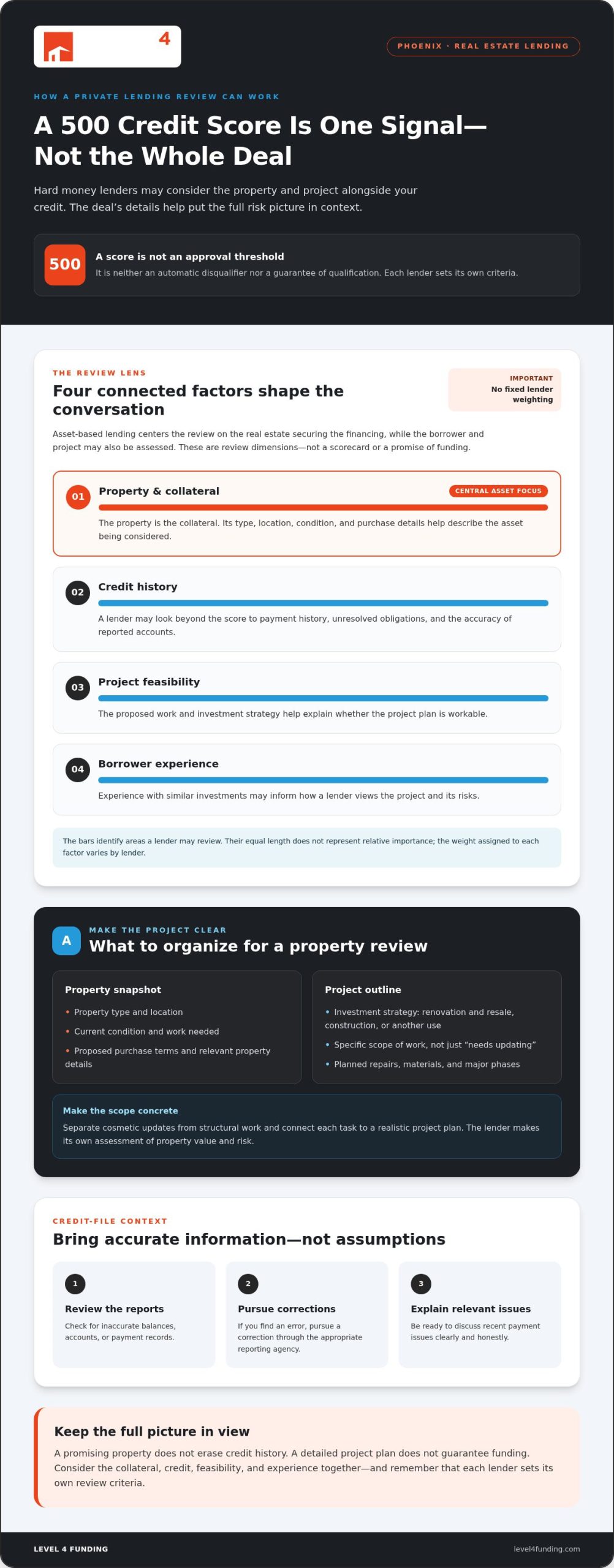
A credit score is one part of a lending review. A lender may also consider the property offered as collateral, whether the project plan is workable, and your experience with similar investments. These factors connect, but they aren’t interchangeable. A promising property doesn’t erase credit history, and a detailed plan doesn’t guarantee funding.
Asset-based lending centers a loan review on the real estate securing the financing, while still allowing the lender to assess the borrower and project. That’s the core idea behind asset-based real estate loans. The weight assigned to credit, collateral, feasibility, and experience varies by lender. Treat these as common areas of consideration, not a guaranteed Level 4 Funding checklist.
Which property details can shape a hard money review?
Build a clear picture of the asset and your plan. Organize details such as:
- Property type and location: Identify what the property is and where it is located.
- Condition: Note its current state and the work you believe it needs.
- Purchase details: Share the proposed purchase terms and relevant property information.
- Investment strategy: Explain whether you plan to renovate and resell, complete construction, or pursue another investment use.
For a renovation, a specific scope of work is more useful than saying the property “needs updating.” List planned repairs, materials, and major phases. For example, distinguish cosmetic updates from structural work and connect each task to a realistic project plan. This makes your intentions clearer, though the lender will make its own assessment of value and risk.
How can credit history affect the overall risk picture?
A score summarizes information in a credit file, but lenders may also review the details behind it. Payment patterns, unresolved obligations, and the accuracy of reported accounts can provide context. If a report contains errors, gather relevant documentation and pursue corrections through the appropriate channels before relying on that information in a financing discussion.
Individual lenders assess credit differently. A property may be central to a private loan review, but collateral doesn’t make credit irrelevant or guarantee funding. If you’re considering a 500 credit score hard money lender, prepare to discuss both the asset and your financial history honestly, along with your experience and project plan.
Level 4 Funding provides private, asset-based financing for real estate investors, including fix and flip projects. Review real estate financing options and organize the property and project details that explain your deal.
Hard Money vs. Bank Financing With a 500 Credit Score
A financing route should fit the property, purpose, and repayment plan, not just the credit score. Conventional bank financing and private hard money loans often approach real estate deals differently, but no single rule applies to every lender. Compare the typical focus, then weigh the trade-offs for your project.
| Factor | Conventional bank financing | Private hard money financing |
|---|---|---|
| Typical process focus | May place significant emphasis on borrower credit, income, and financial documentation. | Often centers on the property and investment plan, while lender-specific borrower criteria still apply. |
| Collateral | Depends on the loan product. A real estate loan generally involves the property being financed. | The investment property typically serves as collateral for the loan. |
| Documentation | May require detailed personal financial and income records, along with property information. | May focus on property details, purchase information, project scope, and the planned exit. |
| Intended use | Can include owner-occupied home financing or investment-property financing, depending on the product. | Commonly used for real estate investment projects, such as a purchase and renovation. |
These are broad tendencies, not universal requirements. Product criteria vary by lender and loan purpose. For a wider discussion of the differences, see the article on hard money loans versus bank loans.
When might conventional financing be a better fit?
If you need long-term financing and meet a lender’s credit, income, and documentation criteria, a conventional option may suit your plans. The right fit also depends on how you’ll use the property. Financing for an owner-occupied home differs from a loan for an investment property, so don’t assume the same product or standards apply to both. A 500 score alone doesn’t establish the outcome.
When might asset-based investor financing be worth exploring?
For an investment purchase or renovation with a tight timeline, private financing may be worth considering if the project has a credible investment case. The property, scope of work, costs, and exit strategy need to fit together. A fix and flip loan may suit an eligible project, but financing terms, underwriting, and repayment obligations vary. A 500 credit score hard money lender may still assess your credit alongside the deal.
Planning doesn’t stop at closing. Renovation delays or a resale that takes longer than expected can affect repayment. Before choosing a route, map out how the loan will be repaid and what could disrupt that plan. Speed and flexibility can be valuable, but they don’t replace realistic project planning or careful review of loan terms.
How to Prepare a Hard Money Loan Conversation in Phoenix
Bring the deal into focus before discussing financing. A concise summary keeps the conversation grounded in the property, project, and repayment plan rather than letting a credit score dominate. Preparation won’t guarantee approval or determine how quickly an application moves, but it can help you explain the opportunity clearly.
What should you organize before discussing an investment property?
Build a concise deal file. Use this sequence to organize the essentials:
- Identify the property. Include its address, property type, current condition, and known features that may affect the project.
- Summarize the purchase. Note whether you own the property or are evaluating a purchase, along with relevant proposed terms and supporting documents.
- Describe the investment plan. Explain whether you intend to renovate and resell, complete construction, or pursue another investment strategy.
- Outline the work. For a renovation, list planned tasks, estimated costs, expected sequence, and a realistic timeline. Include available photos, contractor estimates, or other project documentation.
- Explain your experience and exit. Briefly summarize relevant real estate experience and how you plan to repay the loan, such as through a sale or another planned outcome.
For a Phoenix property, include local context that helps someone understand the specific asset: its neighborhood or submarket, access, visible condition, and known details relevant to your plan. Apply the same approach to investment properties in Scottsdale, Tucson, Glendale, Sedona, Flagstaff, Tempe, Mesa, and Buckeye. Lead with verifiable facts, not assumptions about what the property will be worth or how quickly it will sell.
How can you address a low score without overpromising?
Review your credit reports and note any inaccuracies or recent payment issues. If a circumstance needs context, prepare a short, factual explanation. Don’t hide material information or expect the property to cancel out credit concerns. Instead, focus on what you can document: the property, purchase details, project scope, available funds, experience, and exit plan.
A concise summary might read: “I’m evaluating this Phoenix property for a renovation and resale. Here’s the current condition, proposed work, estimated timeline, and repayment plan.” Support each point with the information you’ve organized. A 500 credit score hard money lender may apply lender-specific criteria, so clear facts help frame the deal without implying a particular outcome.
If renovation is central to your plan, the fix and flip loan guide is a useful next read. Ready to discuss an investment property with Level 4 Funding? Share your real estate deal details and bring your project summary into the conversation.
Explore Fix and Flip Financing for Your Arizona Deal
A credit score matters, but the score alone won’t tell you whether a real estate deal makes sense for financing. Start with the full picture: the property, renovation plan, investment purpose, and repayment strategy. A deal-focused conversation gives those pieces room to be considered without promising a lending outcome.
Is a fix and flip loan relevant to your project?
A fix and flip loan is designed for an investment strategy built around purchasing a property, renovating it, and reselling it. It differs from borrowing for personal expenses or taking out a long-term mortgage for a home you plan to occupy. The financing purpose, project plan, and repayment strategy need to align.
Level 4 Funding is a private real estate lender focused on investment financing, with fix and flip loans as its primary service. If your Arizona project involves buying and improving a property for resale, this type of financing may be relevant. The fit depends on the specific deal and lender review, not on a credit score in isolation. No score, including 500, establishes approval or a specific lending threshold.
What should you expect from the next conversation?
Keep it direct and deal-focused. Summarize:
- The property: Location, type, purchase details, and current condition.
- The project: Planned renovations, estimated costs, and expected work sequence.
- The financing objective: What you’re seeking funds for and how the loan fits the investment plan.
- The exit strategy: Your intended repayment plan, such as selling the renovated property.
If credit concerns are part of your situation, be prepared to discuss them accurately. A 500 credit score hard money lender may evaluate borrower information alongside the property and investment plan, with criteria that vary by lender. Clear facts make the conversation more useful, but don’t guarantee funding.
Bring the deal forward, not just the score. Explore Level 4 Funding’s real estate financing options and present your Arizona property, project plan, and financing objective for a focused discussion.
Move Your Arizona Real Estate Deal Forward
A 500 credit score doesn’t tell the whole story of an investment loan. Property value, project feasibility, your experience, and a clear repayment plan can all inform a lender’s review, while lender-specific criteria still apply. Organize the deal details and discuss the project without assuming approval or rejection based on your score alone.
If you’re evaluating a 500 credit score hard money lender, focus on the complete financing picture. Level 4 Funding specializes in fix and flip loans and provides private, asset-based financing for real estate investors. Share the property, renovation plan, and financing objective to start a deal-focused conversation.
Explore fix and flip financing for your Arizona deal. Your score is one factor. A clear plan gives your investment opportunity a stronger starting point.
Frequently Asked Questions
Can I get a hard money loan with a 500 credit score?
A 500 credit score does not, by itself, determine whether you can get a hard money loan. A 500 credit score hard money lender may review the property, project plan, borrower circumstances, and its own criteria together. Requirements vary by lender and transaction, so the score is neither proof of approval nor an automatic denial. Prepare accurate deal details, including your investment strategy and repayment plan, before discussing financing.
Do hard money lenders check credit scores?
Hard money lenders may check credit, though review methods and criteria vary. Asset-based financing can place substantial attention on the property and investment plan, but that doesn’t mean credit is ignored. Payment history, unresolved obligations, and report accuracy may provide useful context. Be cautious of blanket claims that promise approval regardless of credit. A useful discussion considers the specific property and transaction alongside borrower information.
What matters besides credit score for a hard money loan?
Lenders may consider the property’s value and condition, purchase details, renovation scope, project feasibility, borrower experience, and repayment plan. The exact factors and weight assigned to each vary by lender. For example, a renovation proposal is easier to assess when it identifies the work and expected project sequence. Organize accurate property and project information, but don’t assume strong collateral overrides every concern or guarantees funding.
Can a first-time real estate investor get a hard money loan with bad credit?
Possibly, but a low score or limited experience alone doesn’t determine the outcome. Lender criteria, the property, project details, and repayment plan all matter, and requirements differ by transaction. As a first-time investor, prepare a concise summary of the property, intended improvements, and expected repayment plan. Be realistic about your experience and project assumptions. No preparation can guarantee approval.
Is hard money easier to get than a bank loan with a 500 score?
It depends on the lender, borrower, property, and financing purpose. Private real estate financing often focuses on the asset and investment plan, while conventional bank processes may emphasize other borrower and documentation criteria. Neither route guarantees approval, and a low score doesn’t make one option automatically available. Compare the intended use, repayment expectations, project timeline, and lender requirements before deciding which financing path to explore.
What documents should I prepare before contacting a hard money lender?
Start with the property address, purchase details, and notes on the property’s condition. Add your renovation scope, estimated project timeline, investment strategy, and supporting documents, such as photos or contractor estimates. Summarize relevant real estate experience and your repayment or exit plan. Include borrower and financial information requested during the lender’s process, and check that the facts are accurate. A clear deal summary keeps the discussion focused.
Can I use hard money financing for a Phoenix fix and flip?
Hard money financing is commonly used for real estate investment projects such as fix and flips, but fit depends on lender criteria and the deal. Level 4 Funding specializes in fix and flip loans and provides private financing for real estate investors. Its Arizona service areas include Phoenix, Scottsdale, Tucson, Glendale, Sedona, Flagstaff, Tempe, Mesa, and Buckeye. Prepare the property details, renovation plan, and exit strategy for a focused discussion.

About the author
Matt has a bachelor's degree in political science from Northern Arizona University and works at Level 4 Funding, a private lending company that offers hard money and rental home loans to real estate investors in 35 states.
With Matt's leadership, the firm has financed almost $300 million in loans for investment properties. He often helps real estate investors with rental property purchases, foreclosures, refinancing, and fix-and-flip projects. Matt has extensive experience in fix-and-flip, buy-and-hold, rental properties, and real estate sales. He has lived in Arizona for 43 years and is married with three children. Matt is licensed as a mortgage broker and loan originator in Arizona, with NMLS 2062278 and NMLS 1118493.
Equal Housing Opportunity. This is not a Good Faith Estimate, and it is not a Guarantee to lend; it should not be considered as such. Costs, rates, estimates, and terms can only be determined after a full application is completed. To the extent this message includes any tax or legal advice, this message is not intended or written by the sender to be used, and cannot be used, for legal or tax purposes or advice. This is an advertisement. Copyright © 2026. All rights reserved.