


Hard Money Lending Rates Explained: What Drives Them, What to Expect, and How to Get a Better Deal
October 8, 2026
The fastest quote isn’t automatically the right fit for your deal. An az hard money lender should understand the property, the numbers, and your repayment plan, not just lead with a speed claim.
Speed matters when a promising Arizona investment is on the line. So does knowing whether the property, renovation budget, and exit strategy make sense for the financing. If those pieces don’t line up, a quick answer may still leave you with the wrong structure or unclear obligations.
This guide explains how to evaluate a lender by deal fit, property fundamentals, underwriting clarity, and execution. You’ll learn what to include in a concise deal package and how to compare terms and costs consistently before committing. We’ll also connect those evaluation points to Arizona investment projects, including fix-and-flip deals. Level 4 Funding provides private real estate financing for Arizona investors, with a primary focus on fix-and-flip loans. Assess the whole deal, understand the path forward, and choose financing that fits the project.
Key Takeaways
- Match an az hard money lender to the property, project scope, and repayment plan, not just an advertised funding speed.
- Build a grounded deal picture by separating documented comparable sales from your value assumptions and renovation estimates.
- Compare written loan terms side by side, including project fit, collateral approach, fees, repayment structure, and communication.
- Organize purchase or ownership documents, renovation scope, budget, comparable sales, and exit assumptions to make your deal easier to assess.
- Explore how Level 4 Funding’s fix-and-flip focus and other real estate investment financing options can align with your Arizona project.
When an AZ Hard Money Lender Fits an Arizona Investment Deal
An az hard money lender provides private real estate financing for investment projects, with the property and transaction details guiding the financing review. This approach can fit a purchase, renovation, construction project, commercial property investment, or refinance. The key question isn’t simply whether a loan is available for that project type. It’s whether the property, scope, and repayment plan make sense together.
A useful shorthand: Asset-based evaluation considers the property and proposed transaction; it is not a promise of approval or a successful project outcome. Collateral, the work required, and the planned repayment route all matter. To see an example related to Scottsdale real estate, watch this video:
Which Arizona investment projects may use hard money?
Investors use private financing for property purchases, fix-and-flip projects, construction, commercial property, and refinancing. A Phoenix investor, for example, might be assessing a home that needs substantial renovation, while a Scottsdale investor might be considering a property for a different investment strategy. These examples illustrate project types, not a determination that a particular property or borrower qualifies.
Project labels don’t settle the question. A flip needs a workable scope and a plausible repayment plan. A construction project needs costs and milestones that fit the property. A refinance needs a clear reason for replacing existing financing. The asset and transaction details shape the financing discussion. The Wikipedia overview of What is a Hard Money Loan? provides broader background on this financing category and its uses.
What should investors know before comparing lenders?
Start by treating each deal as its own case. Terms, collateral expectations, and borrower circumstances can vary by transaction, so a general description of a loan type won’t tell you what a specific project’s financing will look like. Separate confirmed facts from estimates: purchase or ownership details, the planned work, and the intended repayment route should tell a coherent story.
Investment-property financing is distinct in purpose from financing for a home someone plans to occupy. Don’t assume the same financing terms or rules apply to both. The property’s intended use and transaction structure matter, and legal classifications depend on the facts and applicable requirements. Describe the use accurately rather than treating “hard money” as a shortcut around those distinctions.
For a plain-language foundation before weighing deal fit, review this hard money loan overview. Then compare the actual written structure with your project’s needs. Financing can provide a path to capital, but it can’t guarantee that the renovation budget, resale, refinance, or profit will work out.
How Arizona Property and Project Details Shape a Lender’s Review
A useful deal summary doesn’t rely on a big after-repair value number and hope the rest falls into place. It shows how the property’s current condition, acquisition basis, renovation plan, and intended exit connect. That gives a lender the details needed to assess the investment rather than fill gaps with assumptions.
A strong project summary connects collateral, budget, and repayment plan. Keep estimates distinct from evidence. Your projected resale value is an assumption; recent comparable sales are supporting data. A renovation budget is a forecast; contractor estimates and a defined scope explain how you built it.
What property information belongs in a deal summary?
Make the basics easy to follow: property location, current condition, intended use, and acquisition status. Clarify whether you’re evaluating a purchase, already own the property, or are planning a refinance. Then describe the work room by room or by major trade. Note known repairs and distinguish required improvements from optional upgrades.
Support the numbers with relevant documents. Include comparable sales that resemble the property in location, type, condition, and size, and explain any important differences. Attach contractor estimates when available and show how each major cost fits the proposed scope. Don’t present an after-repair value as established fact just because it supports the deal. If the comps are distant, dated, or materially different, explain why you used them. A credible range with clear support is more useful than a precise figure without a trail.
Local context matters, but Arizona isn’t one uniform market. A Phoenix property and a Tucson property may have different nearby comparables, buyer demand, property characteristics, and renovation considerations. Even within one city, neighborhood and property differences can affect which sales are relevant. Build the case around the subject property, not a broad citywide claim.
How should an investor explain the exit strategy?
State how you expect to repay the financing and what needs to happen first. For a renovation project, that may mean completing defined work and selling the improved property. Another plan may rely on refinancing if the property and future financing support that route. Explain the steps, the assumptions behind your schedule, and what you would do if a sale or refinance takes longer than expected.
Treat timing as an estimate, not a guaranteed outcome. Construction delays, changing project costs, and market conditions can affect the plan. For a deeper look at renovation financing considerations, the fix and flip financing guide connects project planning to financing. Investors planning an Arizona project can also review Level 4 Funding’s real estate financing as they shape their deal summary.
How to Compare Arizona Hard Money Lenders Beyond Speed Claims
A fast funding claim tells you little about the full deal. Before comparing an az hard money lender, line up the written terms and project requirements to see how each financing structure fits your property, work plan, and exit. One proposal may look attractive because of a single headline feature but carry different costs, payment timing, or payoff conditions.
Compare the full written obligation, not one advertised loan feature. Use the same questions for every proposal, and record the answers in one place:
| Comparison area | What to examine |
|---|---|
| Project fit | Does the structure align with the property type, planned work, and intended use? |
| Collateral approach | What property secures the financing, and how is collateral described in the written terms? |
| Fees and interest | List interest, points, and any other stated charges. Note when each is due. |
| Repayment structure | Compare payment schedule, maturity date, payoff process, and extension provisions. |
| Communication | Are document requests, decision steps, milestones, and points of contact clearly explained? |
Which loan terms deserve a careful side-by-side review?
Read beyond the headline rate. Interest is the cost charged for borrowing; points are charges expressed as a percentage of the loan amount. Then account for other fees stated in the proposal, the payment schedule, and the maturity date, which marks when the loan is due. Check whether extensions are possible, what conditions apply, and whether the written terms specify additional costs or steps.
Payoff language deserves the same attention. Understand how the balance is calculated when you sell or refinance, and whether the written terms describe payoff charges. For renovation financing, review how funds are drawn, what documentation or milestones are required, and how the process could affect the work schedule. An unclear draw procedure can make it harder to coordinate contractors and project cash flow. Model obligations against conservative assumptions, including delays and a longer-than-planned hold, rather than relying on the best-case exit.
How can investors assess lender communication and fit?
Clear communication is practical, not cosmetic. You should understand which documents are requested, what happens at each decision step, and how project milestones relate to the financing structure. If a term is unclear, get its meaning explained in writing before building it into your plan.
Then test the fit against the actual project. A structure that suits a property needing limited work may not align with a larger renovation or construction plan. Compare how payments, draws, maturity, and payoff interact with the intended sale or refinance. Rank the written details by how clearly they support a realistic project plan, not by unsupported claims about speed, approval, or customer satisfaction. Investors evaluating Arizona real estate financing can also explore Level 4 Funding’s investment financing.
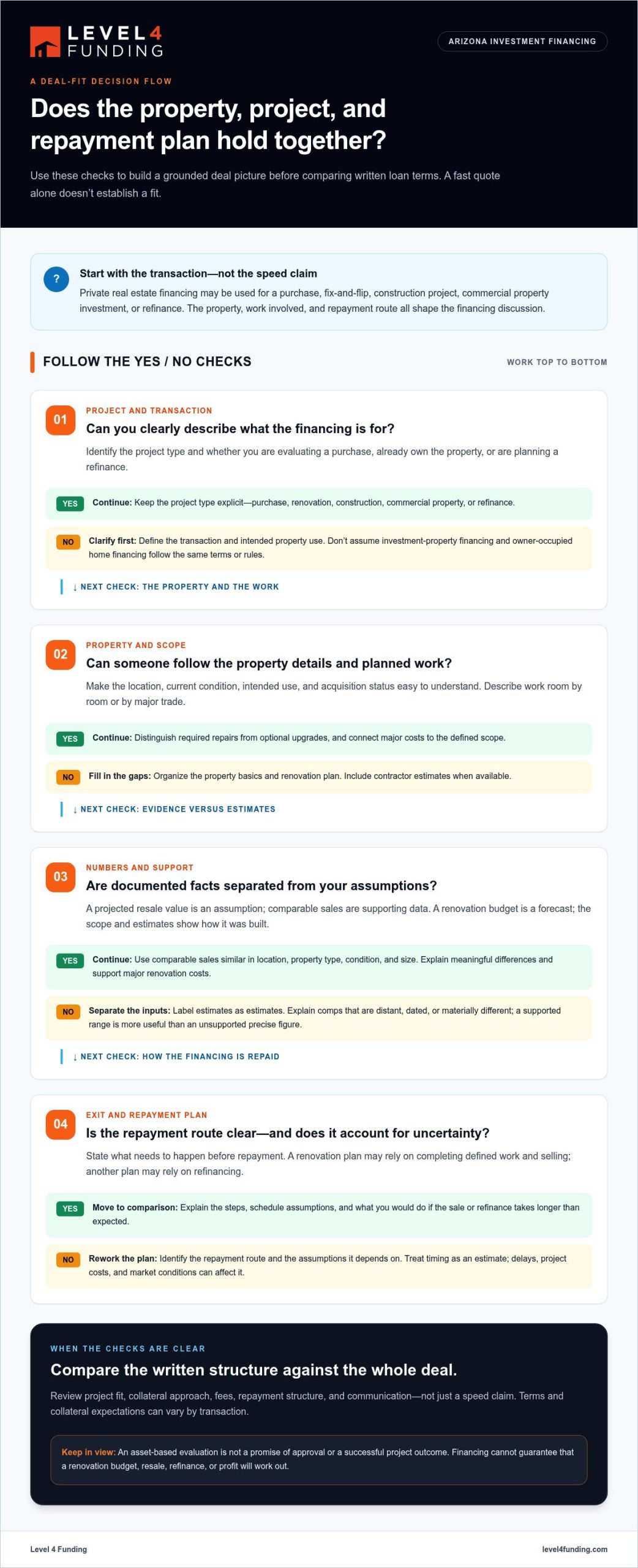
Arizona Hard Money Loan Readiness: Prepare the Deal Before Applying
A clear project file helps an az hard money lender understand what you’re buying or refinancing, what the property needs, and how you plan to repay the financing. Preparation won’t guarantee approval or a particular timeline, but it keeps the conversation focused on the deal instead of missing or inconsistent information.
What should an Arizona investor assemble first?
Build the file in sequence. Whether the property is in Phoenix, Mesa, Buckeye, or another Arizona location, organize facts about the specific property rather than relying on broad claims about its market.
- Review the property. Record its location, property type, current condition, intended investment use, and known issues that could affect the project.
- Document the transaction. Include the purchase agreement or ownership information, as relevant, and summarize the transaction status. Identify the borrower or business entity involved.
- Define the work. Break the renovation or construction plan into clear tasks. Gather contractor estimates or other supporting cost information where available, and distinguish confirmed figures from preliminary estimates.
- Organize the numbers. Prepare a project budget that accounts for acquisition and planned work. Keep each cost traceable to an estimate, quote, or clearly labeled assumption.
- Support property-value assumptions. Include relevant comparable sales and explain how they relate to the subject property. Label projected after-repair value as an estimate, not a documented sale price.
- Explain repayment. Summarize the anticipated sale, refinance, or other repayment route, with the key assumptions behind the plan and timeline.
- Gather requested records. Keep entity and financial documents organized, then provide the items requested for the specific transaction. Requirements can vary by deal.
How can investors reduce avoidable delays?
Use one consistent set of figures across the financing request, budget, and project schedule. If the renovation estimate changes, update the related totals and timeline rather than leaving conflicting versions in the file. A concise summary should answer three practical questions: What is the collateral? What work or transaction is planned? How is repayment expected to happen?
Keep source documents easy to identify, use clear file names, and separate signed agreements from drafts. These habits make gaps easier to spot and assumptions easier to explain. Treat a lender’s requested timeline as a planning input, not a promise of funding. Leave room for document review, follow-up questions, and project changes. For a deeper look at process steps, the hard money loan approval process explains how preparation fits into a financing review.
Have your deal materials taking shape? Explore Arizona real estate investment financing with Level 4 Funding as a next step for your project.
Explore Level 4 Funding for Arizona Real Estate Investment Projects
Once you’ve mapped the property, project costs, and repayment plan, match the deal to a financing category. Level 4 Funding provides private real estate financing for Arizona investors, with a primary focus on fix-and-flip projects. The right starting point depends on what you’re doing with the property, not just the name of the loan.
Which Level 4 Funding options align with an investment project?
Fix-and-flip financing is for investment plans involving property acquisition and renovation. Construction financing relates to construction projects, while commercial property financing serves investment in commercial real estate. Other project categories include Airbnb financing for a property intended for short-term rental use, and cash-out refinance financing when the plan involves refinancing an owned property.
- Acquisition and renovation: Consider fix-and-flip financing as you organize the purchase, work plan, and intended exit.
- Building or commercial investment: Construction and commercial property financing relate to those distinct project types.
- Rental or refinance plans: Airbnb financing and cash-out refinance can fit when those uses match your investment strategy.
These categories help frame a project conversation; they don’t determine qualification or establish loan terms. An az hard money lender evaluates a specific transaction, and the financing structure should make sense alongside the property’s purpose and your repayment plan.
What should investors include in an initial project conversation?
Keep the first summary direct. Identify the property and its transaction status, describe the planned use and major work, outline the budget, and state how you expect to repay the financing. Add the assumptions behind your figures so the project can be discussed in context. You don’t need a polished pitch deck; a concise, consistent account of the deal is more useful than bold projections without support.
Terms depend on the specific transaction. Property details, planned work, and financing category all shape the discussion, so don’t treat general information as a quote or a promise of approval or timing. If you’re comparing options, bring questions about structure, costs, repayment, and project fit. That gives the conversation a practical focus and helps clarify what matters for your investment.
Level 4 Funding serves Arizona real estate investors across markets including Phoenix, Scottsdale, Tucson, Glendale, Sedona, Flagstaff, Tempe, Mesa, and Buckeye. If your project details are ready to discuss, discuss your Arizona investment project with Level 4 Funding.
Put Your Arizona Deal Plan Into Motion
The next move isn’t chasing another bold promise. It’s turning your project details into a focused conversation about whether the financing structure fits your plan. Bring forward the assumptions that matter, including what the property needs, how you’ll manage the work, and how you expect to repay the loan. Clear thinking now can help you approach the next discussion with purpose.
Consider the right az hard money lender in the context of your actual transaction, not a slogan or a single attractive term. Ask how the written obligations connect to your project, and make sure you understand the next steps before you commit. A strong deal deserves a financing conversation grounded in specifics.
Ready to put your project on the table? Share your Arizona investment project with Level 4 Funding and take the next step toward evaluating a financing approach that fits. Your preparation gives the conversation a solid starting point.
Frequently Asked Questions
Is an AZ hard money lender only for fix-and-flip projects?
No. Arizona private real estate financing can support fix-and-flip, construction, commercial property, refinance, and short-term rental plans. A flip centers on acquiring and improving a property for resale; construction financing relates to a building project, while refinance replaces existing financing. An investor planning to rent a property short term has a different use case than one preparing a resale. Project category alone doesn’t establish eligibility.
Can I get an Arizona hard money loan if my credit is less than perfect?
Possibly, but no lender can promise approval based on a brief description of your credit. An az hard money lender may weigh the property and project differently from a conventional lender, yet credit can still matter alongside other transaction details. Be ready to explain the investment plan and relevant circumstances clearly. Before committing, review the written terms, payment obligations, and repayment conditions so you understand the full deal.
How much can an AZ hard money lender finance for an investment property?
There isn’t one standard amount for every Arizona investment property. Proposed financing can depend on the asset, transaction, project scope, collateral, borrower circumstances, and underwriting. Instead of anchoring on a headline amount, check whether the proposed financing aligns with the acquisition and planned work, and whether the repayment plan is realistic. Compare the full written terms, including costs and payment obligations, before deciding whether the structure fits your project.
What happens if a real estate investment project takes longer than expected?
A delay can increase the time you carry the property and disrupt a planned sale or refinance. It can also bring the loan’s maturity date closer, when repayment is due. Before closing, understand the payment schedule, maturity date, and any written extension provisions, including conditions and costs. Don’t assume an extension will be automatic. Build a conservative schedule that accounts for possible construction setbacks or a slower exit, and understand how those changes affect your obligations.
Are hard money loans in Arizona only available for properties in Phoenix?
No. Arizona investment-property financing isn’t limited to Phoenix. Level 4 Funding serves investors in Phoenix, Scottsdale, Tucson, Glendale, Sedona, Flagstaff, Tempe, Mesa, and Buckeye. That geographic reach doesn’t mean every property or transaction qualifies. Location is one part of the review; the asset, project needs, financing structure, and repayment plan also matter. Prepare those details so the proposed financing can be considered in the context of the property.
What documents should I prepare before approaching an Arizona hard money lender?
Gather the purchase agreement or ownership details, a clear renovation scope, contractor estimates, relevant comparable sales, a project budget, and your expected repayment plan. If the deal depends on resale after improvements, make the connection between the planned work and projected exit clear. Keep figures consistent and label estimates as estimates. Additional entity or financial records may be requested for the transaction. A complete file supports review, but doesn’t guarantee approval or a funding timeline.

About the author
Matt has a bachelor's degree in political science from Northern Arizona University and works at Level 4 Funding, a private lending company that offers hard money and rental home loans to real estate investors in 35 states.
With Matt's leadership, the firm has financed almost $300 million in loans for investment properties. He often helps real estate investors with rental property purchases, foreclosures, refinancing, and fix-and-flip projects. Matt has extensive experience in fix-and-flip, buy-and-hold, rental properties, and real estate sales. He has lived in Arizona for 43 years and is married with three children. Matt is licensed as a mortgage broker and loan originator in Arizona, with NMLS 2062278 and NMLS 1118493.
Equal Housing Opportunity. This is not a Good Faith Estimate, and it is not a Guarantee to lend; it should not be considered as such. Costs, rates, estimates, and terms can only be determined after a full application is completed. To the extent this message includes any tax or legal advice, this message is not intended or written by the sender to be used, and cannot be used, for legal or tax purposes or advice. This is an advertisement. Copyright © 2026. All rights reserved.