


Hard Money Loans for Flipping Houses: A Complete Playbook From Offer to Closing
October 9, 2026
What Is a Proof of Funds Letter and How Do Real Estate Investors Get One Fast?
October 10, 2026
What if the biggest challenge in hard money lending isn’t finding capital, but recognizing when a deal is too risky to fund? To become a hard money lender, you need more than money and a willingness to move quickly. You need a disciplined process for evaluating deals, managing loans, and responding when plans change.
Real estate investors often need financing shaped around a property and project. But collateral alone doesn’t make a loan safe. An unsupported valuation, incomplete repair plan, or unrealistic repayment strategy can put your capital at risk.
This guide covers the core parts of a lending business, from setting a strategy and planning capital to evaluating property value, borrower experience, and repayment. It also explains why clear loan documents, payment servicing, and a plan for defaults matter from the start. Arizona-specific legal and regulatory questions require review with qualified professionals, so use this guide to identify issues to raise, not as a one-size-fits-all legal checklist. The goal is to help you understand what responsible lending takes before funding a deal.
Key Takeaways
- To become a hard money lender, build a lending operation, not just a pool of capital.
- Set a clear plan for capital, liquidity, and potential losses before choosing which deals to fund.
- Assess property value alongside borrower experience, project scope, and the repayment plan.
- Map each loan from intake through payoff or enforcement, and review transaction-specific legal obligations with qualified professionals.
- Separate the goal of running a lending business from financing your own real estate project, then choose the path that fits.
What Becoming a Hard Money Lender Actually Involves
A hard money lender is different from a bank, a broker, or a real estate investor borrowing funds for a project. A direct lender commits capital, assesses the risk, documents the agreement, and manages the loan through repayment or another resolution. A passive investor, by contrast, may provide capital without making and managing individual loan decisions.
Hard money lending is asset-based, but the property isn’t the only factor. The real estate anchors the analysis, while the borrower’s ability to execute the plan, the project’s feasibility, and the repayment path all affect the decision. A Phoenix property with promising resale potential can still be a poor loan if the renovation plan is vague or the borrower has no credible exit strategy.
A hard money loan is generally associated with real estate and collateral-focused lending. In practice, a lender needs to look beyond a property’s headline value and consider how the loan exposure, project conditions, borrower’s plan, and supporting documents fit together.
A lender funds and manages the loan; a broker arranges a loan between a borrower and a lender. The distinction matters because arranging a deal is not the same as putting capital at risk and overseeing repayment.
How a hard money lender earns a role in a real estate deal
The lender’s role starts before funds move. It includes reviewing the transaction, agreeing on documented terms, coordinating funding, tracking payments, and handling payoff or resolution. Revenue can involve interest and fees, but neither guarantees a return. Loan performance, operating costs, delays, and losses affect the actual result.
For example, a borrower might seek funds to renovate a Phoenix home and repay the loan after a sale. The lender needs to evaluate the property, repair scope, borrower’s execution plan, and proposed sale as the exit. If work stalls or the sale proceeds fall short, the lender still has to manage the loan and collateral situation. That’s an operating responsibility, not a hands-off investment.
Who may consider entering private real estate lending
Experience in real estate, finance, business operations, or investment risk can help you ask sharper questions and spot weak assumptions. But knowledge alone isn’t enough. Direct lending calls for consistent decision-making, careful records, borrower communication, payment tracking, and readiness to respond when a project changes course.
Someone who wants real estate exposure without managing individual loans may consider a passive arrangement in which another party handles lending decisions and operations. That can reduce day-to-day involvement, but it also means relying on that arrangement’s structure and performance. If you want to become a hard money lender, be prepared to own the full chain of decisions and responsibilities, not just supply funds.
How to Build the Capital, Entity, and Underwriting Foundation
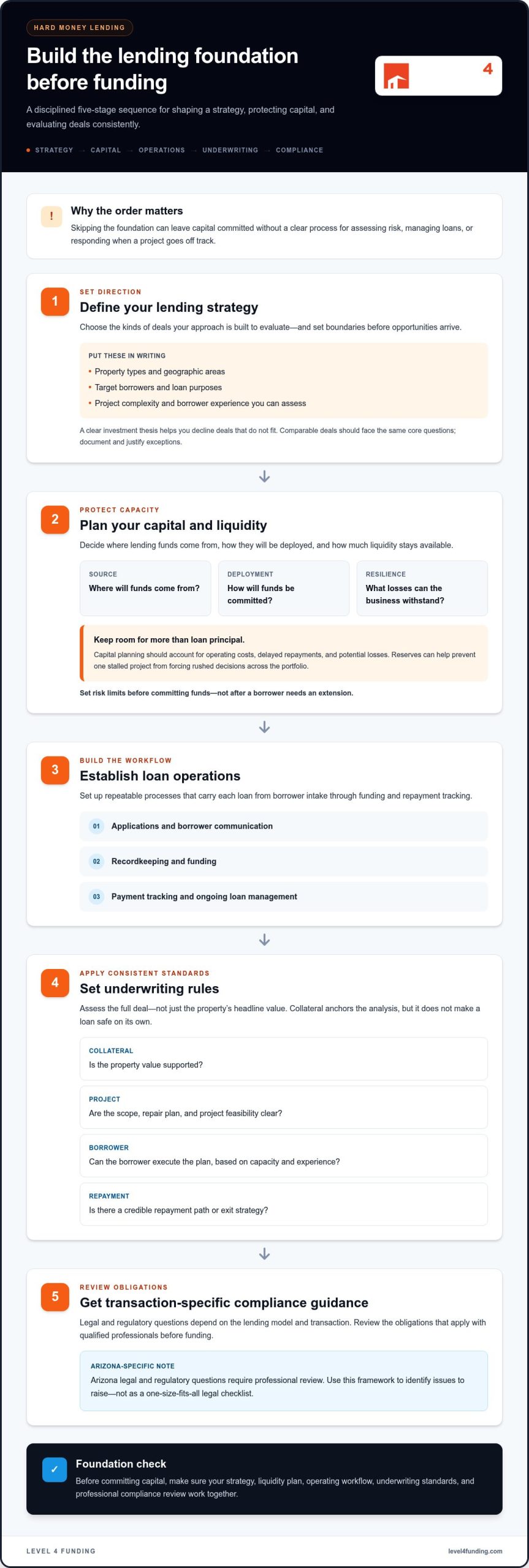
Before funding a deal, build a system that keeps your decisions consistent when opportunities look tempting. A practical sequence is to choose a strategy, plan your capital, establish operations, set underwriting rules, and review compliance with qualified professionals. Skipping steps can leave you with funds committed but no clear process for assessing risk, managing loans, or responding when a project goes off track.
- Define your strategy. Decide which properties, borrowers, loan purposes, and geographic areas fit your approach.
- Plan your capital. Identify where lending funds come from, how they’ll be deployed, what liquidity you’ll keep available, and what losses the business can withstand.
- Establish operations. Set up processes for applications, recordkeeping, funding, payment tracking, and borrower communication.
- Set underwriting rules. Create consistent standards for evaluating collateral, project plans, borrower capacity, and repayment paths.
- Review compliance. Get transaction-specific guidance on the legal and regulatory questions that apply to your model.
Capital planning must cover more than loan principal. A lender needs room for operating costs, delayed repayments, and potential losses. Reserves help prevent one stalled project from forcing rushed decisions across the rest of the portfolio. Set risk limits before committing funds, not after a borrower needs an extension.
Choose a lending strategy before committing capital
A narrow focus, such as residential investment properties, can help you build familiarity with a specific type of collateral and project. A broader strategy may open up more deal types, but it also requires standards that account for their differences. Define your target borrower, property type, loan purpose, and geographic boundaries in writing. A clear investment thesis gives you a reason to decline deals that don’t fit, even when they look attractive at first glance.
For a Phoenix-focused strategy, specify whether you’ll consider renovation projects, construction, or other investment-property uses. Then set boundaries for project complexity and the borrower experience you’re prepared to evaluate. These are strategic choices, not universal rules. The goal is consistency: similar deals should face the same core questions, with exceptions recorded and justified.
Local conditions can vary across Phoenix, Scottsdale, Tucson, Glendale, Sedona, Flagstaff, Tempe, Mesa, and Buckeye. Define the areas and property types your team can evaluate confidently, and use the same documented standards for comparable deals.
Create repeatable underwriting and documentation standards
Build a file that shows how you reached each lending decision. Review the property’s value and condition, the proposed work and budget, the borrower’s relevant experience and capacity, and the intended repayment plan. Keep due diligence records, supporting documents, and a written rationale for approval, modification, or decline. Organized files make decisions easier to explain and provide a reliable record to refer back to.
Entity structure, bookkeeping, tax treatment, and record-retention practices depend on the business and transaction. Discuss those decisions with qualified legal and accounting professionals rather than assuming one setup fits every lender. If your own project needs capital rather than a lending business, explore real estate financing options such as fix-and-flip, construction, or commercial property loans.
How Hard Money Lenders Evaluate Deals and Control Risk
A property may look like strong collateral and still make a weak loan. Deal risk comes from several connected factors: the property’s current value, how much capital is exposed, whether the borrower can execute the plan, and whether the repayment exit is realistic. Asset-based lending means property-focused underwriting, not property-only underwriting. Repayment capacity and project feasibility still matter.
Collateral supports a loan decision, but it doesn’t eliminate default risk. A disciplined review considers each risk separately so a strength in one area doesn’t hide a serious weakness in another.
| Risk area | What to examine | Warning signs |
|---|---|---|
| Property risk | Current condition, comparable sales, title information, valuation assumptions, and collateral relative to the loan exposure. | Unclear ownership details, unsupported value assumptions, or significant condition issues. |
| Borrower risk | Relevant experience, financial capacity, project management ability, and repayment plan. | Limited evidence of execution capacity or reliance on an untested repayment assumption. |
| Execution risk | Project scope, budget, schedule, and the practical steps needed to complete and exit the project. | Missing work details, unrealistic timelines, or no contingency for setbacks. |
These risks affect one another. A larger scope can increase the amount and duration of capital at risk. A delayed project can weaken a sale or refinance exit, even if the property’s underlying value remains sound. Before deciding to become a hard money lender, assess the full chain rather than treating collateral as a substitute for a workable plan.
Assess the property, valuation, and planned work
Start with the property. Compare the proposed value with relevant nearby sales, examine the condition, review available title information, and identify assumptions that could change the valuation. For a renovation, connect each major item of work to its budget and schedule. Consider what happens if costs rise or completion takes longer. After-repair value is an estimate that needs support, not a guaranteed sale price.
For example, a Phoenix home may appear attractive based on renovated comparable sales. Those sales are useful only if the subject property, location, and planned finish are reasonably comparable. If they aren’t, the valuation needs another look.
Test the borrower’s plan and repayment exit
Review the borrower’s relevant experience and capacity to manage the work, contractors, and project decisions. Then test the proposed exit, whether it depends on a sale or refinance. Consider possible delays, changes in project costs, and the chance that the expected sale or refinance doesn’t happen as planned. Stress-testing helps expose weak assumptions before capital is committed.
A sound decision connects the property, loan exposure, borrower’s plan, and exit into one documented risk picture. If one part depends on everything going perfectly, pause and examine the downside.
Set Up Responsible Loan Operations and Review Arizona Requirements
Sound underwriting is only one part of a lending operation. Once you decide to become a hard money lender, you also need a repeatable process for moving each loan from initial inquiry through closing, servicing, and final resolution. Build the workflow before volume grows. Missed handoffs can cause confusion about documents, payment status, borrower communications, or next steps when a project changes.
- Application intake: Record the borrower, property, requested loan purpose, project details, and proposed repayment plan.
- Underwriting and decision: Gather and review relevant property and borrower information, document the decision, and identify outstanding items.
- Closing and funding: Coordinate execution of counsel-reviewed documents and keep complete closing and funding records.
- Servicing: Track amounts due and received, reconcile records, and manage borrower notices and escrow handling where applicable.
- Payoff or enforcement: Confirm payoff details and close the file, or follow documented escalation procedures if payments are missed or a dispute arises.
Build clear loan documentation and servicing workflows
Have qualified counsel review the note, security instrument, disclosures, and closing records for the specific transaction. Don’t rely on a generic document set without understanding whether it fits the loan and the parties involved. Assign responsibility for payment tracking, record reconciliation, borrower notices, and any applicable escrow handling. Define who reviews a missed payment, how project changes are recorded, and how payoff requests or disputes move through the operation.
Keep a file that connects the application, underwriting rationale, executed documents, funding record, communications, payment history, and final resolution. Consistent records make it easier to see what happened and when. They also help the operation follow its procedures instead of improvising under pressure.
Treat Arizona compliance as a transaction-specific review
Legal, licensing, disclosure, and servicing obligations can depend on the transaction, borrower, property use, business structure, and jurisdiction. Don’t assume a rule applies, or that an exemption fits, based only on a deal’s label. Before launching or changing your lending model, review current Arizona requirements and relevant federal rules with qualified Arizona counsel. Use current official sources to verify regulator names, licensing scope, lending limits, and any claimed exemptions. Those details can’t be safely reduced to a universal checklist.
For local background, consult this Arizona hard money lender guide, then verify legal questions against current authoritative sources and professional advice. A guide can help frame the questions; it isn’t a substitute for transaction-specific legal review.
If you’re a Phoenix investor looking to finance a property rather than operate a lending business, explore real estate financing options for investment projects, including fix-and-flip, construction, and commercial property loans.
Choose Your Next Step: Build a Lending Business or Finance a Deal
The key question is what you want to do with your real estate knowledge and capital. Operating a lending business means making decisions about other people’s projects and managing loans after funding. Financing your own project means taking the borrower’s role: finding a property, presenting a workable plan, and understanding how repayment fits your investment strategy. These paths are related, but they carry different responsibilities.
Is starting a lending operation the right move?
If you want to become a hard money lender, weigh the control against the commitment. You decide which opportunities to consider, but you’re also responsible for capital planning, consistent underwriting, compliance review, loan documents, servicing, and responding to problems. Experience in real estate, finance, operations, or investment risk can help, but it doesn’t replace professional support or a clear process.
Before choosing the lender path, consider whether you can answer these questions with confidence:
- Do you understand the property types and project plans you intend to evaluate?
- Can your capital plan account for loans in progress, operating needs, and possible losses?
- Are you prepared to manage borrower communications and loan records through payoff or resolution?
- Have you identified qualified legal and accounting support for your business and transactions?
If your main goal is to renovate, build, or acquire an investment property, starting a lending company may be a detour. Financing through a private lender lets you focus on the project instead of originating and servicing loans. Neither route promises a particular result. Your experience, risk tolerance, available capital, and project goals should guide your choice.
Arizona investors can connect financing to a real project
Understanding how a lender assesses collateral, project scope, borrower execution, and repayment can make your financing conversation more focused. Prepare a clear account of the property, planned work, budget assumptions, relevant experience, and intended exit. The hard money loan overview explains the financing approach, while the hard money loan requirements guide offers further context on preparing for a lender’s review.
Level 4 Funding provides private real estate financing in Arizona, including fix-and-flip, construction, and commercial property loans. If you’re focused on an investment in Phoenix, Scottsdale, Tucson, Glendale, Sedona, Flagstaff, Tempe, Mesa, or Buckeye rather than launching a lending operation, explore real estate financing for your project.
Put Your Next Real Estate Move in Motion
Decide what you want to take on next: operating a lending business or pursuing a real estate project with financing. If you’re serious about becoming a hard money lender, make your next move a focused one. Map your business model, identify the expertise you still need, and get transaction-specific Arizona legal guidance before putting capital to work.
If your priority is a property project, bring the same disciplined mindset to a lender conversation. Organize the deal details, explain your plan, and be ready to discuss how the project will be completed and repaid. Level 4 Funding specializes in private real estate financing, including fix-and-flip, construction, and commercial property loans, and serves Phoenix, Scottsdale, Tucson, Glendale, Sedona, Flagstaff, Tempe, Mesa, and Buckeye.
Explore real estate financing with Level 4 Funding and take a clear next step toward your investment goals. A well-prepared plan helps you move forward with purpose.
Frequently Asked Questions
Can you become a hard money lender without prior real estate experience?
Yes, but a sound review process and qualified support become especially important when you lack direct experience. Before considering a Phoenix-area loan, learn how to interpret comparable sales, renovation estimates, title information, and borrower project plans. You might build that knowledge through work in finance, property operations, or investment analysis. Start with a narrow deal type you can understand, and don’t treat a borrower’s confidence as a substitute for evidence.
Is hard money lending a passive investment?
No, direct lending is an operating role, not simply a way to park funds. A lender may need to review changing project details, track payments, answer borrower questions, and respond if repayment is delayed. For example, a renovation can uncover unexpected work after closing, requiring clear communication and careful review of the loan documents. Someone seeking less involvement may consider a passive arrangement while understanding its structure and associated risks.
How much capital do you need to become a hard money lender?
There’s no single capital figure that fits every lending business. The amount depends on your target loan size, how many loans you plan to hold at once, funding sources, operating expenses, and the liquidity you need if repayment is delayed. Model a conservative scenario before committing funds. For example, ask whether your operation could handle one loan remaining outstanding longer than planned without disrupting its other obligations.
Can a new hard money lender use investor capital to fund loans?
Possibly, but pooling or accepting capital from others can raise legal, regulatory, contractual, and tax questions. The right structure depends on how funds are solicited, who participates, and how the lending business is organized. Before taking investor money, have qualified legal and accounting professionals review the proposed arrangement and its documentation. Don’t assume that calling an investment private or limiting participation automatically removes compliance obligations.
What happens if a hard money borrower defaults?
A default can trigger contractual remedies, but the next steps depend on the loan documents, the reason for default, and applicable law. The lender should review the file, track notices and communications, and get legal guidance before taking enforcement action. A Phoenix renovation loan, for instance, may involve both missed payments and unfinished work, so the response should account for the contract and property circumstances rather than rely on a one-size-fits-all script.
Do hard money lenders need a license in Arizona?
It depends on the transaction and the lender’s activities, so there isn’t a safe blanket answer for every Arizona loan. Property use, borrower type, business structure, and the way lending is conducted can affect the analysis. Before operating in Phoenix or elsewhere in Arizona, review current state and federal requirements with qualified Arizona counsel and verify licensing conclusions through relevant official sources.
Can a hard money lender finance commercial and residential properties?
Yes, private lenders may offer financing for both, but the property and transaction affect underwriting and compliance considerations. A residential fix-and-flip project differs from a commercial acquisition in its intended use, project assumptions, and borrower structure. A lender should define the property types it can evaluate and review applicable legal requirements for each loan. Investors should accurately describe the property’s use and project purpose when discussing financing.

About the author
Matt has a bachelor's degree in political science from Northern Arizona University and works at Level 4 Funding, a private lending company that offers hard money and rental home loans to real estate investors in 35 states.
With Matt's leadership, the firm has financed almost $300 million in loans for investment properties. He often helps real estate investors with rental property purchases, foreclosures, refinancing, and fix-and-flip projects. Matt has extensive experience in fix-and-flip, buy-and-hold, rental properties, and real estate sales. He has lived in Arizona for 43 years and is married with three children. Matt is licensed as a mortgage broker and loan originator in Arizona, with NMLS 2062278 and NMLS 1118493.
Equal Housing Opportunity. This is not a Good Faith Estimate, and it is not a Guarantee to lend; it should not be considered as such. Costs, rates, estimates, and terms can only be determined after a full application is completed. To the extent this message includes any tax or legal advice, this message is not intended or written by the sender to be used, and cannot be used, for legal or tax purposes or advice. This is an advertisement. Copyright © 2026. All rights reserved.