


Loan-to-Value Ratio (LTV) in Real Estate: What It Means, How It’s Calculated, and Why It Matters to Hard Money Lenders
October 13, 2026
What if a promising Phoenix property still isn’t ready for conventional financing? Lending hard money can help real estate investors pursue a renovation or another investment opportunity, but collateral is only one part of the deal. The project scope, budget, timeline, and repayment plan matter too. A purchase that looks strong on paper can become costly if repairs run over schedule or the expected sale takes longer than planned.
When an opportunity is time-sensitive, preparation matters. Before pursuing financing, know what supports the deal, what could put it under pressure, and how you plan to repay the loan. A clear exit strategy is just as important as a clear renovation plan.
This guide explains how hard money lending can fit a real estate investment, what lenders may evaluate beyond the property, and how to prepare a focused deal package. You’ll also learn how to compare financing options and weigh repayment risk against your project timeline and exit plan, including when fix and flip financing may suit a renovation opportunity.
Key Takeaways
- Assess whether lending hard money fits the property, scope of work, timeline, and repayment plan, not just the purchase opportunity.
- Build a clear deal story around the property’s condition, planned improvements, project schedule, and intended exit.
- Compare financing options by purpose, property readiness, underwriting focus, timing, and repayment approach.
- Prepare your assumptions and key deal documents before seeking funding, using Phoenix-area property details to ground your plan.
- Match the financing category to the project, from fix and flip renovations to construction or commercial property investments.
Why Arizona Investors Consider Hard Money Lending for Real Estate Deals
Start with the deal, not the loan. Does the financing fit the property’s condition, the work you plan to complete, and the way you expect to repay? Arizona investors may consider hard money lending for renovation, transitional, or time-sensitive projects when the property and business plan call for investment-focused financing.
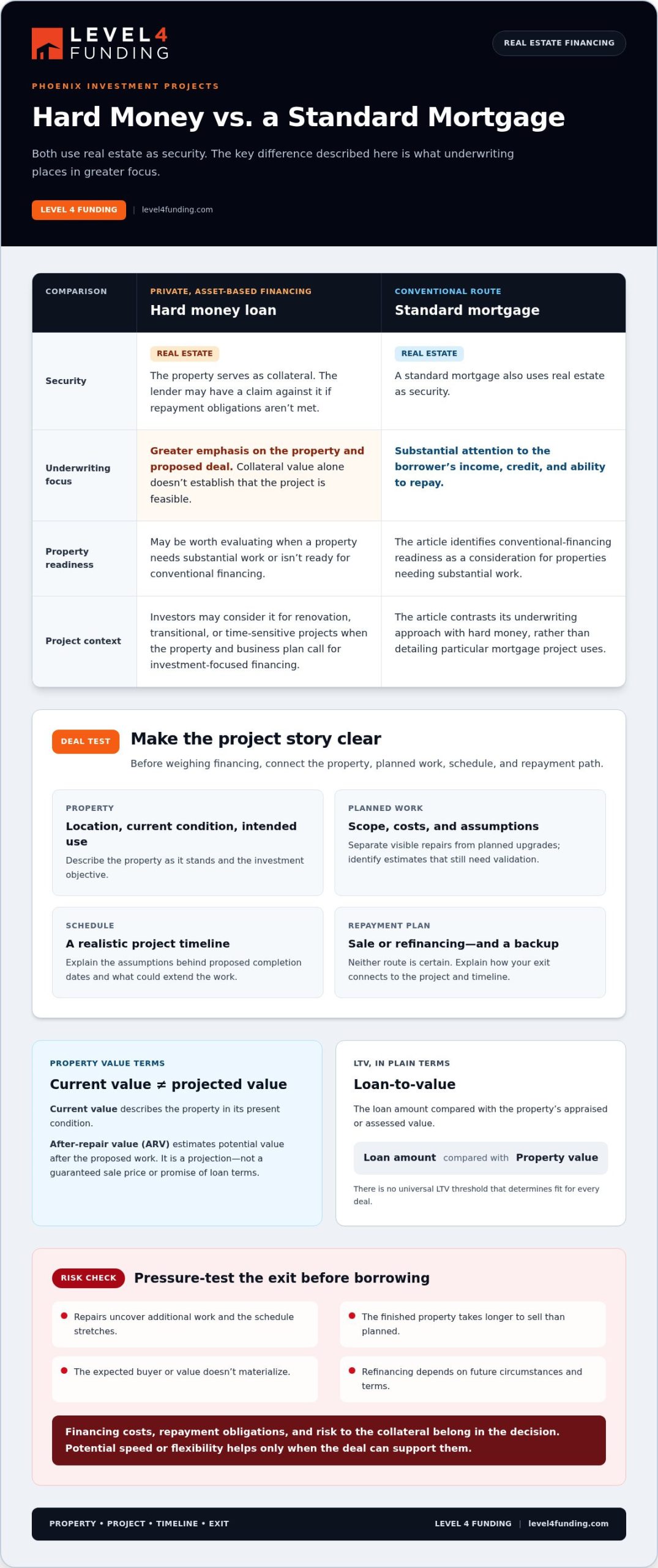
A hard money loan is private financing secured by real estate. The property serves as collateral, meaning the lender may have a claim against it if the borrower doesn’t meet repayment obligations. A standard mortgage also uses real estate as security, but its underwriting commonly gives substantial attention to the borrower’s income, credit, and ability to repay. Hard money financing generally puts greater emphasis on the property and proposed deal. For a broader overview of the Hard money loan structure, see how it’s commonly distinguished from other forms of real estate financing.
This structure may be worth evaluating when a property needs substantial work, isn’t ready for conventional financing, or is part of a project with a defined investment timeline. It doesn’t make a project automatically fundable, and speed shouldn’t be the only consideration. Financing costs, repayment obligations, and the risk to the collateral all belong in the decision.
What makes a hard money loan asset-based?
Property collateral is central to the structure, but collateral value alone doesn’t show that a project will succeed. A property may have potential and still come with an unrealistic renovation budget, a tight schedule, or an uncertain resale plan. Assess the full project rather than treating the property’s estimated value as proof of feasibility.
Loan-to-value, or LTV, is the loan amount compared with the property’s appraised or assessed value. It helps describe how much of the property value the financing represents. There’s no universal LTV threshold that determines fit for every deal. The property, project, and financing structure all matter.
When might hard money lending fit an investment plan?
It may fit when you can explain the investment clearly: what you’re buying, what work is planned, how long the project may take, and how the loan will be repaid. For example, an investor considering a Phoenix-area fixer-upper can map the renovation scope and expected resale strategy before weighing financing. Level 4 Funding’s hard money loan overview offers additional context on this type of financing.
Borrowing because another financing route feels difficult isn’t a project plan. If repayment depends on a quick sale, consider what happens if the property takes longer to sell. If refinancing is the intended exit, account for the steps and uncertainty involved rather than treating it as automatic.
Make the trade-off explicit. Potential speed or flexibility only helps if the deal can support the costs and repayment obligations. If the timeline slips or the exit falls through, you may need another repayment plan, and the property securing the loan is at risk. Match financing to a workable project and credible exit, not urgency alone.
What Lenders May Need to Understand About Your Property and Project
A strong deal presentation makes the logic easy to follow. Show the property as it stands, the work you propose, the assumptions behind your schedule, and how you intend to repay the financing. This is a preparation guide, not a checklist that guarantees approval. Documentation and underwriting approaches can vary by loan and project, so keep your information accurate, organized, and specific to the investment.
How to present the property and renovation plan
Give the deal a clear starting point: identify the property’s location, current condition, intended use, and investment objective. Then describe the work in practical terms. For a Phoenix-area renovation, for example, separate visible repairs from planned upgrades and connect each item to a realistic project timeline. A concise scope helps explain what you plan to change and why.
Keep verified facts separate from estimates. Label proposed costs, completion dates, and projected values as assumptions, and note what still needs validation. Current value describes the property in its present condition; after-repair value (ARV) estimates its potential value after the proposed work. ARV is a projection, not a guaranteed sale price or promise of loan terms.
- Summarize the property’s location, condition, and intended investment use.
- Outline the planned work and explain the assumptions behind the scope and schedule.
- Distinguish documented facts from estimates that may change as the project develops.
- Keep supporting materials, such as available property records, photos, bids, and budget details, together where relevant to your deal.
Why the exit strategy belongs in the deal package
Repayment is part of the project story, not an afterthought. Describe whether you expect to repay through a sale or refinancing, and explain how that path connects to the work and timeline. Neither route is certain: a sale may take longer than planned, while refinancing depends on future circumstances and terms.
Build a backup into your thinking. If repairs uncover additional work, the schedule may stretch. If the finished property doesn’t attract the expected buyer or value, the planned repayment could be affected. Consider what resources or adjustments could help manage those possibilities before borrowing. The hard money loan approval process provides further context for preparing a deal for review.
Before presenting your project, make sure the property facts, scope, budget assumptions, timeline, and exit plan tell one consistent story. Gaps are easier to address when they’re visible early, rather than discovered after the project is underway. For a renovation investment, explore Level 4 Funding’s fix and flip financing as a relevant financing category for your deal plan.
Hard Money Lending Compared With Other Ways to Fund an Investment
Choose the financing structure that fits the job the property needs to do. A Phoenix investment that’s ready for occupancy may call for a different approach than a distressed home needing major repairs or a commercial project with a defined transition. Compare the purpose, property condition, underwriting emphasis, timeline, and repayment plan. The question isn’t simply which option sounds fastest. It’s which one supports the deal without leaving you with an unworkable exit.
Use this high-level comparison to frame your decision. Exact terms and eligibility depend on the lender, property, and proposed transaction.
| Financing type | Potential purpose and property fit | What to weigh |
|---|---|---|
| Hard money | Private, property-secured financing that may suit investment projects, including properties needing work. | Collateral and project details may be central; plan repayment around a realistic sale or refinance path. |
| Conventional mortgage | Often considered for properties that meet the financing program’s property and occupancy requirements. | Borrower documentation and property eligibility matter; confirm that the property’s condition and use suit the intended financing. |
| Other project financing | Construction or commercial property financing may align more directly with a build, development, or commercial investment. | Match the financing purpose to the project scope, draw needs, timeline, and repayment strategy. |
Hard money versus conventional mortgage financing
Both structures may be secured by real estate, but they can emphasize different parts of the deal. Hard money lending often centers on the collateral and investment plan, while conventional mortgage financing typically involves detailed borrower documentation and property requirements. A home with substantial repairs may not fit a conventional mortgage’s condition standards, so assess the property as it is instead of assuming every financing path treats it the same way.
Neither option is universally faster, cheaper, or better. Compare the full obligations, including costs, repayment timing, and what happens if repairs or a sale take longer than expected. A financing structure that works on paper can still strain the project if its repayment plan doesn’t match the likely timeline.
Hard money versus bridge financing
The labels can overlap. “Bridge” describes a temporary financing role between stages of a transaction, while hard money commonly refers to private, real-estate-secured financing. Lenders may use these terms differently, so focus on what the funds need to do: acquire a property, carry it through renovations, support a transition, or bridge to a planned sale or refinance.
If renovation is the core purpose, compare the project with the guidance in this fix and flip loan guide. Level 4 Funding provides fix and flip loans for investors pursuing renovation projects. Explore real estate investment financing in light of your property, scope, and exit plan before deciding which structure fits.
How to Prepare an Arizona Investment Deal Before Seeking Funding
A clear deal package helps you explain the opportunity and spot weak assumptions before they become expensive problems. Prepare the property facts, project plan, and repayment strategy as one connected story. This won’t guarantee approval, timing, or a profitable outcome, but it can make your financing conversation more focused and help you assess whether lending hard money fits the investment.
A four-step deal-readiness checklist
- Clarify the deal. Summarize the property, its current condition, your intended investment, and the work you plan to complete. State whether the project involves a renovation, construction, or another investment purpose. Be direct: what are you acquiring, what will change, and what outcome are you pursuing?
- Document your assumptions. Organize available property information, value estimates, renovation budget assumptions, and a realistic schedule. Separate verified facts from projections. Support estimates with relevant project information, such as contractor bids or comparable property details where appropriate, and identify what still needs validation. Don’t present an estimate as a confirmed result.
- Plan repayment. Explain whether you expect to repay through a sale or refinance, then map that plan against the project timeline. Consider what happens if repairs take longer, costs change, or the expected sale price isn’t achieved. Identify how you might respond without treating a backup option as guaranteed.
- Organize your questions. Before discussing financing, list what you need to understand about the proposed structure, costs, repayment obligations, and the property used as collateral. Clear questions help you compare the financing commitment with your project plan and make the risks easier to evaluate.
Arizona details to account for in your project assumptions
Use local context to describe the actual property, not to make broad claims about the market. A renovation in Phoenix, a commercial investment in Tempe, or a property in Mesa may involve different site conditions, work scopes, and resale assumptions. Name the city when it helps identify the deal, then ground your projections in property-specific information rather than generalizations about local demand, values, permitting, or sale timelines.
Validate details that could change your budget or schedule. Review the property condition, clarify the planned scope, and base resale assumptions on relevant information for that property and its immediate market. If an estimate depends on work that hasn’t been assessed or a timeline that hasn’t been tested, flag that uncertainty in your package. Honest assumptions are more useful than a polished forecast that hides risk.
A checklist is a starting point, not a promise. Your preparation can’t control the lender’s decision, the funding timeline, the project’s costs, or the eventual outcome. It can help you see whether the financing obligations align with the investment before you move forward.
With the property, assumptions, and repayment plan organized, explore real estate financing for your Arizona investment and match the financing category to the work your deal requires.
Explore Level 4 Funding for Your Real Estate Investment Project
You’ve mapped the property, project, and likely exit. Now match the financing conversation to what you’re actually doing. Level 4 Funding provides private real estate financing for investors, with fix and flip loans as its primary service. Start with the project itself, not a loan label chosen before the plan is clear.
Match the financing conversation to your project
For a property you plan to renovate and resell, fix and flip financing is the relevant category. Bring a clear description of the current condition, proposed improvements, and intended resale plan. This gives the financing conversation useful context without assuming that a particular outcome, timeline, or financing structure is guaranteed.
Different projects call for different financing categories. A ground-up build may make construction financing relevant; an investment involving commercial property may call for a commercial property loan. For a plan centered on an Airbnb property, an Airbnb loan may fit the project. If you’re considering refinancing an existing property and accessing equity, cash-out refinance may be relevant. These options serve distinct project situations, so describe the intended use and investment goal clearly.
Choosing the closest category is a starting point, not a substitute for assessing the deal. The property, project scope, and proposed transaction all shape the financing discussion. A renovation plan with a defined resale strategy is different from a new build or commercial investment. Keep the purpose specific, and don’t assume that a product name alone explains the terms or obligations.
Take the next step with a prepared deal
Make the first conversation count. Bring the property details, your project assumptions, the timeline you’re working toward, and the repayment or exit plan. Include what you know and identify what remains an estimate. That clarity connects the financing category to the work ahead, rather than relying on a broad description of the opportunity.
Investors considering lending hard money should understand the transaction’s structure, costs, repayment obligations, and collateral risk before moving forward. Financing terms and structure depend on the specific transaction. Preparation doesn’t guarantee approval, funding timing, or a profitable project, but it gives you a stronger basis for evaluating fit.
Ready to connect your project plan with a relevant financing category? Explore Level 4 Funding’s real estate financing options for your investment project.
Put Your Investment Plan Into Motion
The next move isn’t to chase funding. It’s to turn your property opportunity into a decision you can defend. Set clear boundaries for the project: what you’re willing to invest, how much uncertainty you can manage, and what would make you pause. Those guardrails help keep urgency from outrunning sound judgment, especially if the timeline or expected outcome shifts.
Treat lending hard money as a deliberate capital decision, not a shortcut around an incomplete plan. Compare the proposed obligations with the project’s realistic timeline and exit options. If the financing still fits under less favorable scenarios, you’ll be better positioned to move forward with clarity. If it doesn’t, adjusting the plan before committing is a sound investor decision, not a setback.
Level 4 Funding works with real estate investors on financing for projects such as property renovations, construction, and commercial investments. Explore Level 4 Funding’s real estate financing options and bring your investment plan into the next conversation. A prepared decision is a stronger start. Move forward with a clear view of the deal you’ve built.
Frequently Asked Questions
Is hard money lending only for investors who cannot qualify for a bank loan?
No. Investors may consider it because the financing structure suits a particular property or project, not only because other financing is out of reach. For example, an investor pursuing a time-sensitive acquisition may compare private financing with other options based on the property, schedule, costs, and repayment plan. The key is whether the financing makes sense for the deal. It shouldn’t be treated as a default choice or a substitute for evaluating risk.
Can a first-time real estate investor use hard money lending?
Potentially, yes. Being new to investing doesn’t by itself tell you whether a project fits a particular financing structure, and it doesn’t guarantee approval. First-time investors can strengthen their preparation by documenting experience relevant to the project, explaining how the work will be managed, and showing how they arrived at their budget and resale assumptions. A clearly scoped project may be easier to evaluate than a plan with several untested moving parts.
How much down payment do hard money lenders require?
There isn’t one down payment amount that applies to every hard money transaction. The required borrower contribution can depend on the property, proposed project, financing structure, and lender’s assessment of the deal. Don’t plan around a general percentage as if it were a quote. Build a funding plan that accounts for acquisition and project expenses, and leave room for unexpected costs. Review the actual transaction terms before committing or relying on projected funds.
Does hard money lending require good credit?
Credit isn’t necessarily the only factor in an asset-focused real estate loan, but that doesn’t mean it’s ignored or that a particular credit profile guarantees financing. Underwriting approaches vary by lender and transaction. Be ready to present an accurate picture of your finances alongside the property plan, including existing obligations that could affect your ability to repay. Treat any statement about credit requirements as specific to the financing being considered, not a universal rule.
What happens if a real estate project takes longer than expected?
A delay can leave you carrying the loan longer than planned, while adding time-related expenses and postponing a sale or refinance. Before borrowing, read the repayment provisions and identify what the agreement says about maturity, late payments, and any extension process. Don’t assume an extension will be available. If the schedule starts slipping, review your obligations promptly and consider how you’ll cover repayment if the original exit date no longer works.
Can hard money lending finance a property that needs significant repairs?
It may be considered for a property needing substantial work, particularly when the investment plan includes renovation and resale. The repair scope still needs careful assessment: structural concerns, major systems, and uncertain work can affect the budget and timeline. For a fix and flip project, distinguish essential repairs from optional upgrades, and use supportable estimates rather than optimistic guesses. Financing suitability and structure depend on the specific property and transaction, so repairs alone don’t ensure funding.
Is hard money lending available for real estate deals outside Phoenix?
Level 4 Funding’s Arizona focus includes Scottsdale, Tucson, Glendale, Sedona, Flagstaff, Tempe, Mesa, and Buckeye, as well as Phoenix. Investors with a property in one of these cities can explore financing in the context of that project. The city is only one detail in the deal: property condition, intended work, budget, and repayment plan also shape the financing conversation. Prepare property-specific information rather than relying on broad assumptions about a city’s market.

About the author
Matt has a bachelor's degree in political science from Northern Arizona University and works at Level 4 Funding, a private lending company that offers hard money and rental home loans to real estate investors in 35 states.
With Matt's leadership, the firm has financed almost $300 million in loans for investment properties. He often helps real estate investors with rental property purchases, foreclosures, refinancing, and fix-and-flip projects. Matt has extensive experience in fix-and-flip, buy-and-hold, rental properties, and real estate sales. He has lived in Arizona for 43 years and is married with three children. Matt is licensed as a mortgage broker and loan originator in Arizona, with NMLS 2062278 and NMLS 1118493.
Equal Housing Opportunity. This is not a Good Faith Estimate, and it is not a Guarantee to lend; it should not be considered as such. Costs, rates, estimates, and terms can only be determined after a full application is completed. To the extent this message includes any tax or legal advice, this message is not intended or written by the sender to be used, and cannot be used, for legal or tax purposes or advice. This is an advertisement. Copyright © 2026. All rights reserved.