


Hard Money Lenders in Miami, FL: How to Find the Right Private Lender for Your South Florida Deal
October 14, 2026
Hard Money Lenders in Chicago, IL: What Investors Need to Know Before Borrowing Private Capital
October 15, 2026
What if the strength of your Phoenix investment deal matters to a lender more than a perfect credit profile? If you’re asking “what is a hard money lender,” the short answer is a private lender that finances real estate with the property and project as key parts of its decision. This can give an investor another financing route, but the property securing the loan is also at risk if repayment falls short.
Look beyond the promise of speed. Understand who provides the capital, how asset-based financing differs from bank lending, and what the costs, repayment plan, and collateral risks could mean for your investment.
This guide explains a hard money lender’s role, what may be considered in a fix-and-flip project, and what to weigh before borrowing. You’ll also learn how to organize a deal package, from property details and repair plans to your intended exit. Then you can decide whether this project-focused approach fits your plan and how Level 4 Funding’s private real estate financing may fit an investment in Phoenix or elsewhere in Arizona.
Key Takeaways
- Understand what is a hard money lender by distinguishing the lender, borrower, loan, and property used as collateral.
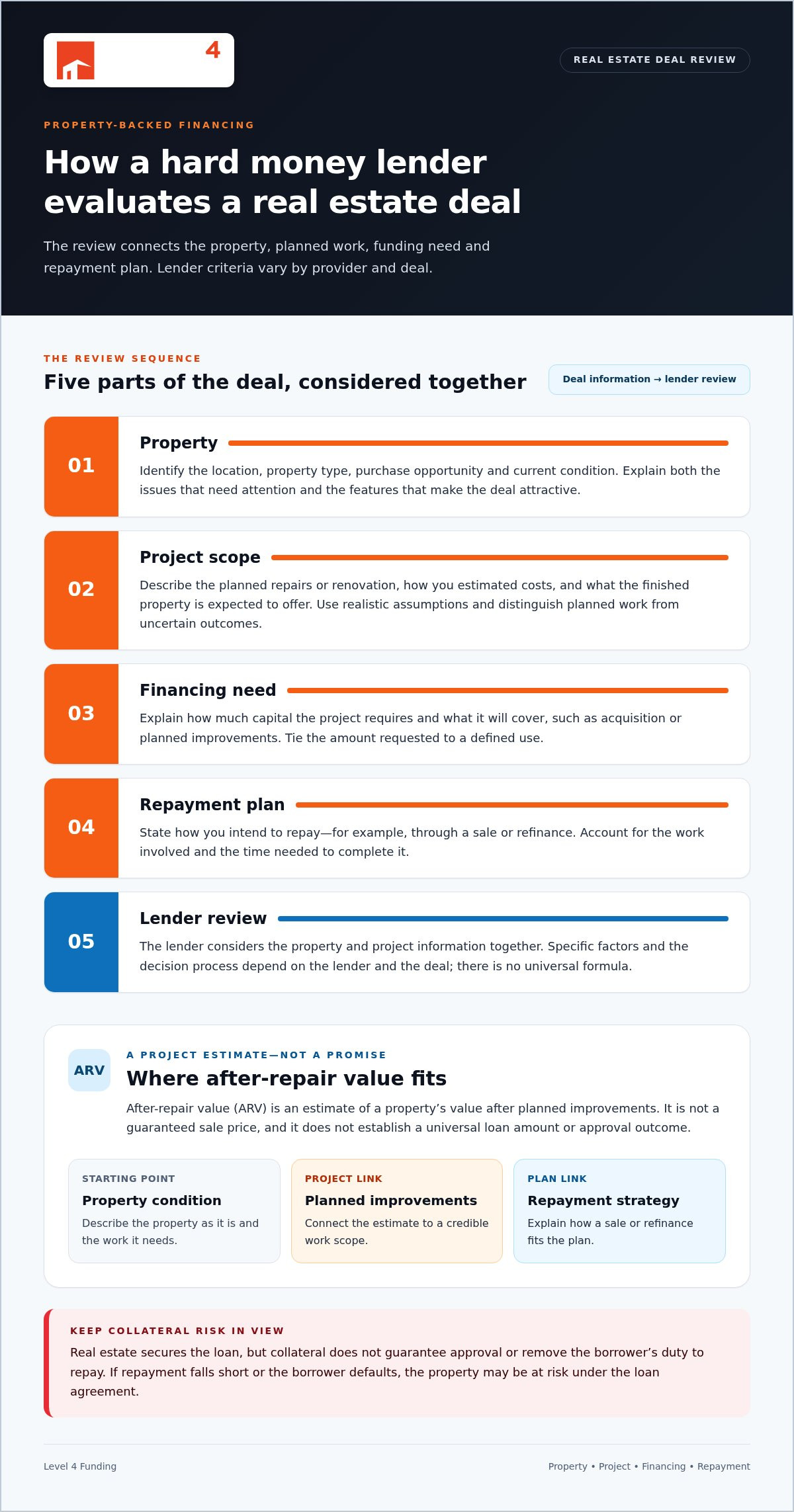
- Assess a deal in sequence: property, project scope, financing need, repayment plan, and lender review.
- Use after-repair value (ARV) as an estimate of a property’s value after planned improvements, not a guaranteed sale price.
- Compare bank and hard money financing by underwriting focus, intended use, and repayment horizon. Terms vary by lender.
- Prepare property details, project scope, a budget, and an exit plan, then explore how Level 4 Funding’s Arizona real estate loans may fit your investment.
What Is a Hard Money Lender? The Role Behind Property-Backed Financing
A hard money lender is a private or nonbank capital provider that offers financing secured by real estate, often for an investment project. If you’re asking what is a hard money lender, focus on the lender’s role: assessing a property and the borrower’s plan, then deciding whether to offer a loan under specific terms. The property helps secure the financing, but it doesn’t guarantee approval or remove the borrower’s responsibility to repay.
Keep the parties and terms distinct. The lender provides capital. The borrower receives it and agrees to repay it. The loan is the financing agreement, including its repayment obligations. Real estate collateral is the property pledged to secure that agreement. The investment property is the asset the borrower plans to buy, improve, refinance, or otherwise use in the project. If the borrower defaults, the collateral may be at risk under the loan agreement.
For a broader overview of how these loans are commonly described and used, see What is a Hard Money Loan? When a lender evaluates a specific deal, the project details matter just as much as the financing label.
For a general walkthrough of how hard money loans work, watch this video:
How is a hard money lender different from a hard money loan?
The lender is the capital provider. The hard money loan is the agreement that sets out the amount borrowed, repayment terms, and property securing the debt. Terms and underwriting approaches vary by project and provider. For example, two fix-and-flip proposals may have different properties, repair scopes, and repayment plans, even if both use hard money loans. Explore this hard money loan guide for more on the financing itself.
What does asset-based lending mean for a real estate investor?
Asset-based lending is financing in which a lender considers the value of the property securing the loan alongside the borrower’s project and repayment plan. A lender may review the property’s current condition, the proposed work, and the investment’s potential to assess the deal. That doesn’t mean credit history, experience, liquidity, or other financial details never matter. A strong-looking property doesn’t guarantee approval either. The lender weighs the proposal, and the borrower should understand the collateral risk before agreeing to the loan.
Hard money financing also differs from personal loans and bank mortgages. A personal loan is not defined by real estate pledged as collateral for an investment project. A bank mortgage follows the bank’s lending process and permitted uses. Hard money lending is private, property-backed financing, but the underwriting and loan terms depend on the lender and the deal.
How a Hard Money Lender Evaluates a Real Estate Investment
A lender’s review starts with the deal, not just a request for funds. To explain an investment clearly, lay out the property, the work you plan to do, the financing need, and how you intend to repay. This sequence shows how the project’s potential and risks fit together. There’s no universal formula, and lender criteria vary.
- Property: Identify the location, property type, purchase opportunity, and current condition. Describe the issues that need attention as well as the features that make the deal attractive.
- Project scope: Describe the planned work, from targeted repairs to a broader renovation. Use realistic assumptions about costs and the finished property.
- Financing need: Explain how much capital the project requires and what it will cover, such as acquisition or planned improvements. Tie the amount requested to a defined use.
- Repayment plan: State how you intend to repay the loan, for example through a sale or refinance. The plan should account for the work involved and the time needed to complete it.
- Review: The lender considers the property and project information together. Specific factors and the decision process depend on the lender and the deal.
Which property and project details help explain the deal?
Give a grounded picture of the opportunity: the property’s current condition, the improvements you intend to make, and how those changes support your investment plan. For a fix-and-flip, that could mean describing a home that needs updates before resale. A clear scope separates planned work from assumptions. If repair estimates or expectations for the finished property are too optimistic, the project may appear less feasible.
Include the planned work, how you estimated project costs, and what the property is expected to offer when the work is complete. Label uncertain outcomes as estimates. The aim is to make the deal’s logic understandable, including its weak points, rather than presenting only the potential upside.
How do collateral, ARV, and repayment plans fit together?
Collateral is property pledged to secure financing. A lender may consider the property’s current condition and value along with the project details. For renovation deals, one possible input is after-repair value, or ARV: an estimate of the property’s value after planned improvements. ARV is not a guaranteed future sale price, and it does not establish a universal loan amount or approval outcome.
ARV is most useful when it connects to a credible project scope and repayment plan. If your intended exit is a sale, explain how the completed property could reach buyers. If you plan to refinance, show how that fits your broader strategy. Neither route eliminates risk: construction issues, changing market conditions, or a delayed exit could affect repayment. Stress-test your assumptions before borrowing, and consider whether you could manage the debt if the plan takes longer than expected.
For Arizona investors considering a property-backed deal, Level 4 Funding’s private real estate financing offers project-focused options. Organize the property details, scope, financing need, and exit plan to keep the discussion focused on the deal.
Hard Money Lender vs. Bank: Understanding the Trade-Offs
Choosing financing isn’t a contest to find the fastest approval or the most flexible terms. It’s about matching the loan to the property, project, and repayment plan. A bank mortgage and private hard money financing may assess a deal differently, but neither is automatically the better fit. Compare the structure, intended use, and risks against what your investment needs.
| Comparison factor | Hard money lender | Bank |
|---|---|---|
| Underwriting focus | May give significant attention to the property, its collateral value, and the project’s feasibility. Borrower finances and other details may also matter. | Typically reviews the borrower’s financial profile and the property under the bank’s lending criteria. |
| Intended use | Often considered for investment projects such as acquiring or improving real estate. | May offer mortgage products for particular property types and uses, subject to its requirements. |
| Repayment horizon | May be structured around a project and a defined exit, such as a sale or refinance. | May offer a longer repayment schedule, depending on the mortgage product and its terms. |
This is a general comparison, not a promise about how every lender operates. Underwriting, permitted uses, repayment schedules, and other terms differ by lender and loan. Review the actual agreement and consider whether its obligations fit your projected cash flow and exit plan.
When might an investor compare private financing with a bank loan?
Start with the project’s constraints. Could the property’s condition affect your financing options? Does the project timeline align with the lender’s process and the loan’s repayment schedule? Does the financing structure fit the intended use? A fix-and-flip investor, for example, should compare how each option treats the acquisition, planned renovation, and exit. The answer depends on the lender and deal, not on a blanket claim that private financing is always faster or more accessible. This hard money loan versus bank loan comparison offers another lens for weighing the differences.
What risks should borrowers understand before using property as collateral?
Collateral is more than paperwork. If you pledge an investment property and fail to meet the loan’s obligations, that property may be at risk. Before signing, build a realistic project budget, account for unexpected work or delays, and map out more than one exit scenario where practical. Consider what happens if the sale takes longer than planned or a refinance isn’t available on your expected schedule. A workable repayment plan accounts for setbacks rather than depending on everything going right.
Speed and flexibility can help a project move, but they don’t erase the risk of pledging property or the need for a credible repayment plan. If you’re weighing property-backed financing for an Arizona investment, explore Level 4 Funding’s private real estate lending as one option to consider alongside your project needs and exit strategy.
How to Prepare for a Hard Money Lending Conversation in Arizona
A focused deal package makes it easier to explain what you’re buying, what you plan to do, and how financing fits. If you’re still asking “what is a hard money lender,” think of this conversation as a chance to present the investment clearly, not as a shortcut around evaluating risk. No checklist guarantees approval, and lenders may review projects differently. Use this list to organize the details behind your deal.
What information can an investor organize before discussing a deal?
Keep the key details together and separate confirmed facts from estimates. A Phoenix-area property and one elsewhere in Arizona may have different project considerations, but a clear summary helps make either opportunity easier to assess.
- Property: Note the address or location, property type, acquisition status, and current condition. Include known issues that could affect the work or project plan.
- Project scope: Describe the intended improvements and the property’s planned use after the work. For a fix-and-flip, outline the renovation and resale plan without treating a projected sale as certain.
- Budget: Break out the expected acquisition and project costs. Label estimates that still need validation, and explain the assumptions behind them, such as planned work or materials.
- Financing need: State the amount you’re seeking and what you expect it to cover. Tie the request to specific parts of the project rather than presenting it as a general cash need.
- Exit plan: Explain whether you intend to sell or refinance, what needs to happen first, and what could disrupt the plan. Consider how you would respond to delays or costs beyond your current estimate.
This is a practical starting point, not a universal set of lender requirements. For a more detailed overview of items investors may organize, use this hard money loan requirements guide.
How can Arizona investors keep local project context clear?
Make the property’s local setting relevant to the deal explanation. For a Phoenix investment, describe the condition and planned work for that specific property instead of relying on broad claims about the local market. If the project is in Scottsdale, Tucson, Glendale, Sedona, Flagstaff, Tempe, Mesa, or Buckeye, identify its location and explain any site-specific factors that affect the scope, budget, or intended use. Keep the details concrete and flag anything that remains an estimate.
Before the conversation, review your numbers and make sure the purchase details, work plan, budget, and exit strategy tell the same story. An organized package won’t remove investment risk, but it can focus the discussion on the project and the questions that still need answers.
With your deal details organized, explore Level 4 Funding’s investor financing for Arizona real estate projects.
How Level 4 Funding Supports Arizona Real Estate Investors
Once you understand what is a hard money lender and how property-backed financing works, the next question is whether a lender’s project focus fits your investment. Level 4 Funding is a private real estate lender serving investors in Arizona, including the Phoenix area. Its financing is focused on real estate projects, with options for investors to consider based on the property and the plan behind it.
Level 4 Funding serves investors in Phoenix, Scottsdale, Tucson, Tempe, Mesa, Glendale, Sedona, Flagstaff, and Buckeye. The address matters, but so does the deal: the property’s current condition, planned work, financing need, and a realistic repayment strategy all help frame a useful financing discussion.
Which real estate projects does Level 4 Funding finance?
For investors purchasing a property to improve and resell, fix-and-flip financing can support the acquisition and renovation plan. The project still needs a grounded scope and exit strategy. Financing doesn’t guarantee resale success.
Level 4 Funding also offers construction loans and commercial property loans for investors pursuing those types of real estate projects. For other investment plans, its offerings include Airbnb loans and cash-out refinance loans. Each serves a different purpose, so start by identifying what you want to accomplish with the property rather than choosing a loan label first.
Match the project to the financing category:
- Buying and renovating for resale: Explore fix-and-flip financing.
- Building or undertaking a construction project: Consider construction financing.
- Acquiring or financing a commercial property: Look at commercial property financing.
- Using a property for short-term rental plans or accessing equity: Explore Airbnb or cash-out refinance loans, respectively.
These categories are a starting point for understanding the offerings, not a guarantee that a project will be approved or funded. The property and investment plan remain central.
What is a practical next step for an Arizona investor?
Bring the deal into focus before exploring financing. Organize the property’s location and acquisition status, describe its condition and planned work, and lay out the project budget. Mark estimates that need validation. Then explain your intended repayment route, whether it depends on selling the improved property or pursuing a refinance, and identify what could change the plan. A clear package keeps the discussion anchored to the project rather than assumptions.
Don’t base a financing decision on speed alone. Compare the proposed structure with your budget, project scope, and ability to repay, and understand the obligations tied to the property. If you’re ready to explore financing for an Arizona investment project, explore real estate financing with Level 4 Funding.
Put Your Investment Plan in Motion
The best next move isn’t simply choosing a loan. Decide what would make the project workable and what you’ll do if costs, timing, or your expected exit change. Before pursuing financing, pressure-test your assumptions and make sure the repayment plan still holds under less-than-perfect conditions.
If you’re asking “what is a hard money lender” because you’re considering your next Phoenix-area deal, connect the financing conversation to the project in front of you. Level 4 Funding provides private real estate financing for investors, including fix-and-flip, construction, and commercial property loans. Start with the property and the outcome you’re working toward, then consider how financing could fit without treating approval or results as guaranteed.
Explore real estate financing with Level 4 Funding and take a clear-eyed next step toward your investment plan.
Frequently Asked Questions
What is a hard money lender?
A hard money lender is a private or nonbank source of real estate financing, often with property securing the debt. The lender provides capital; the hard money loan is the agreement that governs repayment and collateral. A lender may weigh the property and investment plan heavily while also considering the borrower’s circumstances. Criteria and terms differ, so this financing doesn’t mean automatic approval or freedom from risk.
How does a hard money lender make money?
Hard money lenders earn revenue through the financing terms borrowers agree to in the loan contract, which may include interest and other stated charges. The structure depends on the lender and transaction, so don’t assume two loans with similar collateral work the same way. Before committing, read the written agreement closely, including repayment obligations, charges, default provisions, and conditions that could affect the total amount owed.
Can you get a hard money loan with bad credit?
It may be possible, but bad credit doesn’t make approval automatic or mean credit is ignored. An asset-based review may place substantial weight on the property and project while still considering the borrower’s financial circumstances. Criteria vary by lender and deal. Present a complete picture, including relevant financial details, your real estate experience, the planned work, and how you expect to repay, rather than relying on a single credit score.
What happens if you cannot repay a hard money loan?
If you miss repayment, the lender may use remedies described in the loan agreement, and property pledged as collateral could be at risk, including through potential foreclosure. The consequences depend on the agreement and circumstances. Before borrowing, understand the default provisions and repayment obligations, and plan for setbacks that could disrupt your exit. If repayment trouble arises, seek qualified legal or financial guidance specific to your situation.
Is a hard money lender the same as a private money lender?
Not necessarily. Both labels broadly describe nontraditional sources of real estate financing, but their usage and the lender’s structure can differ. “Private money lender” is a broad category, while “hard money lender” commonly describes a lender emphasizing real estate collateral and investment deals. The lender is the source of capital; the loan is the specific agreement. Review the actual terms instead of assuming the labels guarantee a particular structure.
Are hard money lenders only for house flippers?
No. Fix-and-flip deals are one use, but investors may also explore hard money financing for other real estate projects, depending on the lender and transaction. Examples include construction or commercial property investments. The project type alone doesn’t determine whether financing is suitable or available. Clarify what the property will be used for, what work is involved, and how repayment is planned before assessing whether a particular loan structure fits.
Do hard money lenders operate in Arizona?
Yes, real estate investors can seek private financing in Arizona. Level 4 Funding serves investors in Phoenix, Scottsdale, Tucson, Glendale, Sedona, Flagstaff, Tempe, Mesa, and Buckeye. Location is one part of the discussion, not a funding decision by itself. Prepare details about the property, planned project, budget, and intended repayment, then review the terms for the specific transaction before deciding whether to proceed.

About the author
Matt has a bachelor's degree in political science from Northern Arizona University and works at Level 4 Funding, a private lending company that offers hard money and rental home loans to real estate investors in 35 states.
With Matt's leadership, the firm has financed almost $300 million in loans for investment properties. He often helps real estate investors with rental property purchases, foreclosures, refinancing, and fix-and-flip projects. Matt has extensive experience in fix-and-flip, buy-and-hold, rental properties, and real estate sales. He has lived in Arizona for 43 years and is married with three children. Matt is licensed as a mortgage broker and loan originator in Arizona, with NMLS 2062278 and NMLS 1118493.
Equal Housing Opportunity. This is not a Good Faith Estimate, and it is not a Guarantee to lend; it should not be considered as such. Costs, rates, estimates, and terms can only be determined after a full application is completed. To the extent this message includes any tax or legal advice, this message is not intended or written by the sender to be used, and cannot be used, for legal or tax purposes or advice. This is an advertisement. Copyright © 2026. All rights reserved.