


Hard Money Loans in New Jersey: Rates, Requirements, and the Best Lenders for Garden State Investors
October 18, 2026
Duplex Construction Loans: How to Finance a Two-Unit Build With Hard Money or Private Capital
October 19, 2026
What if the financing decision for a Phoenix retail deal depends less on speed than on how clearly you can defend the plan? A seller’s timeline may leave little room for a lengthy financing process, but hard money for retail space acquisition Phoenix investors consider still calls for more than a fast offer. The property, its tenancy, income, condition, and payoff route all matter.
Retail diligence can get complicated quickly. Is the rent roll supported by current leases? Will repairs or vacancies change the numbers? If the loan is short-term, what specific event will repay it? Answer those questions before you commit, not after closing.
This guide will help you evaluate a Phoenix retail property, build an acquisition plan, and compare hard money with other financing paths. You’ll see which property and income details to organize, how to separate documented facts from estimates, and what to include in a concise deal package. Level 4 Funding provides private, asset-based financing, including commercial property loans, for retail acquisitions. A focused financing discussion can cover the asset, acquisition plan, and intended repayment path.
Key Takeaways
- Hard money for retail space acquisition Phoenix investors consider should fit the property, purchase plan, and repayment route, not just the seller’s timeline.
- Separate documented property and tenancy facts from estimates so your deal summary is clear and reviewable.
- Compare conventional commercial financing, hard money, and investor capital by timeline, review needs, repayment horizon, and paperwork.
- Check the specific parcel, submarket, access, surrounding retail context, and property condition before finalizing your acquisition numbers.
- Build a concise financing package that connects the asset and acquisition plan to a credible exit strategy.
Hard Money for Phoenix Retail Space: When It Fits an Acquisition
Retail acquisition hard money is short-term, private, asset-based financing used to purchase a commercial retail property. A financing review considers the asset and the borrower’s plan rather than relying on an automatic approval formula. The What is a Hard Money Loan? overview provides broader background on this type of real estate financing, but a retail deal still needs clear numbers and a credible repayment plan.
Investors may explore this route when a seller’s schedule is tight or the property’s condition, occupancy, or leasing situation makes conventional commercial financing harder to arrange. That doesn’t make hard money the default answer. Compare its cost and repayment horizon with the purchase terms, expected work, income assumptions, and planned exit.
Keep the project type clear. Buying an existing neighborhood retail building is an acquisition. Building new space or carrying out a major redevelopment is a different scope that may call for construction financing, a staged plan, or both. Don’t assume acquisition financing covers renovation or construction costs. Spell out what you’re buying, what work is planned, and how the project will be repaid.
Which Phoenix retail acquisitions may warrant hard-money financing?
Consider the financing fit when timing, property condition, or the business plan affects the options available for a purchase. For example, an investor might be evaluating a neighborhood retail building that needs repairs or a multi-tenant storefront with vacant space. These are illustrative scenarios, not predictions about Phoenix properties or a promise that financing will be approved.
The property is only part of the story. Your intended use, leasing or repositioning plan, available capital, and repayment route help explain how the acquisition is expected to work. For hard money for retail space acquisition Phoenix, show how the proposed financing connects the purchase to a credible payoff, such as a planned refinance or sale. Don’t rely on an assumed increase in value as the entire repayment strategy.
What makes a retail deal different from a residential investment?
Retail property income is tied to commercial tenancy and lease arrangements. A review may need to account for occupancy, lease documentation, tenant responsibilities, and the building’s condition. Separate current income documented by leases from estimates based on future leasing or changes to the space.
Vacant units and tenant turnover can affect both projected income and execution risk. A space expected to lease later may require time and capital before it generates revenue. Account for that gap when assessing how the property will carry its obligations and whether the exit remains realistic if leasing takes longer than planned.
Make the financing conversation about the whole acquisition: what the asset is today, what you plan to do with it, and how repayment follows. A strong timeline alone isn’t a deal plan. Clear assumptions give the project a sharper basis for evaluation.
How Lenders Assess a Phoenix Retail Acquisition
A retail acquisition doesn’t stand or fall on one headline number. A lender needs to understand the property, purchase basis, work required, operating assumptions, and expected repayment. A compelling location can’t erase unanswered questions about tenant income or repair costs. The deal has to add up as a whole.
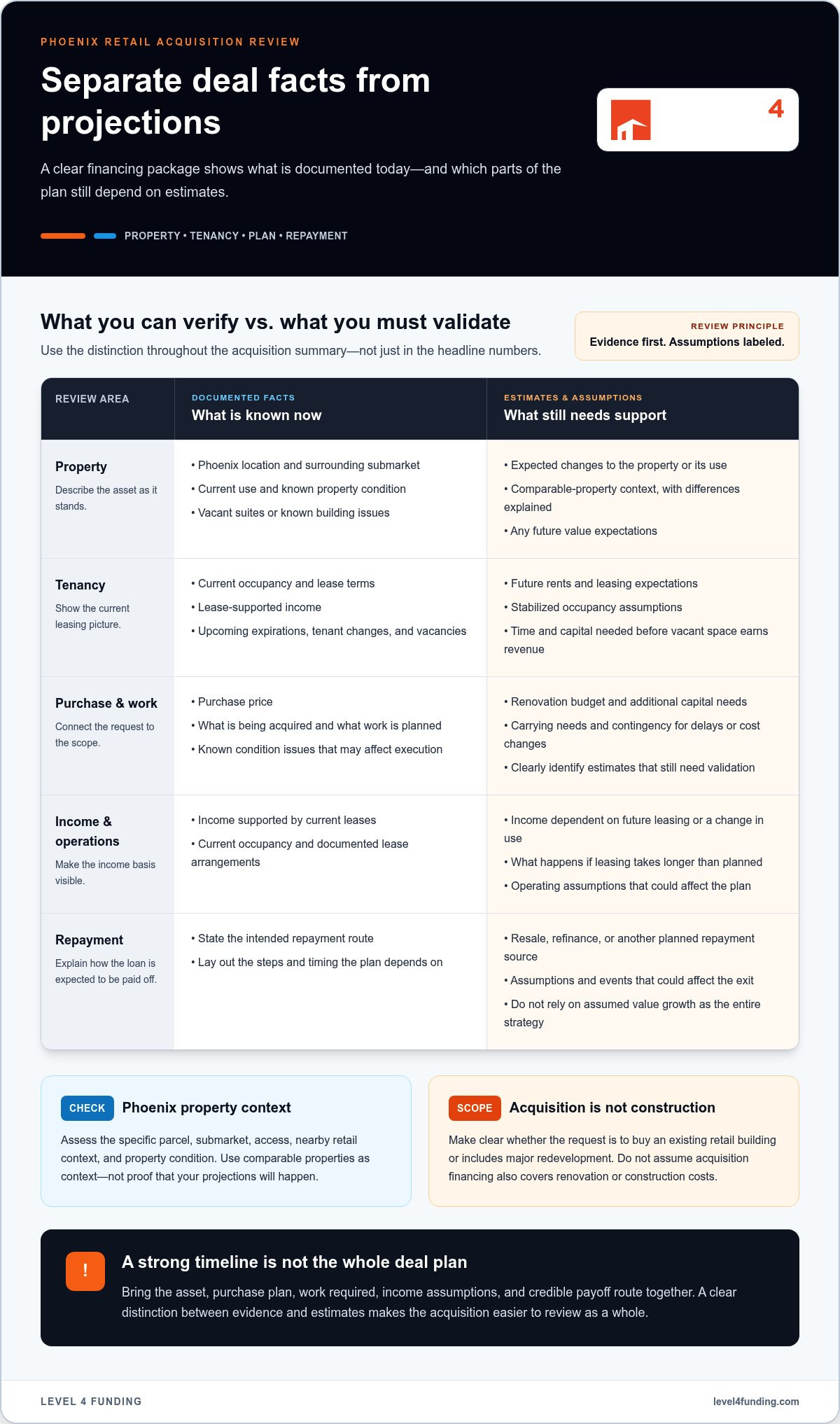
Make the evidence easy to distinguish from projections. Label documented facts, such as the purchase price, current leases, and known property condition. Then identify estimates, including future rent, renovation budget, stabilized occupancy, or resale value. For broader context, the FDIC Guidelines on Commercial Real Estate Lending distinguish acquisition financing from development and construction lending. That distinction helps clarify what your request is meant to fund; it doesn’t establish terms for a particular private loan.
Build a retail property and tenancy snapshot
Start with a concise picture of the asset: its Phoenix location and surrounding submarket, current use, occupancy, lease terms, and known condition. Call out vacant suites, upcoming lease expirations, tenant changes, and assumptions that still need validation. A fully occupied building and one with near-term vacancies can present different income and execution risks.
Use comparable properties as context, not proof that your projections will happen. Separate documented evidence from expectations for future leasing, rent, or value. If a comparable space has a different use, condition, or tenancy profile, explain the difference rather than treating the numbers as interchangeable.
Connect the acquisition numbers to a repayment plan
Show how the purchase price relates to the funding request and what additional capital the plan may require. Include planned work, expected carrying needs, and a contingency for delays or costs that differ from estimates. Keep operating assumptions visible: identify which income is supported by current leases and which depends on future leasing or a change in use.
A credible exit strategy matters because it shows how the acquisition financing is expected to be repaid and what assumptions that repayment depends on. An exit might involve a resale or another repayment source, but neither is certain. Explain the timing, the steps required, and what could affect the plan.
For hard money for retail space acquisition Phoenix, a clear package makes it easier to discuss the asset and full project without confusing an estimate for a verified fact. Level 4 Funding’s private, asset-based commercial property financing supports a project-focused conversation about the property, acquisition plan, and intended repayment path.
Hard Money vs. Other Ways to Finance Phoenix Retail Space
Speed matters, but it isn’t the whole decision. Match the financing path to the property, purchase timeline, ownership plan, and repayment source. Conventional commercial financing, private hard money, and investor capital each bring different tradeoffs. None automatically wins. For broader background on hard money for retail space acquisition Phoenix, compare the options against your actual deal rather than a generic promise of speed or flexibility.
The comparison below is a planning framework, not a guarantee of timing or approval. Requirements and terms vary by lender, borrower, and property. Avoid relying on generic rate or fee figures; review written terms and the obligations tied to your specific transaction.
| Financing path | Likely timeline | Property and borrower review | Repayment horizon | Documentation |
|---|---|---|---|---|
| Conventional commercial financing | May require more time for review and processing | May involve detailed review of the property, income, leases, and borrower finances | Often structured for longer-term ownership | Typically includes property, tenancy, financial, and transaction records |
| Hard money | Can be considered for time-sensitive deals, but timing isn’t guaranteed | Focuses on the asset and acquisition plan, with review depending on the transaction | Short-term financing calls for a defined payoff plan | Organize property facts, purchase details, project assumptions, and exit strategy |
| Investor capital | Depends on the investor’s decision process and available funds | May rely on agreed investment terms and review of the project’s risks and potential | Set by the parties’ investment agreement | Clarify capital commitments, ownership or repayment terms, and decision rights |
When hard money may fit better than a conventional loan
A seller’s deadline or a property requiring a project-specific financing discussion may lead an investor to explore hard money. The case is stronger when the property facts are organized and the exit plan is credible. A faster or more flexible process isn’t assured for every transaction. Compare proposed terms and timing, not assumptions, before choosing a financing path.
When a different financing path may make more sense
If you expect to hold the property long term, a repayment structure designed for that horizon may fit better than short-term debt. Reassess if leasing remains uncertain, projected income lacks support, or the exit depends on an optimistic sale or refinance. Short-term financing needs a realistic repayment timeline and a contingency plan if leasing, work, or the exit takes longer than expected.
Before committing, compare written terms, repayment obligations, timing, and project assumptions side by side. A deal that only works if every estimate lands perfectly needs a second look. Level 4 Funding’s commercial hard money loans provide private financing to consider for a Phoenix retail acquisition.
Phoenix Retail Acquisition Due Diligence: A Practical Deal Checklist
A clean acquisition package starts with facts, not sales language. Work through the property in sequence, mark what’s verified, and flag what still needs investigation. For hard money for retail space acquisition Phoenix investors are considering, that discipline helps distinguish a financeable plan from a stack of optimistic assumptions.
Review the property, leases, and operating assumptions
Start with the asset and its current operation. Keep investor research organized, but don’t treat this checklist as a substitute for legal, zoning, environmental, building, or other professional review. Those reviews may require qualified professionals and current, authoritative information.
- Identify the specific parcel. Record the property address and parcel details. Confirm you’re researching the correct site, then establish its Phoenix submarket and surrounding retail context using current sources.
- Assess location and access. Note how customers, tenants, and deliveries reach the property. Record visible access points, parking, nearby retail uses, and features that could affect the intended business plan. Separate observations from assumptions about future demand.
- Summarize occupancy and leases. Gather available lease documents, occupancy details, rent information, known vacancies, and upcoming lease expirations. Flag missing documents, tenant changes, or income figures that haven’t been verified.
- Describe condition and planned work. Record known property issues, proposed improvements, and unresolved questions. Keep estimates for scope and cost clearly labeled; don’t present unreviewed work assumptions as established facts.
- Test operating and comparable assumptions. Identify the sources behind current income and projected rent, occupancy, or value. Compare like properties cautiously, noting differences in location, use, condition, and tenancy. Verify local information with current sources rather than relying on outdated listings or unsupported generalizations.
Prepare a concise Phoenix deal package
Turn the findings into a short, readable financing summary. Make it easy to see what you’re buying, what the project needs, and what remains unresolved.
- Purchase: Summarize the agreed or proposed purchase terms and transaction timeline.
- Property: Include parcel and location details, current use, occupancy, lease information, condition, and access notes.
- Project: Explain planned work and anticipated carrying needs, labeling estimates and assumptions.
- Funding and repayment: State the funding request, explain how it connects to the acquisition plan, and describe the proposed repayment path without treating a future refinance or sale as certain.
- Open items: List outstanding diligence, professional reviews, missing information, and timing constraints. Don’t present pending questions as settled.
A strong package is candid about gaps. If a lease, repair estimate, or local-use question is still being reviewed, say so and identify the next step. Bring your organized property facts, project needs, and repayment plan to discuss your Phoenix retail acquisition financing with Level 4 Funding.
Explore Retail Acquisition Financing with Level 4 Funding
You’ve evaluated the property, separated evidence from estimates, and mapped the acquisition to a repayment plan. Now put those pieces to work. Level 4 Funding provides private real estate financing, including commercial property loans, for investors in Phoenix and other Arizona markets. A project-focused financing conversation can center on the retail asset, purchase plan, and intended repayment. Investors evaluating properties in Scottsdale, Tucson, Glendale, Sedona, Flagstaff, Tempe, Mesa, and Buckeye can use the same disciplined approach to organize the deal.
Bring a clear acquisition plan to the financing conversation
Before discussing hard money for retail space acquisition Phoenix, prepare a concise summary that lets the property and plan speak for themselves. Include the parcel and location, current retail use, occupancy, lease information, and known condition. Add the purchase terms, acquisition timing, planned work, and funding need tied to the transaction.
Be direct about the numbers. Label documented income and property facts separately from estimates for future rent, repairs, occupancy, or value. If a lease document is missing or a building issue still needs professional review, note it as an open item. Clear gaps are easier to discuss than assumptions presented as settled facts.
Then explain the exit. Identify the intended repayment source, the steps needed to reach it, and the assumptions that could affect timing. A planned refinance or resale may be part of the strategy, but it isn’t a guaranteed outcome. Describe what happens if leasing, improvements, or the sale takes longer than expected. That’s how you turn a property summary into an acquisition plan that can be meaningfully evaluated.
Move from retail opportunity to a financing discussion
Level 4 Funding specializes in private, asset-based real estate financing. For a retail acquisition, the discussion can connect the property’s present condition and tenancy to the proposed purchase, project needs, and repayment path. Review the broader hard-money approval process to understand how a financing discussion may progress, while recognizing that each transaction has its own details and requirements.
Bring the core materials together: purchase information, available lease and occupancy records, condition notes, project estimates, funding request, timing constraints, and exit plan. Keep unresolved diligence visible. No inflated projections. No hidden gaps. Just the deal as it stands, with assumptions clearly marked.
Ready to put your Phoenix retail deal on the table? Share your prepared acquisition plan with Level 4 Funding to discuss private commercial financing for the property, timeline, and intended repayment strategy. A focused first conversation starts with the facts you’ve assembled and the questions that still need answers.
Turn Your Retail Opportunity Into a Clear Next Move
The next move isn’t simply choosing a lender. It’s deciding whether the opportunity still works when you test the timeline, income assumptions, and repayment plan against real-world uncertainty. If a key lease changes or planned work takes longer, does the deal still hold together? Answering that before you commit can protect your options and sharpen your negotiating position.
Use your findings to set a clear go, revise, or pause decision. If the numbers support moving forward, outline what you need from financing and which milestones must happen before repayment. If they don’t, adjust the plan before urgency turns into pressure. That’s how hard money for retail space acquisition Phoenix can be evaluated as one tool in a disciplined investment strategy, not a shortcut around sound judgment.
Level 4 Funding offers private financing for real estate investment projects. Take your next step with a focused conversation about the opportunity and the plan behind it: Discuss your Phoenix retail acquisition with Level 4 Funding.
A well-tested deal puts you in a stronger position to act with purpose. Move forward when the property, financing approach, and exit strategy make sense together.
Frequently Asked Questions
Can I use hard money to buy retail space in Phoenix?
Hard money may be considered for a Phoenix retail purchase if the property and transaction fit the financing review. Note whether the space is occupied, delivered vacant, or subject to a lease transition, since each situation can shape the operating plan. Prepare purchase details and a realistic repayment route, too. Future leasing or resale figures are projections until supported by relevant documents and local evidence.
How do lenders evaluate a retail property acquisition?
Lenders may assess the property alongside the acquisition plan, tenancy, condition, project assumptions, and proposed repayment. Clarify the deal by connecting each major estimate to its source: distinguish signed lease information from anticipated rent, and contractor estimates from preliminary repair allowances. For hard money for retail space acquisition Phoenix investors are considering, no universal checklist or threshold replaces a transaction-specific review.
Is hard money a good fit for a vacant retail property?
It may be worth evaluating, but vacancy puts more weight on the leasing plan and how the loan will be repaid before the space produces income. Identify the intended tenant or use, any work needed before occupancy, and how carrying obligations will be handled during lease-up. Don’t count hoped-for rent as current income. If the payoff depends on filling the space, test a slower leasing scenario.
What should I include in a Phoenix retail property loan request?
Include enough information to make the transaction understandable without forcing the reviewer to piece it together. A short cover summary can identify the parcel, proposed purchase terms, use, occupancy, lease status, known condition concerns, intended work, funding need, and repayment plan. Attach relevant records available to you, such as purchase documents or leases. Clearly label estimates, note missing items, and include any deadline affecting the acquisition.
How much can I borrow for a retail property with hard money?
The amount depends on the property, transaction, collateral review, financing structure, and repayment plan. Don’t treat an online loan-to-value example or another investor’s proceeds as a quote for your deal. Instead, show the purchase basis, available capital, anticipated project needs, and evidence supporting your value assumptions. That gives a lender a deal-specific starting point for discussing a possible structure without assuming a particular amount is available.
How quickly can hard money close on a Phoenix retail acquisition?
There isn’t one closing timeline that applies to every Phoenix retail transaction. Property review, lease records, title work, diligence, documentation, and closing coordination can all affect timing. If a seller has set a deadline, include it early and identify milestones that remain incomplete. Organized records can reduce avoidable back-and-forth, but they can’t guarantee a closing date. Discuss the expected schedule in light of the actual deal.
What exit strategy should I show for a retail acquisition loan?
Show the expected repayment source, the steps required to reach it, and the assumptions that could disrupt the plan. If repayment depends on leasing before a refinance, explain the leasing milestones and what you would do if they take longer. A sale or other repayment source may be part of the plan, but don’t present future income, tenant demand, or resale value as certain. A contingency makes the strategy more grounded.
Can I use a hard money loan to acquire a multi-tenant retail property?
A multi-tenant property can be evaluated as a commercial acquisition, with the full deal determining fit. A rent roll alone may not show the whole picture, so identify which tenants have signed leases, upcoming expirations, vacancies, and known tenant changes. For a property in Phoenix or another Arizona market, keep the submarket and parcel context specific. Explain how tenant turnover could affect operations and the repayment plan.

About the author
Matt has a bachelor's degree in political science from Northern Arizona University and works at Level 4 Funding, a private lending company that offers hard money and rental home loans to real estate investors in 35 states.
With Matt's leadership, the firm has financed almost $300 million in loans for investment properties. He often helps real estate investors with rental property purchases, foreclosures, refinancing, and fix-and-flip projects. Matt has extensive experience in fix-and-flip, buy-and-hold, rental properties, and real estate sales. He has lived in Arizona for 43 years and is married with three children. Matt is licensed as a mortgage broker and loan originator in Arizona, with NMLS 2062278 and NMLS 1118493.
Equal Housing Opportunity. This is not a Good Faith Estimate, and it is not a Guarantee to lend; it should not be considered as such. Costs, rates, estimates, and terms can only be determined after a full application is completed. To the extent this message includes any tax or legal advice, this message is not intended or written by the sender to be used, and cannot be used, for legal or tax purposes or advice. This is an advertisement. Copyright © 2026. All rights reserved.