

Duplex Construction Loans: How to Finance a Two-Unit Build With Hard Money or Private Capital
October 19, 2026
Can hard money help you secure a Phoenix mobile home park when traditional financing doesn’t fit the property or your timeline? It may be a path worth evaluating, but speed alone won’t make a deal work. Park condition, occupancy, infrastructure, operating records, and a realistic exit all shape the financing discussion. Phoenix hard money for mobile home parks starts with the asset and the plan, not assumptions.
Before committing to a specialized acquisition, identify what needs closer inspection, which financing path fits the project’s risks and timeline, and how you expect to repay or refinance the loan. A credible plan connects those points and is supported by records, not just optimistic projections.
This guide explains how to assess a park’s physical and operating condition, compare financing paths using consistent criteria, and assemble a focused project package. Level 4 Funding provides private, asset-based commercial property financing for investors. Whether you’re assessing a property in Phoenix, Scottsdale, Tucson, Glendale, Sedona, Flagstaff, Tempe, Mesa, or Buckeye, organize the facts, pressure-test the numbers, and build a plan you can explain.
Key Takeaways
- Understand why mobile home park financing calls for a close look at both the real estate and the operating business.
- Use consistent criteria to compare Phoenix hard money for mobile home parks with bank and longer-term commercial financing.
- Follow a practical due diligence sequence, including parcel-specific zoning, utility, title, and permitting checks.
- Assess how property condition, occupancy, income records, and capital needs shape the financing discussion.
- Build a lender-ready summary that connects the acquisition plan, project needs, and a credible repayment or exit strategy.
Phoenix Hard Money for Mobile Home Parks: Start With the Deal
Hard money, in this context, is private, real-estate-backed financing used for an investment transaction. The property supports the financing discussion, but a mobile home park is more than land with units on it. The physical asset and its operation both matter. When assessing Phoenix hard money for mobile home parks, first map what’s being acquired, how it functions today, and what you plan to do next.
Location is only one part of the analysis. Two parks in the same metro area can differ in layout, infrastructure, ownership, and operating records. Start with the specific parcel and its records before comparing financing options. That approach applies across Arizona markets, including Phoenix, Scottsdale, Tucson, Glendale, Sedona, Flagstaff, Tempe, Mesa, and Buckeye.
What makes a mobile home park deal different?
Break the deal into its parts: the land, site improvements such as roads and utility systems, any homes owned by the park, and homes owned by residents. That last distinction matters. The park’s real estate and operating income may be connected, but they are not interchangeable. The Mobile home park overview provides foundational terminology for understanding this community structure.
Next, examine the operating picture. Track occupancy, rent collections, utility arrangements, and maintenance needs. Compare income records with actual collections, and note any gaps or near-term capital needs visible in the property’s condition. Ownership and site configuration can change what you need to investigate. A park with owner-owned homes and multiple utility arrangements may call for a different diligence review than one where residents own their homes and the park primarily earns site rent.
Property value describes the real estate; operating performance shows how reliably the park turns that asset into income. Both inform the deal, and neither should stand in for the other.
When might hard money fit a Phoenix park acquisition?
Hard money may be worth evaluating when the acquisition timeline, property condition, or transition plan makes the financing structure important to execution. For example, an investor might be buying a park that needs repairs, better-organized operating records, or a defined plan to stabilize operations. These are circumstances to document, not automatic reasons to assume a loan will fit. A lender still needs a clear view of the asset, the project, and the repayment plan.
An acquisition bridge and a long-term hold strategy address different planning needs. A bridge is generally considered for a defined transition, with repayment or refinancing tied to the investor’s next steps. A long-term hold focuses on ongoing operations and durable financing assumptions. Neither is the universal answer. The right fit depends on the acquisition plan, capital needs, operating evidence, and a credible exit.
Level 4 Funding provides private, asset-based commercial property financing for investors evaluating income-producing real estate in Phoenix and other local Arizona markets. Its project-focused approach considers the property, acquisition plan, and intended exit rather than relying on a one-size-fits-all structure. The broader context of commercial hard money loans can help explain how private financing is used across commercial investment deals.
How Lenders Evaluate a Phoenix Mobile Home Park
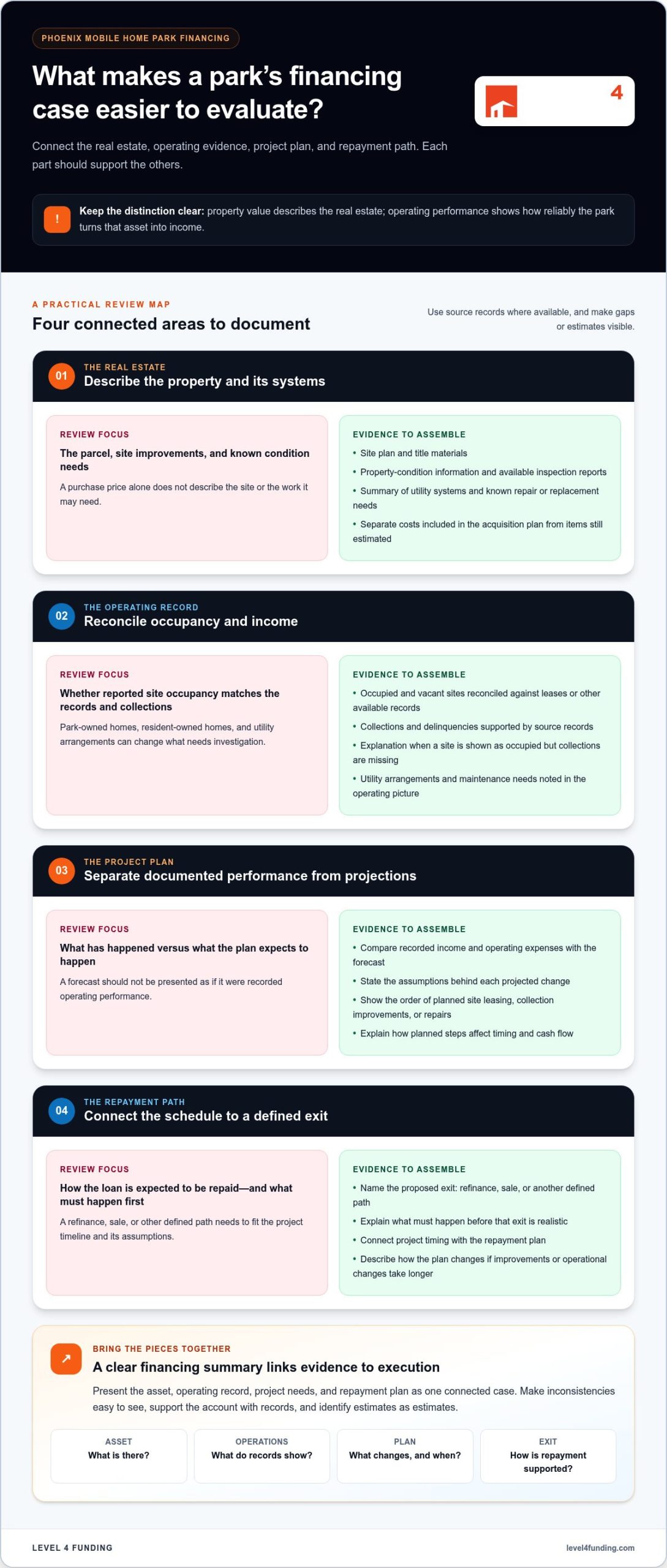
A financing review needs more than an asking price and a rent roll. For Phoenix hard money for mobile home parks, organize the deal around four connected areas: the real estate, the operating record, the borrower’s plan, and the repayment path. Each should support the others. A strong forecast won’t resolve property issues, and a solid asset alone won’t explain how the loan will be repaid.
Property, infrastructure, and occupancy records
Gather records that describe the parcel and how it functions. A clear package helps uncover gaps early, rather than leaving them hidden in optimistic assumptions.
- Property: Assemble the site plan, title materials, property-condition information, and available inspection reports.
- Infrastructure: Summarize utility systems and known repair or replacement needs. Separate costs included in the acquisition plan from items that remain estimates.
- Occupancy: Reconcile occupied and vacant sites against leases or other available occupancy records.
- Income: Present collections and delinquencies using source records, not just a projected monthly total.
Make inconsistencies easy to see. If the rent roll shows a site as occupied but collections are missing, explain the difference and identify the documentation behind your account. If a utility or road improvement is needed, describe its scope and expected timing in the project plan. This gives a lender a clearer picture of current conditions and the work ahead.
Operating assumptions and repayment strategy
Separate documented performance from projections. Compare recorded income and operating expenses with your forecast, and state the assumptions behind any change. If the plan depends on filling vacant sites, improving collections, or completing repairs, show the order of those steps and how each one affects timing and cash flow.
Then connect the schedule to repayment. Is the proposed exit a refinance, sale, or another defined path? Explain what must happen before that exit is realistic, and how the plan changes if improvements or operational changes take longer than expected. Asset-based real estate loans provide useful context for understanding how collateral fits into private financing, while the borrower’s execution plan remains central to the full deal picture.
What lender review does not replace
A lender’s financing review is not a substitute for independent legal, engineering, environmental, or market diligence. Those reviews answer different questions. Legal professionals can assess documents and obligations; qualified specialists can evaluate physical or environmental concerns; and market research can test local assumptions. Keep their findings distinct from lender materials, then summarize how relevant findings affect cost, schedule, and repayment.
Park financing depends on credible property evidence and a repayment plan that holds up under scrutiny. Level 4 Funding evaluates private, asset-based real estate opportunities with attention to the individual project. The Level 4 Funding website provides information about the company’s financing services.
Compare Hard Money With Other Financing for a Phoenix Park
There’s no universal winner. The right financing path depends on what the park needs now, how the deal will be underwritten, and where repayment is expected to come from. Compare options against the same criteria, then test each against the acquisition plan. Actual terms and processes vary by lender, collateral, borrower, and transaction.
| Comparison factor | Hard money | Bank financing | Longer-term commercial financing |
|---|---|---|---|
| Timeline | May suit a transaction with a defined, time-sensitive need; timing depends on the lender and deal. | May involve a more extensive review and documentation process. | Often considered as part of a longer-term ownership plan; closing requirements vary. |
| Underwriting focus | Typically gives substantial attention to the real estate and transaction, alongside the borrower’s plan. | May place significant weight on borrower documentation, property performance, and underwriting standards. | Often centers on sustained property performance and the proposed long-term repayment structure. |
| Collateral | Real estate secures the financing, subject to the lender’s review. | Collateral is assessed within the lender’s broader credit and property review. | The commercial property and its income may inform the financing analysis. |
| Repayment | Needs a clear repayment source and exit plan. | Structured around the approved loan terms and repayment capacity. | Designed around ongoing ownership and longer-term repayment assumptions. |
| Project flexibility | May accommodate a project-specific discussion, depending on the transaction. | May be less suited to unusual conditions or a compressed acquisition plan. | May align with a stabilized hold, depending on property performance and lender criteria. |
Hard money versus bank financing
With a specialized asset, the financing conversation may need to account for details that don’t fit neatly into a standard property profile. Private hard money financing generally emphasizes the real estate and transaction, while bank financing may require a broader review of borrower documentation and property performance. Neither approach removes the need for a clear operating picture. A broader comparison of hard money loans versus bank loans can help clarify the differences before you assess which path fits a park acquisition.
Bridge financing versus a long-term hold strategy
Start with the project’s stage. Is the plan to acquire the park, stabilize operations, complete improvements, or refinance later? A bridge strategy should connect a near-term financing need to a defined repayment source. A long-term hold plan should show how projected operations support ongoing repayment. Put the schedule beside the assumptions. If repairs or stabilization take longer than expected, does the exit still make sense?
Refinancing is one possible exit to evaluate, not a guaranteed result. Future approval may depend on the property’s condition and performance, the borrower, lender criteria, and market conditions at that time. Compare Phoenix hard money for mobile home parks against the full project path, not just the initial acquisition. Level 4 Funding’s private, asset-based commercial property financing is evaluated with the individual property, acquisition plan, and intended exit in view.
Phoenix Mobile Home Park Due Diligence: Prepare a Financeable Plan
A financeable plan is built in sequence. Screen the opportunity, verify what you can, then connect the financing choice to a workable repayment path. This keeps Phoenix hard money for mobile home parks grounded in parcel-specific facts rather than broad assumptions.
Build the park’s deal file
Collect core records before presenting the opportunity. Keep source documents separate from estimates, and label each assumption clearly. A lender should be able to distinguish what’s documented, what’s projected, and what still needs investigation.
- Screen the acquisition. Summarize the purchase terms, ownership structure, intended use, and reason for pursuing the property. Note questions that could affect feasibility, such as unclear records or significant visible repair needs.
- Assemble the property and operating file. Gather available title and ownership materials, the rent roll, operating statements, leases or occupancy records, site plans, and inspection reports. Summarize occupied and vacant sites, income, infrastructure, and known maintenance needs.
- Check parcel-specific requirements. For the specific Arizona parcel, identify the relevant city or county jurisdiction and verify zoning, permitted use, utility arrangements, title matters, and applicable permitting requirements with that jurisdiction and qualified professionals. Don’t assume rules or approvals transfer from one property to another.
- Define the project scope. List planned work, related costs or estimates, who will carry out each task, and the expected sequence. Show how infrastructure needs or improvements could affect the acquisition plan and project timing.
- Compare financing paths. Evaluate each option against the same needs: acquisition timing, project flexibility, collateral, documentation, repayment structure, and intended ownership period. The hard money loan approval process offers general context for preparing a financing request, while the specific transaction determines its terms and review.
- Stress-test repayment and exit. Model conservative occupancy, operating costs, maintenance, and improvement timing. Identify the expected repayment source, then consider what changes if stabilization or a future refinance takes longer than planned. Treat refinancing as a scenario to evaluate, not a guaranteed outcome.
Make the plan easy to assess
Bring the file together in a concise summary of the acquisition, current property and operating conditions, capital needs, project schedule, and exit strategy. State the basis for every projection. If a number depends on filling vacant sites or completing work, label that assumption plainly. A focused package doesn’t hide uncertainty; it shows where it sits and how you plan to address it.
Once the property evidence and repayment plan are organized, the Level 4 Funding website offers information about private real estate financing, including commercial property loans.
Take the Next Step on Phoenix Mobile Home Park Financing
A financing discussion is strongest when four parts line up: the asset’s condition, evidence of how the park operates, a financing structure that fits the project, and a credible repayment plan. Phoenix hard money for mobile home parks isn’t a shortcut around those fundamentals. It’s a financing path to assess against the facts, the acquisition plan, and the investor’s intended exit.
What to bring to a financing discussion
Prepare a concise overview backed by source documents. Start with the property address, purchase details, ownership structure, and current operating records. Include the rent roll, available income and expense statements, occupancy information, and relevant property or inspection materials. Make clear which homes or improvements are included in the acquisition and which are outside its scope.
Next, explain the project. Describe planned improvements, anticipated capital needs, and the sequence and projected timing of the work. Connect each major task to its purpose, such as addressing a condition issue, supporting operations, or preparing for a planned transition. Then state the intended repayment strategy and the milestones that need to be reached for that path to make sense.
Don’t bury open questions. Identify unresolved diligence items, such as a utility detail that still needs documentation or a condition issue awaiting further review. Explain how each could affect cost, timing, or the exit plan, and note the next step for resolving it. Clear disclosure makes the project easier to assess than presenting estimates as established facts.
Move forward with a clear project summary
Keep the initial summary factual and consistent with the supporting file. A practical format is a short overview followed by sections for acquisition, current operations, planned work, financing need, and repayment. Label estimates as projections. If the narrative says improvements will be completed before a refinance, make sure the schedule and assumptions support that sequence.
Also explain how you intend to acquire, operate, improve, or transition the park. Distinguish immediate work from later improvements, and connect each phase to the operating assumptions behind the plan. You don’t need to pretend every detail is settled. Show what’s known, what remains open, and how unresolved items could change the project.
Level 4 Funding provides private, asset-based commercial property financing for investors evaluating income-producing real estate in Phoenix and other local Arizona markets. Its project-focused approach considers the property, acquisition plan, and intended exit rather than treating every transaction as identical. Gather the facts and state the repayment strategy plainly before you discuss the financing plan.
Turn Your Park Investment Plan Into a Clear Next Move
The next step isn’t to force a financing structure onto the deal. Decide what the project needs and build a plan that can hold up as facts become clearer. If assumptions change, update the numbers and exit strategy before relying on them. That discipline can help you pursue Phoenix hard money for mobile home parks with a sharper view of both the opportunity and the work ahead.
Level 4 Funding specializes in private real estate investment financing, including commercial property loans, and serves investors in Phoenix, Scottsdale, Tucson, Glendale, Sedona, Flagstaff, Tempe, Mesa, and Buckeye. Bring the acquisition plan, capital needs, and intended exit together before taking the next step.
Discuss your Phoenix mobile home park financing plan with Level 4 Funding and explore how private commercial property financing may fit the project.
Frequently Asked Questions
Can you use hard money to buy a mobile home park?
Yes, hard money may be considered for a mobile home park acquisition if the property and transaction fit a lender’s underwriting approach. For Phoenix hard money for mobile home parks, one example is a purchase that includes a clear plan for addressing deferred maintenance before pursuing a longer-term strategy. Show how the acquisition, planned work, and repayment connect. Financing terms depend on the lender and specific deal.
What do hard money lenders look at when financing a mobile home park?
Lenders generally assess the property securing the financing and the overall transaction. Be ready to explain issues that could change the deal’s value or execution, such as vacant sites, inconsistent collections, or infrastructure work that hasn’t been scoped. Tie each projection to its source and mark estimates as estimates. Independent inspections or other third-party diligence can help substantiate key assumptions, but lender review and professional diligence serve different purposes.
Is a mobile home park considered commercial real estate in Phoenix?
A mobile home park is commonly discussed as income-producing commercial property, but a listing label isn’t proof of zoning or permitted use. Classification can depend on the parcel, ownership structure, and applicable rules. Review the property and title records, then direct parcel-specific questions to the relevant jurisdiction and qualified professionals. This matters across the Phoenix area, including properties in Mesa, Tempe, Glendale, or Buckeye, where local procedures may differ.
Can hard money finance improvements to a mobile home park?
A financing plan may account for acquisition and planned work, depending on the lender, collateral, scope, and transaction structure. Be specific: distinguish a repair to an existing utility system from a broader infrastructure upgrade, and include the expected schedule and how the work affects operations. Don’t treat projected improvements as funded until the financing structure addresses them. Connect each project cost to a realistic repayment plan.
What documents should I prepare for mobile home park financing?
Prepare the purchase information, ownership and title records, current rent roll, operating statements, and available property or infrastructure reports. Add a short project summary that explains planned work, timing, and repayment strategy. If your projections assume vacant sites will be leased, identify that as an assumption rather than current income. A clear index and consistent figures across documents make missing information easier to spot and discuss.
How do occupancy and resident-owned homes affect a mobile home park deal?
They can change how you interpret both income and the property being acquired. Separate park-owned homes from resident-owned homes, then reconcile occupied sites with leases or available occupancy records and actual collections. An occupied site with unpaid rent, for example, shouldn’t be represented as collected income. A headline occupancy figure alone may conceal these differences, so explain how the underlying records support the operating picture and any income projections.
What should investors verify before buying a mobile home park in Arizona?
Verify the parcel’s condition, title, utility arrangements, occupancy, operating records, and planned work. Then investigate zoning, permitted use, infrastructure, and local requirements for that specific property. Transactions in Phoenix, Scottsdale, Tucson, Sedona, and Flagstaff may involve different jurisdictions and procedures. Confirm parcel-specific details with the relevant authority and qualified professionals. If an open diligence item could affect project cost or timing, explain how it may change the acquisition and repayment plan.

About the author
Matt has a bachelor's degree in political science from Northern Arizona University and works at Level 4 Funding, a private lending company that offers hard money and rental home loans to real estate investors in 35 states.
With Matt's leadership, the firm has financed almost $300 million in loans for investment properties. He often helps real estate investors with rental property purchases, foreclosures, refinancing, and fix-and-flip projects. Matt has extensive experience in fix-and-flip, buy-and-hold, rental properties, and real estate sales. He has lived in Arizona for 43 years and is married with three children. Matt is licensed as a mortgage broker and loan originator in Arizona, with NMLS 2062278 and NMLS 1118493.
Equal Housing Opportunity. This is not a Good Faith Estimate, and it is not a Guarantee to lend; it should not be considered as such. Costs, rates, estimates, and terms can only be determined after a full application is completed. To the extent this message includes any tax or legal advice, this message is not intended or written by the sender to be used, and cannot be used, for legal or tax purposes or advice. This is an advertisement. Copyright © 2026. All rights reserved.