


Spec Home Construction Loans: How Builders and Investors Finance Ground-Up Builds Without a Presale
October 25, 2026
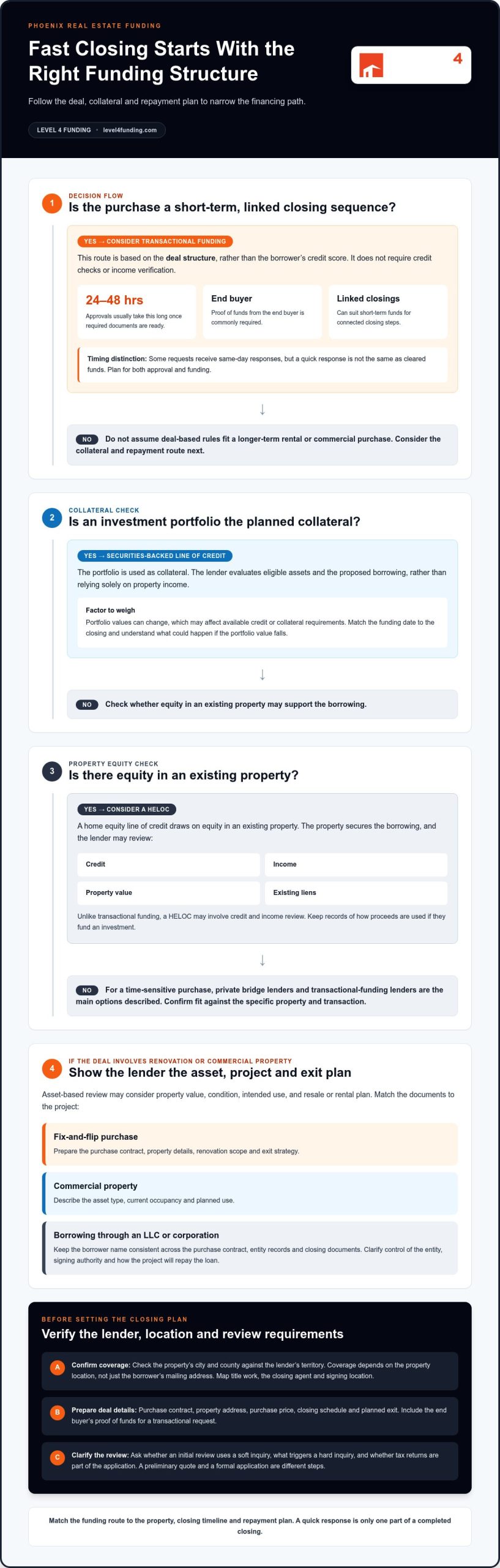
A hard credit inquiry isn’t always the gatekeeper to a fast Phoenix closing. Transactional funding is generally based on the deal structure rather than the borrower’s credit score, and it doesn’t require credit checks or income verification. Once the required documents are ready, approvals usually take 24-48 hours. That’s one route for how to get funding for a quick close real estate deal in Phoenix, but it isn’t the right fit for every rental or commercial purchase.
A tight closing deadline leaves little room for a drawn-out financing process. To get funding for a quick-close real estate deal in Phoenix, match the loan to the property, timeline, and repayment plan, then prepare the documents needed to support the transaction.
This guide compares fast-closing funding options, explains what lenders may assess and where lending coverage matters, and outlines how assistance and repayment can work. You’ll also see when deal-based financing may suit an investment purchase and when another route may make more sense.
Key Takeaways
- Match the funding route to the deal’s closing timeline, property type, and exit plan; fast transactional funding works differently from financing meant to support a renovation or longer hold.
- Understand what a lender may focus on, including the property, deal structure, borrower documentation, and whether a credit check or income verification is required.
- Confirm that the property falls within a lender’s Phoenix-area coverage before building your closing plan around that financing.
- Compare repayment terms and assistance carefully. Homebuyer programs have eligibility rules and may not fit an investment purchase.
- Weigh cash buyers, retirement-plan borrowing, and real estate loans by their requirements and trade-offs, then choose the funding path that aligns with your closing and repayment strategy.
2. Credit checks and tax return requirements
Need a purchase quote without a hard credit inquiry? Start by identifying the loan structure. Transactional funding is based on the deal rather than the borrower’s credit score, and it does not require credit checks or income verification. That may suit a Phoenix investor who needs short-term funds for linked closing steps. However, not every real estate loan skips credit review or tax documents. The product and underwriting approach determine what the lender examines.
Distinguish a preliminary quote from a formal application. A soft inquiry may support an initial review, while a hard inquiry is associated with a formal credit application. Before authorizing a credit pull, ask which type of inquiry the lender will use. Then share the deal basics: the purchase contract, property address, purchase price, closing schedule, and planned exit. Transactional funding commonly requires proof of funds from the end buyer. This helps show how the transaction will be completed.
Tax returns serve a different purpose. A lender assessing income or repayment capacity may request returns alongside other financial records. A deal-based review instead focuses on the transaction structure, including the purchase, resale, buyer, and closing sequence. Explain each step clearly. If financing depends on an end buyer closing after your purchase, the contract and buyer’s proof of funds help document that exit. Don’t assume transactional funding rules apply to a longer-term rental or commercial loan.
Securities-backed lines of credit use an investment portfolio as collateral. The lender evaluates eligible assets and the proposed borrowing, so this option ties the purchase to investments rather than solely to property income. Portfolio values can change, affecting available credit or collateral requirements. Before relying on this approach, match the funding date to the real estate closing and understand what could happen if the portfolio’s value falls.
A home equity line of credit, or HELOC, draws on equity in an existing property. The lender may review credit, income, property value, and existing liens. This differs from transactional funding, which does not require credit checks or income verification. A HELOC can provide flexible access to funds, but the property secures the borrowing. If you use the proceeds for an investment, track how the money is spent and keep the loan records organized.
For a fast Phoenix closing, prepare documents that match the funding type. A transactional request typically needs deal documents and the end buyer’s proof of funds. A HELOC or securities-backed line focuses on collateral and repayment capacity. Ask whether an initial review uses a soft inquiry, what triggers a hard inquiry, and whether tax returns are part of the application. Understanding these steps early can help protect your purchase timeline.
3. Phoenix-area lending coverage
Which Phoenix lenders offer same-day or quick-close bridge loans for real estate? Private bridge lenders and transactional-funding lenders are the main options for time-sensitive purchases. Some transactional requests receive same-day responses, while approvals usually take 24-48 hours once required documents are ready. A quick response isn’t the same as cleared funds, so build the closing schedule around both approval and funding.
Coverage depends on the property’s location, not just the borrower’s mailing address. For a Phoenix-area deal, identify the property’s city and county, then compare them with the lender’s stated territory. Also map the closing agent, title work, and signing location. A lender may serve Phoenix but apply different requirements to properties outside its core market. Check territory early, before setting a firm closing date.
Asset-based lending centers the review on the property and transaction. A lender may consider the asset’s value, condition, intended use, and resale or rental plan. For a fix-and-flip purchase, prepare the contract, property details, renovation scope, and exit strategy. For commercial property, describe the asset type, current occupancy, and planned use. Clear documents connect the requested financing to the specific Phoenix property and help avoid gaps in the deal presentation.
Borrowing through a business or entity adds another layer. If an LLC or corporation will purchase the property, keep the borrower name consistent across the purchase contract, entity records, and closing documents. Explain who controls the entity and how the project will repay the loan. A business loan may use the property as collateral, including through a lien. Make sure ownership details, signing authority, and purchase paperwork align.
That example shows why location and loan structure belong in the same conversation: the property, valuation, project plan, and repayment path all shape financing. It does not establish terms for another property. Present the specific asset and exit plan rather than making a generic request for fast funds.
Before the closing date, organize the address, purchase contract, entity details, property condition, funding timeline, and repayment plan. Ask how the lender defines its Phoenix-area coverage and whether your property type fits its bridge-loan criteria. For an investment purchase, Phoenix real estate funding options can help connect the funding structure to the project and property.
For time-sensitive Phoenix real estate purchases, the main options are private bridge loans and transactional funding.
4. Assistance amount and repayment conditions
Separate investor financing from homebuyer assistance before estimating available capital. Qualifying Phoenix fix-and-flip borrowers may receive financing of up to 100% LTC. LTC means loan-to-cost, so compare the loan structure with the project’s costs, not just the property’s market value. The amount still depends on qualifying for the financing and presenting a workable project plan. Build your purchase and renovation budget around the deal’s documented costs and exit strategy.
Phoenix’s Open Doors Down Payment Assistance Program serves eligible homebuyers, not an investor’s rental acquisition. It can provide assistance of up to 10% of the home purchase price. That makes the program a possible owner-occupied purchase resource, not a substitute for investment-property financing.
Open Doors also has preparation requirements. Buyers must complete an eight-hour pre-purchase homebuyer education course and one-on-one housing counseling with a certified counselor from a HUD-approved housing counseling agency. Assistance can be combined with other homeownership assistance programs. Factor these steps into the closing schedule, as course completion and counseling are part of the program, not optional shortcuts.
Retirement-plan borrowing has separate limits and repayment mechanics. A $40,000 loan used to buy a single-family rental is one example; its repayment period is five years. The strategy is available only when the plan allows loans. IRAs aren’t eligible.
A 401(k) loan is not a distribution, so it doesn’t trigger taxes or penalties under the described approach. Interest paid on the loan is reinvested in the borrower’s own account. That doesn’t erase the repayment obligation: missed payments can affect the borrower’s plan and account. Before using retirement capital, compare the required payment schedule with expected rental income and other personal cash demands.
For a loan between a business and its owner or controlled entity, document the terms in a promissory note. Use a commercially reasonable interest rate, at least the AFR, and clearly state repayment terms. A HELOC used for investments may generally allow interest deductions against that investment activity. The funding source, use of proceeds, collateral, and repayment plan all matter. Write down those details before committing funds to a Phoenix closing.
5. Cash buyer types and funding sources
Cash buyers are a major part of Phoenix’s housing market. Roughly 25% to 30% of Phoenix home sales were cash deals in 2025. But “cash buyer” covers different buyers, price expectations, and deal strategies. Individual buyers typically offer 95-100% of a home’s market value. Small investors typically offer 90-95%. Compare the offer with your acquisition costs and planned exit, not just the speed of closing.
iBuyers typically offer 85-92% of market value in Phoenix. They target homes built after 2000, making property age a practical screening factor. Wholesalers and flippers typically offer 70-85% of market value. Their pricing reflects an investment approach and the property’s potential resale or renovation. These ranges describe different buyer types, not a guaranteed offer for a specific address.
Property condition also shapes the cash-buyer conversation. Most cash buyers in Phoenix purchase homes as-is, without requiring the seller to make repairs. That can matter for older block ranch homes, including Phoenix housing stock built in the 1960s-80s. An as-is offer can simplify the seller’s preparation, but compare the proposed price and contract terms. Cash buyers often waive the inspection contingency, which changes the transaction’s risk profile.
An investor buying with cash can use existing capital or short-term transaction funding. Cash purchases do not require lender underwriting. Transactional funding, by contrast, relies on the deal structure and commonly requires proof of funds, especially from the end buyer. Keep the purchase contract, resale agreement, and closing sequence aligned. Choose a funding method that matches how each step will be paid.
Before accepting or relying on a cash offer, ask for proof of funds, an earnest money deposit, and a clear contract and timeline. These documents help demonstrate the buyer’s ability and intent to close. Cash sales do not require an appraisal unless the buyer requests one for personal valuation. Sellers may still pay title, escrow, and HOA transfer fees. Cash buyers may also expect sellers to cover more closing costs to improve the deal.
Use a comparison sheet to weigh the offer, closing schedule, contingencies, and seller-paid costs. For example, an individual buyer’s higher market-value offer may compare differently with an iBuyer’s offer or a flipper’s as-is purchase. Keep buyer type and funding source distinct: a buyer can have cash without using transactional funding, while an investor can arrange short-term funding for a linked purchase and resale. The terms of the Phoenix deal determine which route fits.
5. What funding options are available for a fast-closing real estate deal in Phoenix?
For investors deciding how to get funding for a quick close real estate deal in Phoenix, start with the transaction’s purpose. A same-day purchase and resale needs a different structure from buying a rental or renovating a property before resale. Compare transactional funding, private bridge financing, available cash, and eligible retirement-plan borrowing. The right fit depends on the property, closing sequence, and repayment plan.
Transactional funding can support linked transactions, such as buying a property and reselling it to an end buyer. Approvals usually take 24-48 hours once required documents are ready, and some requests receive a same-day response. Funding is typically used for a few hours, enough to complete both closing steps on the same day. The review focuses on deal structure rather than the borrower’s credit score. Most cases require proof of funds, especially for the end buyer.
Some transactional funding requests may require no out-of-pocket capital, depending on the deal structure. Prepare the purchase contract, resale agreement, closing timeline, and end buyer’s proof of funds together. These documents should show how the first purchase will be repaid through the next closing. Reputable transactional lenders charge fees only when funding succeeds, and upfront fees are rare. Read the written agreement closely for charges, conditions, and repayment terms.
Private bridge financing may suit an investment property when the plan extends beyond a same-day resale. A reported Phoenix fix-and-flip bridge loan had a six-month term on September 7, 2026. That example is not a universal loan term. The property, renovation plan, exit strategy, and repayment source shape the request. Match the loan period to the project timeline, including the time needed to improve and sell or refinance.
Cash is another option if the buyer has funds ready for closing. A cash purchase doesn’t require lender underwriting, but it still needs a complete contract and coordinated closing plan. A 401(k) loan may be available if the specific plan permits borrowing; IRAs aren’t eligible for this strategy. Keep the funding source distinct from projected property income. Personal capital, retirement-plan borrowing, and transaction-based funding each carry different repayment demands.
The practical answer to how to get funding for a quick close real estate deal in Phoenix is to line up the funding with the transaction sequence. Transactional funding is generally legal across states, but local laws and deal structures vary. For linked closings, account for title coordination, purchase documents, and the end buyer’s ability to complete the second transaction. Compare approval timing, required documents, repayment sources, and the gap between purchase and exit. Explore Phoenix investment financing options to connect a real estate project with a suitable funding path.
Level 4 Funding: Fix and Flip Loans
Level 4 Funding offers Fix and Flip Loans for investors purchasing property to renovate and resell. If your Phoenix deal involves construction work, Construction Loans may fit the project; Commercial Property Loans address investment purchases of commercial assets. Cash Out Refinance can be relevant when you own property and want to access equity for another investment. The right option depends on the property, project plan, and repayment strategy, so line those details up before selecting a funding route. These loans are designed for real estate investment, not every home purchase or short-term transaction. Share your project details and closing timeline to explore which financing path aligns with your deal. For help with an investment property purchase, contact Level 4 Funding.
Set Your Deal Up for the Next Move
A fast closing is only one part of a sound investment. Before committing, decide what happens after the purchase: renovation, construction, leasing, resale, or refinancing. A clear exit plan gives your financing decision a purpose and keeps the property, project, and repayment strategy aligned.
The practical answer to how to get funding for a quick close real estate deal in Phoenix starts with matching the loan to that next move. Level 4 Funding offers Fix and Flip Loans, Construction Loans, and Commercial Property Loans for real estate investment projects. Choose the path that fits the asset and the work ahead, not simply the fastest-sounding option.
Bring your property details, purchase timeline, project scope, and intended exit into the conversation. Those specifics help focus the financing discussion on the deal you’re actually pursuing. Contact Level 4 Funding to discuss your real estate investment plans and take the next step with a clearer direction.
Frequently Asked Questions
Can I get a loan quote in Phoenix without a hard credit inquiry?
A quote and a hard credit inquiry are separate parts of a loan process. Level 4 Funding says it has no minimum credit score, but its review checks for judgments, tax liens, and bankruptcy. A low score may affect the down payment or rate. Before authorizing a credit pull, clarify whether the inquiry is soft or hard. That helps you understand the credit impact before pursuing a Phoenix purchase.
How fast can a loan close in Phoenix?
Most Level 4 Funding loans take about 7 days to complete, with the title report often taking the longest. Get the purchase contract and title work moving early, and make sure the property’s ownership and existing liens are addressed. A closing date also depends on complete application materials and the transaction’s requirements. For a Phoenix purchase with a compressed timeline, start organizing the property and deal documents as soon as terms are agreed.
What documents and borrower qualifications are needed for a fast real estate loan in Arizona?
Prepare a completed application, purchase contract, property details, and a clear repayment or exit plan. If an LLC is buying, keep its name and signing authority consistent across the transaction documents. Level 4 Funding says it does not require tax returns, pay stubs, or income verification, and has no minimum credit score. Its review does check for judgments, tax liens, and bankruptcy, so be ready to discuss those items accurately.
How quickly can private lenders, hard money lenders, and banks close a Phoenix property purchase?
Level 4 Funding says most of its loans take about 7 days to complete. Bank timelines depend on their underwriting and property review processes, so don’t assume a bank can meet a compressed contract deadline. For any financing route, build a schedule around the title report, appraisal or valuation steps, document collection, and closing coordination. A Phoenix investor should compare the funding timeline with the contract’s actual closing date.
How can buyers find and evaluate private money lenders in Phoenix?
Match the lender’s financing to the property and investment plan. Review the written terms for repayment dates, collateral, extension options, and what happens if the planned sale or refinance takes longer. A renovation project, for example, needs a different exit plan from a stabilized rental. Investors in Phoenix, Scottsdale, or Mesa should also make sure the property address and borrower entity appear consistently in the proposed loan documents.
How can investors compare lender offers and avoid real estate lending scams in Phoenix?
Compare written loan terms side by side, including the repayment schedule, collateral, conditions before funding, and the process for changing payment instructions. Pause if you are pressured to sign unclear documents or send funds using newly emailed instructions. Confirm transaction details through contact information already established in the deal, not through an unexpected change to wiring directions. Keep signed agreements and payment records together in the Phoenix property file.
What Phoenix-area programs or local lenders help finance real estate investments?
Phoenix’s Open Doors Down Payment Assistance Program is for eligible homebuyers, not rental or commercial investments. For investment projects, Level 4 Funding offers options including Fix and Flip Loans, Construction Loans, and Commercial Property Loans for Arizona investors in Phoenix and nearby markets.

About the author
Matt has a bachelor's degree in political science from Northern Arizona University and works at Level 4 Funding, a private lending company that offers hard money and rental home loans to real estate investors in 35 states.
With Matt's leadership, the firm has financed almost $300 million in loans for investment properties. He often helps real estate investors with rental property purchases, foreclosures, refinancing, and fix-and-flip projects. Matt has extensive experience in fix-and-flip, buy-and-hold, rental properties, and real estate sales. He has lived in Arizona for 43 years and is married with three children. Matt is licensed as a mortgage broker and loan originator in Arizona, with NMLS 2062278 and NMLS 1118493.
Equal Housing Opportunity. This is not a Good Faith Estimate, and it is not a Guarantee to lend; it should not be considered as such. Costs, rates, estimates, and terms can only be determined after a full application is completed. To the extent this message includes any tax or legal advice, this message is not intended or written by the sender to be used, and cannot be used, for legal or tax purposes or advice. This is an advertisement. Copyright © 2026. All rights reserved.