

The Real Risks of Hard Money Loans: What Every Investor Must Weigh Before Signing
October 24, 2026
Credit can support a hard-money request, while property collateral gives the lender another asset to evaluate. For hard money for buying land in Cave Creek, the parcel and the deal still matter: financing depends on how the land can be used, what supports the purchase, and how the repayment plan works.
It’s reasonable to assume a strong credit profile tells the whole story, or that valuable collateral makes every land deal workable. Neither is enough on its own. Before committing, understand how credit, collateral, land value, and your property plan fit together.
This guide explains how credit and collateral may shape a Cave Creek land purchase, what to assess in the parcel and transaction, and how hard money compares with bank and seller financing. It also covers legal and deal risks to consider, including development plans and terms that can affect your exit. Start with the facts, then decide whether this financing route fits the land you want to buy.
Key Takeaways
- Credit and collateral can strengthen a land-financing request, but the parcel and repayment plan also shape how a lender evaluates the deal.
- Compare Cave Creek parcels by more than asking price: intended use, access, utilities, and development plans can affect their financing appeal.
- Loan-to-value depends on how the land is assessed and how the overall transaction is structured, so plan for the down payment and other funds you’ll need.
- Raw, unimproved, and partially improved land present different development questions; clarify the property’s current condition and your intended use before committing.
- Seller-financed land purchases may carry interest rates of 3-6%, while bank land loans may carry rates of 7-9%; compare the full terms and repayment demands, not rates alone.
Using credit or collateral instead of cash
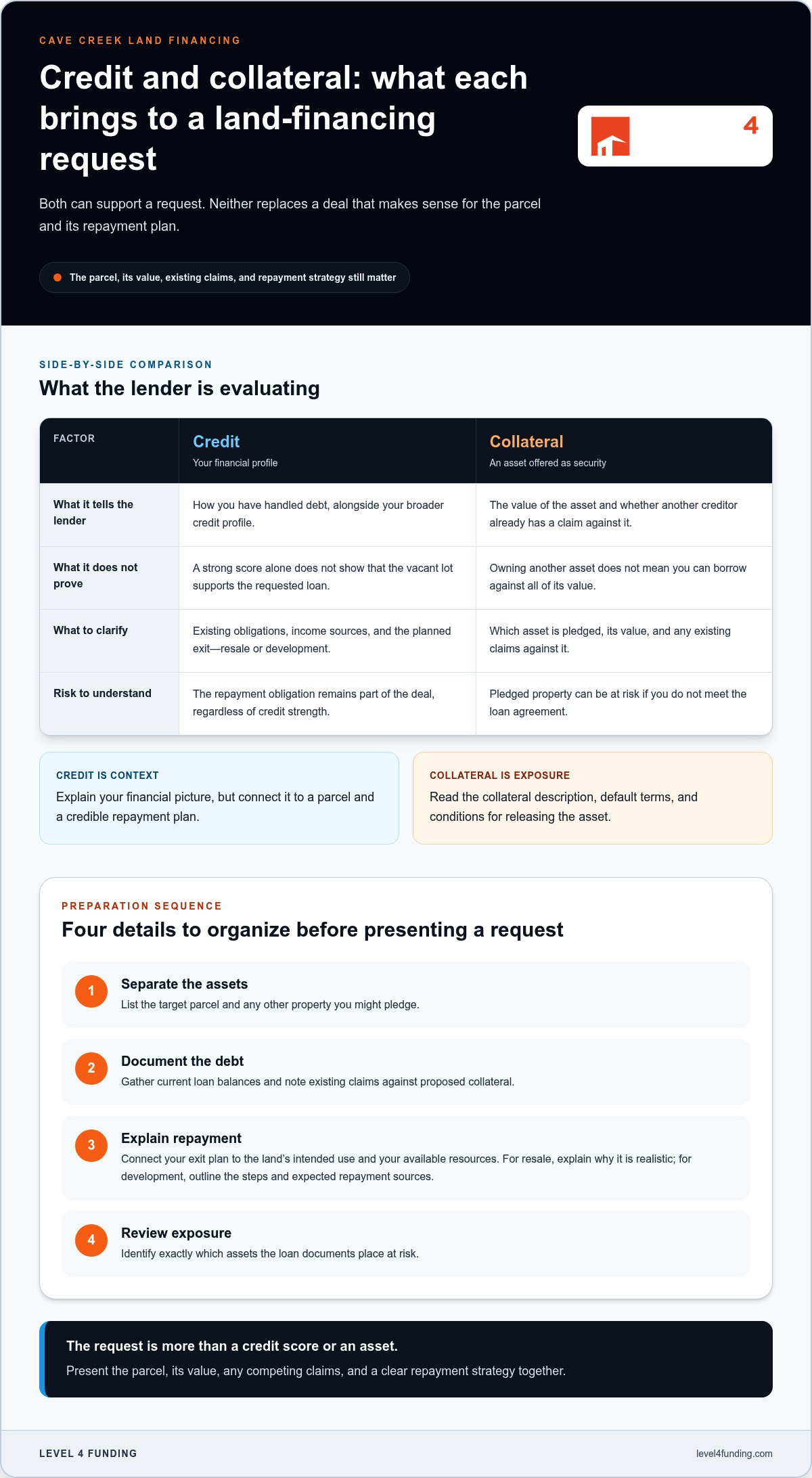
Credit and collateral can strengthen a land-financing request, but neither automatically replaces cash. When seeking hard money for buying land in Arizona, a lender may weigh your credit profile alongside the parcel, its value, and your repayment plan. A strong score alone doesn’t show that a vacant lot supports the requested loan. Likewise, owning another asset doesn’t mean you can borrow against all its value.
Credit gives a lender information about how you’ve handled debt. It can help explain your financial profile, but the deal still needs to work on its own. Prepare a clear account of your existing obligations, income sources, and planned exit. If you intend to resell the land, explain why that resale is realistic. If you plan to develop it, outline the steps and expected repayment sources.
Collateral can provide additional security for a loan. Level 4 Funding and other lenders may consider the asset’s value and whether another creditor already has a claim against it. Pledging property puts it at risk if you don’t meet the agreement. Read the loan documents closely, especially the collateral description, default terms, and conditions for releasing the asset. Collateral does not replace a clear understanding of your repayment obligations.
Local market asking prices show why the specific parcel matters. Acreage alone doesn’t explain the differences. Location, access, land characteristics, and intended use can all affect how a lender views the security. These asking prices are examples, not valuations or loan offers.
Use this preparation sequence before presenting a request:
- Separate the assets. List the target parcel and any other property you might pledge.
- Document the debt. Gather current loan balances and note existing claims against proposed collateral.
- Explain repayment. Connect your exit plan to the land’s intended use and your available resources.
- Review exposure. Identify exactly which assets the documents place at risk.
Keep the purchase and collateral questions distinct. The lender’s assessment considers the property, your credit picture, competing claims, and repayment strategy. Presenting these details clearly helps show whether credit, additional collateral, or a combination supports the transaction.
What hard money lenders finance vacant land in Cave Creek, Arizona?
Hard money can be used for vacant land purchases when the parcel and repayment plan support the request. In Cave Creek, look beyond acreage and asking price: access, existing improvements, intended use, and marketability all help shape the lender’s assessment. Explain whether you plan to hold, resell, or develop the land. Hard money may suit an investor financing a specific real estate transaction, but the parcel still needs to fit the deal.
Local listings show how much land purchases can vary. Those figures are asking prices, not appraisals or loan amounts. Acreage alone doesn’t determine whether a parcel is financeable. A smaller lot with clear access and a practical use may present a different risk profile from a larger property with development constraints.
Use these core property factors to consider what a financing request needs to explain:
- Clear legal and physical access to the parcel
- Current zoning and permitted uses for the land
- Availability of utilities or the cost to bring them to the site
- A realistic timeline for resale or future development
Before seeking financing, assemble the property details that make the deal clear. Identify the parcel, describe its current condition, and outline its intended use. Gather available information about access, utilities, and nearby development. Then match the proposed loan to a specific repayment plan. For a resale, explain who the likely buyer is and why the land could appeal to them. For development, identify the steps between acquisition and the expected exit.
Test development assumptions against practical conditions. For Cave Creek land, consult licensed builders about development plans to help identify obstacles before they become costly surprises. If your plan involves construction, separate the land purchase from the work required afterward. Financing the acquisition does not establish that the site is ready to build.
For investors weighing a parcel purchase, hard money loan options from Level 4 Funding can be part of the financing discussion. Bring a defined property, a realistic use, and an exit strategy. Those details give the request substance beyond the listing price.
What loan-to-value ratios do lenders offer for vacant land in Cave Creek?
There isn’t one loan-to-value ratio for every vacant parcel in Cave Creek. Lenders compare the requested loan with their assessment of the property’s value, then weigh the risks of the deal. LTV means the loan amount divided by the lender’s accepted property value. A listing price alone doesn’t establish that value or determine how much you can borrow.
Those listing figures show different asking prices, not lender valuations. The smaller parcel’s higher asking price per acre doesn’t establish a higher LTV. Land characteristics and marketability also affect how a lender assesses the security.
Consider the factors that can move the calculation:
- Valuation support: Comparable land sales and the parcel’s features help frame the lender’s view of value.
- Access and usability: A practical route to the property and a clear intended use can affect its appeal.
- Development position: Existing improvements and the work needed for the proposed plan can change perceived risk.
- Repayment strategy: A credible sale, refinance, or development exit helps explain how the debt will be repaid.
- Other claims: Existing obligations tied to the parcel or pledged collateral affect the security picture.
Neither acreage nor price alone tells you the acceptable LTV. A lender assesses the property and proposed transaction together. Multiplying an asking price by an assumed percentage can therefore create a misleading budget.
Build your estimate in stages. First, identify the parcel and its asking price. Next, gather property details and comparable sales to support your estimate of value. Then calculate the cash needed by subtracting the proposed loan from the purchase price, and account separately for transaction and development expenses. Finally, test whether your exit plan can repay the loan on its stated terms. Keep the listing price separate from the lender’s valuation.
For a Cave Creek land purchase, present valuation evidence alongside your repayment plan. This lets the lender assess the requested amount in light of the parcel’s characteristics, not just its listing price. The appropriate LTV follows from that review, not a universal land-loan formula or a percentage inferred from nearby asking prices.
Can hard money finance raw, unimproved, or partially improved land in Cave Creek?
Yes. Hard money can finance raw, unimproved, or partially improved land when the parcel and transaction support the loan. The label alone doesn’t determine the outcome. A lender evaluates what exists today, what the buyer plans to do next, and how repayment will work. A raw lot with no improvements calls for a different review from a parcel with grading or utility work already completed.
Cave Creek listings show why buyers should describe each property specifically. Those asking prices don’t establish whether either site is ready to build. Financing depends on the parcel’s characteristics and intended use, not acreage or price alone.
For raw land, explain the basics before presenting your purchase plan. Identify the parcel boundaries, current access, known easements, and available utility information. Then state whether you intend to hold, resell, or develop it. If you plan to build in the future, separate land acquisition from site preparation and construction costs. This makes the financing request and repayment strategy easier to assess.
Partially improved land needs a precise inventory. Describe completed work, such as grading or installed services, and distinguish it from planned work. Document the site’s current condition, and don’t present proposed work as completed value.
Before making an offer, use this practical review:
- Map the parcel. Match the legal description and boundaries to the land being purchased.
- Assess access. Record how vehicles reach the site and identify any access concerns.
- List services. Separate existing utilities from services that would require future work.
- Test the plan. Consult licensed builders about development plans, as Cave Creek land-buying guidance advises.
- Define repayment. Explain how a sale, refinance, or completed project would repay the loan.
Development brings its own risks. A parcel can look attractive while requiring substantial preparation before construction. Builder input can help identify obstacles that affect the schedule, budget, and resale assumptions. Include those findings in your deal analysis.
Raw land isn’t automatically excluded, and improvements don’t automatically settle the financing question. Present the parcel’s current condition, intended use, and repayment plan as separate facts. This gives a lender a clearer basis for assessing the Cave Creek transaction.
How do hard money land loans compare with bank, seller-financed, and land loans
Compare the full repayment terms, not just the interest rate. In Cave Creek, seller-financed land purchases may carry interest rates of 3-6%, while bank land loans may carry rates of 7-9%. Those figures provide reference points, not a quote for a specific parcel. Hard money has no rate figure here, so compare actual proposed terms rather than assuming it costs less or more.
A bank land loan may suit buyers whose documentation, credit, down payment, and property meet that lender’s requirements. The process can involve detailed financial and property reviews. For a vacant parcel, the buyer may also need to explain access, intended use, and repayment plans. Compare the bank’s timeline and conditions with the purchase contract’s deadlines before choosing this route.
Seller financing puts the seller in the role of lender. The buyer and seller negotiate the payment structure, interest, repayment schedule, and consequences of default. The cited 3-6% range is a market figure, not a promise for a Cave Creek transaction. Read the agreement closely: the interest rate alone doesn’t reveal the full obligations or what happens if payments fall behind.
Hard money is private real estate financing assessed around the property and the deal. It may suit an investor pursuing a land purchase with a defined repayment strategy. It isn’t automatically the right fit for a long-term hold or a buyer whose repayment plan depends on uncertain future development. Compare the loan term, payment schedule, collateral, and exit plan before accepting an offer.
“Land loan” describes financing for land, not a single lending structure. A bank land loan, seller-financed purchase, and hard-money loan can differ in underwriting, documentation, and contract terms. Compare them side by side:
- Bank financing: Review its rate, documentation requirements, approval conditions, and timing.
- Seller financing: Check the negotiated interest, payment schedule, default terms, and transfer conditions.
- Hard money: Examine collateral, term, repayment obligations, and how your exit strategy fits.
For example, if you’re pursuing a Cave Creek parcel for future construction, test the development plan and repayment source against the proposed loan term. Selling the land is different from building and selling a completed property. Match the financing to the actual sequence, not a hoped-for outcome.
Before deciding, place every offer beside the purchase timeline and repayment plan. To discuss whether hard money financing fits your land deal, bring the parcel details, intended use, and exit strategy.
Level 4 Funding: Fix and Flip Loans
Level 4 Funding offers Fix and Flip Loans for investors whose real estate plan includes renovating and reselling property. If your Cave Creek land purchase is the first step toward construction, separate the land acquisition from the later building phase. A clear project plan helps you identify which financing need applies at each stage.
Level 4 Funding also offers Construction Loans, Commercial Property Loans, and Cash Out Refinance. These options serve different real estate needs, so focus the discussion on your project’s purpose, property, and repayment strategy. A vacant parcel purchase and a future construction project are distinct parts of the plan.
Prepare the parcel details, intended use, and exit strategy before discussing your next financing step. Contact Level 4 Funding to discuss your real estate investment plans.
Make Your Next Land Move With a Clear Plan
The next step is to turn your Cave Creek purchase idea into a workable transaction. Before committing, connect the land’s intended use to your repayment plan and chosen financing structure. That alignment matters more than moving quickly without a defined exit. Hard money for buying land in Cave Creek can support your strategy when the parcel, collateral, and deal terms fit your investment plan.
If your project moves from acquisition into renovation or development, Level 4 Funding offers Fix and Flip Loans, Construction Loans, and Commercial Property Loans. These offerings address distinct real estate project needs, so frame your discussion around what you’re buying and what you plan to do next.
Bring your parcel details, proposed use, and repayment approach into the conversation. Contact Level 4 Funding to discuss options for your real estate plans. A well-defined next step can help you move forward with sharper focus and greater confidence.
Frequently Asked Questions
What down payment and credit requirements apply to hard money land loans in Arizona?
There’s no minimum credit score requirement for Level 4 Funding loans, and down payments can range from 50% to 0% depending on borrower factors. Those factors include experience, credit, relationship, and real-estate license status. Judgments, tax liens, or bankruptcy are checked, and a low score may mean a higher down payment or rate. For a Cave Creek land purchase, distinguish these general loan terms from the specific terms offered for your transaction.
What zoning, access, water, septic, and utility requirements affect land financing in Cave Creek?
For a Cave Creek parcel, establish whether the intended use matches its zoning and whether the site can practically support it. Review recorded access, water availability, septic feasibility, and the location of utility connections. For example, a parcel without nearby utility service may need additional work before development. Keep written findings separate from assumptions in your project budget, and identify site conditions that could delay construction or change your intended use.
What are the risks, default terms, and exit strategies for a hard money land loan?
The main risks include missing the repayment deadline, underestimating development delays, or relying on a sale that doesn’t happen as planned. Review the written agreement for payment dates, maturity, default triggers, cure provisions, collateral, and any extension terms. Build an exit around a defined sale, refinance, or completed project, then consider how delays could affect repayment. Don’t rely on an extension unless the signed loan documents provide for it.
What Arizona laws and licensing rules apply to hard money lenders and land loans?
Arizona requirements depend on the transaction structure and the parties’ roles. Identify whether the lender is acting directly or as a broker, and whether the loan is for a business or consumer purpose. Review the loan agreement, security documents, disclosures, and default provisions as one package. For a Cave Creek purchase, have Arizona real-estate counsel assess the specific documents and licensing questions rather than relying on a general description of land loans.
What are the steps and documents needed to close a hard money land purchase in Arizona?
Identify the parcel, its condition, intended use, and repayment plan. Gather current loan balances and information on existing claims against any collateral. Then review the loan documents for the collateral description, default terms, and conditions for releasing the asset.

About the author
Matt has a bachelor's degree in political science from Northern Arizona University and works at Level 4 Funding, a private lending company that offers hard money and rental home loans to real estate investors in 35 states.
With Matt's leadership, the firm has financed almost $300 million in loans for investment properties. He often helps real estate investors with rental property purchases, foreclosures, refinancing, and fix-and-flip projects. Matt has extensive experience in fix-and-flip, buy-and-hold, rental properties, and real estate sales. He has lived in Arizona for 43 years and is married with three children. Matt is licensed as a mortgage broker and loan originator in Arizona, with NMLS 2062278 and NMLS 1118493.
Equal Housing Opportunity. This is not a Good Faith Estimate, and it is not a Guarantee to lend; it should not be considered as such. Costs, rates, estimates, and terms can only be determined after a full application is completed. To the extent this message includes any tax or legal advice, this message is not intended or written by the sender to be used, and cannot be used, for legal or tax purposes or advice. This is an advertisement. Copyright © 2026. All rights reserved.