
Hard Money for Land Acquisition in Phoenix: Rates and Terms
November 15, 2026
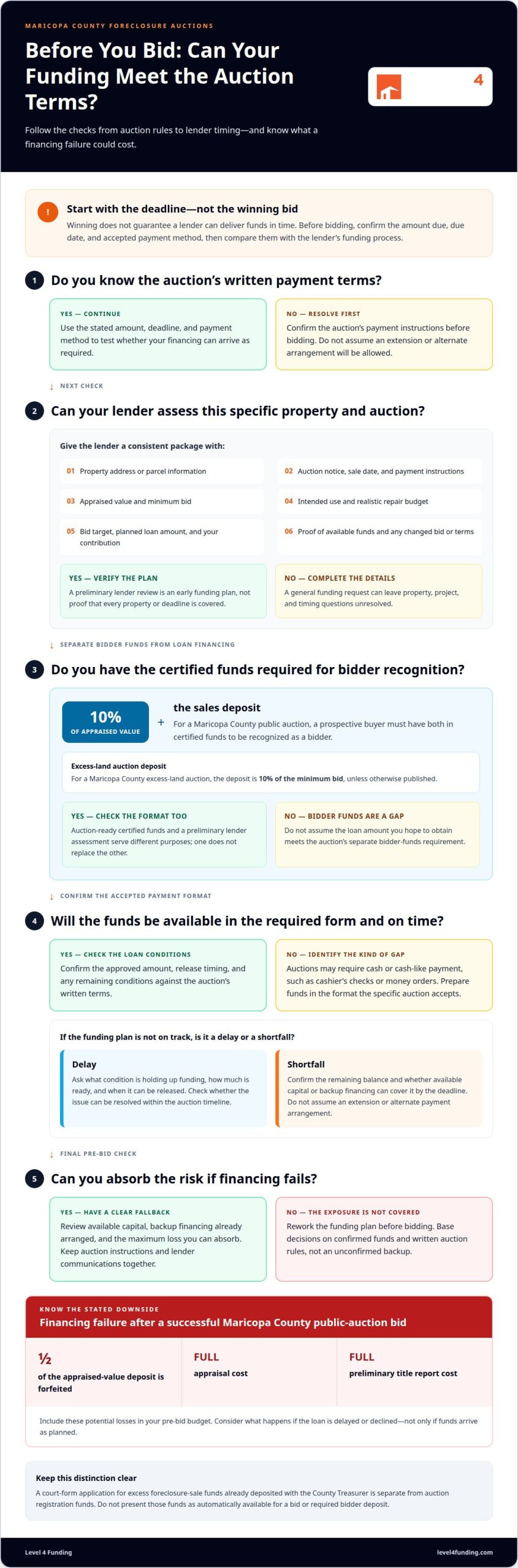
Before bidding, arrange financing that fits the auction’s payment deadline. To understand how to get funding for a foreclosure auction in Maricopa County, give a lender the property details, your intended use, and a realistic repair budget. At a Maricopa County public auction, a successful bidder who cannot obtain financing forfeits one-half of the appraised-value deposit, along with the full appraisal and preliminary title report costs.
Winning the property matters only if you can pay when the auction requires it. Knowing how to get funding for a foreclosure auction in Maricopa County means checking the payment deadline and property condition before bidding, not afterward.
This guide explains what a lender may need to assess auction financing, how payment timing and repairs affect the funding plan, and what options may be available if financing falls through. You’ll learn how to get funding for a foreclosure auction in Maricopa County by preparing your timeline, project budget, and backup plan before you bid.
Key Takeaways
- Learn why a financing backup matters before you place a winning bid.
- See what property and project details help a lender assess auction financing.
- Match your funding plan to the auction’s payment deadline before bidding.
- Account for repairs and other property costs when setting your maximum bid.
- Understand the key steps in a Maricopa County foreclosure auction and what can affect the purchase timeline.
Financing failure after a successful bid
- Treat the bid as a funding deadline, not a financing milestone. Winning does not guarantee that a lender can deliver funds in time. Before bidding, compare the auction’s payment terms with the lender’s funding process. Confirm the amount due, the due date, and the accepted payment method. If they do not align, the purchase may be out of reach even if it looks viable on paper.
- Calculate your exposure before committing. At a Maricopa County public auction, a successful bidder who cannot obtain financing forfeits one-half of the appraised-value deposit, along with the full appraisal and preliminary title report costs. Include these potential losses in your pre-bid budget. Model what happens if the loan is delayed or declined, not only if funds arrive as planned. This makes the risk of a failed financing plan clear.
- Get a clear answer from your lender as soon as a problem appears. If underwriting raises an issue after the auction, send the lender the specific notice, property information, and payment deadline. Ask which condition is holding up funding and whether it can be resolved within the auction’s timeline. “It’s in process” does not establish whether the purchase can close. Base your next step on the lender’s stated conditions and the auction’s written rules.
- Separate a funding delay from a funding shortfall. A delayed transfer and an insufficient approved amount call for different responses. Confirm how much is ready, when it can be released, and what balance remains. If you cannot cover the shortfall by the deadline, do not assume an extension or alternate payment arrangement will be allowed. The auction terms govern. Before committing more money, understand the remaining obligation and the consequences of missing the payment date.
- Prepare a fallback before placing the bid. Decide what you will do if the lender declines the file or funds cannot arrive on time. Review your available capital, any backup financing already arranged, and the maximum loss you can absorb from the deposit and documented costs. Keep the auction’s payment instructions and lender communications together. If the primary loan fails, act on the actual terms and timeline instead of relying on an unconfirmed backup.
Auction registration and proof of funds: what a lender needs to assess financing
- Ask for a preliminary financing assessment before the auction. Buyers can seek an initial lender review before an Arizona foreclosure auction. Treat it as an early funding plan, not proof that every property or deadline is covered. The lender still needs to assess the specific property, your intended purchase, and the auction’s payment terms.
- Give the lender the exact auction and property details. Send the property address or parcel information, auction notice, appraisal value, and minimum bid. Include the sale date and the auction’s deposit and payment instructions. This lets the lender assess the property and timeline together. A general funding request leaves important details unresolved.
- Calculate the certified funds required for bidder recognition. For a Maricopa County public auction, a prospective buyer must have 10% of the property’s appraised value plus the sales deposit in certified funds to be recognized as a bidder. Keep this auction requirement separate from the loan amount you hope to obtain. For a Maricopa County excess-land auction, the deposit is 10% of the minimum bid unless otherwise published.
- Match proof of funds to the auction’s accepted format. Foreclosure auctions may require cash or cash-like payment, such as cashier’s checks or money orders. Prepare proof of funds in the format required by that specific auction. A preliminary lender assessment and auction-ready certified funds serve different purposes: one outlines the financing, while the other meets the auction’s bidder requirements. Do not assume one replaces the other.
- Send a complete, consistent financing package. Organize the auction notice, property details, intended use, bid target, and proof of available funds together. Explain how much you plan to borrow and what funds you expect to contribute. If the bid changes, update the lender with the revised figure and any changed auction terms. Clear information helps the lender identify gaps before registration or bidding creates pressure. A hard money lender can assess an investment property against its auction timeline; review foreclosure auction financing as you prepare your funding request.
In Maricopa County, the court’s forms apply when the lender’s attorney deposited the excess foreclosure-sale funds with the County Treasurer and the applicant wants the money. This concerns funds already deposited and an applicant seeking them. It does not describe the certified funds a bidder must present for auction registration or change the auction’s payment terms. Keep these situations separate when explaining your finances to a lender. Money connected to an application for deposited excess funds should not be presented as automatically available for a bid or required bidder deposit.
Before including such funds in a funding summary, establish whether the relevant condition is met: the lender’s attorney deposited the excess foreclosure-sale funds with the County Treasurer, and the applicant wants the money. If not, this does not establish that the court’s forms apply. Keep the application for those funds separate from the auction financing assessment and proof of funds.
How lenders assess auction-specific payment deadlines
- Map the auction’s payment schedule before discussing loan timing. Foreclosure auction payment rules vary by state and local terms. Some auctions require full payment immediately or by the next business day. Others accept a deposit first and allow more time for the balance. Give the lender the actual auction instructions, not an assumed closing schedule. That lets the lender assess whether funding can meet the deadline for that sale.
- Separate the amount due at bidding from the later balance. List each payment stage in the auction terms: the bidder deposit, the funds required after a winning bid, and any later balance deadline. These amounts and dates determine how much must be available at each stage. A loan meant to cover the purchase price, for example, may not cover an immediate deposit requirement. The lender needs to understand both the total financing need and the cash required first.
- Identify the payment form and delivery method. An auction may require cash or cash-like funds, such as a cashier’s check or money order. Tell the lender which forms the auction accepts and when payment is due. A funding plan can fail if money is available but cannot be released in the required form or within the stated window. Match the lender’s funding method to the auction’s written instructions.
- Build the Arizona trustee-sale deadline into the risk review. A bidder at an Arizona trustee sale risks forfeiting a $10,000.00 deposit if the required sum is not paid by the deadline. That exposure makes the lender’s timing assessment central, not an administrative detail. Share the payment deadline and the amount due with the lender early. Ask which underwriting conditions remain and whether they affect releasing funds before the auction requires payment.
- Set a go-or-no-go point before bidding. Use the lender’s funding status and the auction’s final payment date to decide whether to proceed. If a condition remains unresolved, work out whether your available funds can cover the required payment without relying on a later release. Do not build a possible extension into your plan unless the auction terms allow one. Missing the deadline can have serious consequences under the sale rules, including losing the property.
Before bidding, verify the payment terms for the specific sale instead of relying on what happened at another auction. Requirements vary by state and local rules, so confirm the terms of that auction. Record what is due at the auction and what must be paid afterward, if the terms allow a later balance. Some foreclosure auctions accept a deposit at the auction and give the buyer more time to pay the rest. Treat that time as part of the written terms, not an assumption.
Use the confirmed terms to check whether funds can be ready at every required stage. Resolve unclear instructions before deciding to bid, because uncertainty about the payment schedule can undermine your financing plan. Missing a foreclosure auction’s payment deadline can cause serious problems under its rules and could result in losing the property. Make your decision using the schedule for the specific sale.
How lenders evaluate pre-bid budgets and repair contingencies
- Build a property-specific budget before setting your bid ceiling. Give the lender the auction details, your intended use, and the amount you can contribute. Separate the expected purchase amount from repairs and other project needs. A lender can assess your request more clearly when the figures describe one property and one plan. A home intended for renovation, for example, needs a different budget outline from a property planned for rental use.
- Describe repairs by scope, not as a single guess. List visible work by category, such as roofing, plumbing, or interior repairs, and identify items that need further assessment. Foreclosure properties are often sold as-is, with limited access before bidding, making a detailed inspection difficult. Show the lender which costs are based on available information and which depend on access after purchase. Keep your bid plan tied to the work the property appears to need.
- Include title and recorded obligations in the project review. A title search can identify recorded items that may affect ownership or cost. Depending on priority and local rules, certain tax-related and HOA or condo obligations may survive a foreclosure sale. Include title information and known property obligations in the financing discussion. This gives the lender a fuller picture than the purchase amount alone and keeps known claims in the budget.
- Make the contingency specific to the unknowns. Rather than using a vague cushion for every possibility, name the uncertainty, such as concealed water damage or repairs that cannot be assessed before bidding, and explain how it could change the project plan. The lender can review the budget against the property information and intended use. A contingency should reflect realistic unknown work, not justify a bid beyond what the full project can support.
- Set a maximum bid that protects the repair plan. Add the purchase amount, documented project costs, known obligations, and repair contingency before setting your limit. If the bid rises, reassess the full budget, not just the winning price. A higher purchase amount, for example, may leave less room for repairs or other property needs. Give the lender revised figures before bidding so the financing review reflects the actual plan.
How do Maricopa County foreclosure auctions work?
- Identify the sale type and follow its notice. In Arizona, a trustee may conduct a non-judicial foreclosure auction when property is secured by a deed of trust with a power-of-sale clause. The process can proceed publicly without court assistance. For trustee sales, the trustee must publish notice for four weeks, with the final publication at least 10 days before the sale. Auction terms and timelines differ, so identify the specific sale before planning your bid.
- Use the notice period to establish the timeline. According to the Arizona State Legislature, in Arizona the trustee must send the notice of sale by certified mail to parties with recorded interests within 30 days after recording the notice of sale. A foreclosure auction may be postponed or canceled, even on its scheduled day. Keep the sale notice and any updates together, then base financing and travel plans on the current sale information.
- Account for reinstatement before treating the sale date as final. According to the Arizona State Legislature, a borrower or a party with a subordinate interest may reinstate the loan until 5:00 p.m. on the business day before the scheduled trustee sale. That can affect whether the auction proceeds. Arizona trustee sales may occur between 9:00 a.m. and 5:00 p.m., on days other than Saturdays, Sundays, or legal holidays. Build those timing rules into your plan.
- Review the property and sale terms before bidding. Foreclosure properties are often sold as-is, and access before bidding may be limited. Depending on priority and local rules, some tax-related or HOA and condo obligations may survive the sale. A title search can reveal recorded items that affect ownership or cost. Do not trespass or disturb occupants while evaluating the property. Account for possible postponement, cancellation, and any auction-specific bid conditions.
- Plan for the transfer after a successful bid. After an Arizona trustee sale and payment of the bid amount, the trustee has seven business days to execute and deliver the trustee’s deed to the successful bidder, according to the Arizona State Legislature. Arizona provides no redemption right after a non-judicial foreclosure. That does not remove other practical issues, such as an occupied property affecting possession timing. Use the auction schedule and property details to prepare your auction financing plan.
Level 4 Funding
Level 4 Funding can help investors assess financing for a foreclosure auction and align the proposed loan with the property and project plan. Turn to a hard money lender before bidding, when the auction deadline, purchase amount, and repair budget need to fit together. For a renovation project, Fix and Flip Loans may be relevant; other plans may call for Construction Loans or Commercial Property Loans.
Bring the auction details, property information, intended use, and budget into the financing discussion. That gives the lender a clearer basis for assessing the request and identifying timing or funding gaps before you commit to a bid. If you’re preparing to finance an auction purchase, contact Level 4 Funding to discuss your project.
Make Your Next Bid a Deliberate Move
Auction financing works best when it starts with your investment plan. Decide the property’s intended role, how much capital you can commit, and what would make you walk away. Those choices give your financing discussion a clear direction and help keep bidding from pushing the project beyond practical limits.
If you’re weighing how to get funding for a foreclosure auction in Maricopa County, bring your property details and project goals into a conversation with a lender before bidding. Level 4 Funding offers Fix and Flip Loans, Construction Loans, and Commercial Property Loans for real estate investors. Contact Level 4 Funding to discuss options and take the next step with a plan built around your investment goals.
Frequently Asked Questions
What if I’m the successful bidder and my financing falls through?
Act immediately: contact your lender, confirm outstanding conditions, and follow the auction’s payment terms. At a Maricopa County public auction, a successful bidder who cannot obtain financing forfeits one-half of the appraised-value deposit, plus the full appraisal and preliminary title report costs. Do not assume the auction will extend the deadline. Your next step depends on the written sale terms and whether you can meet the remaining payment obligation.
Can you use a mortgage or hard money loan to buy at a foreclosure auction in Arizona?
Either may work if funds can be delivered in the form and by the deadline the auction requires. Some foreclosure auctions require full payment immediately or by the next business day, making timing critical for mortgage financing. A hard money loan may suit an investment purchase, but approval alone does not mean funds are ready. Before bidding, align the lender’s funding process with the auction’s payment rules.
How much cash is needed upfront to buy a foreclosure at auction in Maricopa County?
For bidder recognition at a Maricopa County public auction, a prospective buyer must have 10% of the property’s appraised value plus the sales deposit in certified funds. This is separate from planning for the remaining purchase balance. Excess-land auctions use a different deposit basis: 10% of the minimum bid, unless otherwise published. The specific auction’s terms determine the required payment method and timing.
What are the typical hard money loan rates, fees, and down payments in Phoenix?
There isn’t one rate or down payment that applies to every Phoenix investment property. Loan terms depend on the property and financing request; down-payment requirements can also depend on experience, credit, relationship, and real estate license. Level 4 Funding provides case-specific terms after a quote request. Bring the property details and project plan to the discussion so the proposed financing can be assessed against the investment.

About the author
Matt has a bachelor's degree in political science from Northern Arizona University and works at Level 4 Funding, a private lending company that offers hard money and rental home loans to real estate investors in 35 states.
With Matt's leadership, the firm has financed almost $300 million in loans for investment properties. He often helps real estate investors with rental property purchases, foreclosures, refinancing, and fix-and-flip projects. Matt has extensive experience in fix-and-flip, buy-and-hold, rental properties, and real estate sales. He has lived in Arizona for 43 years and is married with three children. Matt is licensed as a mortgage broker and loan originator in Arizona, with NMLS 2062278 and NMLS 1118493.
Equal Housing Opportunity. This is not a Good Faith Estimate, and it is not a Guarantee to lend; it should not be considered as such. Costs, rates, estimates, and terms can only be determined after a full application is completed. To the extent this message includes any tax or legal advice, this message is not intended or written by the sender to be used, and cannot be used, for legal or tax purposes or advice. This is an advertisement. Copyright © 2026. All rights reserved.