


Do You Need a Real Estate License to Flip Houses? What Investors Actually Need to Know
October 29, 2026
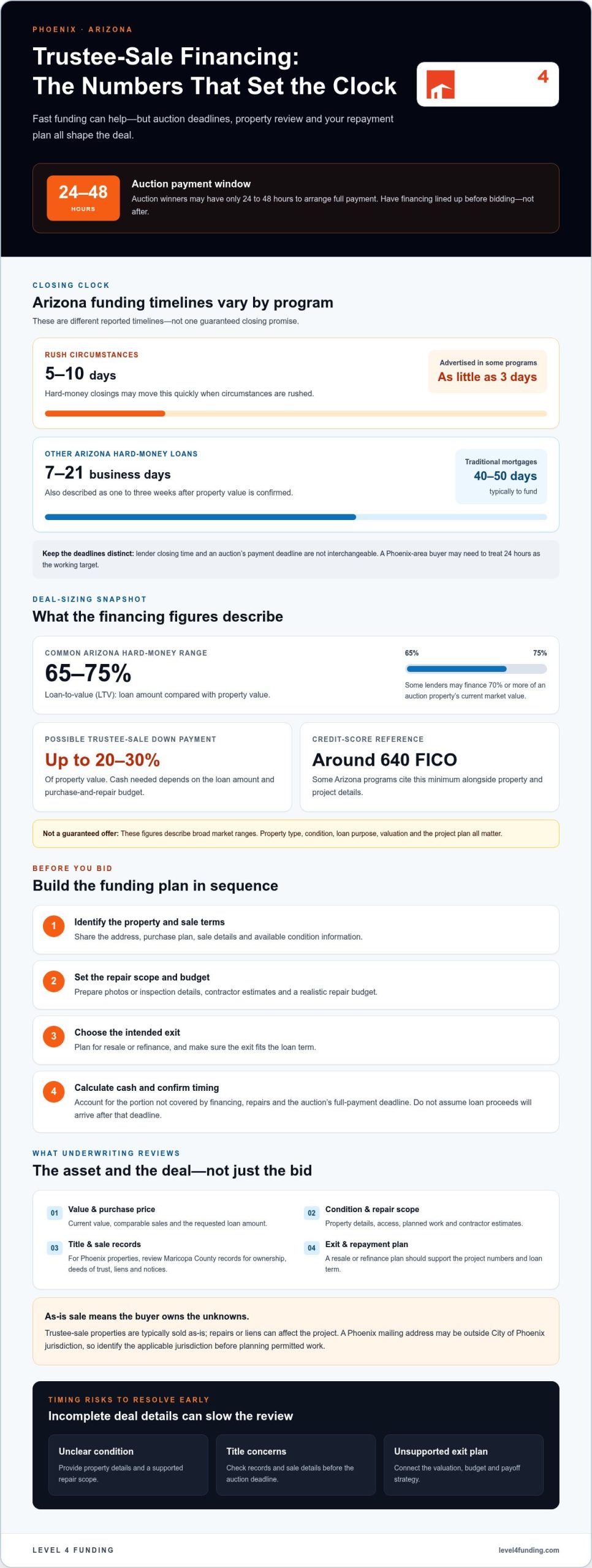
A trustee-sale deal can move faster than a conventional mortgage. Hard money for trustee sale properties in Phoenix may close in 5-10 days under rush circumstances, while traditional mortgages typically take 40 to 50 days to fund. But auction winners may have only 24 to 48 hours to arrange full payment, so financing needs to be lined up before bidding, not after.
That pressure is real: a promising property can become a costly miss if the funds aren’t ready when the sale closes. Speed matters, but so do the property’s condition, value, title details, and repayment plan.
This guide explains how Arizona hard money closings work, what affects timing, and how financing costs fit into a flip or other Phoenix investment property deal. You’ll also learn what to prepare before bidding, how loan structure affects your cash needs, and when this financing may suit your project.
Key Takeaways
- Get financing lined up before bidding. Auction winners may have only 24 to 48 hours to arrange full payment.
- Property value and condition shape underwriting. Build your deal plan around the purchase, needed repairs, and intended exit.
- Budget for the full cost of a flip, not just the winning bid. Trustee-sale properties are often sold as-is, and repairs or liens can affect the project.
- Compare the interest rate, origination points, repayment term, and payment structure together to understand the loan’s impact on your cash flow.
- Plan your payoff before closing. Interest-only payments can reduce payments during the term, but a balloon structure leaves the remaining balance due at maturity.
How fast can a hard money loan close in Arizona?
Arizona hard money financing can close in days, but property review and auction deadlines shape the clock. Some programs advertise funding in as little as 3 days, while rush circumstances may take 5-10 days. Other Arizona loans close in 7-21 business days, or one to three weeks after property value is confirmed. Those are different timelines, not a single closing promise.
For Arizona trustee-sale purchases, borrowers may need a down payment of up to 20% to 30% of the property’s value. The amount of cash needed depends on the loan amount and the purchase and repair budget. Auction winners may have only 24 to 48 hours to arrange full payment, so financing preparation must happen before bidding.
Underwriting starts with the asset and the deal. Lenders review the property’s current value, condition, purchase price, repair scope, and planned exit. Prepare the address, photos or inspection details, comparable sales, contractor estimates, and a resale or refinance plan. A Phoenix property with major repairs needs a clear budget, not just an auction bid. Some Arizona programs commonly cite a minimum credit score around 640 FICO, alongside property and project details.
Loan-to-value, or LTV, compares the loan amount with the property’s value. Arizona hard money loans commonly fall around 65% to 75% of value, while some lenders may finance 70% or more of an auction property’s current market value. For a commercial property, underwriting also weighs its use, condition, income potential, and exit plan. A higher requested LTV means the purchase price and valuation must support the loan.
These figures describe a broad market range, not a guaranteed offer for every Phoenix deal. The property type and loan purpose matter: a residential flip, commercial acquisition, and construction project each call for different value and repayment analysis. Match the financing to the asset and scope of work.
Before bidding on hard money for trustee sale properties in Phoenix, organize the financing steps in sequence:
- Submit the property address, purchase plan, and available condition details.
- Build the repair budget and provide supporting contractor estimates.
- Set an exit strategy, such as resale or refinance, that fits the loan term.
- Calculate cash needed for the down payment and auction payment deadline.
A prompt closing depends on complete information and a property that can be valued efficiently. Unclear condition, title concerns, or an unsupported resale plan can slow underwriting. Share the valuation, budget, and payoff plan early so the lender can assess the deal and structure the financing.
Fix-and-flip financing
A trustee-sale flip pairs a fast purchase with a separate rehabilitation plan. Before bidding, connect the auction price, repair scope, available cash, and resale or refinance exit.
Purchase, Refinance, and Rehab Financing
Fix-and-flip financing can support a property purchase and planned rehabilitation, while refinance financing can replace existing debt as a project changes. Separate acquisition costs from repair costs in your budget, then match each funding need to the project timeline.
For example, an investor buying a distressed Phoenix home should document the condition, expected work, and intended exit. Credit matters, but underwriting also weighs the property and deal structure. Keep contractor estimates and a clear resale or refinance plan ready to support the numbers.
Auction Property Financing
Foreclosure, trustee, sheriff, and REO auctions follow different sale processes, but each calls for a clear funding plan before bidding. Arizona trustee-sale properties are typically sold as-is, so buyers are responsible for associated repairs or liens.
Review Maricopa County public records for ownership, deeds of trust, liens, and notices connected to Phoenix properties. Assess the property’s condition and access, too. A Phoenix mailing address may fall outside City of Phoenix jurisdiction, so identify the applicable jurisdiction before planning permitted work.
Trustee Sale Payment and Cash Requirements
Arizona auction winners may have only 24 to 48 hours to arrange full payment after winning a bid. A Phoenix-area trustee-sale buyer may have 24 hours to arrange financing, so treat the shorter deadline as the working target.
Calculate the cash you can deploy before bidding, including the portion not covered by financing and the repair budget. Don’t assume loan proceeds will arrive after the auction deadline. Confirm that the funding schedule fits the sale’s payment terms before committing to a bid.
Auction-Funding Phoenix Lenders
Phoenix hard money lenders that fund trustee-sale auctions assess the property, requested loan, repair plan, and exit strategy. Give the lender the property address, sale details, condition information, and purchase plan early, so underwriting can focus on the actual asset.
Compare proposed structures by funding timing, loan basis, repayment term, and required borrower cash. For hard money for trustee sale properties in Phoenix, review of the specific auction deal matters more than a generic program description. A commercial property also needs underwriting suited to its use and income potential.
Before bidding, organize the essentials: sale terms, property records, access and condition details, repair estimates, and your repayment plan. That preparation helps investors avoid losing a viable deal because title concerns, hidden work, or funding timing were left until after the auction. Explore hard money financing options as you shape the project plan.
Arizona hard money interest rates and origination points
Interest and origination points affect financing costs, but the figures in an offer must be read together. The interest rate drives ongoing payment costs; origination points are charges tied to the loan. Compare both with the loan term, leverage, property condition, and planned payoff. A lower rate alone doesn’t show which offer leaves more cash for repairs.
Terms vary with the deal structure. A lender considers the property’s value, requested loan amount, borrower’s cash contribution, rehabilitation needs, and exit strategy. For example, a Phoenix investor planning extensive repairs should compare the total borrowing cost with the time needed to complete the work and sell or refinance. An offer that fits one project may strain another.
Arizona judicial foreclosure is a separate route from a trustee sale. According to the Arizona Legislature, judicial foreclosure carries a six-month statutory redemption period for the borrower after the sale. That legal timeline can affect possession and exit planning. Investors comparing foreclosure opportunities should distinguish the sale type before evaluating financing, expected holding time, and payoff strategy.
Comparing Arizona financing takes more than scanning a rate. Review written terms side by side, including how points are calculated, when charges are due, the payment structure, maturity date, and funding conditions. Then test the figures against your project budget. If repairs take longer than planned, carrying costs can change the outcome.
- Compare interest and points together, not as isolated figures.
- Match the repayment schedule to the resale or refinance plan.
- Check how the loan amount relates to property value and borrower cash.
- Read conditions that could affect funding or the payoff date.
A directory can help investors organize prospective lenders, but a listing doesn’t explain the terms for a specific Phoenix property. Compare offers using the same deal details: property type, purchase plan, repair scope, required leverage, and exit. Review written terms for payment timing and charges, then assess each offer against your project assumptions.
Focus on the complete cost and the asset behind the request. A commercial property and a distressed single-family home can raise different underwriting questions, even when both involve short-term financing. Keep the purchase, repair, and exit budgets together. This makes it easier to see whether the proposed structure supports the project or leaves a funding gap before closing.
Hard-money lending for Phoenix investment properties
Phoenix investors use short-term financing to acquire, renovate, or reposition real estate. The right loan amount depends on the asset, project costs, and exit plan, not simply the purchase price. For a rental, compare acquisition and planned work with expected income and a future refinance. For a flip, tie the budget to repairs and resale.
Arizona hard money loans may lend up to 70-75% of a property’s after-repair value. For purchase-and-renovation deals, some programs may reach 85-90% of total project cost. These are different measures: after-repair value estimates the property after work, while total project cost includes the eligible purchase and renovation costs. Use the right basis when estimating your cash contribution.
Multifamily and single-family properties call for different deal analysis. A Phoenix duplex, for example, requires review of its condition, unit mix, and rental plan. A single-family flip may depend more on repair scope and projected resale. Put the property details, work plan, and intended exit together so the loan request reflects the investment, not just a generic property category.
Leverage can help investors preserve cash for repairs, but a larger loan also increases the amount that must be repaid. Arizona hard money loans typically have repayment periods of 6 to 24 months. Match the term to the work schedule and exit. If the plan is a refinance, account for the time needed to complete improvements and prepare the property for the next loan.
Market activity offers context, not a substitute for property-level underwriting. Maricopa County added 35,400 residents between 2024 and 2025, and its population grew 7.9% since 2020. Those figures may inform an investor’s view of the area, but they don’t establish a particular property’s rent, resale value, or loan amount. Assess the Phoenix asset and its immediate submarket.
Arizona hard money loans tracked for the first quarter of 2026 had an average loan amount of $511,600. Elementix reported approximately $866M across 472 Arizona short-term investment real estate loans in the second quarter of 2026, and approximately $4.4B across 580 loans in the first quarter of 2026. These market-wide figures describe activity, not a commitment for any Phoenix borrower.
Before seeking funding, organize the investment into clear components:
- Identify the property type, purchase purpose, and planned use.
- Separate purchase costs from renovation work and operating needs.
- State whether the exit is a resale, rental hold, or refinance.
- Compare the requested loan amount with the project budget and value assumptions.
For hard money loans on Phoenix investment properties, a focused package makes the requested financing easier to assess. Bring property details, repair estimates, and a realistic exit plan together. This helps you judge whether the proposed amount fits the project, whether a rental strategy supports repayment, and whether the timeline works before committing capital.
How do interest-only payments and balloon structures work?
Payment structure affects monthly cash flow and the amount due at payoff. For a Phoenix investment, model both before choosing a hard money loan.
Interest-Only Payment Structure
With an interest-only structure, scheduled payments cover interest rather than reducing the principal balance. That can preserve capital for repairs on a Phoenix flip, but the original balance remains outstanding. Review the payment schedule, rate, and loan term together, then compare scheduled payments with the project’s cash flow.
For example, an investor renovating a Phoenix property may have no rental income during construction. Interest-only payments are still due while work proceeds. Compare expected carrying costs with contractor milestones and the planned resale or refinance date. This makes the cash demand visible before you commit.
Balloon Repayment
A balloon structure requires the remaining principal to be repaid at maturity, often in one final payment. Interest-only payments during the term don’t reduce that balance. You therefore need a defined payoff route, such as selling the improved property or refinancing into longer-term financing.
For an Arizona investor, the exit plan must account for delays in repairs, sale preparation, or refinance underwriting. If a Phoenix flip takes longer than expected, the balloon date still matters. Build a payoff plan around the property’s condition, likely sale process, and available capital rather than assuming a future refinance will cover the balance.
Interest rates and origination points affect borrowing costs in different ways. Interest accrues during the loan term; points are charges calculated from the loan amount. Evaluate the written terms alongside the payment schedule, maturity, and payoff plan. A lower scheduled payment may leave more principal due at the end.
Hard money terms reflect the loan structure and project risk. A Phoenix property needing extensive work presents different underwriting considerations from a stabilized rental. Requested leverage, property value, repair scope, and exit strategy all help shape the offer. Compare complete terms, not just the headline rate, and calculate carrying costs for the expected holding period.
Conventional financing and short-term hard money loans serve different project needs. Investors may use a short-term structure when acquisition and rehabilitation need to move together, while a longer-term refinance can support a completed rental. Moving between loans requires a practical timeline, a property that fits the next program, and a payoff plan for the existing balance.
Before accepting a program, write down the payment due during the term, the principal due at maturity, and the planned source of payoff. Check whether the projected resale or refinance can support that structure. For financing that aligns with an investment project, explore real estate investment loan options.
Level 4 Funding: Fix and Flip Loans
Level 4 Funding offers Fix and Flip Loans for investors planning to acquire and renovate properties, including Phoenix trustee-sale projects. Bring the purchase details, repair plan, and intended exit together when assessing how financing fits the deal. A defined scope helps connect the funding request to the work ahead and the planned resale or refinance.
For projects with different needs, Level 4 Funding also offers Construction Loans, Commercial Property Loans, and Cash Out Refinance. Consider which financing direction matches the property and investment plan. To discuss your project, contact Level 4 Funding or visit level4funding.com.
Make your next move with a clear deal plan
Before pursuing hard money for trustee sale properties in Phoenix, turn your investment thesis into a decision-ready plan. Set your maximum bid using the full project budget, including acquisition, repairs, carrying costs, and the payoff path. Define what would make you walk away, such as unresolved title questions, inaccessible areas, or a repair scope that breaks the numbers. A firm limit helps prevent auction pressure from driving your decision.
Level 4 Funding offers Fix and Flip Loans, Construction Loans, and Commercial Property Loans for real estate investment projects. The right direction depends on the property and what you intend to do with it. Bring your purchase details, work plan, and intended exit together before discussing the financing structure.
Ready to turn your Phoenix investment plan into a financing conversation? Contact Level 4 Funding to discuss the project and your next step. A disciplined plan puts you in control of the bid, the work, and the way forward.
Frequently Asked Questions
How much do hard money loans cost?
The cost depends on the loan structure and investment deal. Review the interest rate, origination points, repayment term, payment schedule, and any balloon balance together rather than judging one figure alone. Property condition, requested leverage, rehabilitation needs, and your exit plan can all affect the terms. Request a quote for project-specific costs, then compare the proposed terms with your budget.
Who Qualifies for a Trustee Sale Loan?
Trustee-sale borrowers are assessed on the property and the strength of the investment plan. Be ready to explain the purchase, identify known repairs, show available funds, and outline a realistic resale or refinance exit. The lender also considers property value and condition. Prepare deal information before bidding: a strong plan connects the requested financing to the asset and payoff.
How Do Trustee Sale Loans Work?
A trustee-sale loan assesses the investment property and proposed transaction. Share property and purchase details, explain the intended work, and identify how the balance will be repaid. After underwriting and closing, funds support the acquisition under the agreed loan terms. You then carry out the plan, such as completing repairs before resale. Keep the auction terms and project budget aligned from the start.
Should I partner with a hard money lender in Phoenix?
Consider a hard money loan when a Phoenix investment depends on property-focused financing and a clear project plan. This can suit a distressed acquisition or renovation that needs short-term funding. Before proceeding, make sure the proposed payment structure, maturity date, and payoff path work with your capital and project schedule. If the plan depends on uncertain resale timing, revisit the numbers first.
What is the difference between hard money and a conventional loan?
Hard money financing focuses more on the property and investment plan, while conventional financing generally involves broader borrower and income underwriting. That distinction can matter for a Phoenix property needing substantial work or an acquisition with a tight timeline. The structures also differ: short-term investment financing requires a defined payoff route, while conventional borrowing is commonly arranged for longer-term ownership. Compare eligibility, timing, payments, and exit needs.

About the author
Matt has a bachelor's degree in political science from Northern Arizona University and works at Level 4 Funding, a private lending company that offers hard money and rental home loans to real estate investors in 35 states.
With Matt's leadership, the firm has financed almost $300 million in loans for investment properties. He often helps real estate investors with rental property purchases, foreclosures, refinancing, and fix-and-flip projects. Matt has extensive experience in fix-and-flip, buy-and-hold, rental properties, and real estate sales. He has lived in Arizona for 43 years and is married with three children. Matt is licensed as a mortgage broker and loan originator in Arizona, with NMLS 2062278 and NMLS 1118493.
Equal Housing Opportunity. This is not a Good Faith Estimate, and it is not a Guarantee to lend; it should not be considered as such. Costs, rates, estimates, and terms can only be determined after a full application is completed. To the extent this message includes any tax or legal advice, this message is not intended or written by the sender to be used, and cannot be used, for legal or tax purposes or advice. This is an advertisement. Copyright © 2026. All rights reserved.