

How a Tampa Investor Used a Hard Money Bridge Loan to Close a Distressed Property in Under a Week
October 28, 2026
Phoenix real estate investor financing with no income verification can assess a rental property through its cash flow instead of relying on your W-2s or tax returns. A debt service coverage ratio (DSCR) of 1.0 or higher means the property’s income covers its debt obligations. No personal income paperwork doesn’t mean no underwriting: the property and the deal still matter.
Need to move quickly on a Phoenix investment property? Phoenix real estate investor financing with no income verification can help investors focus on the property and transaction rather than personal income documents. The property, loan structure, and project plan all shape the financing.
This guide explains how lenders evaluate property value and rental income, what income documentation may be used, and which details influence rates. You’ll also see how underwriting leads to closing, so you can prepare for each step and understand where investor-focused financing fits.
Key Takeaways
- Estimate how the property’s value, condition, and investment plan can shape the loan amount and loan-to-value limit.
- Prepare for underwriting by organizing property and transaction details, which can help keep the path to closing moving.
- For a fix-and-flip, map out the purchase, renovation scope, and exit plan so the financing matches the project.
- When W-2s or tax returns aren’t central to the review, rental income and debt obligations can still matter.
- Compare loan rates in context: the property, project risk, and financing structure all influence the terms.
Loan amounts and loan-to-value limits
Loan size starts with the property and financing structure, not just the borrower’s income documents. Loan-to-value (LTV) compares the loan amount with the property’s value. A lower LTV means the loan covers a smaller share of that value. The property’s condition, purchase price, project plan, and the lender’s valuation all inform the calculation.
What credit score, down payment, and cash reserves do Phoenix investor loans require? There’s no single figure that applies to every loan. Lenders weigh credit history alongside the requested LTV, available cash, property condition, and investment plan. More leverage can make the deal riskier, while reserves help cover costs during repairs, vacancy, or a slower rental period.
What Arizona lending and licensing rules apply to investor loans without income verification? Requirements depend on the loan structure, property use, borrower, and lender role. “No income verification” describes an underwriting approach; it does not remove rules that apply to the transaction. Make sure the loan documents and stated investment purpose match the actual deal.
To estimate LTV, compare the proposed loan with the value used in underwriting. Don’t assume the purchase price automatically sets that value. Property condition, comparable sales, and planned improvements can affect how the lender views the collateral. A Comparative Market Analysis can help you assess a Phoenix purchase before choosing a financing structure.
Phoenix’s median home price is $266,600. That market figure gives context, not a loan limit or a valuation for a specific address. A rental property’s condition and income potential can differ sharply from the citywide median. For example, a home needing major repairs may support a different financing decision than a rent-ready property with established leases.
How do Phoenix rents, property taxes, insurance, and vacancy affect DSCR loan qualification? They affect the income available to cover debt service. A 1.0 DSCR means rental income covers debt obligations; a 1.20 DSCR means rental income must cover 120% of debt service. Taxes, insurance, maintenance, repairs, pest control, landscaping, and vacancy reduce the cash flow available for payments.
- Estimate achievable rent using the property and local rental evidence.
- Include taxes, insurance, repairs, and ongoing maintenance in ownership costs.
- Allow for vacancy when assessing income available for debt service.
- Compare that cash flow with the proposed loan’s payment obligations.
These steps connect property value, leverage, and rental performance. A strong loan request shows how the purchase price, property condition, cash contribution, and expected rental income fit together. That gives underwriting a clear picture of both collateral and repayment capacity.
Loan underwriting and closing timeline
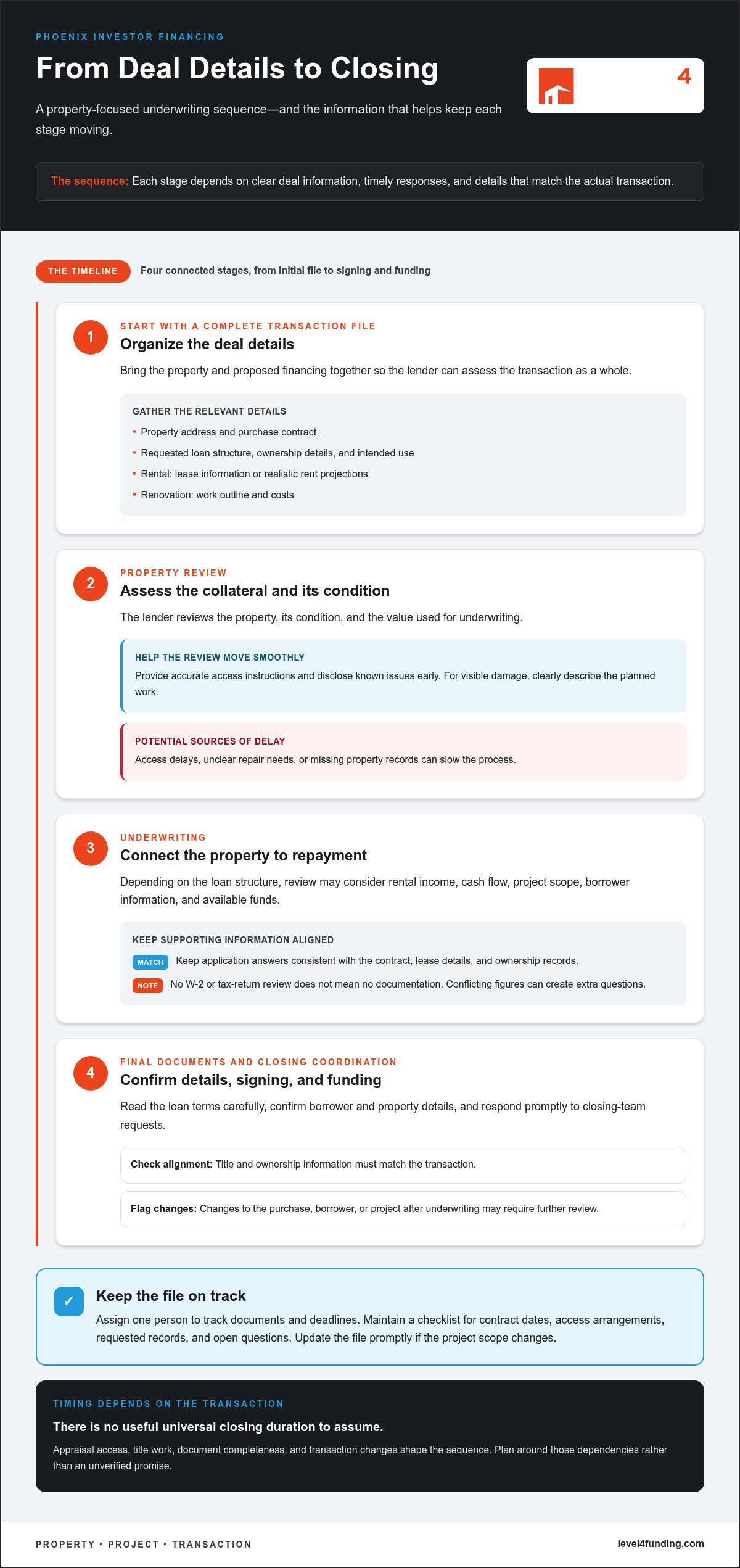
A Phoenix investment loan moves through connected review stages, from initial deal details to signed closing documents. The calendar advances when each stage has the information it needs. A complete purchase contract, clear property details, and prompt responses help prevent avoidable pauses.
Start by organizing the transaction file. Include the property address, purchase contract, requested loan structure, ownership details, and intended use. For a rental, gather lease information or realistic rent projections. For a renovation, outline the work and costs. These details help underwriting assess the property and proposed deal together.
Next comes the property review. The lender evaluates the collateral, its condition, and the value used for underwriting. Access delays, unclear repair needs, or missing property records can slow the process. Provide accurate access instructions and disclose known issues early. A Phoenix home with visible damage, for example, needs a clear account of the planned work.
Underwriting then connects the asset to repayment. Depending on the loan structure, the review can consider rental income, cash flow, project scope, borrower information, and available funds. No W-2 or tax-return review does not mean no documentation. Keep answers consistent across the application, contract, lease details, and ownership records. Conflicting figures create extra questions.
After the review, the transaction moves toward final documents and closing coordination. Read the loan terms carefully, confirm the borrower and property details, and respond promptly to requests from the closing team. Title and ownership information must align with the transaction. Changes to the purchase, borrower, or project after underwriting may require further review.
Use this sequence to keep the file moving:
- Submit the purchase and property details together.
- Provide access and resolve valuation or condition questions.
- Return underwriting responses with consistent supporting information.
- Review final documents and coordinate signing and funding.
Arizona investors can keep the process organized by assigning one person to track documents and deadlines. Maintain a checklist for contract dates, access arrangements, requested records, and open questions. If the project scope changes, update the details promptly so the file reflects the actual deal.
There is no useful universal closing duration to assume: appraisal access, title work, document completeness, and transaction changes shape the sequence. Build your purchase plan around those dependencies, not an unverified promise. If you’re comparing structures for a Phoenix investment, investor financing options can help frame the next discussion around the property and project.
Phoenix fix-and-flip financing
A Phoenix flip needs a financing structure built around the property, renovation plan, and resale strategy. Treat the purchase and rehab as one project, with costs and timing mapped before committing.
Fix-and-Flip Project Financing
Start with a property-specific scope: identify repairs, distinguish essential work from upgrades, and tie each task to contractor estimates. Then compare the project cost with the property’s condition and expected resale plan. A home needing roof, plumbing, and interior work carries different execution risks from one needing mostly cosmetic updates. Clear documentation shows how the financing supports the project.
Build the financing plan around the project’s stages. Track the purchase, renovation expenses, carrying costs, and intended exit, such as resale or a change in use. If inspection findings expand the original scope, update the budget and schedule before work proceeds. Unplanned repairs can use cash needed for later tasks, so account for reasonable contingencies.
In Phoenix, assess the property itself rather than relying on a broad neighborhood label. Review comparable sales, condition, and the improvements buyers are likely to value. A Comparative Market Analysis can help frame your resale assumption, while inspections can reveal costly issues with the roof, plumbing, electrical systems, or HVAC. Match the renovation plan to the home’s actual needs.
Financing Risks and Prepayment Penalties
No-income-verification financing still involves repayment, collateral, and project risks. Whether a prepayment penalty applies, and how it works, depends on the loan agreement. Before signing, read the note for any penalty trigger, calculation method, time period, and exceptions. Don’t assume that selling early or refinancing automatically avoids a charge.
A flip can run over budget, take longer to sell, or achieve less than the planned resale value. That can leave less cash for loan payments and closing costs. Stress-test the plan for a slower sale, additional repairs, or a lower offer. If the project works only under the most favorable outcome, the financing structure may leave too little flexibility.
Review these deal points before accepting terms:
- Whether the agreement includes a prepayment penalty and when it applies.
- How interest accrues and when payments are due.
- Which renovation costs the loan structure covers.
- What happens if the work, sale, or refinance takes longer than planned.
Keep the signed loan documents and approved project scope together. If the work changes, compare the new plan with the loan terms before spending. This can reveal a funding gap or payoff restriction while there’s still time to adjust the project.
Financing without W-2s or tax returns
Phoenix real estate investor financing with no income verification can shift the underwriting focus from employment records to the investment property and transaction. The application still needs a clear picture of the borrower, property, and intended use.
Application Documents and Steps
What documents and steps are needed to apply for a Phoenix investor loan without income verification? Prepare the purchase contract, property address, ownership details, and intended use. For a rental, include lease information or a rent estimate, plus records showing the property’s condition and operating costs.
Organize the file before submitting it. Keep the purchase terms, rent figures, insurance information, and property details consistent across documents. If the Phoenix property needs repairs, include a clear scope and contractor estimates. These records help underwriting understand the deal and the planned use of funds.
Use a straightforward preparation sequence:
- Gather the contract and identify the borrower and property.
- Provide lease details or a supportable rental estimate.
- Collect property, insurance, and repair information relevant to the deal.
- Review the file for inconsistent addresses, figures, or ownership names.
For example, an investor buying a Scottsdale rental can separate current lease details from projected rent after improvements. Label each clearly. Mixing existing income with future assumptions can blur the property’s current cash flow and make the application harder to assess.
DSCR loan eligibility in Arizona centers on rental income compared with debt obligations, alongside property and transaction details. A DSCR of 1.0 or higher means rental income covers debt obligations; a 1.20 DSCR means income must cover 120% of debt service.
W-2 and Tax Return Alternatives
Phoenix real estate investor financing with no income verification doesn’t mean underwriting ignores repayment. A rental loan review can consider the property, its income, condition, and loan structure. Keep lease information, expenses, and projections distinct so the investment plan is clear.
Use information that matches the property’s actual status. An occupied rental may have a signed lease; a vacant property may need a rent estimate based on comparable rentals. Keep projections separate from collected rent. For a renovation, explain how the work could affect occupancy and income rather than presenting future rent as current cash flow.
Property expenses also shape the repayment picture. Taxes, insurance, maintenance, and vacancy can reduce the income available for debt service. A rent figure alone doesn’t show the full operating picture. Organize costs by property and make assumptions visible, especially if the home’s rental strategy is changing.
Investors with variable income can keep transaction records, proof of available funds, and ownership information together. These materials clarify who is borrowing, how the purchase is structured, and how the plan connects to the property. A well-organized file makes the distinction between personal income and property performance easier to follow.
Hard money loan rates
A hard money quote is shaped by the property, loan structure, and repayment plan. Compare the full terms, not a headline rate alone.
How do DSCR loans compare with hard money, private money, and asset-based loans? DSCR financing emphasizes whether a property’s rental income covers debt obligations, while hard money commonly focuses on real estate collateral and the deal. Private money describes funding from private sources, and asset-based lending focuses on the value of pledged assets.
Rates reflect the lender’s assessment of risk. For a Phoenix property, relevant factors include its condition, value, requested leverage, intended use, and exit strategy. A rent-ready home with documented leases presents a different cash-flow picture from a vacant property needing substantial work. A fix-and-flip plan also brings execution and resale risks into the review.
The structure matters, too. Compare whether payments are interest-only or include principal, when payments fall due, and how the balance is repaid. Review any listed charges and prepayment terms alongside the stated rate. Two offers with similar rates can have different total costs because of their payment schedules and payoff provisions.
Build a comparison sheet for each proposal. Record the quoted rate, payment calculation, loan term, repayment method, and each listed charge. Then test the terms against your project’s cash flow. A rental investor can compare scheduled income with debt payments and operating costs. A flipper can map interest and carrying costs against the expected resale timeline.
Loan pricing also reflects the strength of the overall file. Clear property records, a coherent scope of work, realistic assumptions, and a defined exit plan help explain the transaction. A portfolio may require separate analysis of each asset, especially when property condition, income, or ownership structures differ. Don’t assume one property’s performance means another will receive the same terms.
Rates and lending practices can vary across states, so compare Arizona offers using the same assumptions. Ask what the quoted rate applies to, how payments are calculated, and which costs affect payoff. Make comparisons specific to the same property, requested amount, project plan, and repayment scenario.
Before accepting an offer, read the note and closing documents for the rate, payment obligations, fees, maturity, and early-payoff language. Match those terms to your expected hold period. If selling or refinancing is central to the exit plan, model that payoff before signing.
Use request hard money loan options to discuss how a Phoenix investment property and its financing structure fit together.
Level 4 Funding: Fix and Flip Loans
Level 4 Funding offers Fix and Flip Loans for investors financing a property purchase and renovation project. Bring the deal’s details together: property condition, planned repairs, budget, and intended exit. A clear project outline helps connect financing needs with the work required to prepare the property for resale.
For projects involving new construction, Construction Loans may fit the financing need. Commercial Property Loans and Cash Out Refinance address different investment situations, depending on the property and transaction. The right direction starts with the asset and your plan, not simply the paperwork you want to avoid.
Share your Phoenix property and project details with Level 4 Funding to discuss a suitable next step.
Make Your Next Financing Move With Clarity
The strongest next step is turning your investment idea into a decision-ready plan. Before pursuing Phoenix real estate investor financing with no income verification, define the property, intended use, expected hold, and exit strategy. Put those choices in writing. A clear plan helps you assess whether the financing structure matches the deal, rather than forcing the deal to fit a loan.
Be direct about your priorities, too. Is preserving cash for renovations more important than minimizing borrowing? Does your timeline depend on a quick resale, or can the property support a longer hold? Those answers help focus your financing conversation on the terms that matter to your investment.
Level 4 Funding can discuss your project and financing needs. Contact Level 4 Funding to explore a practical path forward. Bring your next investment into focus and take the next step with confidence.
Frequently Asked Questions
How fast can you close on a Phoenix property?
Most loans from Level 4 Funding take about 7 days to complete, and the title report is the longest part. A Phoenix purchase can move more smoothly when the title company has accurate property and ownership details early. Keep the purchase contract and transaction information consistent, and respond promptly to title-related questions. That gives the closing process fewer preventable delays.
What no-income-verification financing options are available to real estate investors in Phoenix?
Investor options include hard money financing for projects such as fix-and-flips, construction, commercial property, rentals, or Airbnb properties. Level 4 Funding offers Fix and Flip Loans, Construction Loans, Commercial Property Loans, and Airbnb Loans, among other investor products. The right structure depends on the property and intended use. For example, a renovation purchase and a stabilized rental call for different financing plans.
What are current DSCR and hard money loan rates and fees in Phoenix?
Level 4 Funding advertises fixed rates from 5.99% APR*, rates from 6.99% APR*, and loan rates starting at 7.99%*. Rental loans start at 5.5% APR. The applicable terms depend on the loan and property. The company states it has no up-front or junk fees and no cost to request a quote. Compare the complete terms, including repayment and payoff provisions.
Can investors use no-income-verification loans for Phoenix fix-and-flip or rental properties?
Yes. Investors can use these financing approaches for Phoenix fix-and-flip projects or rental properties, depending on the loan structure and property. Level 4 Funding offers Fix and Flip Loans and rental options, including Airbnb Loans. A flip plan should explain the renovation and resale strategy; a rental plan should distinguish current rent from projected income. Those details help connect the financing to the property’s intended use.
Which Phoenix-area lenders offer DSCR or other investor loans without personal income verification?
Level 4 Funding provides private hard money financing for real estate investors in Phoenix and nearby markets, including Scottsdale, Glendale, Tempe, and Mesa. Its offerings include investor loans for fix-and-flip, construction, commercial property, and rental projects. The company does not identify its products as DSCR loans here, so describe the specific property and financing need rather than assuming every rental loan uses DSCR underwriting.

About the author
Matt has a bachelor's degree in political science from Northern Arizona University and works at Level 4 Funding, a private lending company that offers hard money and rental home loans to real estate investors in 35 states.
With Matt's leadership, the firm has financed almost $300 million in loans for investment properties. He often helps real estate investors with rental property purchases, foreclosures, refinancing, and fix-and-flip projects. Matt has extensive experience in fix-and-flip, buy-and-hold, rental properties, and real estate sales. He has lived in Arizona for 43 years and is married with three children. Matt is licensed as a mortgage broker and loan originator in Arizona, with NMLS 2062278 and NMLS 1118493.
Equal Housing Opportunity. This is not a Good Faith Estimate, and it is not a Guarantee to lend; it should not be considered as such. Costs, rates, estimates, and terms can only be determined after a full application is completed. To the extent this message includes any tax or legal advice, this message is not intended or written by the sender to be used, and cannot be used, for legal or tax purposes or advice. This is an advertisement. Copyright © 2026. All rights reserved.