


How to Get a Loan to Flip a House: Financing Options, Requirements, and Pro Tips
November 2, 2026
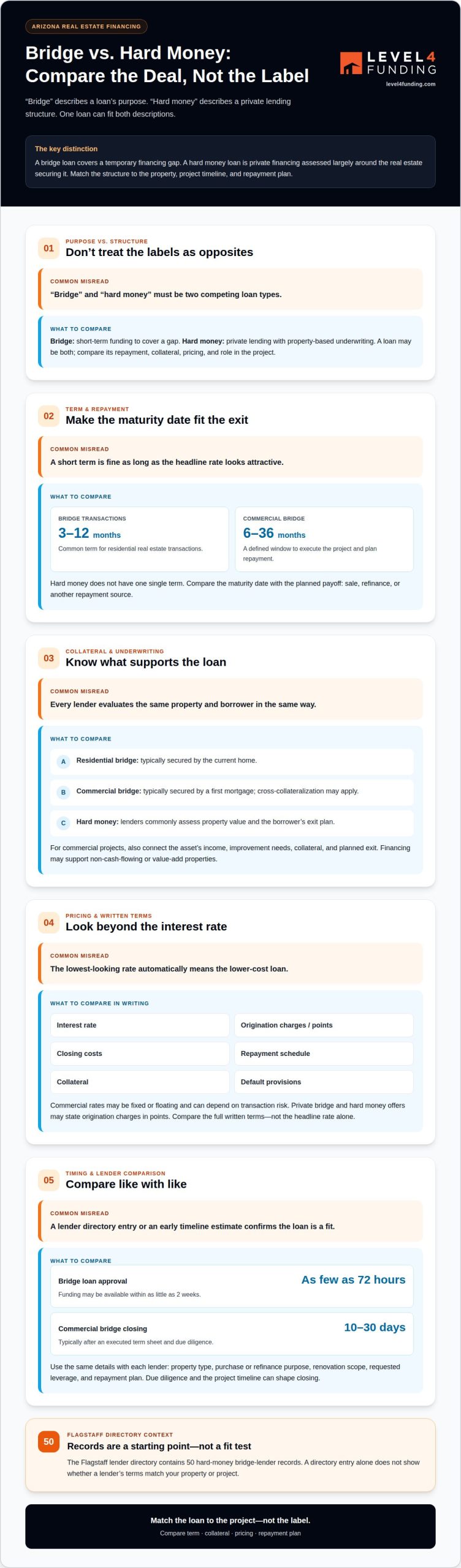
A bridge loan and a hard money loan aren’t always competing options. In Flagstaff, “bridge loan” describes short-term financing used to cover a funding gap, while “hard money” describes private lending that focuses on the real estate securing the loan. One loan can fit both descriptions, so the purpose and structure matter more than the label.
When comparing these options, focus on more than the rate. Consider the collateral, available equity, property condition, repayment plan, and total borrowing costs. A lower-looking rate may still be a poor fit if the loan structure does not match your project timeline.
This guide explains how bridge loans and hard money loans differ, where they overlap, and what to compare before financing an Arizona real estate project. You’ll learn which costs and loan terms to review, what lenders may consider, and how to choose a structure that supports your next move.
Key Takeaways
- Compare loan purpose and repayment plan, not just the “bridge” or “hard money” label; the two can overlap.
- Assess commercial financing by the property’s income, improvement needs, collateral, and planned exit strategy.
- Understand how credit, debt, available equity, and property value can shape eligibility and loan structure.
- Look beyond the interest rate: origination charges and closing costs also affect the total borrowing cost.
- Match the financing to your project, whether you’re buying and renovating, building, or financing commercial property.
Bridge vs. Hard Money Loans: Which Do You Need in Arizona?
In Arizona, “bridge loan” describes short-term financing by purpose, while “hard money” describes private lending by structure. The labels can overlap, so compare repayment, collateral, pricing, and the property’s role before choosing.
Arizona’s applicable rules and disclosures depend on the transaction. Before signing, review the written terms for the interest rate, origination charges, repayment schedule, collateral, and default provisions.
Loan Terms and Collateral
A bridge loan typically covers a temporary financing gap, with real estate transactions commonly running 3-12 months. A hard money loan is defined more by its private lending structure and property-based underwriting than by a single term. For Arizona commercial bridge loans, terms can run 6-36 months; commercial rates may be fixed or floating, based on transaction risk.
Repayment and collateral matter as much as loan duration. A homeowner’s bridge loan is typically secured by the current home, while commercial bridge financing is typically secured by a first mortgage, with cross-collateralization when applicable. Hard money lenders commonly assess property value and the borrower’s exit plan. Compare the planned payoff, sale, refinance, or other repayment source with the maturity date.
Flagstaff and Arizona Lenders
Bridge loan lenders serving Flagstaff may include private lenders and commercial financing institutions operating across Arizona. The Flagstaff lender directory contains 50 hard-money bridge-lender records, but a directory entry alone doesn’t show whether a lender’s terms match your property or project. Commercial lenders may focus on income-producing assets, while private lenders can assess an investment property and its planned turnaround.
When comparing bridge loans in Flagstaff, use the same project details for each lender: property type, purchase or refinance purpose, renovation scope, requested leverage, and repayment plan. Arizona commercial bridge financing can support non-cash-flowing or value-add projects, including improvements that may require construction draws or reserves. How the lender treats the property and project timeline can matter more than the loan label.
Application and funding timeline: Bridge loan approval can take as few as 72 hours, and funding may be available within as little as 2 weeks. Commercial bridge loans typically close 10-30 days after an executed term sheet and due diligence. For a smoother comparison, prepare property details, project costs, and your exit strategy together; commercial due diligence can shape the closing schedule.
Rates and origination points: Rates depend on the transaction’s risk, collateral, and loan structure; commercial rates may be fixed or floating. Private bridge and hard money offers may express origination charges in points. Compare the rate and points with the repayment schedule and full written terms, rather than judging an offer by its headline rate alone.
| Option | Typical purpose | Term and repayment | Collateral and pricing |
|---|---|---|---|
| Bridge loan | Cover a short-term financing gap | Residential real estate transactions commonly run 3-12 months | May be secured by a current home; compare rate and charges |
| Hard money loan | Private financing for real estate investment | Structure follows the project and repayment plan | Property-focused underwriting; compare points and rate |
Choose a loan by matching its term, collateral, pricing structure, and exit plan to the property and project, not by relying on the loan label.
Commercial bridge financing for income-producing real estate
For Arizona investors, commercial bridge financing can support acquisitions, repositioning, and improvements before a property reaches its next financing stage. Commercial bridge loans can run 6 to 36 months, giving a defined window to execute the project and plan repayment.
Income matters, but it isn’t the only consideration. Arizona commercial bridge financing can support non-cash-flowing or value-add projects, including properties that need work before generating income. A lender can assess the asset, improvement plan, and intended exit together. This structure may suit an investor acquiring a property, recapitalizing an existing investment, or repositioning an asset for stronger operations.
Hospitality, industrial, and resort properties can have different renovation needs and revenue patterns. A hospitality property may need room updates; an industrial asset may need improvements before a tenant can use it; a resort may require capital work tied to its operations. These examples do not guarantee loan approval. The financing case depends on the property, proposed work, and repayment strategy.
Construction draws and improvement reserves may fund renovation and capital expenditures in stages. This structure links access to project capital with planned work, rather than treating all improvement costs as one expense. Prepare a scope of work, construction budget, and timeline, then connect each improvement to the property’s operating or resale plan. A clear breakdown shows how the work supports the asset’s next phase.
Purchase, refinance, and cash-out requests need different framing. A purchase request centers on acquiring the property and funding its planned transition. A refinance replaces existing debt, while cash-out financing uses property equity to release capital for another purpose. State which transaction you’re pursuing and how you plan to repay it. For repositioning, connect the financing period to the milestones leading to a sale or longer-term takeout.
Commercial bridge loans are typically interest-only during the loan term and secured by a first mortgage, with cross-collateralization when applicable. Arizona commercial bridge financing may be non-recourse, with partial recourse available case by case. Leverage may reach 75% to 85% of loan-to-cost or cost coverage. Rates may be fixed or floating, based on transaction risk. Compare these terms against the project’s cash needs and repayment plan.
For an income-producing property that needs acquisition funding or improvements, commercial property financing can be a relevant next step to explore.
Credit score, debt-to-income, and equity requirements
Arizona bridge financing requirements weigh the borrower, the property, and the planned repayment. Some lenders look for credit scores above 650; others require 740 or higher. These are different underwriting thresholds, not a single statewide qualification standard.
A debt-to-income ratio below 50% is one threshold some bridge lenders use. They also assess whether existing mortgage payments and other debts leave room for the proposed loan. Investors can prepare by organizing current debt obligations, income records, and a clear explanation of the project’s repayment plan.
Equity can be decisive for a residential bridge loan secured by a current home. Arizona borrowers typically need at least 20% equity, though some lenders may require up to 50%. A borrower who owes more than 80% of the home’s value may find a bridge loan unavailable. The property’s value and outstanding mortgage balance determine the available equity.
Loan-to-value figures offer another useful comparison. The typical loan-to-value ratio offered for loans in Flagstaff is 72%, while Arizona bridge loans averaged 60% in the first quarter of 2026. These figures measure different scopes and periods, so don’t treat either as a promise for one borrower. Property value, existing liens, and loan purpose affect the calculation.
Credit reviews and appraisals answer different questions. A credit review shows how the borrower has handled past obligations; an appraisal assesses the property securing the loan. Tax returns can document reported income, while project records can explain an investor’s expected repayment source. Organize these materials alongside mortgage statements and property details.
Bridge loans also differ from a home equity line of credit (HELOC) or home equity loan. A HELOC lets a homeowner draw against available home equity, while a bridge loan addresses a short-term financing gap tied to a property transaction. Home equity loans typically have repayment terms of 10 to 20 years, compared with bridge financing’s shorter project-oriented structure.
For example, an investor buying a residential property in Flagstaff should compare the property’s value, current liens, credit history, and planned exit. A homeowner in Scottsdale considering a HELOC should instead weigh available equity and the longer repayment period. Match the product to the transaction, not just the borrower’s credit score.
- Credit: Compare the lender’s score threshold with your credit history.
- Debt: Calculate existing obligations against income.
- Equity: Subtract mortgage balances and other liens from property value.
- Property: Prepare for an appraisal and organize ownership details.
Closing costs and origination fees
Compare the full cost of a bridge loan, not just its interest rate. Arizona bridge-loan closing costs, administrative fees, and legal expenses generally range from 1.5% to 3% of the loan’s total value. Origination charges are another key line item, so separate each charge before assessing the financing.
For a clear comparison, list each offer’s costs: origination fee, closing costs, administrative fees, legal expenses, and interest. Arizona hard money and private bridge loans may quote origination charges as points, which express a fee relative to the loan amount. Before comparing offers, understand how each lender calculates and collects those charges.
The interest rate affects borrowing costs over time; upfront fees affect the amount needed at closing. With a shorter hold, upfront charges can be especially significant relative to how long you use the capital. Compare offers by recording the interest structure, every listed fee, and repayment date. The lower rate alone does not identify the less costly option.
Underwriting and closing speed also shape a project’s real cost. Bridge loan approval can take as few as 72 hours, and funding may be available within as little as 2 weeks. Commercial bridge loans typically close 10 to 30 days after an executed term sheet and due diligence. These timelines reflect different stages and transaction types, not interchangeable promises.
To move underwriting forward, organize the property details, purchase or refinance purpose, requested amount, improvement plan, and repayment strategy. Due diligence on a commercial property can affect the closing schedule. A complete project file helps the lender assess the asset and transaction without avoidable gaps.
Conventional and retail lending programs may follow different processes from private bridge financing. Review the written terms rather than assuming a familiar loan label means familiar fees or timing. At closing, match each charge against the agreed terms and confirm how interest accrues and when repayment is due. This final review connects upfront costs to the actual loan structure.
- Separate costs: Distinguish origination charges from closing, administrative, and legal expenses.
- Compare interest: Evaluate the rate alongside the expected borrowing period.
- Review timing: Identify underwriting, due diligence, and closing milestones.
- Check the agreement: Match each cost and repayment term to the written loan terms.
Bridge loans versus hard money loans
These labels answer different questions. “Bridge” describes a transaction’s purpose: temporary funding that connects one financing stage to another. “Hard money” describes a private lending structure, often centered on the real estate securing the loan. A single loan can be both. For an Arizona investor, the useful comparison is how each offer funds the deal and how repayment works.
Start with the transaction. A buyer purchasing a property before selling another may need bridge financing to cover the timing gap. An investor acquiring a property that needs substantial work may consider a hard money lender whose underwriting focuses on the asset and project. These needs can overlap: a purchase loan may bridge the timing gap while using private, property-focused underwriting.
Then identify the repayment source. A bridge loan needs a clear next step, such as selling the property or moving into longer-term financing. A hard money loan also needs a workable payoff plan, but its structure may emphasize the property’s current value, planned improvements, and expected sale or refinance. If the transaction has no credible exit, a short-term loan label does not solve the underlying risk.
| Comparison point | Bridge loan | Hard money loan |
|---|---|---|
| What the term describes | A temporary financing purpose | A private lending structure |
| Common transaction example | Buying before another property sale | Funding an investment property or renovation |
| Key planning question | What financing or sale comes next? | How do property value and project plans support repayment? |
| Potential overlap | May use private, property-focused underwriting | May bridge a purchase or refinance gap |
Use the table to classify the job first, then compare written terms. For each offer, record the property, transaction purpose, repayment source, maturity date, and fees. Keep the facts consistent across offers. For example, describe a Flagstaff purchase with a planned renovation using the same scope and exit plan each time. This makes each proposed loan structure easier to assess.
Location alone doesn’t define the loan. Investors in Flagstaff or Phoenix should focus on the property and transaction, rather than assume a city name determines the financing type. A direct money lender may describe an offer as a bridge loan, hard money, or both. Review what the label means in the written terms, especially for collateral, repayment, and any planned refinance.
Decision guide: Choose by purpose. If the central need is temporary funding between two stages, assess the bridge structure. If private, property-focused lending fits the asset and project, assess hard money terms. If both describe the deal, compare the actual contract and payoff plan instead of choosing by name. Discuss your real estate financing needs as you map the next step.
Level 4 Funding: Fix and Flip Loans
Level 4 Funding offers Fix and Flip Loans for real estate investors planning to purchase and renovate a property. Match the financing choice to the project: renovation-focused plans may suit a fix-and-flip loan, while a ground-up build may call for a Construction Loan. For an income-producing asset, Commercial Property Loans may better align with the property’s role. Property owners seeking to access equity can consider Cash Out Refinance.
Before choosing, outline the purchase or refinance purpose, planned work, capital needs, and repayment strategy. That gives you a practical basis for comparing the loan structure with the project, rather than choosing by label alone. If your next move is a real estate investment, visit level4funding.com to discuss your financing needs.
Turn Your Financing Decision Into a Clear Next Step
Before pursuing bridge loans in Flagstaff, define what success looks like after the financing period. Set out the property’s next milestone, the capital needed to reach it, and the repayment route. This project plan gives your financing conversation a practical focus, whether you’re pursuing an acquisition, renovation, or construction project.
Level 4 Funding offers Fix and Flip Loans, Construction Loans, and Commercial Property Loans for real estate investors. Match the loan purpose to the work ahead, then bring your project details into the discussion. The right next step is a financing structure that supports the property plan, not simply a familiar loan label.
Contact Level 4 Funding to discuss your real estate financing needs. Take the next step with a clear plan and move your project forward with confidence.
Frequently Asked Questions
Are there modern ways to buy a house before I sell?
Yes. A bridge loan can help cover a purchase while your current home is still on the market. A HELOC or home equity loan can also draw on available equity, but each works differently. Consider whether you need a lump sum for the new purchase or flexible access to funds. Include both mortgage payments and expected sale proceeds in your budget before committing.
What is a bridge loan, in simple words?
A bridge loan is short-term financing used to cover a funding gap between real estate steps. For example, a buyer might use it to complete a purchase before another property sells or longer-term financing begins. The practical test is your payoff plan: identify the event that will repay the loan, then make sure the timing fits the loan’s maturity and your transaction.
Who Qualifies for Bridge Financing?
Qualification depends on the borrower, property, available equity, and repayment plan. Level 4 Funding states that it has no minimum credit score requirement, while its process checks for judgments, tax liens, or bankruptcy. A lower score can affect the down payment or rate. Prepare a clear project summary and details about the property, its ownership, and your intended exit so the financing request is grounded in the deal.
Who provides bridge loans in Arizona?
Arizona bridge financing comes from private lenders, hard money lenders, and commercial real estate lenders. Level 4 Funding serves real estate investors in Flagstaff, Phoenix, Scottsdale, Tucson, Glendale, Sedona, Tempe, Mesa, and Buckeye. Provider type often signals the financing focus: private and hard money lenders assess investment properties, while commercial lenders focus on income-producing assets. Match the lender’s focus to the property and transaction.
What are bridge loans and how do they work in Flagstaff, Arizona?
Bridge loans in Flagstaff finance a defined real estate transaction, with repayment tied to a planned next step. For a local purchase, map the funding from acquisition through improvements or transition, then identify the source that will repay the balance. Keep the purchase documents, property details, and exit plan consistent. This helps clarify whether the financing fits the project’s purpose and timeline.
Which lenders offer bridge loans in Flagstaff, AZ?
Level 4 Funding is one local option for real estate investors seeking private hard money financing. The company states that it presents loan criteria to a network of 200+ professional lenders to pursue terms suited to the request. For a Flagstaff investment, organize the property type, transaction purpose, and intended repayment route. Those details help frame the financing need clearly before comparing structures.
What are current bridge loan rates and fees in Flagstaff?
Rates and fees depend on the loan structure, collateral, transaction risk, and repayment period. Compare the interest basis, origination charge, and other closing costs in the written terms rather than relying on a headline rate. Note whether interest is fixed or floating and how payments are scheduled. For an apples-to-apples comparison, use the same loan amount and expected holding period for each proposal.
What are typical bridge loan amounts, terms, and loan-to-value limits?
Loan size and leverage depend on the property, equity, and project scope. Its stated limits include up to 90% of as-is value and up to 100% of rehab costs. Those program figures aren’t a universal market standard; the transaction determines the relevant structure.

About the author
Matt has a bachelor's degree in political science from Northern Arizona University and works at Level 4 Funding, a private lending company that offers hard money and rental home loans to real estate investors in 35 states.
With Matt's leadership, the firm has financed almost $300 million in loans for investment properties. He often helps real estate investors with rental property purchases, foreclosures, refinancing, and fix-and-flip projects. Matt has extensive experience in fix-and-flip, buy-and-hold, rental properties, and real estate sales. He has lived in Arizona for 43 years and is married with three children. Matt is licensed as a mortgage broker and loan originator in Arizona, with NMLS 2062278 and NMLS 1118493.
Equal Housing Opportunity. This is not a Good Faith Estimate, and it is not a Guarantee to lend; it should not be considered as such. Costs, rates, estimates, and terms can only be determined after a full application is completed. To the extent this message includes any tax or legal advice, this message is not intended or written by the sender to be used, and cannot be used, for legal or tax purposes or advice. This is an advertisement. Copyright © 2026. All rights reserved.