


Compare Bridge Loan and Hard Money Loan Fees and Requirements
November 3, 2026
For bridge loans in Gilbert, Level 4 Funding ensures the right fit depends on the property and your exit plan. While our primary offices are based in Phoenix, Scottsdale, and surrounding Arizona cities, we actively serve real estate investors and property owners throughout Gilbert. A bridge loan can fund a transition such as renovation, lease-up, or a pending closing, while hard money describes private, property-focused lending often used for investment properties. These terms can overlap, so the key is matching the financing to the deal.
When a property opportunity has a tight timeline, speed and flexibility matter. But the loan label alone won’t tell you whether the financing fits. This article explains how commercial bridge loans, hard money loans, and other options compare for Gilbert properties, including their purpose, property fit, and exit strategy. Use those differences to match financing to your next move, whether that means improving a property, reaching lease-up, or transitioning to permanent financing or a sale.
Key Takeaways
- Separate the purpose of the loan from its label: the property, business plan, and exit strategy help determine whether bridge or hard money financing fits.
- Understand how interest and origination points affect the total borrowing picture, and compare terms alongside the proposed loan structure.
- For construction or lease-up, connect the funding need to a clear plan for completing the work, stabilizing occupancy, and repaying the loan.
- Residential investment financing depends on the property plan and the path to repayment, whether that means a sale or permanent financing.
- Use property type, deal scale, and timing to distinguish commercial bridge financing from hard money and identify the most relevant loan option.
Bridge vs. Hard Money Loan: Which Do You Need in Arizona?
In Arizona, “bridge loan” describes a temporary financing purpose, while “hard money” describes private, property-focused lending. For Gilbert projects, compare the exit plan, collateral, interest, points, and timing before choosing either structure.
Bridge Loan Rates and Origination Points
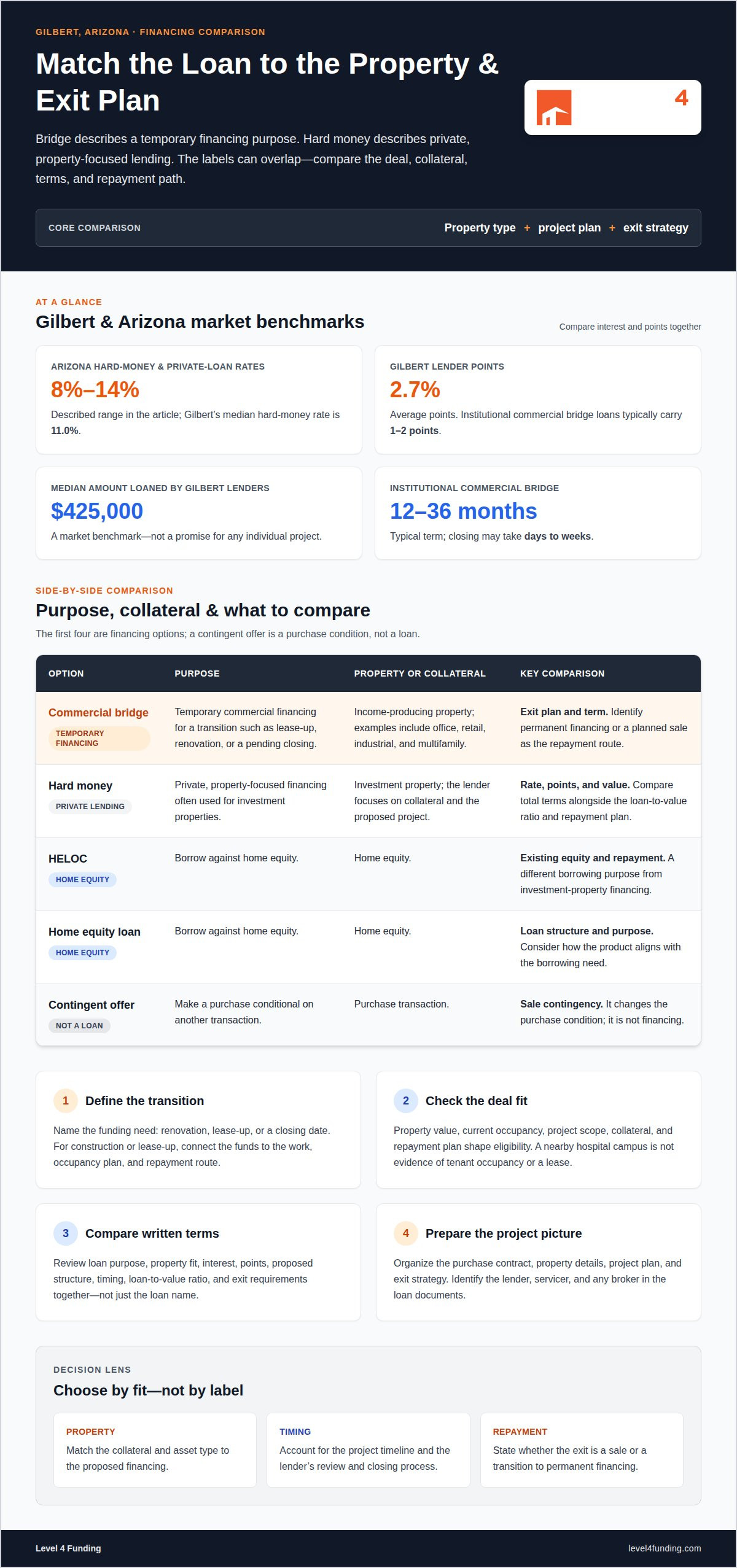
Arizona hard-money and private-loan rates are described at 8%-14%; Gilbert’s median hard-money rate is 11.0%. Gilbert lenders average 2.7% in points, while institutional commercial bridge loans typically carry 1-2 points. Those terms distinguish lender structures, not just loan names. Compare the interest rate and points together, then assess the planned repayment route and loan-to-value ratio.
Loan Amounts and Eligible Property Types
The median amount loaned by Gilbert lenders is $425,000, a market benchmark rather than a promise for any project. Eligible property types depend on the asset and business plan; examples include office, retail, industrial, and multifamily properties. A residential mortgage or home-equity product serves a different property and borrowing purpose.
Gilbert and Arizona Bridge Loan Lenders
Arizona commercial bridge loans can come from institutional lenders or private lenders. Institutional commercial bridge loans typically run 12-36 months and may take days to weeks to close. Private money lenders focus on collateral and the proposed project. Compare written terms, loan purpose, property fit, points, and exit requirements. Treat lender licensing and local presence as separate comparison criteria, not proof that financing fits the deal.
Gilbert Use Cases and Eligibility
A Gilbert bridge-loan plan may involve lease-up, renovation, or a closing date. A nearby hospital campus is not a substitute for evidence of tenant occupancy or a lease. Identify permanent financing as the exit, or state that you plan to sell. Property value, current occupancy, project scope, and repayment plan shape eligibility. To prepare an application, organize the purchase contract, property details, project plan, and exit strategy.
A bridge loan can fund a time-sensitive property transition. A HELOC or home equity loan borrows against home equity, while a contingent offer makes a purchase depend on another transaction. Arizona or Maricopa County taxes and closing charges depend on the transaction. Review tax prorations and title, escrow, and recording items in the settlement statement.
How long does approval and funding take in Gilbert? Institutional commercial bridge loans are estimated to close in days to weeks, with timing shaped by underwriting, property review, and closing documents.
| Option | Purpose | Property or collateral | Key comparison |
|---|---|---|---|
| Commercial bridge | Temporary commercial financing | Income-producing property | Exit plan and term |
| Hard money | Private, property-focused financing | Investment property | Rate, points, and value |
| HELOC | Borrow against home equity | Home equity | Existing equity and repayment |
| Home equity loan | Borrow against home equity | Home equity | Loan structure and purpose |
| Contingent offer | Make purchase conditional | Purchase transaction | Sale contingency, not a loan |
Choose the option whose collateral, timing, total terms, and repayment path match the property and project.
Arizona lender licensing and local presence
A lender’s Arizona footprint and legal role are separate questions. For a Gilbert transaction, identify the entity funding the loan, the party servicing it, and any broker arranging it. Match each name to the loan documents. A Phoenix mailing address alone doesn’t explain who holds the note or handles payments.
Arizona licensing depends on the lender’s role and transaction details, so “private lender” is not a complete answer. Identify the lending entity and its license information, if applicable, along with any explanation of an exemption. Compare those details with the signed loan documents. Know who can approve draws, issue payoff figures, and respond to a default notice.
National private lenders can serve Arizona without a Gilbert office, while Arizona-based lenders may know local property conditions firsthand. Neither label proves that a loan fits. Compare the legal entity, collateral requirements, servicing contact, funding process, and experience with the property type. A Gilbert office acquisition may require different underwriting from a Phoenix rental renovation, even if both use commercial property as collateral.
Local presence matters most when a project needs property inspections, construction draws, or coordination around closing. Ask who evaluates the asset, who approves each funding step, and where notices must be sent. Arizona market coverage can be broad: 50 lenders operate in Gilbert, while Phoenix offers another major market for investment projects. The count doesn’t establish licensing, loan quality, or suitability. Confirm the lender’s role and the loan’s terms independently.
Renters facing foreclosure need to separate the owner’s debt from the renter’s occupancy. In Gilbert, consider whether a written lease exists, who owns the property, and what foreclosure or occupancy notices have arrived. Keep the lease, rent receipts, and notices together. The effect on a tenant depends on the lease, property status, notices, and applicable law. Don’t assume a mortgage default alone determines what happens next.
For a refinance or sale exit, also identify who will communicate with the borrower through payoff and closing. Gilbert’s median loan term is 37 months, but that market figure doesn’t define an individual contract. Read the maturity date, extension provisions, default terms, and payoff process as written. If a bridge lender uses a separate servicer, record both entities and their responsibilities before signing.
For a Gilbert investment, organize the lender’s identity, licensing details, servicing contact, collateral, and exit terms in one comparison. Private real estate financing is one route to explore when a project depends on property-focused lending.
Bridge financing for construction and lease-up
A Gilbert property may need funding before construction finishes or tenants move in. The choice depends on the project stage: bridge financing can cover a transition, while construction financing funds building or renovation work. Match the loan purpose to the work, payment needs, and planned repayment transaction.
A bridge loan can fit an existing property undergoing renovation or lease-up, especially when the borrower has a defined sale or refinance exit. Construction financing is aimed at funding building or renovation itself. Granite Bank describes construction loans as funding home building or renovation, typically repaid once work is complete. The distinction is practical: one addresses a transition; the other supports construction activity.
For either structure, map the project in stages. Identify what needs funding now, what must happen before the property can generate income, and how you expect to repay. For a renovation, connect the work scope to the property’s post-work use. For lease-up, show how occupancy supports the exit plan. This sequence helps a lender assess the collateral and transaction.
Gilbert’s Silver Creek Development office property shows how a bridge loan can support a commercial transition. The $31.4 million loan covered a 120,294-square-foot office property and closed in under 30 days. That example is not a construction budget or a typical timeline; it illustrates a specific commercial financing transaction. The useful lesson is to define the asset, funding purpose, and exit clearly before seeking terms.
Construction financing calls for a clear picture of the work, the property’s current condition, and how the finished asset will be used. A bridge proposal for lease-up should instead explain current occupancy, the steps toward stabilization, and the planned repayment source. If a Gilbert project combines renovation and lease-up, separate the construction funding need from the later transition need.
Before choosing financing, assemble a concise project file with purchase or ownership details, property information, work scope, funding plan, and exit strategy. For construction, organize the work sequence and anticipated completion milestones. For bridge financing, show what event ends the temporary loan, such as a sale or refinance. Keep projected equity needs and debt payments visible in the same plan.
Choose construction financing when the central need is funding building or renovation. Choose a bridge structure when the property needs temporary capital through a defined transition, such as lease-up or a closing. For a mixed Gilbert project, determine which phase needs financing first, then align each loan’s purpose with its repayment path.
Residential investment property bridge financing
For a Gilbert rental that needs renovation or a transition before permanent financing, a bridge loan can cover the gap. Arizona’s average interest rate for bridge loans secured by residential investment properties was 7.49% in the first quarter of 2026. That market figure is a benchmark, not a quote for an individual property. The project’s condition, occupancy, requested financing, and repayment plan shape the decision.
Start with the exit. A bridge-loan proposal should identify a permanent financing source or state that the planned exit is a sale. Possible takeout sources include agency, HUD, life company, bank, and CMBS financing. Name the intended route and explain what must happen before it can replace the short-term debt. For example, an investor renovating a Gilbert rental can outline the work, lease-up plan, and refinance path together.
The takeout needs to fit the property after the bridge period, not merely the investor’s hopes at purchase. A lender assessing a refinance path will weigh the property’s condition, income plan, occupancy, and debt structure. If the plan relies on a sale instead, explain how renovation or lease-up supports that transaction. Keep the exit practical and connected to the asset.
Conventional permanent loans offer a different timeline. The typical speed cited for conventional permanent loans is 45-75 days, making them a poor match for every time-sensitive acquisition. Short-term bridge financing can suit a purchase or renovation when the longer-term loan cannot align with the transaction. The tradeoff is that investors need a credible plan to repay the temporary debt, rather than treating it as permanent capital.
For investors considering Gilbert, Scottsdale, or another Arizona market, build the financing plan around the specific property. A residential rental and an income-producing commercial asset may call for different lending structures. A commercial property loan addresses commercial real estate, but it isn’t automatically the right answer for a residential investment. Keep property type, intended use, work scope, occupancy, and exit strategy consistent throughout the proposal.
Banner Gateway and the cancer center draw clinical users to Gilbert, but nearby institutions don’t substitute for a property’s lease or tenant occupancy. For a rental, connect the location’s demand story to the actual property plan: identify current occupancy, planned renovations, lease-up steps, and the repayment event. That gives a clearer basis for evaluating the transition than relying on nearby amenities alone.
Before choosing short-term financing, align the bridge term with the work and takeout sequence. List what must be completed, what supports permanent financing, and what happens if the planned sale or refinance takes longer. A workable plan connects the property’s present condition to a defined repayment route, whether through a sale or a refinance into suitable permanent debt.
Commercial bridge loans versus hard money loans
For a Gilbert commercial deal, “bridge” describes the financing job; “hard money” describes a private-lending approach. That distinction matters. An investor buying an occupied office building before refinancing may need temporary bridge capital. An investor focused on collateral and a property turnaround may consider hard money. Arizona bridge-loan volume reached approximately $866 million across 472 loans in the second quarter of 2026, showing activity across varied transactions.
Hard money can describe loans for investment projects where the property and exit plan carry significant weight. The categories can overlap: a private lender can fund a bridge transaction, and a commercial bridge loan can use property as collateral. Don’t decide from the label alone. Start with the asset, funding purpose, and repayment event.
Credit is part of the borrower’s overall picture, but the loan structure determines which factors drive the decision. For a Gilbert office acquisition, map current income, occupancy, planned improvements, and the takeout source. For a renovation project, show how capital supports the work and what transaction repays the loan. A clear exit helps distinguish temporary financing from debt intended to remain on the property.
| Option | Best fit | Primary focus | Repayment direction |
|---|---|---|---|
| Commercial bridge loan | Income-producing property in transition | Asset, occupancy, and transaction timeline | Sale or permanent financing |
| Hard money loan | Property-focused investment project | Collateral and planned exit | Sale, refinance, or another defined payoff |
Use the table as a starting point, then compare the written terms. Check the loan’s stated purpose, payment structure, maturity, extension provisions, and payoff requirements. Confirm who funds and services the loan. If a separate servicer is involved, record both roles. These details help an Arizona borrower understand how the program operates beyond its marketing name.
Choose commercial bridge financing when the deal needs short-term capital through a defined transition in income, occupancy, or ownership. Choose hard money when private, property-focused lending better matches the investment plan. If a Gilbert transaction has both characteristics, compare the actual terms and exit path rather than forcing it into one label. The best fit is the structure whose repayment plan matches the project’s next milestone.
For a property-led investment plan, explore hard money loan options and align the financing discussion with the asset and intended exit.
Level 4 Funding: Fix and Flip Loans
Level 4 Funding offers Fix and Flip Loans for real estate investors planning a property purchase, renovation, and resale. If your Gilbert project depends on improving an investment property before its planned exit, this financing may fit better than a commercial bridge structure designed for an income-producing commercial transaction.
For a project centered on new construction or a commercial asset, compare Construction Loans or Commercial Property Loans with your timeline and repayment plan. Match the loan type to the property and the work ahead, not the label alone.
Contact Level 4 Funding to discuss which financing option aligns with your property plan.
Put Your Property Plan Into Motion
Choosing bridge loans in Gilbert starts with a decision specific to your next move: what the capital will accomplish and what happens when that phase ends. Turn the plan into a clear financing brief. Describe the property, intended work, timing, and expected exit. A focused brief helps keep the financing conversation centered on the deal, not just the loan label.
Level 4 Funding offers Fix and Flip Loans, Construction Loans, and Commercial Property Loans for different real estate investment needs. Match the project to the financing category, then discuss the details behind your plan. The right next step is a direct conversation about the property and the outcome you’re working toward.
Contact Level 4 Funding to discuss your financing needs. Your next property decision can start with a clear plan and a practical conversation.
Frequently Asked Questions
What is a bridge loan and how does it work for homebuyers in Gilbert, Arizona?
A bridge loan provides temporary financing for a property purchase or transition before longer-term funds arrive. For a homebuyer moving between properties, the intended payoff may depend on selling the existing home. For real estate investors, a Gilbert bridge loan may support a purchase, renovation, or lease-up. The property’s use and repayment plan determine which financing structure makes sense.
Which lenders offer bridge loans in Gilbert or the Phoenix metro area?
Gilbert and Phoenix-area borrowers can consider institutional commercial bridge lenders and private real estate lenders. Level 4 Funding is an Arizona hard-money lender serving real estate investors, with local relevance to Phoenix and Scottsdale. Its related financing includes hard money loans for investment projects. For a commercial property transaction, compare the lender’s role, property focus, loan purpose, servicing arrangements, and how the proposed structure supports the planned exit.
What are typical bridge loan rates, fees, and terms in Arizona?
Rates, origination points, and repayment terms depend on the lender type, property, leverage, and exit plan. Rather than judging an offer by its interest rate alone, review the full payment schedule, points, maturity date, extension terms, and payoff conditions together. A renovation project with a sale exit has different timing and repayment considerations from an occupied property moving toward permanent financing.
How much equity do borrowers need to qualify for a bridge loan?
There isn’t one equity amount that fits every Gilbert property transaction. The required contribution depends on the property’s value, existing liens, requested loan amount, project scope, and lender’s valuation. Equity is the property value remaining after debt is accounted for, but available equity and acceptable loan proceeds aren’t identical. Investors should model purchase funds, renovation capital, and closing needs alongside the expected payoff.
What credit score, income, and debt-to-income requirements apply to bridge loans?
Requirements depend on the loan program and property plan. Level 4 Funding doesn’t require a minimum credit score; judgments, tax liens, and bankruptcy are checked, and a lower score may affect the down payment or rate. Debt obligations and the project’s repayment plan also matter when assessing financing. A borrower should present a clear picture of the property, planned work, and intended exit.

About the author
Matt has a bachelor's degree in political science from Northern Arizona University and works at Level 4 Funding, a private lending company that offers hard money and rental home loans to real estate investors in 35 states.
With Matt's leadership, the firm has financed almost $300 million in loans for investment properties. He often helps real estate investors with rental property purchases, foreclosures, refinancing, and fix-and-flip projects. Matt has extensive experience in fix-and-flip, buy-and-hold, rental properties, and real estate sales. He has lived in Arizona for 43 years and is married with three children. Matt is licensed as a mortgage broker and loan originator in Arizona, with NMLS 2062278 and NMLS 1118493.
Equal Housing Opportunity. This is not a Good Faith Estimate, and it is not a Guarantee to lend; it should not be considered as such. Costs, rates, estimates, and terms can only be determined after a full application is completed. To the extent this message includes any tax or legal advice, this message is not intended or written by the sender to be used, and cannot be used, for legal or tax purposes or advice. This is an advertisement. Copyright © 2026. All rights reserved.