

Hard Loan Lenders Explained: How They Work, What They Offer, and How to Choose the Right One
November 7, 2026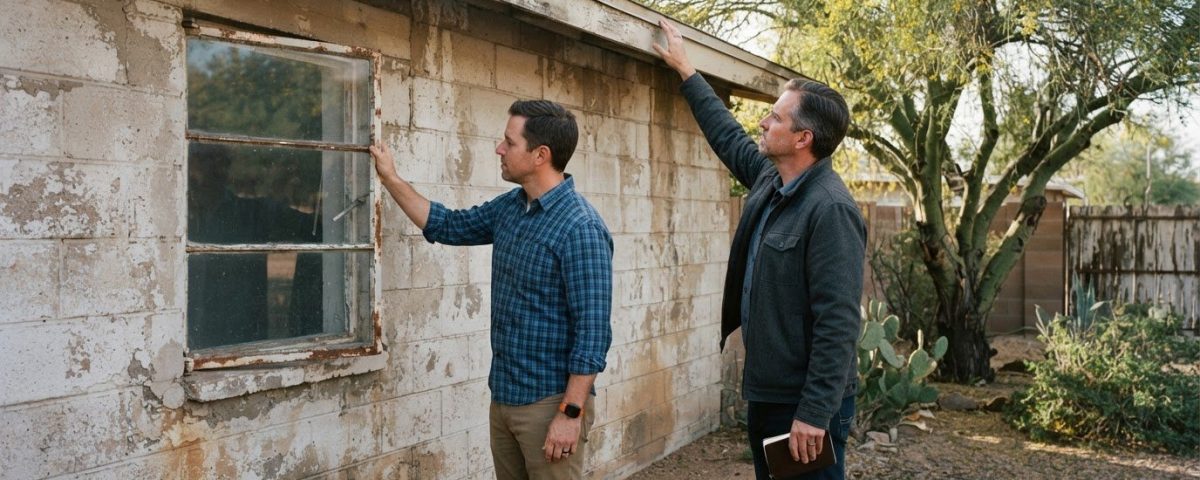
Your first flip is won on paper before a contractor swings a hammer. Learning how to become a fix and flipper in Phoenix starts with finding a property you can afford, estimating its after-repair value and renovation costs, and setting a purchase limit that leaves room for the project to make sense. A common guideline is the 70% rule: multiply the after-repair value by 70%, then subtract estimated repair costs.
It’s easy to focus on the transformation. The harder work is assessing the deal before you buy, setting a realistic budget and timeline, and knowing how you’ll manage the renovation and resale. Those decisions shape the project long before the property is ready for its next owner.
This guide explains how to find properties in Phoenix, estimate a maximum purchase price, and prepare for your first flip. You’ll also learn which professional relationships and practical skills can help you identify risks, plan the work, and make informed decisions as you get started.
Key Takeaways
- Choose a Phoenix neighborhood that fits your budget, and evaluate the property’s condition and resale potential before committing.
- Compare cash, hard-money, private-money, bank, and partner financing by how each affects your costs, timeline, and control of the project.
- Build a deal pipeline through agents, wholesalers, direct outreach, and auctions, then assess each property against the same criteria.
- Use the 70% rule as a starting point for setting a maximum offer, with after-repair value and renovation costs driving the calculation.
- Strengthen your project-management skills and build relationships with contractors and other professionals to spot risks before they become costly setbacks.
Are house-flipping seminars worth it?
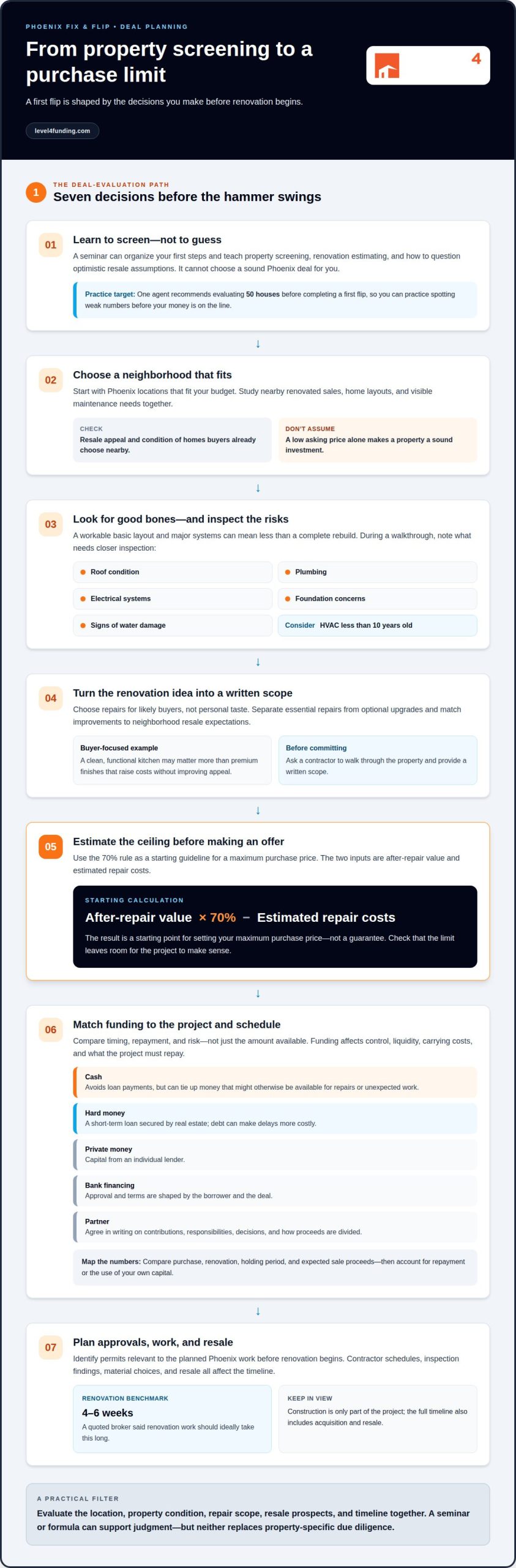
A house-flipping seminar can help organize your first steps, but it can’t choose a sound Phoenix deal for you. Use a class to learn how to screen properties, estimate renovation scope, and question optimistic resale assumptions. Then test those lessons against local homes. One agent recommends evaluating 50 houses before completing a first flip, giving you practice spotting weak numbers before your money is on the line.
Start with location, not a dramatic renovation. Choose Phoenix neighborhoods that fit your budget, then study the condition and sale appeal of homes buyers already choose there. Broad market examples may not reflect a particular block. Review nearby renovated sales, property layouts, and visible maintenance needs together. A low asking price alone doesn’t make a property a sound investment.
Next, look for a property with good bones. That means the basic layout and major systems appear workable, rather than requiring a complete rebuild. During a walkthrough, note roof condition, plumbing, electrical systems, foundation concerns, and signs of water damage. An HVAC system less than 10 years old is one property feature recommended for consideration. A seminar can teach a checklist, but the house itself determines what needs closer inspection.
Choose repairs for likely buyers, not personal taste. A clean, functional kitchen, for example, may matter more than premium finishes that increase costs without improving the home’s appeal. Separate essential repairs from optional upgrades, and match each improvement to neighborhood resale expectations. Ask a contractor to walk through the property and provide a written scope before you commit. This turns a vague renovation idea into tasks you can evaluate.
Seminars are most useful when they teach deal analysis and renovation planning without presenting one formula as a guarantee. Bring a Phoenix property example and ask how the class evaluates its location, repair needs, resale prospects, and timeline. Be wary of advice that treats every neighborhood alike or skips property-specific risks. The value is practical judgment you can apply, not a shortcut around due diligence.
In the United States, permits depend on the planned work and applicable local requirements, so identify the approvals relevant to a Phoenix project before renovation begins. Tax treatment depends on the flip and how the activity is treated; the Internal Revenue Service says a flip held for a year or less produces a short-term gain taxed at the taxpayer’s regular income rate.
A house flipper buys a property, renovates it, and resells it, coordinating the purchase, repairs, budget, and sale. Costs, rules, and potential profitability vary by location because resale demand, property condition, labor needs, and local requirements differ. Buyer expectations in one Phoenix neighborhood may make an upgrade worthwhile, while the same work may be harder to recover elsewhere.
How did I flip my first house?
A first flip starts with a funding plan that fits the property, renovation scope, and resale timeline. Cash, financing, private capital, and partners each affect how much control you retain and what the project must repay.
Financing Options for Flips
Flip financing is the capital used to buy and renovate a property before resale. Cash avoids loan payments, while hard money is a short-term loan secured by real estate. Private money comes from an individual lender, and a partner contributes capital or other agreed resources. Bank financing is another route, with approval and terms shaped by the borrower and deal.
Choose by comparing timing, repayment, and risk, not just the amount available. A hard-money loan may suit a project with a clear renovation and resale plan, but carrying debt makes delays more costly. With a partner, agree in writing on contributions, responsibilities, decision-making, and how proceeds are divided. A bank loan may take a different path to approval than private financing, so the property’s condition and your project schedule matter.
Cash Purchases and Financing
A cash purchase uses your own available funds for the acquisition; financing borrows some or all of the capital. That distinction affects liquidity, carrying costs, and how much of your capital remains available for repairs. About 63% of U.S. house flips are purchased with cash, but that figure doesn’t mean cash is the right fit for every investor.
Cash can simplify funding, but tying up money in one property may leave less for renovation or unexpected work. Financing can preserve some cash, but interest and loan terms affect the project’s break-even point. Before making an offer, map the purchase, renovation, holding period, and expected sale proceeds. Then compare what remains after repayment or after using your own capital.
Flip Timelines and Profit Margins
A flip’s timeline runs from acquisition through repairs and resale, while profit margin reflects what remains after project costs. One reported flip took about six months from repair work through marketing, contract, and closing. A quoted broker said renovation work should ideally take four to six weeks, but the full project involves more than construction.
U.S. house flips generated median profits of about $73,500 per property in 2024. That is a profit figure, not a promise or a margin for your Phoenix deal. The median return on investment in recent years has fallen below 30%, compared with more than 50% a decade earlier. Estimate your own outcome after repairs, financing, holding, and selling costs.
Plan for time as carefully as for budget. Contractor schedules, material choices, inspection findings, and the resale process can all affect the finish date. A slower sale can add holding costs after renovations are complete. Base your financing decision on the entire sequence, not only the purchase date.
Keep the funding structure clear for your first project. Write down when you’ll need capital, how you’ll repay it, and what happens if the renovation or sale takes longer than expected. Comparing these details makes cash, lenders, and partners easier to assess against the same deal assumptions.
Finding deals through agents, wholesalers, direct marketing, and auctions
Finding a Phoenix flip means building several deal sources and applying the same screen to each property. A listing, wholesaler lead, or auction purchase may look promising, but none replaces checking neighborhood sales, repair needs, and the price your analysis supports.
A real estate agent can help identify listed homes that may suit a renovation project. Explain your criteria clearly: target neighborhoods, acceptable condition, and the repairs your team can handle. Ask about homes that have been on the market for a while or need substantial work. Becoming an agent is also an option, but it’s a separate profession, not a shortcut to finding deals.
Wholesalers bring potential deals to investors, often properties that need work. Assess the property itself, not just the wholesaler’s description or estimated resale value. Confirm its condition, compare nearby renovated sales, and understand the purchase rights being offered before proceeding. Direct marketing is another route: contact property owners with a clear, professional message, then assess an interested seller’s home using the same criteria as listed properties.
Auction properties can broaden your search, but the buying process differs from a standard listing. Before bidding, review available property information, estimate repairs, and set a firm ceiling based on your analysis. Auction prices can move quickly, so decide your limit in advance. If the condition or sale terms leave major questions unanswered, include that uncertainty in your risk assessment.
How do you find and evaluate a profitable fixer-upper? Choose a target Phoenix neighborhood, then compare renovated homes sold in the same area with similar size and style during the previous three to six months. Use completed sales, not active listings, to estimate after-repair value. Next, assess the repair scope and whether the expected resale can support the purchase and project costs.
Base your offer on evidence. Use comparable sales to support your resale estimate and a contractor’s written scope to account for the work. If a walkthrough reveals an aging roof, damaged plumbing, or other repairs, factor them in before setting your offer. Keep your maximum price separate from the seller’s asking price. If the seller won’t accept terms that fit your analysis, move on.
Keep a simple deal log for each lead: source, neighborhood, asking price, sale comparables, visible repairs, and next action. That record helps compare an agent’s listing with an auction property without letting urgency distort your judgment. Evaluate 50 houses before completing a first flip, as one agent recommends. Repeated practice makes it easier to spot unsupported resale assumptions and walk away from a weak deal.
The 70% rule for estimating a maximum purchase price
The 70% rule gives flippers a quick way to screen an asking price against a property’s projected resale value and repairs. Use it as an initial calculation, then account for the deal’s actual costs.
Applying the 70% Rule
The 70% rule sets a common offer guideline: multiply the after-repair value by 70%, then subtract estimated repair costs. The result is a rough maximum purchase price for screening a flip. For example, if a Phoenix home’s after-repair value is $300,000 and repairs are estimated at $50,000, the calculation is $300,000 × 0.70 − $50,000, or $160,000.
That calculation leaves a 30% gap intended to cover holding, financing, and selling costs, renovation overruns, and profit. It doesn’t mean the entire gap becomes profit. If your project runs longer than planned or repairs expand, those costs use up part of the room built into the calculation.
Write down each assumption before relying on the result: the resale estimate, repair scope, and offer ceiling. If a contractor’s assessment changes the repair estimate from $50,000 to a higher amount, recalculate before negotiating. The rule is most useful when it stops an attractive asking price from overpowering the deal’s numbers.
Estimating Resale and Purchase Prices
After-repair value, or ARV, is the estimated sale price after planned work is complete. For a Phoenix property, base your estimate on renovated homes sold in the same neighborhood with comparable size and style. Use recent completed sales, not active asking prices, because an unsold listing doesn’t show what buyers actually paid.
Then estimate the repairs that will bring the home in line with those comparable properties. A $300,000 ARV and $50,000 repair estimate produce the $160,000 maximum under the 70% rule. If the seller wants more, the calculation signals that the deal may leave too little room for other expenses and profit.
Keep the maximum offer distinct from a profit forecast. For example, a property bought for $300,000, renovated for $50,000, and sold for $400,000 yields $50,000 before holding costs and taxes. That example shows why gross resale minus purchase and renovation costs isn’t the same as take-home profit.
Use the rule as an initial screen, then test its assumptions. A different Phoenix resale estimate or repair scope immediately changes your purchase ceiling. If the deal works only with an optimistic resale estimate or an unrealistically small repair budget, revise your offer rather than stretching the formula.
Skills and knowledge needed to flip properties
Learning how to become a fix and flipper takes more than renovation ideas. You need to assess property condition, turn repairs into a workable scope, manage contractors, and track spending against the deal’s assumptions. These skills matter when problems arise, such as discovering a hidden repair after work begins. A clear process helps you respond with evidence instead of guesswork.
Start by evaluating the property. During a walkthrough, distinguish visible cosmetic work from issues that could change the project’s scope. Note signs of water damage, roof wear, and plumbing or electrical problems. Organize your observations for a home inspector and contractor. Their assessments can help identify concerns that need further review and repairs to include in the written renovation plan.
Contractor communication is a core operating skill. Walk through the property together and get a written scope before buying, as one agent recommends. The scope should connect each planned task to the property’s condition, so you can compare the work with your budget. If the walkthrough reveals an additional repair, update the plan and projected costs before treating your earlier estimate as final.
Project management means tracking decisions from the first workday through completion. Record the agreed scope, completed tasks, schedule changes, and new issues. For example, if a contractor finds damage behind a wall, document the finding and its effect on the remaining work. Clear records help explain changes to costs or timing and keep the project team aligned.
Build relationships with contractors, home inspectors, accountants, and attorneys. Each brings a different perspective: contractors assess work, inspectors identify property concerns, accountants help organize financial records, and attorneys address legal questions. In Phoenix, older homes also require attention to applicable work rules: according to the U.S. Environmental Protection Agency, lead rules affect how work may be done on homes built before 1978.
Financial discipline ties these skills together. Track spending against the original repair estimate, and update projected profit when the scope changes. Keep purchase, renovation, holding, and selling costs separate so a rising repair bill doesn’t disappear in a broad budget line. This makes it easier to decide whether to continue, adjust planned upgrades, or revise the resale plan.
For anyone learning how to become a fix and flipper, the takeaway is clear: treat a flip as a managed project, not a weekend makeover. Use written scopes, organized records, and clear communication to connect property conditions with each decision. To discuss how funding fits into your investment plan, map out your property financing options.
Level 4 Funding: Fix and Flip Loans
Level 4 Funding offers Fix and Flip Loans for real estate investors planning a purchase and renovation. Once you’ve assessed the property, repair scope, timeline, and projected resale, financing can become the next part of your deal plan. A Fix and Flip Loan may fit a project centered on buying and renovating a property; a Construction Loan may suit a construction-focused investment.
Bring your project details into the financing conversation, including the property, planned work, and your budget assumptions. That gives you a clearer basis for considering how financing could fit the flip. If you’re ready to discuss financing for your investment, contact Level 4 Funding.
Make your next move with a clear project plan
Learning how to become a fix and flipper comes down to making disciplined decisions before a property consumes your time and capital. Start with a project brief: define the property you’re pursuing, the work you’re prepared to manage, and the financing approach that fits your plan. This gives you a practical way to assess opportunities without letting urgency set the terms.
If your investment strategy extends beyond a straightforward resale, Level 4 Funding also offers Commercial Property Loans. The right financing conversation starts with the project itself and the role the property will play in your investment plans.
Ready to discuss your next real estate investment? Contact Level 4 Funding to talk through your financing needs. Build your plan one sound decision at a time, and move forward with purpose.
Frequently Asked Questions
How much money can you make?
Flip profit depends on the purchase price, renovation scope, financing, holding period, and resale proceeds. The sale price alone doesn’t show what you keep. For example, unexpected repairs or a longer marketing period on a Phoenix project can change the net result from your initial estimate. Track every expense and compare it with the sale proceeds to calculate actual profit after closing.
How much does it cost to own a flip?
Ownership costs include more than the purchase and renovation. While holding a Phoenix property, account for loan interest, property taxes, insurance, utilities, maintenance, and sale preparation. Which costs apply depends on the property and financing arrangement. Build a monthly cash-flow plan, then update it if repairs or marketing extend the holding period. This shows how time can affect the deal.
Should you do the work yourself on a flip?
Do work yourself only if you have the skill, time, and tools to complete it safely and to a professional standard. DIY work may reduce contractor labor, but delays can add carrying costs or postpone resale. Painting may be manageable for an experienced investor, while unfamiliar electrical work can lead to costly rework. Compare your expected time and results with a contractor’s written estimate.
What are the most important things to know when flipping?
Know your exit plan before buying: who is likely to purchase the finished home, what features they value, and what could prevent a sale. Buyer expectations can differ between Phoenix neighborhoods, even for similar properties. Keep written records of your assumptions, project decisions, and changing costs. If new information undermines the resale plan, reassess the project rather than relying on the original forecast.
What are the steps when flipping for the first time?
Set your project criteria and arrange funding first. Find a suitable property, assess its condition, and establish a purchase limit based on the expected resale and work required. Define the renovation scope and schedule before closing. After purchase, track the work and expenses, prepare the home for buyers, and manage the sale through closing. A clear sequence keeps decisions connected instead of treating each task separately.
What is the ARV?
ARV means after-repair value, the estimated market value of a property after planned improvements. It helps you judge whether the likely sale price supports the project. For example, a Phoenix home with a different layout or lot may not match a nearby sale, even if both have similar square footage. Adjust your estimate for meaningful differences rather than treating one comparable sale as a guaranteed outcome.
What experience, skills, or licenses do you need to become a house flipper?
You need practical judgment in property evaluation, budgeting, renovation planning, and project coordination. A real estate license isn’t required to flip your own homes unless you’re selling for another party. Before taking on a Phoenix property, learn to review repair estimates, keep financial records, and assess how changes affect your plan. Reviewing potential deals can build useful judgment before you commit capital to a renovation.
How much money do you need to start flipping houses in the U.S.?
There’s no single starting amount that suits every U.S. flip. The capital required depends on the purchase price, repairs, closing and holding expenses, and how much financing you use. A cash purchase requires more funds upfront; financing changes the cash needed but adds repayment obligations. For a Phoenix deal, estimate the full project cash flow, including funds needed before resale, rather than budgeting only for the down payment.

About the author
Matt has a bachelor's degree in political science from Northern Arizona University and works at Level 4 Funding, a private lending company that offers hard money and rental home loans to real estate investors in 35 states.
With Matt's leadership, the firm has financed almost $300 million in loans for investment properties. He often helps real estate investors with rental property purchases, foreclosures, refinancing, and fix-and-flip projects. Matt has extensive experience in fix-and-flip, buy-and-hold, rental properties, and real estate sales. He has lived in Arizona for 43 years and is married with three children. Matt is licensed as a mortgage broker and loan originator in Arizona, with NMLS 2062278 and NMLS 1118493.
Equal Housing Opportunity. This is not a Good Faith Estimate, and it is not a Guarantee to lend; it should not be considered as such. Costs, rates, estimates, and terms can only be determined after a full application is completed. To the extent this message includes any tax or legal advice, this message is not intended or written by the sender to be used, and cannot be used, for legal or tax purposes or advice. This is an advertisement. Copyright © 2026. All rights reserved.