


Fix and Flip Loans: The Complete Investor’s Guide to Financing Your Next Rehab Project
November 9, 2026
Hard Money Lenders in Nevada: Rates, Requirements, and How to Fund Your Next Deal Fast
November 10, 2026
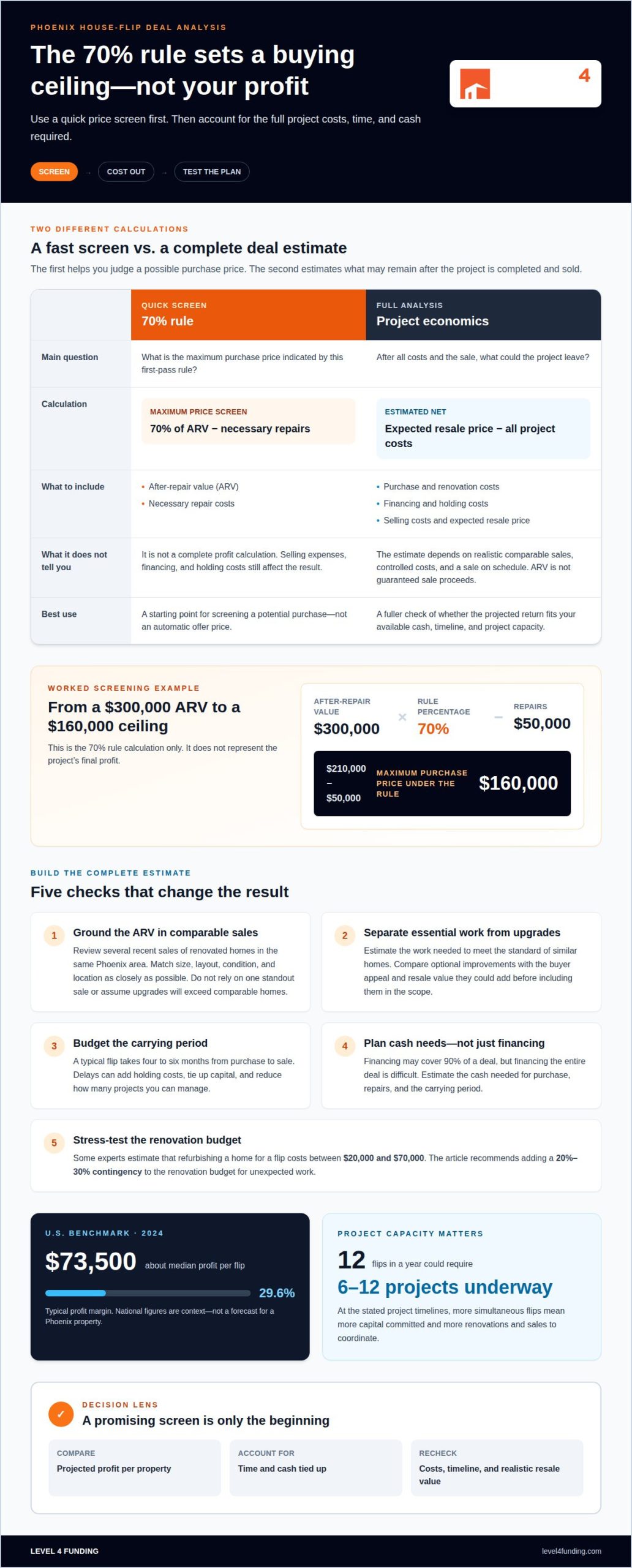
A profitable flip is won before the renovation starts. You can make money flipping homes in Phoenix, but the purchase price, repair budget, holding costs, and resale value determine whether a deal leaves a net profit. The 70% rule offers a quick screen: with a $300,000 after-repair value and $50,000 in repairs, it puts the maximum purchase price at $160,000.
That’s a starting point, not your take-home profit. Across the United States, median profits on house flips were about $73,500 per property in 2024, while the typical profit margin was 29.6%. Phoenix results depend on the numbers behind each property, and renovation overruns or a slower sale can shrink the margin fast. This guide shows you how to estimate a flip’s potential profit, account for costs and practical challenges, and compare recent returns so you can judge a deal before committing.
Key Takeaways
- Estimate a flip’s potential by subtracting acquisition, renovation, holding, and selling costs from the expected resale price.
- Build your project timeline into the deal analysis: delays can tie up capital and limit how many flips you can manage.
- Price and present the renovated home for its likely buyers, while allowing for renovation overruns and a slower sale.
- Plan how much cash each project will tie up, even when financing covers part of the deal.
- Compare year-over-year market trends with the numbers on the specific property before deciding whether its potential return fits your goals.
How much can you make on a single house flip?
You can make money flipping homes by buying below a realistic resale value, controlling repair costs, and selling on schedule. Use these steps to evaluate a potential Phoenix deal before committing capital.
- Compare the property’s condition, layout, and location with nearby homes that could attract similar buyers. Estimate the work needed to meet that standard, then separate essential repairs from optional upgrades. A low asking price alone does not make a strong flip if extensive repairs or an unrealistic resale estimate erase the potential profit.
-
Estimate the After-Repair Value
Estimate the property’s after-repair value (ARV) by reviewing recent sales of comparable renovated homes in the same Phoenix area. Match the property’s size, layout, condition, and location as closely as possible. Use several relevant sales rather than one standout price, and don’t assume upgrades will push the home above comparable properties. ARV is an estimate, not guaranteed sale proceeds.
- Apply the 70% rule as a first-pass buying screen: pay no more than 70% of the ARV minus necessary repair costs. For example, a home with a $300,000 ARV and $50,000 in repairs gives a maximum purchase price of $160,000 under this rule. Treat that figure as a ceiling for screening, not a complete profit calculation. Selling expenses, financing, and holding costs still affect the result.
-
Assess Potential Flip Returns
Compare your projected profit with market benchmarks, then account for the difference between gross profit and money left after costs. U.S. house flips generated median profits of about $73,500 per property in 2024, with a typical 29.6% profit margin. Results vary by market: Delaware’s gross profit was $165,763, while Louisiana’s return on investment was 65% and Kentucky’s was 7% in 2024.
- Build the timeline and financing into your calculation. A typical flip takes four to six months from purchase to selling the finished home, so delays can increase holding costs and tie up capital. Financing may cover 90% of a deal, but financing the entire deal is difficult. Estimate the cash needed for the purchase, repairs, and carrying period before deciding whether the project fits your resources.
Consider your project capacity, too. Completing twelve flips in a year at the stated timelines can require six to twelve projects underway at once. More simultaneous projects mean more capital committed and more renovations and sales to coordinate. Calculate profit per property alongside the time and cash tied up. A promising margin on one home does not automatically make a Phoenix flipping plan scalable.
Why is flipping houses hard?
Renovation costs, contractor coordination, and the final sale price all affect a flip’s margin. For Phoenix properties, account for each factor in your budget and schedule before work begins.
- Identify applicable permit and contractor requirements before setting the renovation schedule. In Phoenix, permits depend on the work and local rules, so don’t assume every project follows the same process. Confirm the work scope, responsibilities, and schedule in writing with contractors. Unclear task ownership can lead to delays and unexpected costs.
-
Budget Renovation and Holding Costs
List the purchase price, renovation work, financing interest, property expenses, and selling costs separately. Some experts estimate that refurbishing a home for a flip costs between $20,000 and $70,000. Add a contingency of 20%-30% to the renovation budget for unexpected work, rather than spending the entire reserve on planned upgrades.
Then test the full budget against a realistic sale scenario. Interest and time on the market can reduce what you keep, so don’t treat the gap between purchase, repairs, and sale price as final profit.
-
Build Renovation Skills and Manage Contractors
Separate tasks you can manage from work that requires specialized skills, then build the schedule around the work sequence. For example, completing surfaces before essential repairs may mean paying to redo finished work. Give each contractor a defined scope, schedule, and written agreement so responsibilities and changes don’t get lost between trades.
Track progress against the renovation budget and timeline at every stage. If a contractor’s delay pushes back later work, revise the schedule and account for added holding time. Don’t approve an upgrade just because it looks appealing. Compare its cost with the buyer appeal and resale value it could add.
-
Price, Stage, and Sell the Home
Set the asking price using comparable renovated homes in the same Phoenix area, not the highest sale you can find. Pricing above nearby alternatives can extend the selling period and add interest and property expenses. Match the home’s presentation to its likely buyers, and stage rooms to make the layout and improvements easy to understand.
Before listing, walk through the property as a buyer would. Finish details that could undermine the renovation, then prepare clear photos and a listing that accurately describes the improvements. Strong presentation can support the asking price, but it cannot rescue a price that ignores local comparisons.
- Review the numbers again before committing to the project. If the renovation scope changes, update both the contingency and expected completion date. For a commercial property project, review property financing considerations as part of planning the capital required.
Challenges involved in flipping houses
House flipping combines property acquisition, renovation, and resale, with risks at every stage. Before buying, account for possible delays, changing costs, and taxes in your plan.
- Map the full process before buying: acquire the property, complete the renovation, then sell the finished home. Each stage depends on the last. A repair discovered after demolition can disrupt the schedule, while a delayed sale can keep your money tied up longer.
Build flexibility into the plan. A property may need more work than an initial walkthrough suggests, and buyers may take longer to commit than expected. If a Phoenix home sits on the market, ongoing holding expenses can cut into your margin. Don’t treat the planned sale date as certain income.
-
Manage Risks and Practice Patience
Set decision points before work begins: review the renovation scope, track completed work, and update the sale plan when conditions change. Flippers can lose money, so calculate how a delay or added repair could affect the deal. Don’t treat an attractive projected profit as protection against every surprise.
Account for resale timing, too. FHA rules impose a 90-day waiting period before a flipped home can be resold to a buyer using an FHA loan. That restriction can affect the pool of potential buyers and the timing of a sale. Include that possibility when planning a property’s exit.
-
Account for Taxes on Profits
Record the purchase date and expected sale date before calculating take-home profit. Short-term capital gains on properties held less than a year are taxed at regular income rates. That means a profitable sale can leave less after taxes than its gross margin suggests.
Organize project records by property, including acquisition documents, renovation invoices, and sale records. These details help distinguish gross proceeds from what remains after project costs and taxes. Don’t count the full gap between buying and selling prices as spendable income.
- Stress-test the deal against specific setbacks, not just the ideal timeline. Consider what happens if a repair reveals additional work, a contractor misses a milestone, or a buyer’s financing changes. Each scenario can affect completion, carrying costs, and the eventual sale.
Use a simple sequence for each Phoenix flip: confirm the work scope, monitor progress, track spending, and reassess the sale plan as the renovation advances. If the expected resale price no longer supports the costs and timeline, adjust the project before additional spending compounds the risk.
Financing and cash requirements
Financing affects how much cash investors need upfront and how long capital stays committed. Map the funding plan to the purchase, renovation, and resale before making an offer.
-
Assess Financing and Cash Needs
Calculate the cash each project needs, even when financing covers part of the deal. One house flipper estimates needing at least $50,000 of personal cash for each financed flip.
Separate available funds from money already committed to another property. Include acquisition, repairs, and the holding period in the project plan. If one renovation runs long, its cash may remain tied up while other homes still need funding.
-
Consider Financing and Cash Offers
Compare the cash required for financing with the capital needed to buy outright. Nationwide, about 63% of house flips are purchased with cash.
A cash purchase avoids borrowing but ties up more capital in each property. Financing can preserve some cash for other project needs, but adds financing costs. Compare the full project budget and timeline, not just the amount due at closing.
- Stress-test the funding plan against financial and market risks. A delayed renovation can extend the holding period, while a slower resale can keep capital committed after the work ends. Estimate how those changes affect the project’s cash needs before taking on another property.
Investors planning several flips should map overlapping timelines. A second purchase, for example, may need funding while the first property is under renovation or waiting for a buyer. Don’t count expected sale proceeds as available cash until the transaction closes. This helps prevent one delayed exit from disrupting the next project.
- Match the financing structure to the property and the planned work. A renovation-heavy house and a property requiring new construction may have different funding needs and cash-flow schedules. Include the project scope, expected resale, and funding period in the same calculation.
Before committing, list the cash needed at each stage: purchase, renovation, carrying costs, and sale. Compare that schedule with capital already tied up elsewhere. A plan that works for one flip may not support several simultaneous projects, especially if completion or resale takes longer than expected.
How flipping returns changed from 2023 to 2024
National activity declined, while gross profits rose in many metro areas. Use these comparisons to put a Phoenix deal in context, not to predict its outcome.
- Compare the number of completed flips first. Investors flipped 322,782 homes in the United States in 2023 and 297,885 in 2024. That was a 7.7% decline year over year, and 2024 activity was 32.4% below the recent peak in 2022.
Fewer transactions don’t show whether a particular home can earn a profit, but they do indicate a shift in the national pace. For a Phoenix project, weigh repair needs, purchase terms, and likely resale against local competition. Don’t treat national transaction volume as a price forecast.
- Separate transaction volume from investor returns. Among U.S. metropolitan areas with enough data, gross flipping profits increased in 141 of 213 areas in 2024. That means the national decline in flip volume occurred alongside higher gross profits in many measured metros.
Gross profit is not the same as net profit. Renovation, financing, holding, and selling costs affect what an investor keeps. Use metro-level trends to frame your analysis, then calculate the Phoenix property’s costs and sale assumptions separately.
- Compare return on investment, not just the dollar amount earned. Michigan’s return on investment for home flips was 8% in 2024, while the median return for house flipping in recent years has fallen below 30%. Different markets can produce sharply different returns, even within the same year.
A higher gross profit may require more capital, while a smaller project may deliver a different percentage return. For each Phoenix deal, compare expected profit with the money committed and time required. Don’t use another state’s return in place of local property analysis.
- Use the 2023-to-2024 comparison as context, then test the repair budget and resale estimate. A market may show rising gross profits while an individual flip loses money through overruns or a weak sale. Check whether the project still works when repairs cost more or the finished home takes longer to sell.
Keep the timeline connected to the cash plan. A delayed sale can keep funds tied up in one property while market conditions change. Review expected costs and sale assumptions together before making an offer, and update them if the repair scope changes.
- Turn market context into a financing decision only after the property’s numbers make sense. If you’re preparing a Phoenix flip, discuss financing for your investment project as part of the funding plan.
Level 4 Funding: Fix and Flip Loans
Level 4 Funding offers Fix and Flip Loans for real estate investors financing a property purchase and renovation. Consider this option when your Phoenix deal’s purchase price, repair scope, expected resale, and cash contribution are mapped out. Financing is part of the flip’s cost structure, so include its impact in your profit estimate instead of judging a deal by resale value alone.
For projects involving new construction, Construction Loans may fit the project better. The right financing depends on the property and planned work, so keep your deal assumptions clear as you consider the next step. If you’re planning a Phoenix flip and want to discuss financing, contact Level 4 Funding.
Make Your Next Move With a Clear Financing Plan
Can you make money flipping homes in Phoenix? Yes, when the deal assumptions, renovation plan, and financing work together. Turn your property analysis into a funding plan that accounts for the project scope and the capital you’ll need throughout the process.
Choose financing that fits the work ahead. A renovation project may call for Fix & Flip Loans, while a ground-up project may suit Construction Loans. For an investment property with a commercial focus, Commercial Loans may be relevant. The right approach starts with the project, not a one-size-fits-all funding choice.
Bring your property plans and financing questions together before moving forward. Contact Level 4 Funding to discuss financing for your real estate investment. A disciplined plan gives your next decision a stronger foundation.
Frequently Asked Questions
How profitable is house flipping in the United States on average?
In 2024, U.S. house flips generated median profits of about $73,500 per property, with a typical profit margin of 29.6%. So, can you make money flipping homes? Yes, but national averages aren’t a forecast for a Phoenix property. Gross profit differs from the amount left after expenses, so account for repairs, financing, holding time, and selling costs before estimating what you could keep.
What costs should you include when calculating a home flip budget?
Include the purchase, renovation labor and materials, financing interest, utilities, insurance, property expenses, and selling costs. Also allow for staging, marketing, and repairs discovered after work begins. Damage found behind a wall, for example, can affect both budget and schedule. Calculate expected net proceeds only after subtracting all project costs from the likely sale price.
How much money do you need to start flipping houses, and what financing options are available?
Cash needs depend on the property, work scope, and financing structure. One flipper estimates needing at least $50,000 of personal cash for each financed project, but that’s an individual estimate, not a universal requirement. Investors may use cash or private hard money financing, including Fix and Flip Loans. Level 4 Funding offers these loans for real estate investors in Phoenix; match financing to the deal’s timeline and scope.
What are the steps to buying, renovating, and selling a flipped home?
Start by comparing a prospective home with similar renovated properties and estimating its after-repair value. Inspect the work needed, set a renovation scope, and calculate the full project budget. Arrange capital before closing, then manage the renovation in sequence and track changes. Once the home is ready, price it against relevant local sales, prepare it for showings, and complete the sale.
How long does a typical house flip take from purchase to sale?
A typical house flip takes four to six months from purchase to selling the finished home. The schedule depends on the renovation scope, contractor progress, and how quickly a buyer commits. Build the plan around milestones, such as completing essential repairs before finishing surfaces. A delayed task can push back later work, so track progress and update the expected sale timing as the project changes.
What taxes apply to profits from flipping houses in the United States?
Short-term capital gains on properties held less than a year are taxed at regular income rates. Track the purchase date, sale date, and project expenses to distinguish gross proceeds from taxable profit. Keep invoices and transaction records organized by property. The holding period and financial records matter when determining how a particular flip is treated for tax purposes.
What are the biggest risks of flipping houses, and how can you reduce them?
Common risks include hidden repairs, contractor delays, a longer-than-planned sale, and a resale price below expectations. Limit exposure by inspecting the property before purchase, defining the renovation scope in writing, and tracking spending against the plan. Stress-test the deal for a delayed sale or additional repairs. If the project depends on an optimistic resale price, the margin leaves little room for setbacks.
Which U.S. markets are currently best for flipping homes, and how do local prices vary?
Pittsburgh, Buffalo, Baltimore, and Oklahoma City were identified as strong U.S. flipping markets in 2024. Returns varied widely: Delaware recorded gross flipping profit of $165,763, while Michigan recorded $71,000. Whether you can make money flipping homes in Phoenix depends on local comparable sales, repair needs, and project costs. Another market’s results don’t establish Phoenix prices or returns.

About the author
Matt has a bachelor's degree in political science from Northern Arizona University and works at Level 4 Funding, a private lending company that offers hard money and rental home loans to real estate investors in 35 states.
With Matt's leadership, the firm has financed almost $300 million in loans for investment properties. He often helps real estate investors with rental property purchases, foreclosures, refinancing, and fix-and-flip projects. Matt has extensive experience in fix-and-flip, buy-and-hold, rental properties, and real estate sales. He has lived in Arizona for 43 years and is married with three children. Matt is licensed as a mortgage broker and loan originator in Arizona, with NMLS 2062278 and NMLS 1118493.
Equal Housing Opportunity. This is not a Good Faith Estimate, and it is not a Guarantee to lend; it should not be considered as such. Costs, rates, estimates, and terms can only be determined after a full application is completed. To the extent this message includes any tax or legal advice, this message is not intended or written by the sender to be used, and cannot be used, for legal or tax purposes or advice. This is an advertisement. Copyright © 2026. All rights reserved.