

Which Phoenix Property Types Qualify for Hard Money?
November 26, 2026
How to Finance and Win a Foreclosure Bid Using Hard Money: A Step-by-Step Playbook
If you need a practical answer for how to bid on foreclosed homes and actually win without overpaying, this playbook ties auction speed to disciplined underwriting. It shows how to use hard money financing to establish fast proof of funds, calculate a safe maximum bid using ARV, repairs, and lender LTV, and handle deposits, title risks, and rapid closings. Follow the step-by-step formulas, checklists, and auction-day tactics to structure competitive bids that protect your profit.
How hard money complements foreclosure purchases and when to choose it
Hard money wins where speed, certainty, and asset-focused underwriting matter more than rate. When you are bidding on foreclosed homes at trustee sales or courthouse auctions, the practical problem is not whether you could qualify for a conventional mortgage — it is that conventional lenders cannot meet the deposit and closing timeline and they will balk at properties sold as-is with title quirks.
How underwriting differs: Traditional lenders underwrite the borrower; hard money underwrites the asset. That matters in auctions because a hard money lender will focus on ARV, the rehab plan, and quick title snapshots rather than credit score paperwork. Use this when you need a proof of funds and a funding window measured in hours, not weeks.
Typical terms and practical trade-offs
Common terms: Expect higher rates and fees — typical hard money pricing is in-market but elevated to reflect speed and risk: rates often range from mid-teens to low double digits, points up front, and LTV caps around 60 to 70 percent on ARV. Many lenders (including Level 4 Funding) will offer up to 70 percent LTV on ARV and same-day to 24 hour funding for eligible deals.
- Speed vs cost: Hard money buys time and certainty; it reduces execution risk but eats your margin through higher interest and points.
- LTV and appraisal nuance: LTV is often applied to ARV or to purchase-plus-rehab depending on lender — get clarity before you bid.
- Title tolerance: Lenders will price or limit proceeds for properties with known junior liens, tax liens, or municipal code violations.
When to choose hard money: Use it for trustee sales with tight deposit/closing windows, properties that need immediate stabilization, or when you plan a short flip and cannot wait for bank underwriting. Do not pick hard money for thin-margin buy-and-hold deals where refinance to conventional financing is the plan unless you have a clear refinance path and buffer for fees.
Concrete example: A bidder wins an auction on a vacant 3BR with ARV estimated at 200,000 and rehab of 40,000. The auction requires a cashier's check for 5,000 deposit and closing within 48 hours. A hard money lender that provides a proof of funds and a 70 percent ARV loan can underwrite the rehab plan and fund within 24 hours, covering most of purchase and rehab — but the borrower must still provide the deposit and any cure reserves for title exceptions.
Real-world limitation: Lenders will reduce the effective loan if comps are thin or your rehab estimate looks optimistic. In practice, this is where many bids fail: investors assume 70 percent LTV will magically cover purchase plus rehab. It rarely does unless you underwrite conservatively and confirm the lender applies LTV to ARV rather than purchase price.
- Choose hard money when: auction timeline < 72 hours, property needs immediate work, and exit is flip or short-term hold with clear ARV comps.
- Avoid hard money when: local redemption periods are long, title exposure is unknown and expensive to cure, or your expected margin is below the blended cost of funding and repairs.
Practical next step: Before you bid, get a conditional proof of funds from a hard money lender and an agreed list of lender conditions. A fast POF reduces auction risk; see our guide to get one quickly: Proof of Funds Letter: Get One Fast for Investors Now.
Bottom line: Hard money is a tactical tool for auctions — it buys speed and certainty but costs margin and demands conservative underwriting. Use it when execution risk, not rate, is the primary deal killer.

Pre-bid preparation: market intel, title snapshot, and quick repair budgeting
Start with three matched facts before you bid: a defensible ARV band, a rapid title snapshot, and a realistic repair budget. Missing any one of these turns an auction win into a liability. This section gives a tight, repeatable workflow so you can produce those three facts in 24 to 48 hours and decide whether to place an aggressive bid backed by hard money.
Market intel fast checks
What to validate quickly. Pull 3 to 6 comps inside the same immediate submarket and within six months, note the sales to list spread, days on market, and whether similar homes are selling to retail buyers or investors. Foreclosure comps and REO sales matter more than MLS list prices for auction properties.
- Comp rule: use the median sale price per square foot and weight the two closest comps heavier than distant comps
- Velocity: check average days on market and recent cash sale share to judge exit timing
- Price stress: compare active distressed inventory and recent auction results to see bid pressure
- Sources: use the county tax site, MLS, and auction listing sites like Auction.com learning center for recent trustee sale results
Practical insight: ARV is a local number. National calculators mislead. In hotter submarkets ARV compresses quickly and your margin must expand; in soft pockets add structure to your exit plan, not optimism.
Quick title snapshot — do this before you sign anything
Run an expedited title query or order a preliminary title commitment. For auctions you do not need a full title policy before bidding, but you must know likely junior liens, tax delinquencies, and recorded mechanics liens. Ask a title company for a same-day preliminary search and identify top three worst-case liens and the party responsible.
- Minimum pulls: recent recorder chain of title, tax collector account, and online lis pendens search
- Watch for: open tax liens, IRS liens, recorded mechanic liens, active bankruptcy or probate flags, and HOA liens
- Budget decision: if junior liens total more than 3 to 5 percent of expected ARV, you must either avoid the bid or build a cure line into your hard money ask
Tradeoff: paying for an expedited title search costs money and time but often saves 10 times the price when a hidden lien appears. Many investors underbudget title curative reserves and get stuck resolving liens after closing.
Rapid repair estimate workflow
Use a 15 minute driven checklist plus a per square foot baseline. Do a driveby, photograph hard-to-access areas, confirm square footage, and run a room count. Convert that to a baseline repair by floor condition tier and add contingency.
| Scope | Phoenix baseline per sqft | National baseline per sqft |
|---|---|---|
| Cosmetic (paint, floors, minor systems) | $12 to $25 | $10 to $30 |
| Moderate rehab (kitchen, bath refresh, systems work) | $25 to $45 | $20 to $50 |
| Full gut / structural work | $45 to $85 | $40 to $100 |
Concrete example: 1,200 sqft bungalow in Phoenix with visible roof wear and outdated kitchen. Use moderate rehab at $25 per sqft = $30,000. Add 15 percent contingency = $34,500. That number is what you present to a hard money lender and what you subtract from loan proceeds when you calculate maximum safe bid.
Lender nuance that matters. Hard money underwriters, including Level 4 Funding which funds up to 70 percent LTV, will verify your rehab budget and may reduce allowable loan proceeds if repairs look understated. Do not assume lender flexibility — present a line-item budget or be conservative with your bid.
If you cannot produce a 15 minute repair budget and a same-day preliminary title snapshot before bidding, reduce your bid or skip the property.
Final takeaway: Treat market intel, title snapshot, and repair budget as a single decision unit. One weak leg should either shrink your bid significantly or remove the property from your list. Next step: convert these facts into a funding ask and a proof of funds for your chosen hard money partner so your bid is credible and fundable on auction timelines.
Obtain proof of funds and pre-approval from a hard money lender
Start here: get a lender-issued proof of funds and a conditional pre-approval before you step up to the podium. Auctions require evidence you can close fast. A bare bank screenshot or a personal line item will sometimes satisfy an auction clerk, but what actually lets you bid aggressively without stalling is a lender letter that states a funding commitment window, the maximum conditional loan amount, and the conditions that must be met to draw funds.
What a credible POF and conditional pre-approval should state
Key elements: the dollar amount available, whether the lender is using ARV or purchase-plus-rehab to calculate proceeds, the lender LTV cap (for example up to 70 percent with Level 4 Funding), an expiry date, and the contact for a funding officer who will confirm the letter by phone. Explicitly note any title or appraisal conditions that will void or reduce the commitment.
- Investor packet: short bio, proof of experience or portfolio, and the borrower entity name
- Deal packet: property address, drive-by photos, quick rehab estimate, and 3 comps supporting ARV
- Funds verification: bank statements or lender underwriting confirmation showing available capital
- Title snapshot: recent preliminary title report or lien search if available
- Contract evidence: copy of auction notice, bid docket, or draft purchase terms
| Document | Why it matters |
|---|---|
| Drive-by photos and comps | Let the lender verify ARV quickly and set LTV limits |
| Prelim title or lien search | Flags junior liens that could change funding or require cure reserves |
| Investor profile and bank statements | Shows capacity to cover deposits, cure amounts, and points or fees |
Practical example: An investor preparing to bid on a trustee sale sends Level 4 Funding a two page deal packet 48 hours before the sale. Level 4 reviews the comps, agrees to a conditional pre-approval up to 70 percent of ARV subject to title and a contractor bid, and issues a proof of funds letter that the auction accepts because it names the funding contact and a 72 hour funding window. That letter lets the investor run the numbers and place a disciplined top bid without scrambling for cash after a win.
POF letters are usually conditional and time limited. Never assume a POF guarantees an unconditional wired payoff the moment you win.
Tradeoff and next step: a stronger POF speeds bidding but costs you time and sometimes small upfront fees for underwriting. If you rush a weak POF, you expose yourself to a collapsed close or reduced proceeds because title exceptions or contractor costs changed. Next consideration: align the POF expiry with the auction rules and confirm the lender will meet the closing timeline required by that auction.
Max bid formula and worked numeric example using hard money parameters
Key point: Use a repeatable, lender-aware formula that converts allowable loan proceeds into a safe maximum purchase price rather than guessing a percentage discount off list or ARV.
The formula you will use at auction
Core formula: Max Bid = (ARV x Lender LTV) – Repair Costs – Closing & Holding – Target Profit – Lending Fees & Reserves – Contingency Buffer. Apply the lender LTV to the ARV when that is the lender standard; if your lender uses loan to cost, treat the loan cap as the lesser of the LTV on ARV or permitted loan to cost.
| Line item | Value | Notes |
|---|---|---|
| ARV | 180,000 | Market comps drive this number |
| LTV (Level 4 Funding example) | 70% | Typical asset based cap for fast hard money funding |
| Loanable proceeds (ARV x LTV) | 126,000 | 126,000 = 180,000 x 0.70 |
| Estimated repairs | 30,000 | Quick driven estimate |
| Closing + holding costs | 10,000 | Escrow, recording, property taxes, utilities, staging, etc |
| Target profit | 20,000 | Your required margin for a flip or wholesale |
| Lender fees (3 points) | 3,780 | 3% of loanable proceeds |
| Interest reserve (2 months @ 10% APR) | 2,100 | Interest paid from reserve until exit |
| Contingency buffer | 5,000 | Soft unknowns – additional liens, scope creep |
| Max Bid (full adjustments) | 55,120 | 126,000 – sum(deductions) = 55,120 |
Worked arithmetic: Start with 180,000 ARV. 70 percent LTV yields 126,000 available loan proceeds. Subtract repairs 30,000, closing and holding 10,000, desired profit 20,000, lender fees 3,780, interest reserve 2,100, and a 5,000 contingency. The result is a maximum safe bid of 55,120.
Practical nuance and the common mistake
Practical nuance: Many bidders stop at ARV x LTV minus repairs and call that a max bid. That is optimistic when hard money fees, interest reserves, and real world contingencies exist. If you fail to include fees and reserves you will bid above what the lender will effectively deliver and then need bailout capital or accept a smaller profit.
- When lender applies LTV to ARV: Use the formula above; loanable funds are predictable and you convert them into a bid.
- When lender uses loan to cost or funds purchase plus rehab to a cap: Your effective loan may be purchase price plus rehab draws but still cannot exceed the ARV based cap, so re-run the formula using the lender cap and the expected draw schedule.
- Auction deposit and timing: Remember deposit requirements reduce your available working capital on day one – the deposit is not funded by the loan until closing in most trustee sale scenarios.
Concrete example, real use case: An investor in Phoenix wins a trustee sale at 55,000 and has a Level 4 Funding conditional proof of funds for 126,000. Because the investor subtracted fees, reserves, and a 5,000 contingency up front, they can post the required deposit and move to a 24 hour close without scrambling for extra cash. If the investor had ignored lender points and reserves, a winning bid at the same price could have required an unexpected out of pocket payment.
If your comps are wrong or ARV is overstated by 5 to 10 percent you lose margin faster than you expect. Always stress test the max bid against a reduced ARV scenario.
Next consideration: Before you bid, run the formula twice: once with the stated lender LTV on ARV and once with a conservative ARV reduced by 5 to 10 percent. Use the lower resulting max bid as your absolute auction limit.
Auction day strategy and deposit logistics for trustee sales and courthouse auctions
Straight to it: auction day is about control and contingency — control your deposit, control the timeline, and have a pre-planned fail-safe if the title or funding stalls. Bring money, paperwork, and a process that converts a win into a funded close within the auction timetable.
Deposit mechanics: what to bring and why
Required funds types: most trustee and courthouse sales insist on certified funds — cashier check, money order, or a wired deposit — and some counties demand a set percentage (commonly 5 to 10 percent) or a minimum flat amount (often $5,000 to $20,000). Always confirm the sale notice for exact numbers and acceptable instruments.
Practical trade-off: carrying a cashier check removes execution risk the second you win, but it ties up cash you could use for rehabs or reserves. Asking a hard money lender to front the deposit preserves liquidity, but it creates dependency on that lender's same-day wiring capability and adds administrative friction — and lenders will expect a binding commitment and quick title work before they wire. Choose based on which resource you trust to perform under time pressure.
| Deposit type | Pros | Cons |
|---|---|---|
| Cashier check on hand | Immediate acceptance; simple | Uses your capital; risk of holding large checks physically |
| Wire from bank | Fast and traceable | Requires bank business hours and wiring details; fees |
| Lender-backed wire/POF | Preserves investor cash; aligns with fast-closing lenders | Requires lender readiness; smaller margin for error |
Auction tactics and immediate post-win workflow
- Pre-authorize contacts: have the title company, your hard money lender, and the auction clerk on speed dial. If you win, someone must receive the sale affidavit and start the closing clock immediately.
- Set an absolute bid ceiling: program that into your online proxy or write it on your quick-reference card for in-person bidding. Emotional overbids cost you more than a lost deal.
- Proxy bidding for online auctions: use auto-bid tools when available. They prevent you from chasing a price in the heat of the moment. Confirm the platform's increment rules so you know how far an automated proxy will push you.
- Deposit handoff protocol: if the auction requires same-day deposit delivery, designate who will present the certified funds and where; for wired deposits, confirm the receiving account details ahead of time and verify cut-off times with the clerk.
- Post-win immediate steps: secure the receipt for the deposited funds, obtain the docket or certificate showing you as the high bidder, notify your title company and lender that the countdown has begun, and deliver any required sale paperwork within the clerk's stated window.
Concrete example: at a Maricopa County trustee sale requiring 10 percent deposit within 24 hours, an investor won a $150,000 bid and needed to get $15,000 to the clerk. The investor had a cashier check ready and a committed hard money lender on standby. They handed the cashier check at the courthouse, scanned the receipt to the lender, who then prepared the funding packet and title instructions to meet the county closing timeline.
What commonly trips investors up: assuming a lender will wire instantly without a signed auction docket or updated title report. In practice, lenders need proof of the win, the sale paperwork, and a clear title path before they move funds. If you rely on the lender for the deposit, have formal written confirmation that they will wire under the exact conditions of that sale.
Final judgment: winning at auction is only half the job — the real risk is losing the deposit or being unable to close because you misjudged how quickly funds and title work must be delivered. Prioritize a clean, executable deposit plan first; arrange lender and title contact details second. That order wins more deals than clever bidding tactics alone.
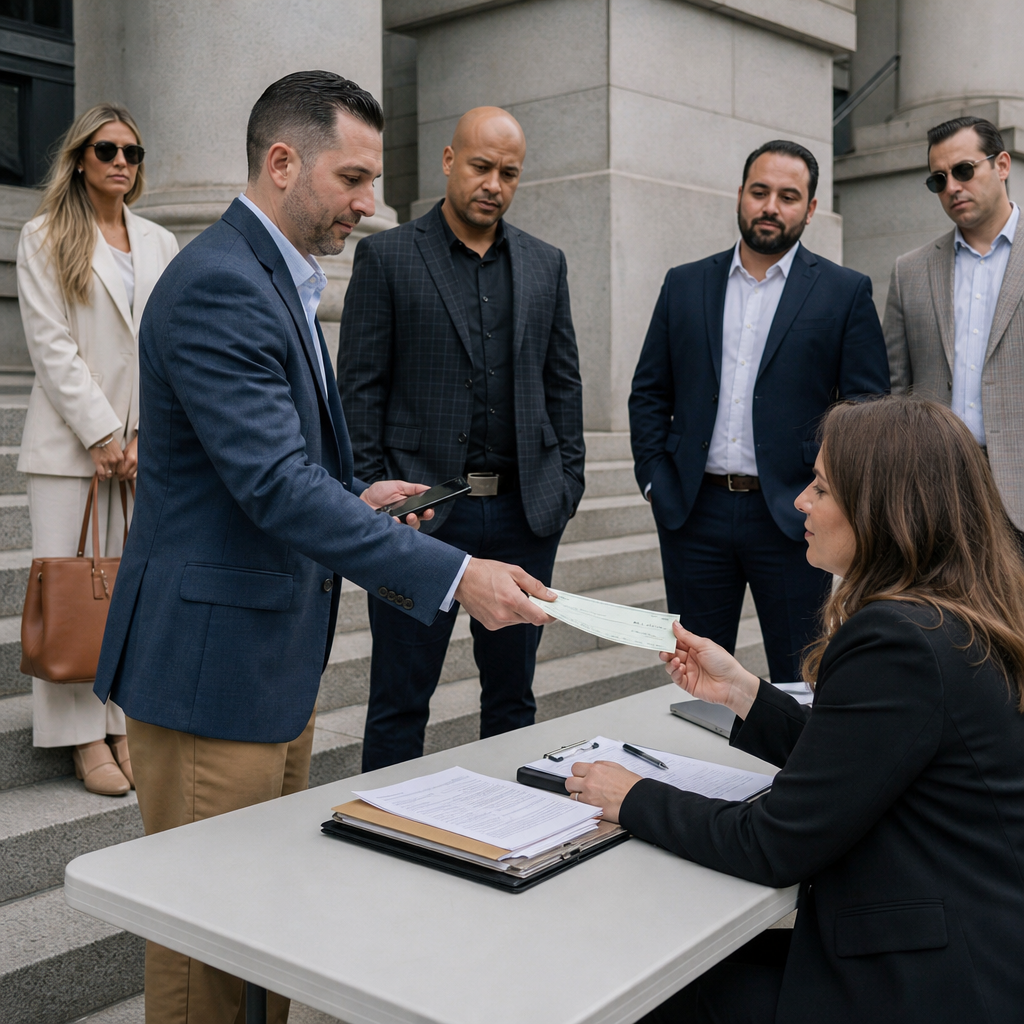
Next consideration: confirm whether the jurisdiction has a redemption period and how deposit forfeiture works there before you bid; that affects how aggressive you should be and whether the hard money lender will accept the transaction terms.
Closing with hard money: timeline, title curative work, and lender conditions
High-level point: fast hard money funding is real, but closing is where speed meets legal friction. Expect the lender to treat funding as conditional until title issues are accounted for and underwriting deliverables are complete.
Practical closing timeline and funding triggers
Standard timeline: for experienced hard money lenders the clock runs from accepted auction receipt to funding. Ideal case—clear title commitment and rehab budget delivered—can close in 24 hours. Real-world case—junior liens, tax certificates, or missing documentation—pushes you to 48 to 72 hours or longer.
| Milestone | Typical timing | Lender trigger |
|---|---|---|
| Send auction receipt and POF | Same day | Lender opens file and orders preliminary title |
| Title commitment returned | 12-36 hours | Identifies exceptions, liens, taxes |
| Cure strategy agreed or escrow funded | Same day to 48 hours | Lender signs off on clear title path |
| Loan docs signed and funding | 24-72 hours | Funds wired once title and closing conditions met |
Tradeoff to accept: accept a lender conditional close with a cure escrow and you get speed but give up leverage on unknown liens. If you insist on absolute title clearance before funding you will slow down and may lose the deal at auction purchases that require immediate performance.
Title curative workflows lenders expect
- Quick lien triage: order a title commitment immediately and categorize exceptions into payoffs, endorsements, and non-curable items.
- Cure escrow: lender may require borrower to fund a cure escrow for identified junior liens instead of immediate payoff to close fast.
- Title endorsements: lender frequently requires a mortgagee title policy and specific endorsements for tax lien, mechanic lien, or bankruptcy gaps.
- Payoff handling: for municipal or tax liens lenders often insist on certified payoff letters and will not fund without them.
Practical insight: most auction losses come from underestimating municipal and utility liens. Drive-by and county record checks are not enough. Require a preliminary title pull before bidding when possible and budget a 10 percent reserve above known payoffs to handle last-minute exceptions.
What lenders will condition funding on
Common lender conditions: completed borrower ID and KYC, signed purchase paperwork or auction docket, contractor bids, rehab draw schedule, title commitment with acceptable exceptions, mortgagee title policy, and evidence of funds for cure escrow or required down payment.
- Interest reserve or upfront points: lender may require points and initial interest paid at closing.
- Holdback for undisclosed liens: a percentage of proceeds can be held in escrow until title is fully clear.
- Contractor verification: licensed contractor info and a basic scope of work are often required to release rehab funds.
- Personal guaranty or additional collateral: when title risk is higher lenders ask for more borrower skin in the game.
Concrete example: I financed a trustee sale with Level 4 Funding where funding was available within 24 hours. Title commitment revealed a $6,200 municipal lien; the lender allowed funding conditioned on the borrower wiring a $7,000 cure escrow that the title company used to satisfy the lien at closing. The borrower closed fast, but available rehab proceeds were reduced by the escrow requirement.
Key judgment: prefer a lender who will document conditional funding paths in writing before bidding. A verbal promise to fund is not adequate when title exceptions surface after a high-stakes auction win.
Next consideration: if a title risk forces significant cure escrows, re-run your max bid math before completing closing. Speed matters, but so does preserving your margin.
Risk controls and exit strategies after acquisition
Immediate priority: lock down title exposure and cash flow the first 24 to 72 hours. After an auction win the work is triage, not strategy session – confirm the title company is working cures on junior liens, verify municipal lien and tax status, and secure basic hazard insurance or boarding to stop further deterioration.
Short-term risk controls
- Title triage: order a quick title commitment and push the title company to list required cures and costs. If a junior lien exceeds your contingency buffer, treat it as a negotiation point – you may ask the trustee to reduce price, or decide to walk.
- Reserve sizing: set aside a hard reserve equal to 10 to 20 percent of your purchase price for unknown liens, soft costs, and emergency repairs. Hard money lenders commonly require reserves – plan for that when calculating your post-win cash position.
- Stabilize before scope: do the minimum required to make the property secure and insurable before spending on cosmetic rehab. This reduces shrinkage, liability, and the chance of local code fines eating your margin.
- Document chain-of-custody: retain photos, vendor bids, and dated receipts for any curative work. Lenders will insist on this for draw approvals and title endorsements.
Practical limitation: hard money speeds funding but does not eliminate title risk. Lenders will not back unrestricted exposure – you will often need to cure or escrow out problematic liens, which reduces effective proceeds and can flip a profitable flip into a break-even hold.
Exit strategy options and trade-offs
| Exit | Time to exit | Cash required | Typical net vs ARV | Lender fit / constraints |
|---|---|---|---|---|
| Wholesale to another investor | 7 to 30 days | Low – marketing and small fix | Lowest net – fast cash | Easiest – lender accepts assignment or cash payoff |
| Rehab and retail sale | 60 to 180 days | High – rehab plus carrying | Highest net if ARV realized | Requires draw schedule and interest reserves |
| Hold and refinance to rental | 90 to 365 days | Medium – rehab then lease-up | Moderate net plus recurring income | Must meet DSCR or conventional lender requirements; see How to Calculate DSCR: Step-by-Step Formula for Investors |
| Short-term flip + seller financed carryout | 30 to 120 days | Variable – depends on buyer down payment | Variable – depends on financing terms | May conflict with hard money payoff requirements |
Concrete example: An investor wins a 120,000 auction bid using Level 4 Funding for same day close. Title reveals an 8,500 municipal lien and a collapsed section of roof needing 12,000 repairs. The investor has two realistic options: pay the lien, fix the roof, and retail for full ARV, or wholesale to a local flipper at a 10 percent discount to save time and avoid additional lender reserves. In practice the wholesale option preserved capital and avoided a forced draw delay on the hard money loan.
Judgment that matters: most inexperienced bidders assume selling fast is always best. That is false. If the purchase discount plus ARV support a proper rehab margin, committing to rehab and sell will usually produce more net, even after higher interest and points. If title or structural unknowns are large, take the fast exit. The right call depends on verified cure costs and your available reserves, not instincts.
Rule of thumb: choose the quickest path that preserves at least your target profit after paying for title cures, lender reserves, and interest carry.
If you need reference material on investor protections and owner redemption considerations use HUD guidance and consult local counsel for state redemption law. Next consideration – align your exit decision with the lender s draw cadence and reserve rules so funding timelines do not sabotage the plan.
Operational playbook, templates, and a downloadable bid worksheet
Start with a strict timeline and a single accountable operator. When auctions move fast the difference between a winning bid and a costly liability is coordination, not luck. Use this playbook the way a pit crew uses a checklist: clear roles, time triggers, and an actionable worksheet that everyone can update in real time.
48 hours out to auction – pre-bid operations
- Assign roles. Name who handles deposits, who sends the POF, who notifies the title company, and who is the lender point person.
- Lock POF and lender window. Send the POF request using the template in the lender proposal guide and secure a funding window that matches auction rules. See Proof of Funds Letter: Get One Fast for Investors Now.
- Prep title packet. Deliver the property address, preliminary lien search, and estimated cure budget to your title partner so they are standing by.
- Populate the bid worksheet. Fill fields for ARV, repairs, lender LTV, target profit, deposit amount, and deadline to fund.
Bid day and immediate post-auction steps
- Execute deposit immediately. Have certified funds or cashier check ready and the accountant or investor authorized to sign or wire on short notice.
- Trigger lender packet. As soon as the hammer falls upload the auction docket or sale receipt, final purchase number, and the filled worksheet to the lender portal or email contact.
- Title engagement. Send the title company the auction receipt and instruct them to deliver a commitment or flag unanticipated liens within 24 hours.
- Decision gate at 24 hours. If title shows a major undisclosed lien or red flag, enact your preplanned exit – either fund a cure escrow, assign the contract, or walk away per your contingency rules.
Practical tradeoff to accept. Speed reduces time to discover title and structural issues. The playbook forces you to choose between paying to cure unexpected liens or accepting a higher profit margin that assumes a clean title. Neither choice is free; pick the one that fits your balance sheet and document it on the worksheet.
Templates to copy into your workflow
- POF request email. One paragraph: property address, max requested amount, requested funding window, link to ARV comps, and contact for wire instructions. Use the lender proposal guide at How to Create a Convincing Real Estate Investment Proposal for Lenders.
- Deposit authorization memo. Short form instructing bank or partner to issue certified funds to named payee after auction win and within X hours.
- Title checklist for closer. Items: auction receipt, sale docket, known liens, estimated cure budget, and escrow wiring instructions.
| Worksheet Field | Sample Entry |
|---|---|
| ARV | $180000 |
| Repair Estimate | $30000 |
| Lender LTV (ARV) | 70% |
| Max Loan Proceeds | $126000 |
| Max Bid Allowed | $64000 |
| Deposit Required | $5000 certified funds |
| Funding Deadline | 24 hours from sale |
Concrete example: An investor targets a trustee sale with a published 24 hour funding window. They prefill the worksheet, secure a POF from Level 4 Funding, pre-authorize a $5000 cashier check, and tell their title partner to stand ready. Hammer falls at 10am, investor uploads the auction docket, title confirms minor junior lien that can be cured for $3500, and the loan funds in 24 hours so closing meets the auction deadline.