


Hard Money vs. Asset-Based Real Estate Loans: Which Funding Structure Wins for Investors?
November 27, 2026
A self-storage loan request doesn’t need a perfect file to get an initial review. For Phoenix hard money for self-storage facilities, rent rolls and operating statements can help show the property’s income, but they aren’t required for a first review. Start with a clear picture of the facility, the financing need, and your plan for the property.
The loan amount needs to fit the deal, not just the amount you want to borrow. This article explains what to include in a request, when Phoenix hard money for self-storage facilities may fit, and how lenders assess a facility’s value, occupancy, and operating performance.
You’ll also see how acquisition, bridge, construction, and cash-out financing may serve different property needs. Learn how Phoenix hard money for self-storage facilities fits into those options and what information can help move the financing discussion forward.
Key Takeaways
- Build a loan request around the facility’s income, occupancy, condition, and intended use of funds so the lender can assess the deal in context.
- Hard money may suit a property that needs a faster financing path or doesn’t fit conventional lending criteria, especially when the real estate itself is central to the review.
- Underwriting looks beyond the property’s asking value: occupancy, net operating income, expenses, and debt-service coverage all influence how a facility performs on paper.
- Separate stabilized, lease-up, acquisition, and construction scenarios in your financing plan; each presents a different risk profile and funding need.
- Match the financing route to the project stage, whether the need is commercial property funding, construction capital, or cash-out refinancing.
What information do Phoenix hard money lenders need for a self-storage loan request?
A strong request links the facility, its income, and the capital needed to your investment plan.
Loan Request Information
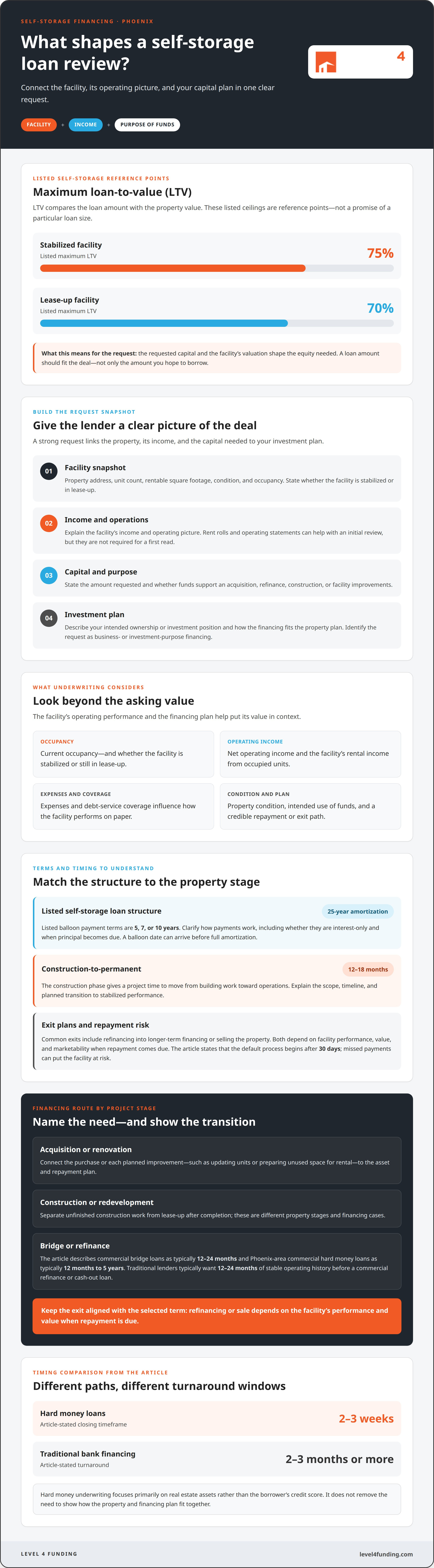
Give the lender a clear snapshot of the property and transaction. Include the Phoenix property’s address, unit count, rentable square footage, condition, occupancy, and whether it is stabilized or in lease-up. State the amount requested, how you plan to use the funds, and your intended ownership or investment position. Rent rolls and operating statements can help with an initial review, but aren’t required for a first read.
Explain whether the capital will support an acquisition, refinance, construction, or facility improvements. This helps connect the request to the property’s income and your plan for the investment.
Loan Purpose and Property Type
Identify the request as business- or investment-purpose financing and describe the commercial asset. A self-storage facility is a distinct property type, with rental income tied to occupied units and facility operations. Commercial real estate also includes multifamily properties with 5 or more units.
Clarify whether the loan is for an acquisition, refinance, construction, or another property-related need. A request for personal spending doesn’t explain a commercial real estate investment. A clear purpose keeps the property’s role central to the review.
Loan Amounts, Leverage, and Terms
Self-storage loan listings show maximum loan-to-value ratios of 75% for stabilized facilities and 70% for lease-up facilities. LTV compares the loan amount with the property value, so the requested capital and the facility’s valuation shape the equity needed. These figures are reference points, not a promise of a particular loan size.
Listed self-storage terms include a 25-year amortization period and 5-, 7-, or 10-year balloon payments. Ask how the payment structure works, including whether payments are interest-only and when principal becomes due. A balloon date can arrive before full amortization, making the planned repayment or refinance path central to the request.
Risks, Defaults, and Exit Strategies
The key risks include weaker-than-planned occupancy, insufficient operating income, and a balloon payment that arrives before an exit is ready. Default terms can describe the steps a lender may take after a borrower fails to meet payment obligations. That makes payment obligations and default language important parts of the loan review.
What are the risks, default terms, and exit strategies? Missed payments can put the facility at risk, and the stated default process begins after 30 days. Common exit plans include refinancing into longer-term financing or selling the property; each depends on the facility’s performance, value, and marketability when repayment comes due.
Situations suited to hard money financing
Yes. Phoenix hard money financing may support self-storage acquisitions, construction, renovation, and refinancing. The right fit depends on the property’s stage, your plan, and a credible repayment or exit path.
Construction and Redevelopment Financing
Construction financing can fit a ground-up facility or a redevelopment plan that changes an existing property. Self-storage construction-to-permanent financing typically includes a 12-to-18-month construction phase. That period gives the project time to move from building work toward operations, while the request should explain the scope, timeline, and planned transition to stabilized performance.
For a Phoenix value-add project, distinguish construction work from lease-up. A facility with unfinished improvements may need capital before it can attract tenants; a completed property still building occupancy presents a different financing case. Bridge financing can address a temporary gap, but the exit strategy should explain how the property will support repayment.
Acquisition, Renovation, and Refinance Situations
Acquisition financing can help investors pursue a self-storage property when timing matters or the facility needs work before traditional financing fits. For renovation requests, connect each improvement to the property plan, such as updating units or preparing unused space for rental. This lets the lender assess the asset, intended use, and repayment plan together.
Refinancing may suit owners seeking to replace existing debt or access equity for a business-purpose investment. Traditional lenders typically want 12-24 months of stable operating history before a commercial refinance or cash-out loan. A property with a shorter record may need a bridge strategy while operations develop.
Hard money underwriting focuses primarily on real estate assets rather than the borrower’s credit score. That can matter when a deal involves credit challenges, unpaid liens or judgments, or circumstances outside traditional lending guidelines. It doesn’t remove the need to show how the property and financing plan fit together.
Traditional bank financing may suit owners whose facilities have established operations and can meet the lender’s guidelines. Traditional lenders typically take two to three months or more to turn around a loan, while hard money loans can close in 2-3 weeks. The trade-off is a shorter-term financing approach that calls for a defined exit.
Commercial bridge loans typically run 12-24 months, while Phoenix-area commercial hard money loans typically range from 12 months to 5 years. Those terms can support an acquisition, lease-up, or planned transition, but the exit must fit the selected term. For a commercial property financing path, consider commercial real estate financing options alongside the project’s stage and repayment plan.
How do hard money lenders evaluate commercial properties for lending?
For Phoenix commercial properties, underwriting considers current value, operating performance, occupancy, and the business plan. The facility’s physical condition and proposed construction also shape the review.
Stabilized Facility Requirements
For stabilized self-storage facilities, listed minimum occupancy is 80% physical and 85% economic. Minimum debt service coverage is 1.25 for stabilized properties, compared with 1.15 for lease-up facilities. These measures show whether occupied units and collected rent support the property’s debt obligations.
Its listed debt service coverage ratio is 1.24, just below the stated 1.25 stabilized benchmark. That comparison shows why underwriting considers income alongside occupancy, not occupancy alone.
As-Is Value and Property Factors
For existing income-producing properties, Phoenix-area commercial hard money lenders usually lend 65-75% of current value. The as-is condition matters: deferred maintenance, unfinished improvements, and current operations shape the property’s position before planned growth. A proposed construction project may inform the business plan, but it doesn’t replace review of the property as it stands.
Operating expenses also affect the income available for debt service. In the sample facility, expenses are $273,000, calculated using a 35% operating expense ratio. Underwriting relates that expense load to revenue and net operating income, then considers whether the requested financing fits the property’s performance.
Zoning, Permitting, and Due Diligence
Phoenix zoning, permits, and due-diligence findings can affect whether a self-storage facility’s current use and planned work align with its financing plan. Review the property’s recorded use, available permits, and proposed construction scope as part of the transaction. These details help show whether the business plan relies on existing operations or future improvements.
For an expansion or redevelopment, separate completed work from planned work and identify the documentation for each. A mismatch between the proposed scope and the property’s permitted use can complicate underwriting or affect how planned income is assessed. Zoning and permitting requirements depend on the parcel and project.
Management and market performance complete the picture. Underwriting considers whether the operating plan supports occupancy and income, alongside the asset’s current value. A 1.24 debt service coverage ratio in the Phoenix example falls short of the listed 1.25 stabilized benchmark, illustrating how a small performance gap can matter. Strong property records, clear operating figures, and a coherent construction or business plan give each factor context.
Arizona self-storage hard money and bridge loans
Arizona licensing and lending rules depend on the transaction, loan purpose, and parties involved. For a commercial self-storage loan, have qualified Arizona counsel review the applicable requirements and documents.
Phoenix-area private hard money financing can serve self-storage requests. The structure depends on the facility, project stage, and repayment plan.
Bridge loans can cover a defined transition, such as acquiring a facility before improving operations or completing planned work. Commercial bridge loans typically have 12-24-month terms. Phoenix-area commercial hard money loans typically range from 12 months to 5 years, so the proposed exit should match the loan period.
Timing can shape the decision. Traditional commercial acquisition loans can take 60-90 days to close, while hard money loans can close in 2-3 weeks. That difference may matter when a purchase contract has a tight timeline. Approval still depends on underwriting the property and transaction, not simply the calendar.
Trustee-sale and foreclosure-auction purchases need careful timing and property review. The stated process begins foreclosure and auction after a borrower defaults for 30 days. That fact describes a default process, not a special loan product or a guaranteed way to finance an auction purchase. For an auction acquisition, the buyer’s timeline, property condition, and exit plan all matter.
Construction and development projects call for a different structure from a stabilized acquisition. A construction loan can address a project’s building phase, while a bridge loan may cover a temporary financing need. The request should distinguish planned work from completed improvements and explain how the project moves toward repayment.
For self-storage construction-to-permanent financing, the construction phase typically lasts 12-18 months. This structure connects construction with a later permanent financing stage. The project plan should explain the build, the transition to operations, and the anticipated path to longer-term repayment. Those details help underwriting assess whether the financing period fits the work.
When weighing financing for a Phoenix property, match the loan to the facility’s current position. A lease-up property, a redevelopment, and a completed facility each present different operating and construction questions. Hard money loans are based primarily on real estate assets rather than the borrower’s credit score, but the property and repayment plan remain central to the decision. A clear timeline, defined project scope, and realistic exit plan help focus the request.
Arizona rules vary with the transaction, loan purpose, and parties involved. Have Arizona counsel assess the requirements for the specific loan and review its documents.
Funding amounts for Arizona self-storage facilities
Arizona self-storage financing can involve different loan sizes and deal structures. These ranges describe different lending contexts, not one automatic amount for every facility.
For an acquisition, start with the purchase amount, then distinguish it from the loan request. That example shows how purchase equity and financing combine in one transaction.
The requested amount depends on the assets supporting the loan and the property’s current position. Facility value, operating income, occupancy, condition, and planned use of funds all influence the lending analysis. A stabilized property and a lease-up asset may support different loan structures, even when their purchase amounts are similar. The amount should fit both the collateral and the transaction plan.
For owners pursuing cash-out financing, Phoenix-area commercial cash-out loans can provide 65-75% of a property’s current value. That range helps frame potential proceeds, but cash available to the owner also depends on existing debt and the property’s valuation. Equity in the asset is not automatically equal to cash received; outstanding obligations affect the amount left after refinancing.
Compare a private hard money request with traditional financing by looking beyond the headline loan size. The financing period, repayment plan, property performance, and intended exit all shape whether the structure fits. An acquisition loan supports a purchase, while a cash-out refinance uses equity in an owned property. The same facility can therefore lead to different requested amounts depending on the purpose.
Prepare a clear rationale for the amount: identify the transaction, explain the capital requested, and connect it to the property’s income or project plan. A specific breakdown helps lenders assess the deal rather than treating the requested amount as an unsupported target.
Need a lending plan tied to your facility’s value and intended use? Discuss your self-storage financing request and outline the amount, transaction, and repayment strategy.
Level 4 Funding
Level 4 Funding helps real estate investors assess financing paths for commercial properties, construction projects, and property equity needs. For a self-storage investment, the next step is connecting the facility’s current performance and planned use of funds to a practical financing strategy. That context can help clarify whether Commercial Property Loans, Construction Loans, or Cash Out Refinance may fit the project.
Bring the property details, transaction purpose, operating picture, and intended repayment or exit plan into the discussion. These specifics give the financing request a clear foundation without reducing the decision to a single loan-size estimate. If you’re considering financing for a Phoenix self-storage facility, contact Level 4 Funding to discuss your project.
Turn Your Facility Plan Into a Financing Strategy
Your next step is to connect the facility’s role in your investment with a clear financing plan. Phoenix hard money for self-storage facilities may fit when the financing purpose aligns with the property and your ownership goals.
As you consider Phoenix hard money for self-storage facilities, focus on how the funding would support the next stage of your investment. A clear strategy can help shape a productive financing conversation and keep the property’s goals in view.
Level 4 Funding offers Fix and Flip Loans, Construction Loans, and Commercial Property Loans for real estate investors. If Phoenix hard money for self-storage facilities fits your project, contact Level 4 Funding to discuss your plans. Take the next step with a clear direction and move your investment forward.
Frequently Asked Questions
Can I use funding for a ground-up expansion or a new building?
Yes, Construction Loans can support real estate construction projects, including a planned new building or expansion. For a self-storage project, distinguish the proposed build from the facility’s existing operations. Explain how construction fits the property plan and what the finished project is intended to achieve. Funding structure depends on the project and loan terms, so make the construction scope and intended use clear in your request.
Do you require personal guarantees on commercial loans?
Whether a personal guarantee applies depends on the commercial loan documents. A guarantee is separate from the property used as collateral, so review both obligations before accepting a loan. Pay attention to who must sign, what obligations are covered, and how those terms relate to the borrowing entity. Guarantee requirements can vary by transaction.
How Do Hard Money Loans Work?
Hard money loans provide private financing for real estate investors, with the property central to the lending review. The borrower identifies the property and financing purpose, then the lender assesses the asset and proposed transaction. For example, an investor might seek financing to acquire a commercial facility or improve a property. Repayment terms and collateral obligations are set out in the loan documents.
How do self-storage facilities in Arizona get funding?
Arizona self-storage owners can seek commercial real estate financing for an acquisition, construction, or property-related investment. The request should connect the facility, its operating plan, and the intended use of capital. Local relevance matters across Phoenix, Scottsdale, Tucson, Glendale, Sedona, Flagstaff, Tempe, Mesa, and Buckeye, where property and project details shape the financing discussion.
How fast can an Arizona business get funded?
Most loans through Level 4 Funding take about 7 days to complete, according to its FAQ. The title report is identified as the longest step in that process. For an Arizona commercial property, timing also depends on the transaction details and completing the steps involved. A purchase timeline or construction schedule should account for title work and the loan process rather than assuming funding occurs immediately.
How much funding can I get?
That range covers lending programs generally, not a promised amount for every self-storage property. The requested amount depends on the transaction, property, and financing purpose. State the amount clearly and explain how it connects to the acquisition, construction plan, or other commercial real estate need.
What are typical hard money loan rates, fees, and terms for Phoenix self-storage properties?
Rates and terms vary by loan program, and the listed general term range is 3 to 60 months. The available product details don’t establish one typical rate for Phoenix self-storage loans. Level 4 Funding states there are no up-front fees or junk fees, and there’s no cost to ask about financing. Review the proposed rate and repayment terms for the specific loan before proceeding.
What loan-to-value and loan-to-cost ratios do Phoenix hard money lenders offer for self-storage?
Self-storage lending references list maximum LTV ratios of 75% for stabilized facilities and 70% for lease-up facilities. LTV compares the loan amount with property value. Loan-to-cost compares financing with project costs, so it addresses a different calculation. The available figures establish self-storage LTV reference points, not a loan-to-cost ratio. A facility’s condition and operating stage affect how the proposed amount is assessed.

About the author
Matt has a bachelor's degree in political science from Northern Arizona University and works at Level 4 Funding, a private lending company that offers hard money and rental home loans to real estate investors in 35 states.
With Matt's leadership, the firm has financed almost $300 million in loans for investment properties. He often helps real estate investors with rental property purchases, foreclosures, refinancing, and fix-and-flip projects. Matt has extensive experience in fix-and-flip, buy-and-hold, rental properties, and real estate sales. He has lived in Arizona for 43 years and is married with three children. Matt is licensed as a mortgage broker and loan originator in Arizona, with NMLS 2062278 and NMLS 1118493.
Equal Housing Opportunity. This is not a Good Faith Estimate, and it is not a Guarantee to lend; it should not be considered as such. Costs, rates, estimates, and terms can only be determined after a full application is completed. To the extent this message includes any tax or legal advice, this message is not intended or written by the sender to be used, and cannot be used, for legal or tax purposes or advice. This is an advertisement. Copyright © 2026. All rights reserved.