


10 Things Every First-Time Fix and Flip Investor Should Know Before Choosing a Loan
November 28, 2026
The lowest monthly payment isn’t always the cheapest way to clear debt. A cash-out refinance to pay off debt in Phoenix replaces your existing mortgage with a larger one, and you receive the difference in cash at closing. For most loan types, borrowers generally need to keep at least 20% equity in the home after refinancing.
A cash out refinance to pay off debt in Phoenix can simplify repayment, but it changes the stakes: unsecured debt paid with refinance proceeds becomes debt secured by your home. Understand that trade-off before moving forward.
This guide explains how cash-out refinancing works in Arizona, what affects your available proceeds and costs, and how it compares with an unsecured debt-consolidation loan. The new rate and mortgage payment matter just as much as the debt you can pay off. Compare the full costs and trade-offs before choosing.
Key Takeaways
- Estimate usable proceeds by subtracting the existing mortgage payoff and closing costs from the new loan amount.
- Compare the new rate and payment with your current mortgage, not just with the interest rates on the debts you plan to pay off.
- Look beyond monthly savings: a longer repayment term can increase the total interest paid over time.
- Compare a refinance with an unsecured debt-consolidation loan by weighing repayment simplicity, borrowing costs, and the effect on your home equity.
- Level 4 Funding offers Cash Out Refinance for property owners considering this route as part of a real estate financing plan.
How does a cash-out refinance work in Arizona?
A cash-out refinance replaces your current mortgage with a larger one, and you receive the difference as cash at closing. In Arizona, the available amount depends on your home’s value, mortgage payoff, loan terms, and equity.
Accessing Cash Through Home Equity
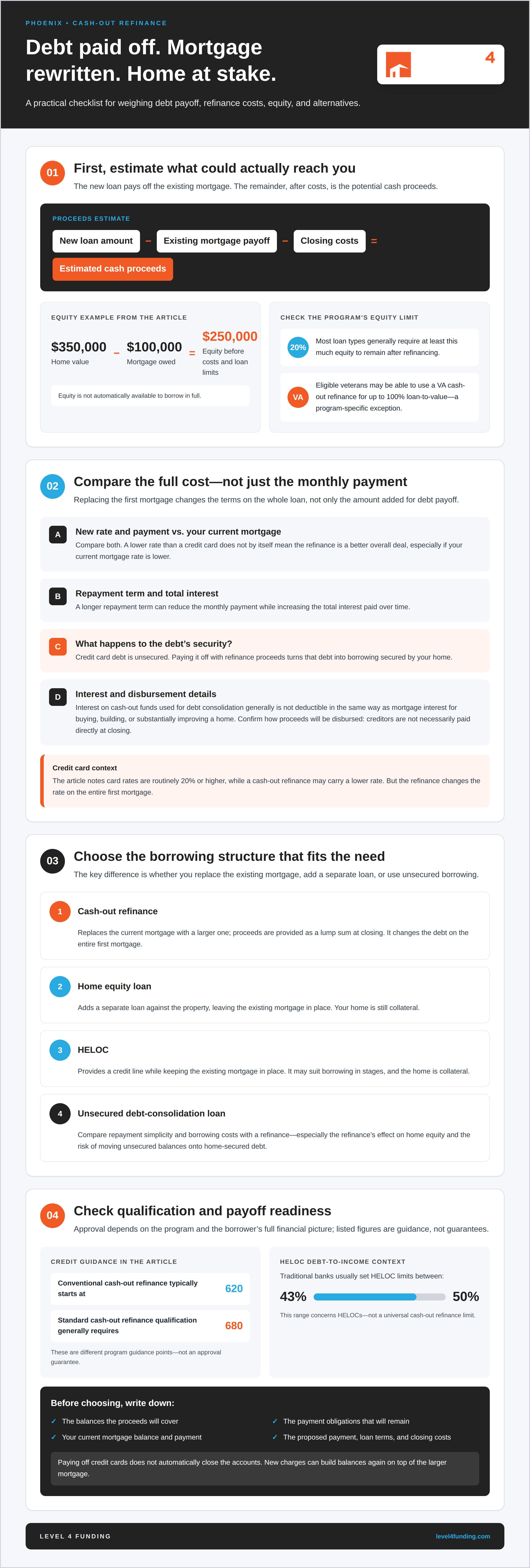
Home equity is the gap between a property’s value and the debt secured against it. A lender uses the home’s value and mortgage payoff to assess whether a larger loan can provide a lump sum. For example, a home worth $350,000 with $100,000 owed has $250,000 in equity before costs and loan limits. The full equity amount isn’t automatically available to borrow.
Arizona home values have appreciated more than 22% since 2020, and the state ranks in the Top 25 nationwide for home price growth. Average tappable equity has grown by nearly $102,000 since 2020, while the median home value is around $424,000. Those broad figures don’t determine an individual Phoenix homeowner’s borrowing amount; property value and existing debt do.
Equity Requirements Across Refinance Programs
For most loan types, Arizona cash-out borrowers need to retain at least 20% equity after refinancing. That means the new mortgage generally cannot use all the home’s value. Eligible veterans may be able to use a VA cash-out refinance for up to 100% loan-to-value, a program-specific exception. The loan type changes the equity calculation, so compare the program’s limit with your estimated mortgage payoff.
Arizona or Maricopa County assistance is separate from a lender-based mortgage transaction. A cash-out refinance is not county debt-relief funding. For property acquired during marriage, both spouses often need to sign refinance documents, even if only one appears on the title or mortgage.
Comparing Refinance and Home Equity Options
A cash-out refinance replaces your current mortgage and provides the proceeds as a lump sum. A home equity loan adds a separate loan against the property, while a HELOC provides a credit line and lets you keep your existing mortgage. The distinction matters if your current mortgage has favorable terms: refinancing changes the debt on the entire first mortgage, while a second-lien option leaves it in place.
Both a home equity loan and a HELOC use your home as collateral. Compare the new monthly payment, repayment structure, and effect on available equity, not just the cash received. A HELOC may suit borrowing in stages, while a refinance provides cash through one closing transaction.
Applying for a Cash-Out Refinance in Phoenix
A Phoenix lender reviews credit, confirms the current mortgage balance, and compares the proposed payment with the existing payment. Processing may include appraisal, title review, and underwriting before closing. Common application records include identification, mortgage and property details, and financial documents used to assess income and debts. For an Arizona application, property acquired during marriage may require both spouses’ signatures.
Typically, the lender assesses the application and property, completes its reviews, then prepares the closing documents. At closing, the new mortgage pays off the old one, and the remaining proceeds go to the borrower. This sequence highlights the key figures: property value, payoff, loan amount, and costs.
Using cash-out refinancing to pay off credit card debt
Using refinance proceeds to clear high-interest balances can simplify payments, but it also turns unsecured debt into debt secured by your home. Compare the full mortgage cost and repayment term, not only the next monthly payment.
Eligible Debts for Payoff
Cash-out proceeds are generally yours to use, so you can prioritize credit cards with the highest interest first. Credit card rates are routinely 20% or higher, while a cash-out refinance may carry a lower rate. But the refinance changes the rate on your entire first mortgage, not just the added amount. If your current mortgage rate is lower, replacing it may weaken the overall deal.
Student loans and tax balances also call for careful comparison. Paying them with home-secured borrowing can change the consequences and repayment structure attached to those debts. Interest on cash-out funds used for debt consolidation generally isn’t deductible in the same way as mortgage interest for buying, building, or substantially improving a home. Include this distinction when evaluating the total cost.
At closing, the new mortgage pays off the existing mortgage, and the borrower generally receives the remaining proceeds. Don’t assume card issuers or other creditors will be paid directly. Clarify how the proceeds will be disbursed in the closing plan.
Credit, Income, and Debt Requirements
Credit score expectations vary by program. Conventional cash-out refinancing typically starts at a 620 credit score, while standard cash-out refinance qualification generally requires 680. Those figures describe different program guidance, not an approval guarantee. Income and existing debts also matter because lenders assess whether the proposed mortgage payment fits the borrower’s finances.
Traditional banks usually set HELOC debt-to-income limits between 43% and 50%. That range concerns HELOCs, not a universal cash-out refinance limit. To assess ability to qualify, a lender reviews credit, confirms the mortgage balance, and compares the proposed payment with the current one. Income stability and monthly debt obligations help shape that assessment.
Set a specific payoff goal. List the balances the proceeds will cover and the payment obligations that will remain. This makes it easier to judge whether the new mortgage solves the debt problem or merely shifts it.
Paying off credit cards doesn’t automatically close the accounts, and new charges can build balances on top of the larger mortgage. A lower card balance helps only if your spending pattern changes too. Consider how you’ll manage future card use before converting unsecured balances into debt tied to your home.
Cash-out refinance compared with an unsecured debt-consolidation loan
Both options combine debts into one repayment structure, but they put different assets at risk. Arizona homeowners should compare mortgage terms, loan security, and total repayment cost before choosing.
Consolidating Credit Card Debt
A cash-out refinance uses home equity to pay off credit card balances, then rolls the borrowed amount into a new mortgage. Instead of separate card due dates, the borrower manages one mortgage payment. The trade-off is direct: credit card debt that was unsecured becomes secured by the home.
An unsecured debt-consolidation loan combines balances without using your home as collateral. Its interest rate, payment, and term depend on your financial profile and the loan terms. It may suit a homeowner who wants one payment without attaching the debt to property. Compare the total repaid over the full term, not just the initial monthly payment.
Combining High-Interest Debt
Debt consolidation can simplify several balances with different rates and repayment schedules. A cash-out refinance may offer a lower rate than other forms of credit, but it also replaces your existing first mortgage. If that mortgage has a lower rate, refinancing the full balance can offset savings from paying off higher-interest debt.
An unsecured loan leaves your mortgage intact, but its rate and repayment period affect whether consolidation saves money. Compare each option using the same payoff balances and repayment horizon. A lower payment may come from spreading repayment over a longer term, not from reducing borrowing costs.
For example, a homeowner with credit card balances and a favorable existing mortgage should compare two complete scenarios. One includes the new mortgage rate, balance, term, and closing costs. The other keeps the current mortgage and adds the unsecured consolidation loan payment. This side-by-side comparison shows whether refinancing changes the overall financial picture or mainly rearranges the debt.
Consider risk as well as the payment. With refinancing, missed mortgage payments put your home at risk because the consolidated amount is secured by the property. With unsecured borrowing, the home doesn’t secure the consolidation loan, though you still owe the debt under its loan terms. For homeowners seeking to protect their property, that distinction may matter more than a rate comparison.
Account for what happens after payoff. Clearing credit card balances doesn’t close the accounts, so new purchases could create fresh balances while the mortgage remains larger. An unsecured loan can also leave cards available. Base your choice on how you’ll manage future borrowing, not only on which option clears today’s balances.
For Arizona borrowers, key considerations include the current mortgage terms, the proposed loan’s full repayment cost, and whether using home equity fits the situation. Debt consolidation can make repayment easier to track, but it doesn’t erase what you owe. Choose a structure that reduces complexity without overlooking collateral, term length, or borrowing costs.
Estimating refinance proceeds after mortgage payoff and closing costs
The estimated cash-out isn’t the new mortgage amount. The existing mortgage payoff and closing costs are deducted first, leaving the proceeds available to the borrower. A lender’s estimate depends on the proposed loan, confirmed payoff, property valuation, and transaction costs. The final amount may change as these figures are finalized for closing.
Consider an illustrative calculation: a home is valued at $400,000, the current mortgage payoff is $240,000, and the new mortgage is $300,000. Subtract the $240,000 payoff, then $8,000 in example closing costs. Estimated proceeds are $52,000. This is a calculation example, not a quote; the borrower’s actual amount depends on their own loan and closing figures.
At closing, the new mortgage pays off the existing mortgage, and the borrower receives the remaining proceeds after applicable costs. The payoff may differ from the balance shown on a recent statement, and closing costs reduce the cash available. A useful estimate separates the new loan amount, payoff, costs, and net proceeds rather than treating equity as cash in hand.
Payment comparisons can change the decision. The new mortgage rate applies to the full refinanced balance, not just the additional borrowing.
Homeowners with a mortgage rate of 3% or under may face a substantially higher rate in a higher-rate environment. A cash-out refinance replaces that existing loan, so compare the new rate across the entire balance. A home equity line of credit can preserve the first mortgage while borrowing against equity, although it creates a separate obligation.
Term length also changes the real cost. Replacing a mortgage with 20 years remaining with a new 30-year loan extends the scheduled payoff date by 10 years. The new monthly payment may look more manageable, yet the longer repayment period can increase total interest. Compare both payment and payoff timeline before treating a lower monthly figure as savings.
For a sound estimate, the lender reviews the application and property, confirms the mortgage balance, and compares the proposed payment with the existing one. Then assess the net proceeds against your debt-payoff goal. A refinance can provide enough cash and still be a poor fit if a higher mortgage rate or longer term outweighs the benefit.
Cash-out refinance rates and payments
A cash-out refinance rate applies to the full new mortgage balance, not just the cash added for debt payoff. That makes the existing mortgage rate a key part of the calculation. Homeowners with a mortgage rate of 3% or under may face a substantially higher rate in a higher-rate environment. The payment can rise even when the proceeds replace expensive debt.
Credit also affects pricing. Better cash-out refinance pricing starts at around a 700 credit score. A loan officer reviews credit, confirms the existing mortgage balance, and compares the proposed payment with the current payment. The loan amount and repayment term also shape monthly costs. Review the full offer, not just the interest rate.
For Phoenix homeowners, a cash out refinance to pay off debt should be compared with a HELOC if preserving the first mortgage matters. A HELOC keeps the existing mortgage and adds a separate credit line against home equity. Variable-rate HELOCs are around 7.2%, while fixed-rate HELOCs are around 9-10%. Those figures describe HELOCs, not cash-out refinance quotes. Compare each option’s payment, terms, and total borrowing cost.
That result applies to the example, not every property or borrower. The comparison changes with the existing mortgage, amount borrowed, and proposed terms. Use the same debt-payoff amount for both options, then include the mortgage payment in the refinance calculation.
Payment changes aren’t the whole story. A lower monthly amount can result from extending repayment, which may increase total interest. Review the new loan’s payoff timeline alongside its monthly payment. If you plan to sell or refinance again, how long you keep the new loan also affects whether upfront costs make sense.
A cash out refinance to pay off debt in Phoenix should be assessed against your full financial picture. Consider how the proposed interest rate affects the entire mortgage balance and monthly payment. A low-rate first mortgage can make a full refinance less attractive, even when the new loan clears higher-interest balances. The central question is whether consolidation improves your overall borrowing plan.
For a property-based financing review, explore cash-out refinance options and compare the proposed payment with your current mortgage before committing.
Level 4 Funding: Cash Out Refinance
Level 4 Funding offers Cash Out Refinance for property owners weighing whether home equity can support a debt-payoff plan. It’s a practical next step when you’ve compared the projected proceeds, new mortgage payment, and total repayment cost against an unsecured consolidation loan.
Bring the decision into focus: identify the debt you want to pay, the current mortgage balance, and how a new payment would fit your finances. The key is understanding the full mortgage change, not just the cash available at closing. If the numbers point toward refinancing, Level 4 Funding can help with a cash-out refinance. If another real estate project is your priority, its offerings also include Fix and Flip Loans, Construction Loans, and Commercial Property Loans.
Contact Level 4 Funding to discuss whether a cash-out refinance fits your property and goals.
Choose a Debt Plan That Fits Your Next Move
A cash-out refinance to pay off debt in Phoenix should do more than change your payment in the short term. It should fit your property plans and how you want to manage borrowing going forward. Before moving ahead, decide what matters most: easing the pressure of multiple balances, preserving flexibility, or keeping your current mortgage intact.
That decision can also connect to broader real estate goals. Level 4 Funding offers Fix and Flip Loans, Construction Loans, and Commercial Property Loans alongside Cash Out Refinance. Consider which financing path matches the property and your intended use, rather than forcing every goal into one loan structure.
If refinancing looks like a fit, take the next step with a clear picture of your priorities and the questions you still need answered. Start a conversation with Level 4 Funding about your property and financing goals. A thoughtful choice now can put you on steadier ground for what comes next.
Frequently Asked Questions
How much equity do I need?
For most loan types, Arizona borrowers need to retain at least 20% equity after refinancing. The lender assesses the property value and mortgage payoff to determine whether the proposed loan leaves that equity in place. Eligible veterans may be able to use a VA cash-out refinance for up to 100% loan-to-value. Program eligibility and the property’s value shape how much equity can be used.
What Are the Risks of Using a Cash-Out Refinance for Debt?
The key risk is that debt that was unsecured becomes secured by your home. If your finances change and you can’t manage the new mortgage payment, your home is collateral. You also replace the terms of your existing mortgage, potentially extending repayment or changing its rate. Consider whether the payment would remain workable during a period of reduced income, not just under your current budget.
Can You Use a Cash-Out Refinance to Pay Off Credit Cards?
Yes. Borrowers can generally use cash-out proceeds to pay credit card balances, including prioritizing cards with the highest interest. Paying the balances doesn’t automatically close the accounts. If cards remain open and new charges build up, you could have both a larger mortgage and renewed card debt. Plan how you’ll manage card use after paying down the balances.
Can a Cash-Out Refinance Lower Your Interest Costs?
A cash-out refinance can lower the rate applied to high-interest balances, but the total cost depends on the entire new mortgage. It replaces the rate on the full first-mortgage balance, not just the cash borrowed. A longer repayment term can also increase total interest, even if the monthly payment falls. Compare the full mortgage terms and repayment timeline with the debts you plan to clear.
Can the Lender Pay Creditors Directly?
Cash-out proceeds are generally yours to use, so direct creditor payment isn’t automatic. The existing mortgage is paid off through closing, and the remaining proceeds are disbursed to you. If you plan to use the cash for several accounts, list the payoff amounts and track which balances the proceeds are intended to clear.
How does a cash-out refinance work to pay off debt?
A new, larger mortgage replaces the existing mortgage, pays off its outstanding balance, and provides remaining proceeds to the borrower. Those proceeds can then be used toward eligible debt balances. For a primary residence, the process includes a 3-day right of rescission. Funds are typically disbursed within one to two business days after that period ends.
What are current cash-out refinance rates in Phoenix, Arizona?
There isn’t one rate that applies to every Phoenix borrower. Pricing depends on factors including credit, the proposed loan, and the property. Better cash-out refinance pricing starts at around a 700 credit score. Compare the rate on the full new mortgage with your current mortgage rate and the interest on debts you plan to repay. The monthly payment alone doesn’t show total borrowing cost.
What are the cash-out refinance loan-to-value limits for conventional, FHA, and VA loans?
For most loan types, Arizona borrowers need to retain at least 20% equity after refinancing. Eligible veterans may be able to use a VA cash-out refinance for up to 100% loan-to-value. FHA follows its own program requirements; FHA refinancing includes an upfront mortgage insurance premium of 1.75%, which is a mortgage-insurance cost, not an LTV limit. Compare eligibility and equity rules for the specific program.

About the author
Matt has a bachelor's degree in political science from Northern Arizona University and works at Level 4 Funding, a private lending company that offers hard money and rental home loans to real estate investors in 35 states.
With Matt's leadership, the firm has financed almost $300 million in loans for investment properties. He often helps real estate investors with rental property purchases, foreclosures, refinancing, and fix-and-flip projects. Matt has extensive experience in fix-and-flip, buy-and-hold, rental properties, and real estate sales. He has lived in Arizona for 43 years and is married with three children. Matt is licensed as a mortgage broker and loan originator in Arizona, with NMLS 2062278 and NMLS 1118493.
Equal Housing Opportunity. This is not a Good Faith Estimate, and it is not a Guarantee to lend; it should not be considered as such. Costs, rates, estimates, and terms can only be determined after a full application is completed. To the extent this message includes any tax or legal advice, this message is not intended or written by the sender to be used, and cannot be used, for legal or tax purposes or advice. This is an advertisement. Copyright © 2026. All rights reserved.