


7 Costly Mistakes Real Estate Investors Make When Choosing a Fix-and-Flip Lender
September 28, 2026
How Are Hard Money Lenders Regulated? State-by-State Rules Every Borrower Should Know
September 29, 2026
What if the property looks like a solid deal, but the lender still says no? Collateral matters, but it doesn’t guarantee approval. If you’re asking, “how does a hard money lender work,” start here: the lender reviews both the property and your proposed plan for repaying the loan.
Terms like loan-to-value, draws, and exit strategy can make the process seem complicated. Fast financing won’t fix weak project numbers or an unrealistic repayment plan. It helps to know what a lender may assess, what information to prepare, and what to clarify before funding.
This guide follows the loan lifecycle, from the initial property and deal review through funding, repayment, and payoff. Using a fix-and-flip loan as an example, it explains how a Phoenix investor’s property, project plan, and exit strategy fit into the process. You’ll be better equipped to judge whether hard money financing suits your project and whether your plan can handle the costs, timeline, and risks.
Key Takeaways
- Understand how does a hard money lender work by looking at both the property and the proposed transaction, not just the collateral.
- Learn how after-repair value (ARV) and comparable sales can help test whether a renovation estimate is grounded in evidence.
- See the typical steps from discussing a deal to closing, while keeping in mind that document requests and timing vary by transaction.
- Know what to examine in the signed loan terms so repayment timing and costs don’t catch you off guard.
- Prepare the property details, project numbers, and repayment plan you’ll need to discuss a potential deal with a lender.
How Does a Hard Money Lender Work From an Investor’s Perspective?
How does a hard money lender work? A private real estate lender reviews a property as collateral and evaluates the proposed transaction to decide whether its financing fits the deal. The property matters, as do the project plan and the borrower’s path to repayment.
Asset-based lending doesn’t mean automatic approval or risk-free borrowing. Collateral is the real estate securing the loan. Your repayment plan explains how you expect to pay it back, such as by selling a renovated property or refinancing. The lender assesses the deal, but you remain responsible for repaying the loan and carrying out the project.
For a quick background on the financing type, see this overview of the hard money loan. For a closer look at its role in real estate investing, read our hard money loan overview.
This video offers another perspective on getting a hard money loan:
What does a hard money lender evaluate?
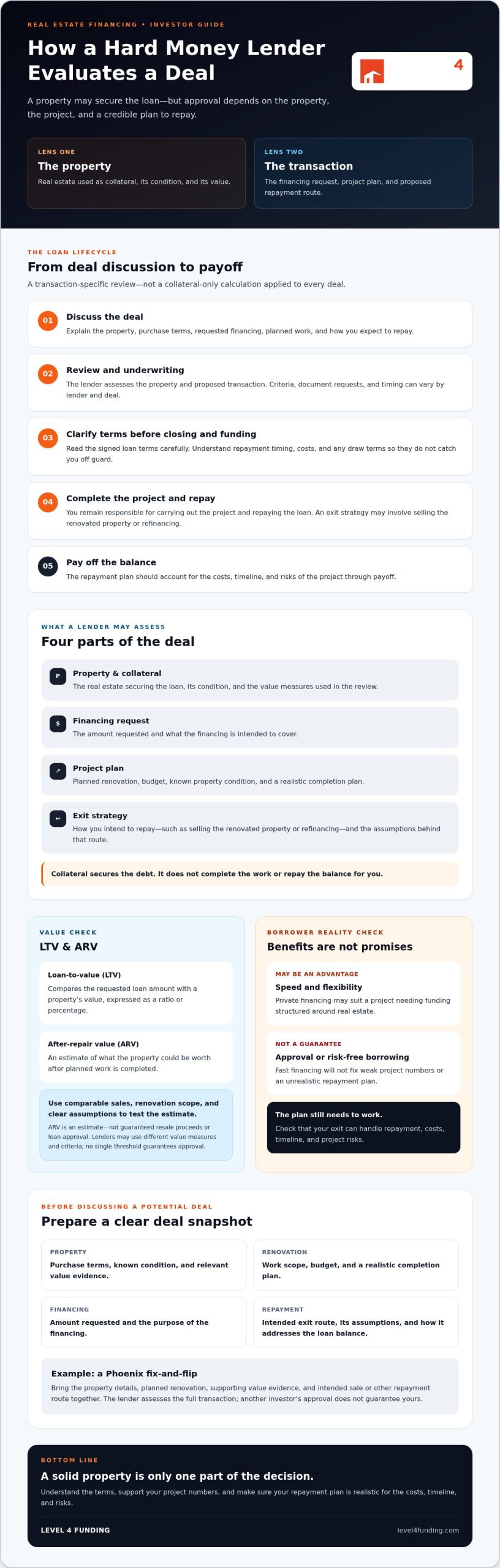
Expect a transaction-specific review, not a single calculation based on the property alone. A lender may consider the real estate and its condition, the amount and purpose of the requested financing, your project plan, and your proposed exit strategy. Underwriting criteria vary by lender and deal, so one investor’s approval doesn’t guarantee another’s.
For a fix-and-flip project, the lender may look at the property, planned renovation, and intended sale. Make the numbers and repayment route easy to follow. The property secures the debt, but it doesn’t complete the work or repay the balance for you.
Why do investors use private real estate financing?
Private financing may suit an investor whose project needs funding structured around real estate. A Phoenix investor considering a fixer-upper might explore fix-and-flip financing, but the property and plan still need to meet the lender’s criteria. Speed and flexibility may be advantages, not promises. Review the proposed terms, identify what the project requires, and check that your exit plan accounts for repayment.
Level 4 Funding specializes in private real estate financing for investors, including fix-and-flip loans. Before discussing a potential deal, prepare a clear picture of the property, project, and repayment plan.
How Does a Hard Money Lender Review a Property and Deal?
To understand how does a hard money lender work in practice, look beyond the property’s current value. A lender considers the purchase terms, property condition, proposed work, financing request, and repayment plan together. The review is specific to the transaction, rather than one collateral-only calculation applied to every deal.
How do collateral, loan-to-value, and ARV fit together?
Collateral is the property securing the loan. Loan-to-value (LTV) compares the requested loan amount with a property’s value, expressed as a ratio or percentage. Lenders may use different value measures and criteria, so there’s no single threshold that guarantees approval.
For a renovation, the lender may also consider after-repair value (ARV), an estimate of what the property could be worth after planned work is completed. Support the estimate with evidence rather than guesswork. Relevant comparable sales can help test whether the projected value makes sense, while the renovation scope and assumptions explain how the property might reach it.
ARV is an estimate, not guaranteed resale proceeds or loan approval. A useful starting point is this ARV calculation guide. For another overview of the financing type and its trade-offs, see Chase’s Hard Money Loans: Pros and Cons to Consider.
What project details can shape the lender’s decision?
Make the deal easy to assess. Lay out the purchase terms, the property’s known condition, the work you’re proposing, your budget, and a realistic completion plan. For a fix-and-flip, explain what needs repair, how the budget relates to that scope, and how you plan to sell the finished property. If your exit depends on refinancing or another route, describe the plan and its assumptions.
A clear exit strategy shows how you intend to repay, not just what secures the loan. A high projected resale value won’t resolve a weak budget, an unclear work plan, or an unrealistic repayment route. Ask the lender what information it needs to evaluate each part of the deal.
Document requests, valuation methods, and approval criteria vary by lender and transaction. Don’t assume a preliminary discussion is final approval. If you’re weighing a Phoenix-area project, organize the property details and plan first, then discuss your real estate project with a lender to understand what may fit.
What Happens During Hard Money Loan Underwriting and Funding?
Underwriting turns an initial conversation into a documented decision about a specific deal. After you share a property, the lender reviews the transaction, may request supporting information, and determines whether it can proceed. A preliminary discussion isn’t final approval or a promise that funds will be available.
Which steps typically occur before closing?
The sequence can vary by lender and transaction. A typical process may include:
- Discuss the deal. Share the property, purchase terms, requested financing, project scope, budget, and proposed exit plan.
- Provide requested information. The lender may ask for documents about the borrower, property, purchase, and project. Confirm what applies to your transaction rather than assuming every deal requires the same package.
- Review value and title. Depending on the transaction, the lender may assess the property’s value and arrange title work to clarify ownership and related matters.
- Evaluate the request. The lender considers the available information and decides whether the deal can proceed, and on what terms.
- Prepare for closing. If the transaction advances, review and complete the required closing documents and conditions before funding arrangements are finalized.
Valuation methods, title work, document requests, and timing aren’t universal. Confirm Level 4 Funding’s workflow and requirements directly for the property and project you’re discussing. A conversation or preliminary review alone doesn’t equal final approval.
How do loan documents and funding fit into the process?
Before signing, read the transaction documents carefully. They set out the actual terms for your loan, including repayment obligations and any applicable conditions. Check that the written terms match your understanding. Ask the lender to explain anything unclear, including what must happen before funding and how funds will be made available for your transaction.
For renovation financing, ask whether funds are provided at closing or released in draws as work progresses. If draws apply, clarify how to request them and what documentation or other conditions are required. Closing is where the required documents and conditions are completed and funding arrangements are carried out according to the agreement. Don’t plan a purchase or project around assumed proceeds until the lender confirms the status and expected next steps. To prepare for lender discussions, use this hard money loan requirements guide, then verify which requirements apply to your deal.
What Should Borrowers Understand About Repayment, Costs, and Risk?
Collateral doesn’t erase the debt. A hard money loan still has to be repaid, and the borrower carries the risk of a delayed or unsuccessful project. That’s crucial to understanding how does a hard money lender work: the property secures the loan, but it doesn’t guarantee your renovation, sale, refinance, or ability to repay.
Your signed loan documents determine the repayment schedule, applicable costs, and other obligations. Don’t rely on generic online figures or assumptions about how a loan is structured. Review the complete terms, including when payments are due, what costs apply, what happens at the end of the term, and what the documents say about default. The hard money loan rates guide can help explain why financing costs matter, but your actual terms are transaction-specific.
What happens if a project takes longer than expected?
A renovation delay can mean more carrying costs and less time to reach your planned sale or refinance. Underestimated work can strain the budget, while a slower-than-expected sale can leave you with repayment obligations before your exit is ready. Before closing, ask whether an extension is possible, what conditions apply, and what the loan documents say. Don’t count on an extension unless it’s confirmed in your specific terms.
How can investors assess whether the financing fits?
Stress-test the project before you commit. Use realistic renovation costs and timelines, account for available reserves, and consider more than one plausible exit. What happens if the work costs more, takes longer, or the sale price falls short of your estimate? If the plan only works under ideal conditions, revisit the numbers.
Potential flexibility may help a project move forward, but it doesn’t replace a clear understanding of your contractual obligations. Compare the financing structure with other options available to you, and judge each against the project’s schedule, costs, and exit plan. This hard money lender and bank loan comparison can help frame that evaluation.
Before signing, read every loan document and get clarification on any term you don’t understand. Have a specific project and repayment plan in mind? Discuss your real estate deal with Level 4 Funding and ask which terms and conditions apply.
How Can Arizona Investors Decide Whether to Contact a Hard Money Lender?
A useful first conversation starts with a clear deal, not an expectation of approval. If you’re considering a property in Phoenix or a nearby market such as Tempe or Mesa, organize your numbers and plan before discussing financing. The lender can then explain what information it needs to assess the opportunity and whether the project may fit its criteria.
What information should an investor prepare for a first conversation?
Start with the basics. You don’t need every answer, but clear information makes it easier to discuss the deal and identify what still needs checking.
- Property: Address, current condition, and any known issues.
- Purchase: Proposed or agreed purchase terms and relevant timing.
- Project: Estimated work scope, supporting budget, and a realistic timeline.
- Value: Relevant comparable sales that support your value assumptions.
- Exit: How you plan to repay, such as through a sale or another proposed route.
Ask which documents the lender needs, how it will review the property and transaction, and what details could affect its decision. Requirements vary, so clarify the process for your deal instead of relying on another investor’s experience.
When might Level 4 Funding be relevant to an Arizona project?
Level 4 Funding specializes in private real estate financing for investors, with fix-and-flip financing as its primary offering. That may be relevant if you’re evaluating a property that needs renovation, though every property and plan must be reviewed on its own merits. Other project types may align with the company’s construction, commercial property, Airbnb, or cash-out refinance loans. The fit depends on the purpose of the financing and details of the transaction.
So, how does a hard money lender work when you’re deciding whether to reach out? You bring the property and plan; the lender can explain what it needs to evaluate them. That conversation isn’t prequalification or a guarantee of approval, rates, funding speed, or availability. Confirm current service coverage and all terms directly.
If you have a specific property and financing scenario in mind, discuss your real estate financing scenario with Level 4 Funding and ask what information is needed to review it.
Make Your Next Financing Decision With a Clear Plan
So, how does a hard money lender work? The lender reviews the property and proposed deal, then evaluates whether the financing and repayment plan fit the transaction. A property’s value matters, but it doesn’t guarantee approval or remove your responsibility to repay.
Be ready to explain the purchase, project scope, budget, and exit strategy. Underwriting and funding steps can vary, so read the signed terms carefully. Costs, repayment timing, and the consequences of delays should all factor into your decision before you commit.
Level 4 Funding specializes in private real estate financing for investors. Its offerings include fix and flip, construction, and commercial property loans, with suitability depending on the project and lender review.
For a property in Phoenix, Scottsdale, Tucson, Glendale, Sedona, Flagstaff, Tempe, Mesa, or Buckeye, discuss your real estate financing needs with Level 4 Funding.
Frequently Asked Questions
How does a hard money lender decide whether to approve a loan?
A hard money lender evaluates the property and proposed transaction, then decides whether the deal fits its criteria. The review may include property condition and value, requested financing, purchase details, project budget, and your repayment plan. Lender requirements differ, so no single factor guarantees approval. Be ready to explain how you’ll complete the project and repay the loan, and ask which documents are needed for your specific application.
Does a hard money lender only care about the property?
No. The property may secure the loan, but the lender also reviews the proposed deal and how you intend to repay. For a renovation, that can mean looking at the work scope, budget, timeline, and planned sale or other exit. A strong property doesn’t automatically make a project workable. Your plan and transaction details matter, and you remain responsible for completing the project and meeting the signed loan obligations.
How long does it take a hard money lender to fund a loan?
Funding time varies by lender and transaction, so don’t rely on a general estimate as a promise. The process may depend on how quickly information is provided, property valuation, title work, required documents, and closing conditions. Ask the lender about the expected steps and timing for your deal, and what could cause delays. A preliminary conversation or review isn’t final approval, and it doesn’t mean funds are ready to disburse.
What happens if I cannot repay a hard money loan on time?
If you can’t repay as agreed, you could face serious financial consequences, including the risk of losing the property securing the loan. Specific consequences depend on your signed documents and applicable processes. Before closing, review what the agreement says about missed payments, maturity, default, and any extension options. Don’t assume an extension will be offered. If repayment trouble arises, contact the lender promptly and consider seeking qualified professional advice.
Can a first-time real estate investor use a hard money lender?
A first-time investor may discuss a project with a hard money lender, but experience alone doesn’t determine approval. The property, transaction, borrower information, project plan, and repayment strategy may all matter, and criteria vary. For projects in Phoenix, Scottsdale, Tucson, Glendale, Sedona, Flagstaff, Tempe, Mesa, or Buckeye, confirm current service availability directly. Bring realistic numbers and ask what information the lender needs to assess your opportunity.
Is a hard money lender the same as a private lender?
Not exactly. “Private lender” is a broad term for a lender outside the conventional banking system, while “hard money lender” commonly describes a private lender focused on real estate collateral and deal-specific financing. The terms can overlap, but lenders may use them differently. Ask who will make the loan, what property and borrower details they evaluate, and which written terms will govern repayment. Focus on the actual loan structure, not just its label.
What should I ask a hard money lender before signing?
Ask for a clear explanation of the full repayment schedule, applicable costs, due dates, and what happens if the project runs late or you can’t repay as planned. Confirm any funding conditions, required documents, and whether extension options exist, including their conditions. Read every transaction document and ask about terms you don’t understand before signing. Make sure the written agreement matches what you believe you discussed; verbal expectations aren’t a substitute for contract terms.

About the author
Matt has a bachelor's degree in political science from Northern Arizona University and works at Level 4 Funding, a private lending company that offers hard money and rental home loans to real estate investors in 35 states.
With Matt's leadership, the firm has financed almost $300 million in loans for investment properties. He often helps real estate investors with rental property purchases, foreclosures, refinancing, and fix-and-flip projects. Matt has extensive experience in fix-and-flip, buy-and-hold, rental properties, and real estate sales. He has lived in Arizona for 43 years and is married with three children. Matt is licensed as a mortgage broker and loan originator in Arizona, with NMLS 2062278 and NMLS 1118493.
Equal Housing Opportunity. This is not a Good Faith Estimate, and it is not a Guarantee to lend; it should not be considered as such. Costs, rates, estimates, and terms can only be determined after a full application is completed. To the extent this message includes any tax or legal advice, this message is not intended or written by the sender to be used, and cannot be used, for legal or tax purposes or advice. This is an advertisement. Copyright © 2026. All rights reserved.