

Recourse vs. Non-Recourse Hard Money Loans: Which Structure Protects You More as a Real Estate Investor?
October 20, 2026
A strong deal can lose momentum when the numbers are fuzzy, the rehab plan feels incomplete, or repayment is left to guesswork. Learning how to create a convincing real estate investment proposal for lenders means presenting more than a promising property. Connect verified value, a realistic funding request, an executable timeline, and a clear exit strategy. The details matter, and so does showing where the risks sit.
It’s reasonable to wonder which facts a lender needs, especially when an overly optimistic assumption could weaken your credibility. This guide breaks the process into practical steps so you can prepare a concise proposal tailored to your property and loan request. You’ll learn how to organize property and valuation evidence, outline rehabilitation costs and timing, explain repayment, and address risks with a credible backup strategy. You’ll also see how to prepare for financing conversations in Arizona, whether your project is in Phoenix, Scottsdale, Tucson, Glendale, Sedona, Flagstaff, Tempe, Mesa, or Buckeye.
Key Takeaways
- Frame your proposal as a focused case for financing, not a general business plan.
- Build a one-page deal summary that connects the property, funding request, project schedule, and repayment exit.
- Separate verified facts from estimates, cite each assumption, and test how delays or cost changes could affect the deal.
- Use address-specific Arizona property evidence and describe the scope, access, contractors, and project dependencies without relying on broad market assumptions.
- Before presenting, check that your request, budget, timeline, valuation, and exit strategy align, then organize supporting documents for easy review.
What Makes a Real Estate Investment Proposal Convincing to Lenders?
A lender proposal is a deal-specific case for financing, not a general business plan with a property added as an afterthought. It should quickly answer three questions: What property and project will the loan fund? What supports the expected performance? How will the debt be repaid? Show a clear line from collateral and requested loan structure to execution and exit. That’s the foundation of how to create a convincing real estate investment proposal for lenders.
Make the document easy to scan. Lead with a concise deal summary, then point to supporting evidence by clear file name or exhibit label. A lender shouldn’t have to hunt for the purchase status, proposed work, value rationale, or repayment plan. Keep the case factual, not flashy. State what you know, identify estimates as estimates, and disclose risks or dependencies that could affect the schedule, costs, value, or exit.
A strong proposal shows how the request fits the property. For commercial projects, loan-to-value, debt service coverage, appraisal information, and borrower due diligence can inform underwriting; the overview of commercial mortgage underwriting guidelines describes these common considerations. Connect relevant evidence to your deal rather than assuming one metric tells the whole story. For a fix-and-flip, construction, or commercial project, Level 4 Funding offers hard money financing designed for real estate investors. The proposal should still make the property, funding need, and repayment plan clear.
How is a lender proposal different from an investor pitch?
Debt and equity ask for different decisions. A lender proposal centers on the collateral, requested loan structure, project execution, and planned source of repayment. Keep ownership shares and investor distributions out of the lead unless they directly explain the project’s financing structure. A partner pitch, by contrast, may focus on equity offered, profit splits, governance, and how returns could be distributed. Don’t blend the two into one vague ask. State whether you’re seeking a loan or an equity partner, then make the supporting case fit that request.
What does a lender need to understand first?
Start with the property and its status: identify the address, whether it’s under contract or already owned, the project’s purpose, and the amount and type of financing requested. Then summarize the value thesis and repayment exit. For a renovation, explain what work is expected to support the projected value. For a rental or commercial property, show how the operating plan relates to repayment. Label forecasts as projections, not outcomes. If the property is in Phoenix, Scottsdale, Tucson, or another Arizona market, use evidence tied to its address and local conditions, not a city name as a substitute for proof.
- Clear request: State the financing purpose and proposed structure.
- Support: Reference property, value, and project evidence.
- Repayment: Explain the intended exit and the assumptions it depends on.
A credible case is specific, traceable, and honest about uncertainty. It doesn’t promise the deal will perform. It shows how you plan to execute and where risk or delay could affect the plan.
How to Build a Lender-Ready Real Estate Investment Proposal
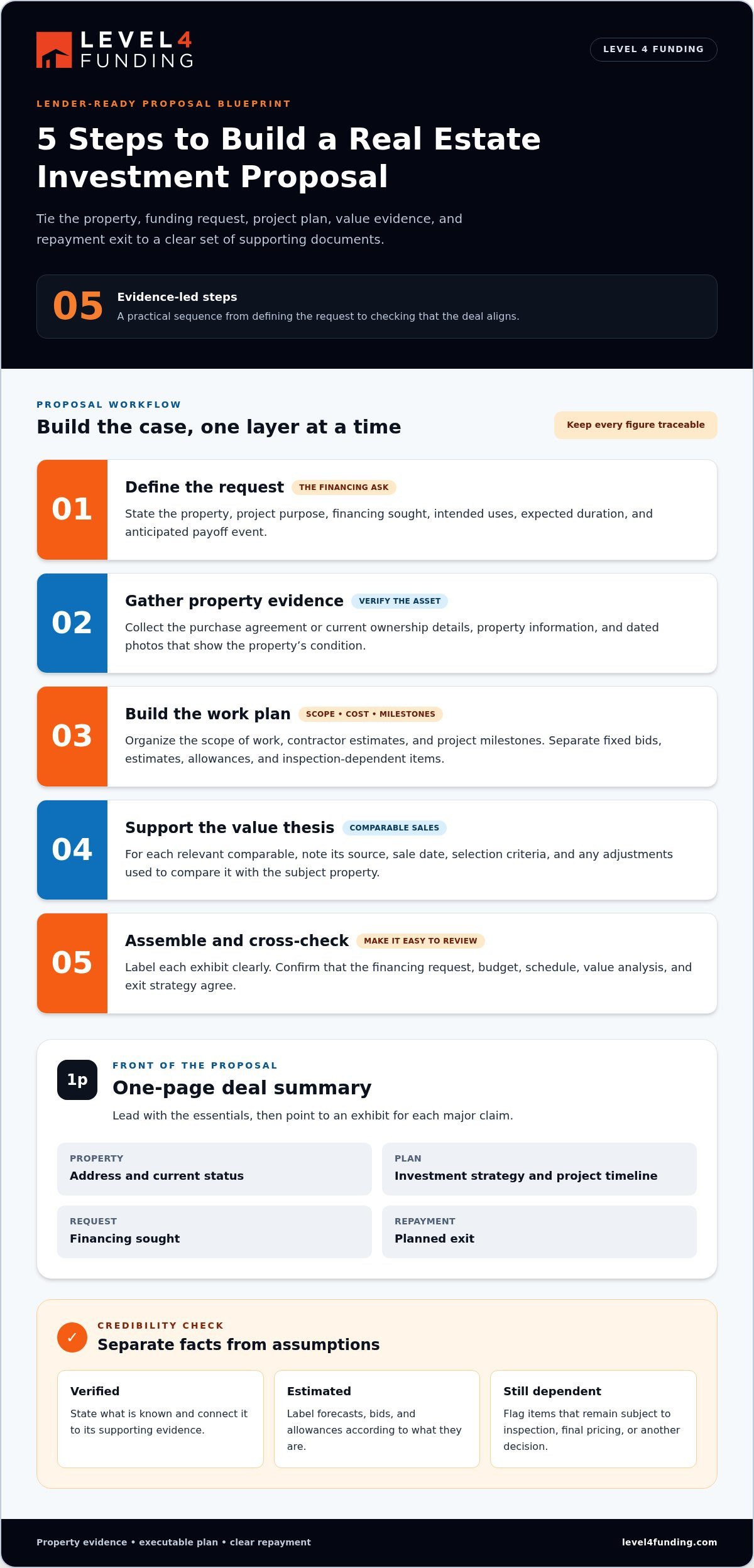
Build the proposal from evidence, not from a fill-in-the-blank template. This workflow for how to create a convincing real estate investment proposal for lenders keeps the request, budget, and repayment story tied to the actual property. Make every figure traceable, and flag anything that still depends on an inspection, bid, or other decision.
- Define the request. State the property, project purpose, financing sought, intended uses, expected duration, and anticipated payoff event.
- Gather property evidence. Collect the purchase agreement or current ownership details, property information, and dated photos showing its condition.
- Build the work plan. Organize the scope of work, contractor estimates, and project milestones. Label fixed bids, estimates, allowances, and inspection-dependent items separately.
- Support the value thesis. Select relevant comparable sales and note their source, sale date, selection criteria, and any adjustments used to compare them with the subject property.
- Assemble and cross-check. Label each exhibit clearly, then confirm the financing request, budget, schedule, value analysis, and exit strategy agree.
Put a one-page deal summary at the front. Include the property and its status, investment strategy, requested financing, project timeline, and repayment exit. Keep the summary direct, then point to the supporting exhibit for each major claim. The SBA business plan guide offers useful guidance on structuring summaries and financial information, but a real estate loan proposal should stay focused on this property and request.
Which property and project documents should support the proposal?
Make verification simple. Give files descriptive names, use consistent dates, and connect each document to a claim in the summary. For comparable sales, explain why each one is relevant and how differences in condition, size, or location affect your analysis. Don’t present an asking price or preliminary contractor estimate as a confirmed fact. State what is known, what is estimated, and what remains subject to inspection or final pricing.
Use a compact sources-and-uses breakdown so the lender can see where funds go and where they come from:
- Uses: Purchase, rehabilitation, carrying costs, and other project expenses.
- Sources: Requested loan proceeds, borrower contribution, and any other identified capital.
Show the amount or status for each line, then confirm total sources equal total uses. If an item is uncertain, label it and explain how you’ll address it rather than burying it in a broad contingency.
How should you present the financing request?
State the requested loan amount, intended uses, project duration, and anticipated payoff event in plain language. Reconcile the request to the budget and identify the borrower’s planned contribution without implying a lender commitment or inventing terms. Describe a sale, refinance, or other exit as the plan, not a guaranteed result. This organized package also gives you a practical starting point for the next-stage hard money loan approval process.
Once the deal summary and supporting documents are organized, you can discuss your real estate project with Level 4 Funding as a concrete financing request rather than a rough idea.
How to Prove the Numbers, Manage Risks, and Compare Funding Options
A polished proposal can still fall apart if its value estimate has no trail, its rehab budget hides uncertainty, or its exit depends on everything going right. Show where each number comes from and test what changes if the plan slips. This is the practical core of how to create a convincing real estate investment proposal for lenders: make the case transparent, then show how it holds up under pressure.
How can you make property value and project economics credible?
For each comparable sale, record the source, sale date, distance from the subject, and why it’s relevant. Explain material differences such as condition, size, or features, and identify any adjustments you made. Date the analysis so a lender can tell when the evidence was gathered. For rehabilitation, break costs into work items and distinguish contractor bids from allowances or preliminary estimates. Note dependencies such as inspection findings, permits, material choices, or work that must finish before another phase can begin.
“The after-repair value (ARV) is a supported projection based on selected comparable sales and stated assumptions, not a promise of the property’s future sale price.”
Label every assumption with its source and date. A contractor estimate, comparable sale, borrower estimate, and market-based projection are not interchangeable. That distinction lets a reviewer see which figures are documented and which may change.
Which risks and exit plans should the proposal address?
Build three scenarios using the same categories: base, delayed, and downside. For each, show the effect of changes in rehabilitation costs, completion timing, expected value, and repayment capacity. Don’t invent a precise delay or cost increase. Use project-specific evidence, state the assumption, and explain why it belongs in the scenario.
| Funding structure | Project fit to explain | Repayment focus |
|---|---|---|
| Fix and flip loan | Renovation followed by resale | Sale proceeds and the effect of a slower sale |
| Construction loan | New construction or a defined build plan | Completion and the stated payoff event |
| Commercial or rental financing | Income-producing property strategy | Operating income or the proposed takeout plan |
Match the financing discussion to the project’s needs, collateral, timeline, and exit. A renovation resale proposal should address contractor availability, permitting where relevant, buyer demand, and the fallback if the sale takes longer than planned. A rental plan should explain what happens if leasing or projected income is slower than expected. Disclose these risks instead of disguising the numbers.
State the primary repayment exit, then describe a realistic alternative if it’s delayed. A backup plan is not a guaranteed refinance or sale; it’s a reasoned response with its own assumptions. A complete proposal can’t guarantee approval, but it can make the property, economics, and risks far easier to evaluate.
Tailoring Proposals to Arizona Property and Deal Conditions
“Arizona property” isn’t a single underwriting story. A Phoenix home, a Mesa rental, and a Scottsdale construction project each need evidence tied to the actual address, property type, and plan. Keep the proposal grounded in the subject property: show its condition, access, work required, and any dependencies that could change the schedule or budget. That address-level detail is central to how to create a convincing real estate investment proposal for lenders.
Build a local evidence file, not a collection of broad city claims. For each comparable sale, explain why it’s a reasonable match: proximity, property type, size, condition, and sale timing. Note meaningful differences rather than treating every nearby sale as equal. Support project details with dated photos, inspection findings, contractor bids, and milestones. If a permit or municipal requirement affects the plan, cite current information from the relevant authority and state how it affects the schedule. Don’t generalize rules or market conditions from one Arizona city to another.
What local evidence strengthens an Arizona property proposal?
Connect the local evidence to the proposed exit. For a resale, show how the selected sales support your projected value and explain any adjustments. For a rental strategy, document the operating assumptions behind expected income and repayment. Present both as projections, not certainties. A reported Scottsdale construction loan of $2,825,000 at 100% funding at 9.9% is an example of a completed transaction, not a promise of similar terms or an underwriting benchmark for another property.
How should the proposal change by project type?
Keep the evidence aligned with the strategy. A fix-and-flip proposal should foreground the purchase basis, itemized rehabilitation scope, resale support, and payoff plan. A construction proposal should organize plans, budget, schedule, and project milestones so the sequence is easy to follow. A rental proposal should explain its operating assumptions and intended repayment strategy. Don’t mix project types or describe an exit that the property plan doesn’t support.
- Property condition: Include clear, dated photos and inspection findings that relate directly to planned work.
- Execution: Connect contractor scope and bids to specific milestones, dependencies, and budget lines.
- Valuation: Identify comparable-sale sources and valuation dates, then explain why the evidence fits this property.
- Local details: Verify market, access, or permitting information against sources for the property’s municipality.
Before presenting the package, check that the property address, scope, valuation evidence, schedule, and exit all describe the same deal. If one changes, update the connected assumptions rather than leaving conflicting details in the proposal. That discipline gives a lender a clearer view of what the project depends on and how you plan to manage it.
For an Arizona deal, bring your address-specific evidence and project plan into a financing conversation. Discuss your real estate project with Level 4 Funding.
How to Present Your Proposal and Move Toward a Funding Decision
A strong proposal should make the next decision obvious. The lender should be able to identify the property, understand what you’re requesting, see how funds will be used, and follow the path to repayment without piecing together conflicting files. Before you send it, do one final pass for accuracy and clarity. Small inconsistencies can create avoidable questions.
What should you check before sending a proposal?
Start with the numbers. Confirm that each figure matches its supporting document and that the totals reconcile across the financing request, sources and uses, and project budget. Check that the schedule aligns with the work plan and that your proposed exit fits the stated timeline. Then review every valuation reference and assumption for its source and date.
Remove unsupported claims, outdated comparable sales, unexplained estimates, and dates that no longer match. If a cost or milestone is still uncertain, label it plainly instead of presenting it as final. Make the requested decision and next action easy to find on page one. A concise executive summary should give the lender the deal at a glance; clearly named, well-organized supporting files should make the details easy to verify.
- Request: Does the amount and intended use match the budget?
- Schedule: Do project milestones and dependencies support the proposed duration?
- Valuation: Are the evidence, dates, and assumptions consistent throughout?
- Exit: Does the repayment plan fit the project and account for delays?
This final review is the practical payoff of learning how to create a convincing real estate investment proposal for lenders. You’re not trying to hide uncertainty. You’re showing that you’ve identified it, checked the supporting information, and built a coherent financing request around the property.
How can Level 4 Funding help evaluate a project?
Bring a clear account of the property, financing purpose, requested amount, project plan, and intended exit. Level 4 Funding’s mission is to understand your situation and provide the best possible loan. The process includes a one-page application, review of loan options, approval steps, and closing through a title or escrow company. Most loans take about 7 days to complete.
Think of the proposal as the starting point for a focused financing conversation, not a promise of approval. Your job is to make the evaluation straightforward: keep the summary short, label exhibits clearly, and be ready to explain the assumptions behind your plan. Level 4 Funding provides hard money financing for real estate investors, including fix-and-flip, construction, and commercial property loans.
If your proposal is organized and the key figures are ready to discuss, request a conversation about your real estate project and review financing options.
Turn Your Deal Plan Into a Clear Next Step
Your proposal doesn’t need to make a risky deal look certain. It needs to help a lender understand the opportunity, the decisions ahead, and how you plan to respond if conditions change. That clarity can make your financing conversation more focused and productive.
Put your property-specific information to work. Bring your financing request, supporting documents, and repayment plan into a conversation about the deal. Level 4 Funding has operated since 2010 and serves investors in 35 states, with a mission to understand each borrower’s situation and provide the best possible loan. Arizona investors in Phoenix, Scottsdale, Tucson, Glendale, Sedona, Flagstaff, Tempe, Mesa, and Buckeye can discuss projects involving fix-and-flip, construction, rental, and commercial financing.
Ready to discuss your project? Request a free consultation about your real estate project and take the next step with a clear plan.
Frequently Asked Questions
How detailed should a real estate investment proposal be?
Make it detailed enough for a lender to verify the deal without burying the key request. A useful standard for how to create a convincing real estate investment proposal for lenders is to make every major claim traceable to a document, dated source, or clearly labeled estimate. Keep the opening summary tight, and put detailed evidence in organized exhibits. For example, separate an accepted contractor bid from an allowance that may change after inspection.
What should a real estate investment proposal include for a lender?
Include the deal information a lender needs to assess this particular property and request. That usually means property status, project purpose, financing request, value support, costs, funding sources, schedule, repayment plan, and relevant risks. For a Phoenix rental or a Tempe renovation, use evidence that matches the property and strategy. A lender should be able to tell which figures are documented, which are estimates, and where to find the supporting material.
How do I show an exit strategy in a real estate loan proposal?
Explain the expected repayment source and the steps needed to reach it. If you plan to sell after renovating a Tucson property, connect the planned improvements and expected resale value to relevant sales evidence. For a rental in Mesa, describe the operating plan and how it supports repayment. Add a credible alternative if the preferred exit is delayed, such as adjusting the sale plan, and state the assumptions behind it. Don’t present any projected sale or refinance as certain.
Should I include a rehabilitation budget in a lender proposal?
Yes, if rehabilitation is part of the deal. Break the work into meaningful categories, such as roofing, plumbing, or interior finishes, and show the basis for each major estimate. Identify which figures come from contractor bids and which are allowances. Note dependencies, including inspections or material availability, that could affect cost or timing. Then check that the rehab total agrees with the funding request and budget summary. This lets a lender follow how project funds are expected to be used.
How can I make a real estate proposal more convincing without overstating returns?
Use evidence, not sales language. Support important claims with property documents, comparable sales, contractor estimates, or clearly identified assumptions. Then test how the plan responds if costs rise, work takes longer, or the projected value changes. A proposal for a Glendale flip, for example, should identify the local evidence behind its resale estimate and explain the impact of a slower sale. Transparent scenarios show you’ve considered uncertainty without suggesting approval or a guaranteed return.
How long does it take Level 4 Funding to close a loan?
Most loans take about 7 days to complete, and the title report is the longest part of the process. The transaction and its documentation can affect how long completion takes, so avoid building a plan around a guaranteed closing date. Investors preparing a Phoenix or Scottsdale deal can make the project easier to evaluate by keeping property details and supporting documents organized and consistent.
Does Level 4 Funding require a minimum credit score?
No, Level 4 Funding doesn’t require a minimum credit score. Judgments, tax liens, or bankruptcy are checked, and a low score may require a higher down payment or rate. Be accurate when describing your financial situation, and don’t assume the proposal alone determines approval or final terms. For an investment property in Flagstaff or Sedona, present the deal clearly while understanding that the lender evaluates the overall situation.
How do I apply after preparing a real estate investment proposal?
Complete the one-page application, then email it to matt@level4funding or text a photo to 623-582-4444. The process includes a consultation, pre-approval, review of loan options, approval, and closing with a title or escrow company. Most loans take about 7 days to complete. Have your project details ready so the financing discussion can focus on the property, purpose, and plan.

About the author
Matt has a bachelor's degree in political science from Northern Arizona University and works at Level 4 Funding, a private lending company that offers hard money and rental home loans to real estate investors in 35 states.
With Matt's leadership, the firm has financed almost $300 million in loans for investment properties. He often helps real estate investors with rental property purchases, foreclosures, refinancing, and fix-and-flip projects. Matt has extensive experience in fix-and-flip, buy-and-hold, rental properties, and real estate sales. He has lived in Arizona for 43 years and is married with three children. Matt is licensed as a mortgage broker and loan originator in Arizona, with NMLS 2062278 and NMLS 1118493.
Equal Housing Opportunity. This is not a Good Faith Estimate, and it is not a Guarantee to lend; it should not be considered as such. Costs, rates, estimates, and terms can only be determined after a full application is completed. To the extent this message includes any tax or legal advice, this message is not intended or written by the sender to be used, and cannot be used, for legal or tax purposes or advice. This is an advertisement. Copyright © 2026. All rights reserved.