


Presto Loans in Phoenix AZ: Myth vs. Hard Money Reality for Investors
August 26, 2026
Private Construction Loans for Real Estate: The Investor’s Fast-Track to Ground-Up Growth
August 28, 2026
Why are you still letting a traditional bank’s red tape choke your profit margins? If you’re waiting sixty days for an approval and another ten for every single draw, you aren’t building. You’re just stalling. In the fast-moving 2026 market, the “cheapest” interest rate is a trap if it costs you the deal. You need a new construction hard money loan that moves as fast as your crew. No 30% down payments. No inflexible underwriting. No more begging for your own funds while your project sits idle.
We get it. You’re tired of “draw hell” and lenders who don’t understand the ground-up game. This guide is your definitive roadmap to securing high-leverage financing, hitting 90% LTC, and closing in under 14 days. We’re stripping away the bureaucratic nonsense to show you exactly how to master the 2026 lending environment. You’ll learn the mechanics of a reliable draw process and the strategy to keep your contractors paid on time, every time. It’s time to stop waiting and start building.
Key Takeaways
- Stop waiting for banks. Learn why traditional lenders are retreating from speculative builds and how to bypass their 60-day approval cycles.
- Minimize your cash out of pocket. Discover how to use land equity as your down payment for a new construction hard money loan.
- Focus on the deal, not just the borrower. Secure high-leverage financing even with credit scores as low as 500.
- Escape draw hell. Master a streamlined schedule that uses virtual inspections to keep your contractors paid and your project on track.
- Get funded in under 14 days. Leverage local Arizona market knowledge to value your project accurately and skip the bureaucratic nightmares.
Why Traditional Banks Kill New Construction Deals in 2026
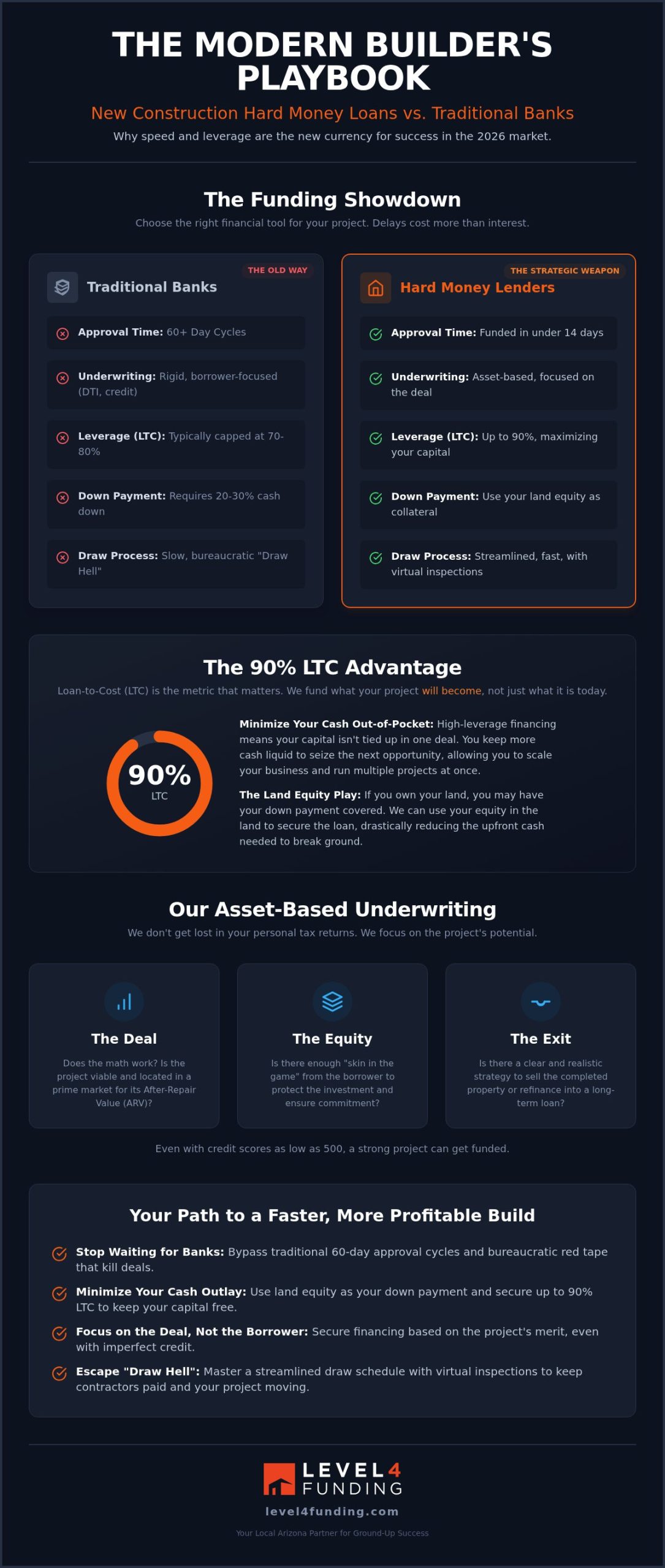
Banks are retreating. In 2026, traditional institutions have tightened their grip, making speculative builds nearly impossible for independent investors. They want 30% down. They want a sixty-day underwriting window. They want a perfect credit score and a decade of experience. If you don’t fit their narrow box, they kill your deal before the foundation is even poured. This is exactly why a new construction hard money loan is no longer a “last resort.” It’s a strategic weapon for those who value time over red tape.
Speed is the only currency that matters in a hot market like Arizona. While a bank is busy checking your personal tax returns from five years ago, a what is a hard money loan focuses on the property’s future. It bypasses the bureaucratic nightmares that stall projects and drain bank accounts. You shouldn’t be penalized for scaling your business just because you don’t have a twenty-year corporate resume. You need capital that moves at the speed of your ambition.
The High Cost of Bank Delays
Slow money is expensive money. Every day your construction site in Phoenix or Scottsdale sits quiet is a day you’re losing profit. You’re paying for insurance, property taxes, and site security. These daily carry costs add up fast. Even worse, 2026 has seen massive volatility in material pricing. A two-month delay at a bank can result in a significant spike in your budget due to sudden lumber or steel price hikes. By the time the bank says yes, your profit margin has already evaporated.
There’s also the human element. Your best subcontractors aren’t sitting around waiting for a bank to approve a draw request. They have bills to pay. If your funding is slow, they’ll leave for a competitor who pays on time. Losing a reliable framing crew or electrician can set your timeline back months. You can’t afford that friction. You need a partner who understands that a construction site is a living, breathing machine that requires constant fuel.
Rigid Underwriting vs. Asset-Based Reality
Banks are obsessed with your Debt-to-Income (DTI) ratio. They treat a million-dollar construction project like a car loan. It’s a fundamental misunderstanding of real estate investment. A Hard money loan operates on a different logic. It’s asset-based. This means the collateral is the star of the show, not your personal debt history. We focus on the After-Repair Value (ARV) and the viability of the build.
The Level 4 approach is built for the “street-smart” builder. We evaluate the deal based on three simple pillars:
- The Deal: Does the math work? Is the location prime for the 2026 market?
- The Equity: Is there enough skin in the game to protect the investment?
- The Exit: Is there a clear path to sale or refinance?
We don’t get bogged down in tax returns or DTI. If the project’s potential is there, the funding follows. We look at where you’re going, not where you’ve been. Don’t let a bank’s “Experience Gap” or rigid underwriting stop you from breaking ground on your next big win.
The Mechanics of a New Construction Hard Money Loan
Navigating the financial architecture of a ground-up build requires a different set of tools. You aren’t just buying a house; you’re creating value from dirt. This is where the new construction hard money loan separates the pros from the amateurs. While banks obsess over Loan-to-Value (LTV) based on current appraisals, hard money lenders focus on Loan-to-Cost (LTC). It’s a fundamental shift. We look at what the project will become, not just what it is today.
In the 2026 market, leverage is your best friend. Term lengths for spec homes in Phoenix typically range from 12 to 24 months. This gives you plenty of runway to build, list, and sell. Don’t fear the points. Think of them as a strategic tool to keep more cash in your pocket during the build phase. High-leverage debt allows you to scale. It lets you run three projects simultaneously instead of one. That’s how you build real wealth in a competitive landscape. Savvy investors are increasingly turning to private construction loans for real estate to access the high-LTC financing that traditional banks simply won’t offer.
Breaking Down the LTC Formula
The Total Project Cost is the heartbeat of your loan. It isn’t just the price of the lumber. It includes land acquisition, permits, architectural fees, materials, and labor. Understanding how construction loans work starts with mastering this math. Many lenders in 2026 are capping at 70% or 80% LTC. That’s a deal-killer for many builders. We strive for 90% LTC. This high-velocity approach minimizes your initial capital outlay and maximizes your Return on Equity (ROE) by keeping your cash liquid for the next opportunity.
The Land Equity Play
Got land? You’ve got leverage. One of the most powerful moves in 2026 is using your owned land as your down payment. If you already own the dirt in Scottsdale or Sedona, you can often secure 100% of the construction funding. We value horizontal improvements like grading, utilities, and paving as part of your equity. As Arizona land values continue to climb in 2026, your equity position strengthens before you even frame the first wall. It’s about working smarter. If you want to see how your specific site stacks up, talk to a hard money lender who knows the local Arizona dirt and understands the true value of your site prep.
How to Secure Your Construction Loan: A 5-Step Guide
Stop guessing. Start executing. Securing a new construction hard money loan isn’t about surviving a bank’s interrogation. It’s about presenting a bulletproof business case. We don’t care about your debt from five years ago. We care about the project you’re breaking ground on tomorrow. If the math works and the exit is clear, the capital is yours. Here is the five-step blueprint to get your project funded in record time.
- Step 1: The Executive Summary. Don’t send us a novel. We want a high-impact snapshot of your vision. Who is the builder? What is the neighborhood demand? Why does this spec home win in 2026?
- Step 2: The Budget and Pro-Forma. Precision is non-negotiable. Your line items must reflect current 2026 material costs. No “miscellaneous” padding. Show us exactly where every dollar goes and what the final profit looks like.
- Step 3: The Draw Schedule. This is your project’s heartbeat. Align your construction milestones with your cash flow needs. We need to see when the foundation, framing, and finishes hit so we can keep the checks moving.
- Step 4: Underwriting and Appraisal. We dive deep into the asset. We verify the land value and the projected After-Repair Value (ARV). It’s an objective look at the collateral.
- Step 5: Closing and Groundbreaking. No sixty-day waits. Once the docs are signed, the first check is in your hand. You move from paperwork to power tools in days, not months.
Pre-Approval and the “Street-Smart” Application
Forget the mountains of paperwork. We don’t need your high school transcripts or three years of personal tax returns. A “street-smart” application focuses on the Scope of Work (SOW). This document is the backbone of your loan. It tells us exactly what you’re building. Pair this with your contractor’s resume. We need to see that your team has the hands-on experience to execute. Understanding How Construction Loans Work in the private sector means knowing that your team’s track record is your best form of collateral.
The Appraisal Process for Spec Homes
Appraising a house that doesn’t exist yet is an art. In Phoenix and Scottsdale, the market moves fast. We look for the “as-completed” value. This isn’t just about what the dirt is worth today. It’s about what the finished home will command in the 2026 market. We select comps from the last ninety days in your specific neighborhood to ensure the ARV is realistic. Whether it’s a luxury build in Paradise Valley or a modern infill in Phoenix, we value the project based on its future reality. We see the finish line before you even dig the first trench.
Navigating the Draw Process and Avoiding “Draw Hell”
Draw hell is real. It’s the dead zone where your framing is finished, your crew is restless, and your bank is “reviewing” paperwork for the third time. A new construction hard money loan lives or dies by the draw process. If the money doesn’t move, the project doesn’t move. In 2026, manual reviews still take five to ten business days at traditional institutions. That’s a week of zero progress. We’ve streamlined the cycle to ensure you aren’t begging for your own capital while your profit margins evaporate.
The draw schedule is your project’s financial heartbeat. It aligns specific construction milestones with cash flow releases. You finish the foundation; we release the funds. You finish the roof; we release the next tranche. To survive 2026 material price spikes, you must maintain a robust contingency fund. Industry data from August 2026 shows that 98% of large projects face cost overruns, with average increases hitting 80% of the original budget. Don’t be the builder who runs out of gas at the finish line because they didn’t account for market volatility.
Mastering the Inspection Cycle
The biggest shift in 2026 is the move toward virtual inspections. Waiting for a third-party inspector to drive out to your site is an outdated bottleneck. We use technology to verify progress in real time. If you want 24-hour draw approval, follow the checklist for success. Document everything. We need high-resolution photos of the completed work, signed lien waivers from your subs, and organized invoices. When you provide a clear digital trail, we provide the capital. Speed is our priority because it’s your priority.
Paying Subcontractors on Time
Your subcontractors are your most valuable asset. If you pay them late once, they’ll prioritize other jobs. If you pay them late twice, they’re gone. Fast draws build subcontractor loyalty. This is especially critical for “just-in-time” material deliveries in high-demand areas like Flagstaff or Sedona. You need the cash ready when the truck arrives. While a fix and flip loan draw process might focus on cosmetic updates, a ground-up build requires a more complex, milestone-based approach. We understand the difference. We know the Arizona market. If you’re ready to stop waiting and start building, apply for your construction draw funding today and keep your project on the fast track.
Level 4 Funding: Your Local Arizona Partner for Ground-Up Success
Nationwide lenders are a dime a dozen. They have slick websites and call centers in other time zones. But do they know the specific permit timelines in Glendale? Do they understand why a spec build in Tucson has a different risk profile than one in Phoenix? No. They don’t. We do. Level 4 Funding is your boots-on-the-ground ally. When you need a new construction hard money loan, you need a partner who knows the local dirt. We don’t hide behind corporate committees. We make asset-based decisions that prioritize your deal’s potential over your personal credit score.
We aren’t afraid of a 500 credit score. If the project makes sense, we fund it. While big banks are busy disqualifying you for past mistakes, we’re busy looking at your exit strategy. It’s direct. It’s fast. It’s the only way to win in the 2026 Arizona market. No more waiting sixty days for a “maybe” from a loan officer in New York. You get a “yes” from a decision-maker who understands the Valley.
The Level 4 Advantage in Arizona
Local expertise isn’t just a buzzword. It’s a financial advantage. We understand the zoning nuances of Mesa and the specific inspection requirements in Scottsdale. Our network of local inspectors and appraisers means your valuations are accurate and your draws are approved without delay. You get direct access to decision-makers. No middleman. No bureaucratic gatekeepers. If a problem arises on-site, you can pick up the phone and talk to someone who knows exactly where your project is located. We prioritize speed because we know that in construction, time is quite literally money.
Scaling Your Portfolio in 2026
The smartest builders in 2026 aren’t just selling; they’re holding. We help you move from the construction phase into long-term wealth generation. If your build is destined for the short-term rental market, you can leverage our Airbnb loans to secure your fast-track to STR funding. This allow you to recycle your capital and move onto the next groundbreaking while your first project starts generating cash flow. We provide the bridge between your vision and a finished, profitable asset. Stop letting slow money dictate your growth. Your next new construction hard money loan should be the catalyst for your entire portfolio. Ready to see what we can do for your next build? Get a Quote for Your New Construction Project today and let’s get that dirt moving.
Stop Waiting and Start Breaking Ground
Success in 2026 isn’t about who has the lowest interest rate. It’s about who has the capital to move when the opportunity strikes. You now have the blueprint to bypass the bank’s red tape. You know how to leverage land equity. You know how to master the draw process. A new construction hard money loan is the fuel your portfolio needs to scale without the friction of traditional lending. Don’t let your vision gather dust while a loan committee in another time zone debates your DTI.
Level 4 Funding is here to be your street-smart ally. We provide the local Arizona expertise you need in Phoenix, Scottsdale, and Tucson. Our asset-based underwriting looks at the future value of your build; not just your past credit score. With our fast draw funding, you’ll never have to worry about your contractors walking off the job. It’s time to take control of your construction timeline. Apply for Your New Construction Hard Money Loan Now and get the funding you deserve. Your next groundbreaking is just days away. Let’s get to work.
Frequently Asked Questions
How does a hard money construction loan differ from a fix and flip loan?
Ground-up projects involve higher risk and more moving parts than simple renovations. A new construction hard money loan covers everything from the initial dirt to the final roof. In contrast, a fix and flip loan is designed for existing properties that need cosmetic or structural updates. Construction loans require a detailed draw schedule and more oversight because you’re creating value from scratch rather than just restoring it.
What is the minimum credit score for a new construction hard money loan in Arizona?
We look at your deal, not just your score. While many lenders in 2026 demand a 600 or 620, we can fund builders with credit scores as low as 500. We prioritize asset-based underwriting. If the After-Repair Value is strong and the budget is tight, the capital is available. Don’t let a past financial hiccup stop your future build. We focus on the project’s potential in the Arizona market.
Do I need a general contractor to get a construction loan?
You absolutely need a professional team. Most private lenders require a licensed general contractor to ensure the project stays on track and meets local building codes. Your contractor’s resume is a vital part of the underwriting process. It proves to us that the hands on the tools know how to finish the job. A solid GC relationship minimizes our risk and speeds up your funding approval.
Can I use a hard money loan to buy the land and build the house?
You can bundle both land acquisition and construction costs into one loan. This is a common strategy for investors looking to maximize their leverage. If you already own the land, you can often use that equity as your down payment, potentially securing 100% of the construction costs. It’s a powerful way to keep your cash liquid for other projects while your ground-up build moves forward.
How fast can a hard money construction loan close?
We close in under 14 days. Traditional banks move at a glacial pace, often taking 60 days or more to navigate their bureaucracy. We don’t have loan committees or layers of corporate red tape. Our asset-based approach allows us to make rapid decisions. When you find the right lot or the right deal, you need capital that moves as fast as the market. We deliver that speed.
What happens if my construction project goes over budget?
Budget overruns are a reality you must prepare for. Data from August 2026 shows that nearly 98% of large projects exceed their initial estimates. This is why we insist on a robust contingency fund. If your costs spike due to material price hikes or labor shortages, that buffer keeps the project alive. Without it, you risk “draw hell” where progress stops because the cash ran out.
Are hard money construction loans interest-only?
Yes, these loans are typically interest-only. You aren’t paying down the principal while the house is still under construction. You only pay interest on the funds that have been disbursed through the draw process. This structure keeps your monthly carry costs as low as possible during the build phase. Once the project is complete and sold or refinanced, the principal balance is paid off in full.

About the author
Matt has a bachelor's degree in political science from Northern Arizona University and works at Level 4 Funding, a private lending company that offers hard money and rental home loans to real estate investors in 35 states.
With Matt's leadership, the firm has financed almost $300 million in loans for investment properties. He often helps real estate investors with rental property purchases, foreclosures, refinancing, and fix-and-flip projects. Matt has extensive experience in fix-and-flip, buy-and-hold, rental properties, and real estate sales. He has lived in Arizona for 43 years and is married with three children. Matt is licensed as a mortgage broker and loan originator in Arizona, with NMLS 2062278 and NMLS 1118493.
Equal Housing Opportunity. This is not a Good Faith Estimate, and it is not a Guarantee to lend; it should not be considered as such. Costs, rates, estimates, and terms can only be determined after a full application is completed. To the extent this message includes any tax or legal advice, this message is not intended or written by the sender to be used, and cannot be used, for legal or tax purposes or advice. This is an advertisement. Copyright © 2026. All rights reserved.