


How Fast Can a Hard Money Loan Really Close? The Timeline, the Bottlenecks, and How to Speed It Up
October 27, 2026
Industrial deals can’t always wait for a bank’s timeline. Phoenix hard money for industrial properties can help investors finance commercial real estate, with some Arizona hard-money loans approved and funded in as little as a few days. The property and the deal’s investment case take center stage.
Speed matters, but so do the numbers. Understand how a lender assesses an industrial property, what the application and funding process involves, and how the rate, repayment terms, and costs affect your plan.
This guide explains what hard money may finance, how to prepare an application, and which factors shape loan terms. It also covers repayment and exit planning, so you can decide whether this financing fits your Phoenix project.
Key Takeaways
- Hard money can support commercial real estate investment when timing or a property’s condition makes conventional financing a poor fit.
- Learn which industrial property details and investment plans matter when a lender evaluates an application.
- Understand the stages from submitting a loan request through underwriting, funding, and repayment.
- Compare rates, repayment structures, and fees as parts of the total financing plan, not in isolation.
- See how Level 4 Funding’s commercial property, construction, and fix-and-flip loans may fit different project goals.
What Are Hard Money Loans in Arizona Used For?
Arizona hard money loans can provide property-backed capital for a commercial real estate purchase, renovation, or short-term investment plan. For industrial property, the lender focuses on the asset, its condition and value, and the borrower’s repayment route. Funding timing depends on the transaction and underwriting.
Arizona licensing, lending, and foreclosure requirements depend on the lender’s role, loan structure, borrower, and collateral documents. Industrial collateral alone does not determine which requirements apply. Before signing, review the lender’s legal capacity, lien documents, default provisions, notices, and remedies under Arizona law.
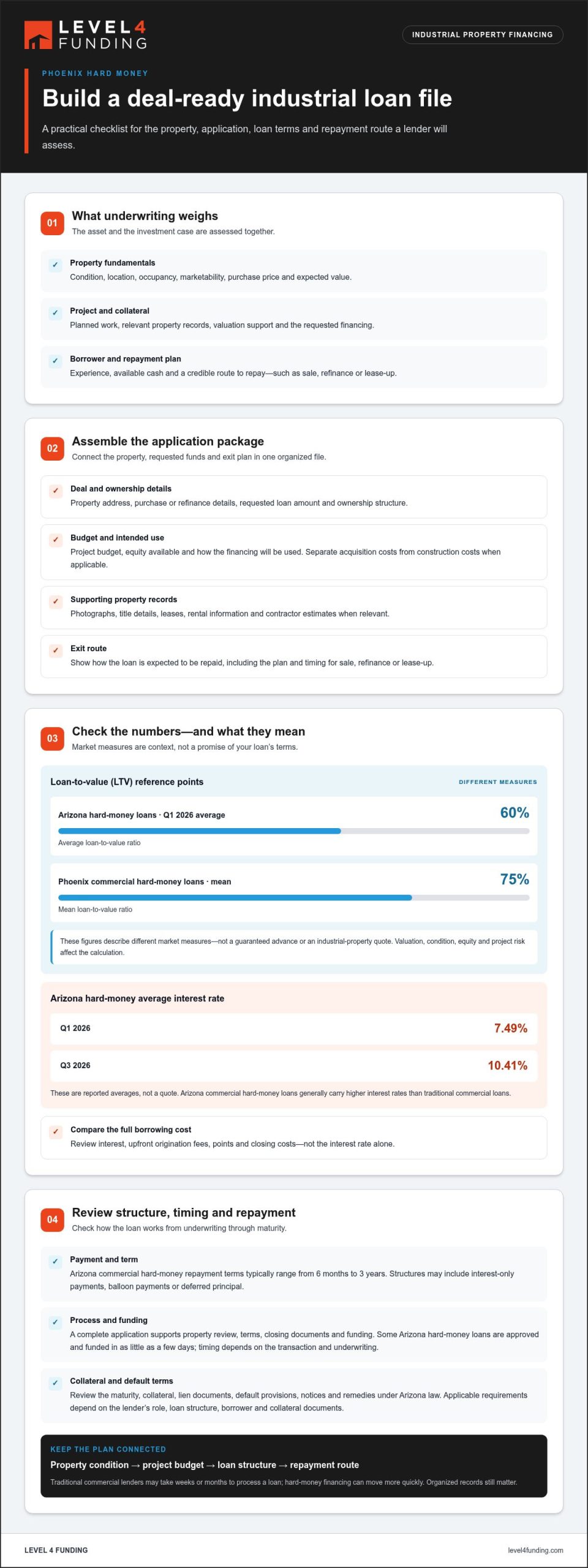
A hard money loan is private financing secured by real estate. Unlike a loan assessed mainly through conventional income documentation, asset-based underwriting gives substantial weight to the property and the deal. A private money lender may examine the industrial building’s condition, location, occupancy, marketability, purchase price, and expected value. The borrower’s experience, available cash, and repayment plan also help shape the decision.
Prepare a clear application package with the property address, purchase or refinance details, requested loan amount, ownership structure, project budget, and intended exit. Include photographs, leases, rental information, title details, and contractor estimates when relevant. This helps the lender assess the collateral and repayment plan together, rather than relying on property value alone.
Loan-to-value ratio compares the loan amount with the property value used for underwriting. Arizona hard money loans averaged a 60% loan-to-value ratio in the first quarter of 2026. Phoenix commercial hard money loans had a mean loan-to-value ratio of 75%. Those figures describe different market measures, not a guaranteed advance or an industrial-property quote. Valuation, condition, equity, and project risk affect the calculation.
Rates and fees matter. Arizona commercial hard money loans generally carry higher interest rates than traditional commercial loans, and may include upfront origination fees, points, and closing costs. Compare the complete repayment obligation, not just the interest rate. Arizona commercial hard money repayment terms typically range from 6 months to 3 years; payment structures may include interest-only payments, balloon payments, or deferred principal.
Before applying, build the file in a practical sequence:
- Document the asset, including condition, occupancy, and supporting value information.
- Set out the requested financing, project costs, equity, and intended use.
- Show the repayment path, such as sale, refinance, or lease-up.
- Review proposed pricing, payment schedule, maturity, collateral, and default terms.
Traditional commercial lenders may take weeks or months to process a loan, while hard money financing can move more quickly. A short timeline still calls for organized records. A complete application helps underwriting progress through property review, terms, closing documents, and funding with fewer avoidable gaps.
For comparison, the average interest rate for Arizona hard money loans was 7.49% in the first quarter of 2026 and 10.41% in the third quarter of 2026.
Phoenix-area industrial property financing options
Phoenix hard money for industrial properties may suit investors who need asset-focused financing. Compare the loan structure with the building’s condition, planned work, and intended exit.
Construction and Redevelopment Funding
Construction and redevelopment financing can support ground-up work, major renovations, or repositioning an industrial building. Review the scope, budget, contractor plan, and how the completed work supports the property’s intended use. A warehouse conversion, for example, needs a clear work plan and an explanation of its future industrial function. Separate acquisition costs from construction costs in the proposal.
Comparing Commercial Loan Options
Hard money financing emphasizes collateral and the project’s investment case. Banks, SBA-backed loans, and other commercial loans may involve different financial reviews, documentation, and timelines. Compare repayment structure, total borrowing costs, and fit for the planned improvements. Assess Phoenix hard money for industrial properties against the deal’s timing and property needs, not just the loan category.
Submarkets and Underwriting Conditions
Phoenix-area submarkets, including Scottsdale, Tempe, and Mesa, vary in access, tenant demand, industrial space, and building utility. Underwriting considers location alongside comparable-property evidence, condition, occupancy, and lease income. Vacancy can affect projected revenue and the exit plan. A metro-wide trend cannot tell the full story of an individual property.
For a transitional asset, private money may bridge the period between acquisition and a stronger operating position. A building may need repairs, lease-up, or repositioning before sale or refinance. Explain the project stages, budget, and expected exit together. This gives a lender context for assessing the property’s current condition and financing purpose.
Multifamily financing serves a different property type. For an apartment building, underwriting focuses on residential units, occupancy, rents, and building condition. Industrial property analysis considers space configuration, access, functionality, tenant use, and relevant industrial demand. Keep the property category and income assumptions consistent throughout the financing request.
Choose a structure that fits the project’s purpose: acquisition, construction, or a transition toward sale, refinance, or leasing. Gather property records and a clear budget, then connect the requested financing to a practical repayment route. That preparation can frame a focused discussion of Phoenix hard money for industrial properties and its fit for your project.
For a closer look at commercial property financing options, consider how the asset’s condition and intended use shape the financing structure.
Application, approval, funding, and repayment process
Keep the transaction moving by treating each stage as a handoff: application, underwriting, closing, funding, and repayment.
Submitting an Application
Start with the real estate details: property address, purchase status, ownership entity, intended use, and requested loan structure. Add a project budget, current photographs, leases or occupancy information, and a clear repayment plan. For an industrial property in Phoenix or Scottsdale, explain how the building will operate after acquisition or improvements.
Organize the file before sending it. Separate acquisition costs from renovation or construction expenses, and identify available borrower equity. Include relevant financial statements and credit details, as well as experience with comparable projects. A clean package helps the lender connect the requested funding to the asset, work plan, and exit without chasing missing details.
Approval and Funding
During underwriting, the lender evaluates the property, proposed loan, borrower, and repayment plan as one transaction. Be ready to clarify title, existing liens, occupancy, insurance, and the scope of planned work. If a lease or contractor estimate changes, update the file promptly so the approval reflects the deal that will actually close.
Approval leads to agreed terms and closing documents, not an automatic transfer of funds. Review the loan amount, collateral description, payment obligations, maturity, and closing conditions line by line. Resolve title or ownership inconsistencies before signing. Funding follows the agreed process once closing requirements are satisfied and documents are executed.
Repayment Process
Build repayment into the project calendar before accepting funds. Tie the expected payoff to a concrete event, such as a property sale, refinance, or completed lease-up. An investor renovating an industrial building, for example, should map improvement milestones against the planned exit and account for delays that could affect cash flow.
Track every payment date and maturity obligation in the signed documents. Keep project records, lease updates, and construction progress organized to monitor whether the original exit plan still fits. If the property’s income or timeline shifts, revisit the cash-flow plan early rather than waiting until closing is near.
A flexible loan structure still requires disciplined execution. Use a simple checklist to track application items, underwriting questions, closing conditions, funding, and repayment dates. This gives Phoenix real estate investors a practical way to manage a deal from submission through payoff.
Asset-driven private lending
Asset-driven lending puts the property at the center of the financing decision. For Phoenix real estate investors, the private lender examines the asset’s current condition, marketability, existing debt, and potential value alongside the borrower’s plan. The property supports the loan, but it does not replace a workable repayment strategy.
For an industrial asset, make the collateral case specific. Describe its location, access, building condition, occupancy, and intended use. Explain how repairs, tenant improvements, or lease-up could affect marketability and income, then connect those details to the requested loan and proposed exit. A clear bridge plan shows how short-term capital could lead to a sale, refinance, or stabilized operation.
A Phoenix hard money example from October 2023 illustrates how asset value can factor into underwriting. The property’s estimated after-repair value was $665,000, and the loan had a 56% loan-to-after-repair-value ratio. Its term was five months, with a 12% interest rate. This example is not an industrial-property benchmark; it shows how projected value and loan structure can be considered together.
After-repair value is useful only when the proposed work and valuation support it. Present a detailed scope, realistic costs, and evidence for the completed-property value. For an industrial building, explain how a repair addresses a functional problem or how planned work supports a tenant’s intended use. Weak assumptions can undermine the asset case before approval.
Equity also matters. Compare the proposed loan with the property’s current condition and value, then account for existing liens and project costs. The financing request should leave a credible path to payoff. If the exit is a future sale, identify improvements that matter to buyers. If the exit is refinancing, show how the completed asset supports that plan.
Before submitting, organize the collateral story in a short sequence:
- Document the property’s condition, occupancy, and current use.
- Separate purchase, repair, and improvement costs.
- Support projected value with relevant property evidence.
- Connect the requested capital to a defined exit strategy.
Asset-driven approval still involves risk review. A vacant building, uncertain renovation scope, or unsupported value estimate can weaken the financing case. Address these pressure points directly with records and a realistic timeline. A strong link between the asset, the work, and repayment makes it easier to assess whether private lending fits the investment.
Interest rates, repayment terms, and fees
For a Phoenix industrial loan, compare the full repayment obligation, not just the rate. Key risks include rising carrying costs, delayed lease-up, and a missed exit. Default remedies and prepayment terms depend on the signed loan documents.
Interest Rates and Fees
Hard money rates are generally higher than those for traditional commercial loans. A Phoenix commercial hard money loan’s rate and costs depend on the collateral, requested leverage, property condition, and repayment plan. Review the note and closing statement for the rate type, payment calculation, origination charge, points, and closing costs.
Ask how interest accrues and whether payments cover interest only or reduce principal. A lower regular payment can still leave a large payoff obligation. Compare scheduled payments and the final balance with expected property income or sale proceeds. For industrial investment properties, rental income, vacancy, and repair costs all affect carrying capacity.
Repayment and Prepayment Terms
The median term for Phoenix commercial hard money loans is 22 months. Arizona commercial hard money terms typically range from 6 months to 3 years. Loan documents may require interest-only payments, a balloon payment, or deferred principal until maturity. Match the schedule to the property’s lease-up, construction, refinance, or sale timeline.
Prepayment language matters if you expect to refinance or sell early. Read the documents for any prepayment charge, minimum interest period, notice requirement, and payoff calculation. Do not assume early payoff automatically reduces every charge. A rental property that stabilizes ahead of schedule may need a different payoff plan than a building held for the full term.
Before signing, compare payment obligations with conservative project cash flow. For example, list expected rent, operating costs, improvement expenses, and the planned payoff source month by month. Identify when a delayed tenant or sale could strain funds. This forecast helps show whether scheduled payments fit the real estate plan.
Default can put the collateral at risk and may trigger remedies described in the loan documents. Those documents specify what counts as default, any notice or cure process, and the lender’s contractual options. Review those provisions alongside insurance, taxes, and maintenance obligations. A missed payment is not the only concern; failure to meet another written obligation can also matter.
Compare offers in one worksheet. Record the interest calculation, payment schedule, maturity date, origination charges, points, closing costs, and prepayment terms. Then calculate the payoff under both the planned exit and a delayed exit. This makes the tradeoffs clear without treating a headline rate as the full cost of borrowing.
Investors evaluating a commercial-property loan can explore commercial property financing in light of their property plan and repayment needs.
Treat that figure as one part of the obligation, not a complete measure of affordability. Compare it with expected property income, operating costs, and the payoff plan. If cash flow depends on lease-up or a sale, consider whether available funds can cover delays before committing.
Level 4 Funding: Fix and Flip Loans
Level 4 Funding offers Fix and Flip Loans for real estate investors planning an improvement-and-resale project. For an industrial property, consider whether the deal centers on renovating an existing asset, completing construction, or financing a commercial property. The project’s scope and intended exit help determine which financing category best matches the work.
Construction Loans may fit projects involving construction, while Commercial Property Loans address commercial real estate financing needs. Cash Out Refinance may suit property owners seeking to refinance and access equity. Match the request to the property plan, then prepare the asset details, project scope, and repayment strategy for discussion.
Contact Level 4 Funding to discuss the financing path that fits your industrial property project.
Make Your Next Industrial Deal Finance-Ready
Turn your property plan into a clear financing case. For Phoenix hard money for industrial properties, connect the asset, planned improvements, and repayment route before pursuing terms. A focused plan keeps decisions grounded in the project rather than urgency alone.
Level 4 Funding offers Fix and Flip Loans, Construction Loans, and Commercial Property Loans for real estate investment projects. The right fit depends on whether your next step is renovating an existing property, completing construction, or financing a commercial asset. Set out the project’s purpose and planned exit, then discuss the financing path that aligns with them.
Bring your property details and investment plan to the conversation. Contact Level 4 Funding today to explore your next step. A well-framed project gives you a stronger starting point for moving forward with confidence.
Frequently Asked Questions
Which Phoenix-area hard money lenders finance industrial properties?
Level 4 Funding offers hard money loans and Commercial Property Loans for real estate investors. For an industrial acquisition, redevelopment, or refinance, prepare a concise summary of the property, its intended use, and your exit plan. Phoenix investors can use those details to frame the financing conversation around the asset and project, rather than approaching it as a generic business funding request.
What loan-to-value or loan-to-cost ratios are available for Phoenix industrial hard money loans?
There is no single fixed ratio for every Phoenix industrial loan. Loan-to-value compares financing with the property’s appraised or supported value; loan-to-cost compares financing with eligible project costs. The basis matters, especially for construction or rehabilitation, when a lender may assess both the existing asset and planned work. List acquisition costs, improvements, and valuation separately to make the calculation clear.
What credit, equity, income, and experience requirements do Phoenix industrial hard money lenders have?
Level 4 Funding doesn’t require a minimum credit score, but it checks judgments, tax liens, and bankruptcy; a low score may affect the down payment or rate. Tax returns, pay stubs, and income verification aren’t required. Down payment can range from 50% to 0%, depending on experience, credit, relationship, and real estate license. Present project experience and available equity clearly in the application.
What is the application and closing process and timeline for a Phoenix industrial hard money loan?
Level 4 Funding’s process starts with a one-page application, followed by pre-approval, review of loan options, approval, and closing through a title or escrow company. Most loans take about 7 days to complete, with the title report taking the longest. For an industrial purchase, line up ownership details and property records early so title work can proceed alongside the lender’s review.
What Phoenix-area industrial submarkets, property values, and vacancy trends affect hard money loan underwriting?
Industrial properties in the Phoenix area can differ in access, tenant demand, available space, and building utility. Underwriting considers location, comparable-property evidence, condition, occupancy, lease income, and vacancy, which can affect projected revenue and the exit plan.

About the author
Matt has a bachelor's degree in political science from Northern Arizona University and works at Level 4 Funding, a private lending company that offers hard money and rental home loans to real estate investors in 35 states.
With Matt's leadership, the firm has financed almost $300 million in loans for investment properties. He often helps real estate investors with rental property purchases, foreclosures, refinancing, and fix-and-flip projects. Matt has extensive experience in fix-and-flip, buy-and-hold, rental properties, and real estate sales. He has lived in Arizona for 43 years and is married with three children. Matt is licensed as a mortgage broker and loan originator in Arizona, with NMLS 2062278 and NMLS 1118493.
Equal Housing Opportunity. This is not a Good Faith Estimate, and it is not a Guarantee to lend; it should not be considered as such. Costs, rates, estimates, and terms can only be determined after a full application is completed. To the extent this message includes any tax or legal advice, this message is not intended or written by the sender to be used, and cannot be used, for legal or tax purposes or advice. This is an advertisement. Copyright © 2026. All rights reserved.