


Hard Money Lender Meaning: Fast Funding for Phoenix Deals
October 2, 2026
What is a Hard Money Lender? Funding Phoenix Investments
October 4, 2026
The biggest financing mistake is choosing a loan based only on the amount you need instead of the project you’re building. Phoenix private funding for real estate development should match your project’s stage, property, scope, and exit plan. If those pieces don’t fit together, even a promising deal can stall.
It can be hard to tell whether a project calls for construction financing or a commercial property loan. Start by identifying what the funding will pay for and when you’ll need it. A clear package with property details, project scope, budget, schedule, and repayment plan helps a lender assess the opportunity.
This guide compares private funding options for Phoenix development projects and explains what to prepare before discussing a deal. You’ll learn how construction loans and commercial property loans address different needs, which details help communicate an opportunity, and how Level 4 Funding’s private, asset-based financing can support a project-specific conversation.
Key Takeaways
- Match Phoenix private funding for real estate development to the project’s stage, collateral, funding needs, and planned exit.
- Distinguish construction financing for building work from commercial property financing for eligible commercial assets. They serve different purposes.
- Compare potential flexibility with financing costs, repayment timing, construction risks, and uncertainty around the exit plan.
- Prepare a lender-ready package with a project summary, budget, collateral details, and repayment plan. Label estimates and assumptions clearly.
- Level 4 Funding provides construction and commercial property loans. The project details and underwriting determine which financing structure fits.
Phoenix Real Estate Development Funding: What Private Capital Can Address
Private development funding is financing assessed in relation to a real estate asset and the purpose of the loan. The property, proposed work, budget, and repayment plan help explain how the funding supports the project. That’s different from treating the deal as a standard home purchase.
Private development funding supports a real estate project and its planned use; a conventional long-term mortgage is generally structured around financing a completed property over an extended repayment period. The distinction matters in Phoenix, where a project might involve land, construction, or an existing commercial property with a different path to income. The broader real estate development process can include planning, financing, and construction, so state which stage your request covers.
For an overview of how private lending can connect with development and growth, watch this conversation:
Which development projects may need private financing?
Ground-up construction starts with a site and builds a new property. A substantial redevelopment project may involve major changes to an existing property or a plan to reposition it. Both differ from acquisition-only financing, which funds a purchase without necessarily covering later work, and renovation financing, which focuses on improving an existing asset. Long-term hold financing is generally designed for a property intended to remain an investment, rather than to fund every stage of development.
Commercial property financing is relevant when the asset is intended to produce income or serve a business use. For example, a commercial building planned for occupancy raises a different funding question from vacant land intended for new construction. The property’s actual use, work plan, and repayment strategy should guide the request.
How Phoenix investors should frame the funding need
Describe the project sequence. Specify whether the funding request includes land acquisition, construction, or finishing work, and connect each cost to the project budget and schedule. For a Phoenix or Maricopa County property, identify the site and accurately describe the status of relevant approvals. Separate confirmed details from assumptions. The appropriate structure depends on the full project, not the amount requested alone.
For more context on financing commercial assets, see commercial hard money loans. Phoenix private funding for real estate development is easier to evaluate when the project scope, collateral, budget, and exit strategy tell a consistent story.
Compare Phoenix Private Funding by Project Stage, Collateral, and Exit
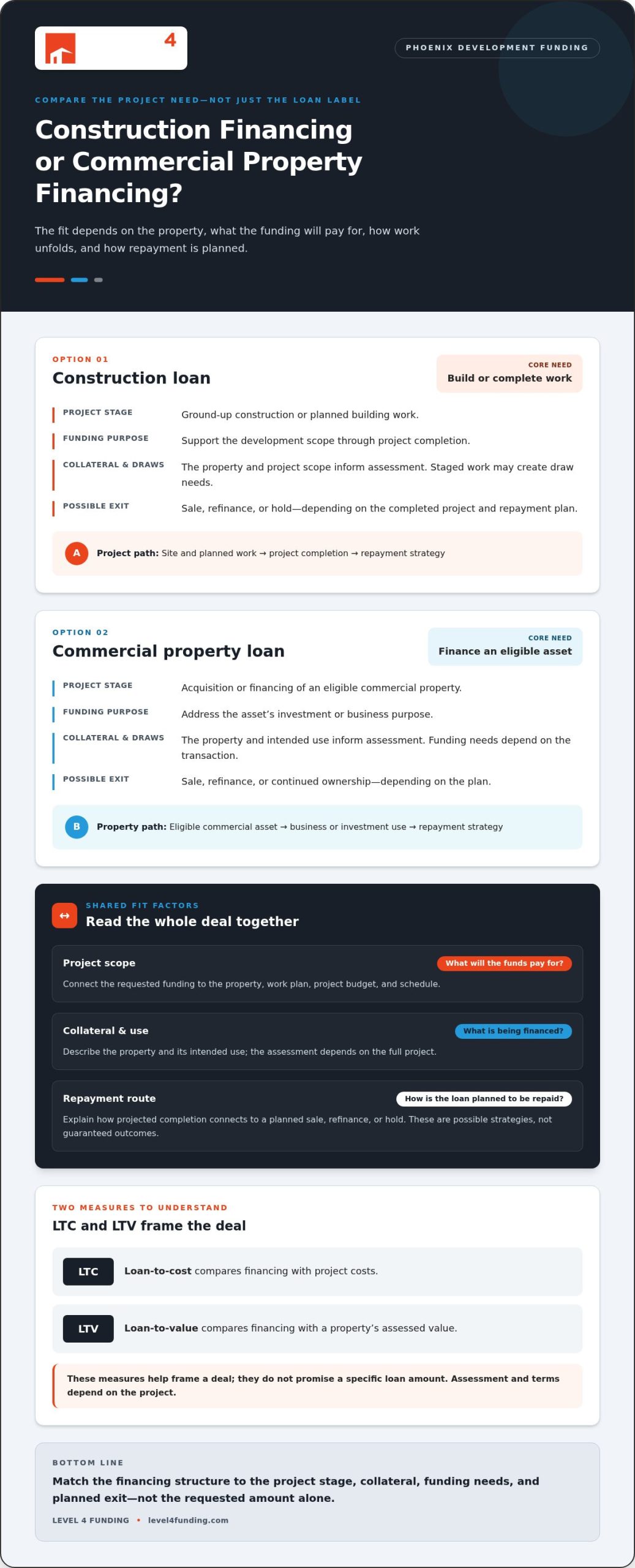
Compare funding options by what the property needs now, not by loan label alone. Construction financing addresses planned building work and project execution. Commercial property financing relates to an eligible commercial asset and its acquisition or business purpose. The right fit depends on the property, use of funds, and repayment plan.
| Funding category | Project stage | Funding purpose | Collateral and draw needs | Possible exit |
|---|---|---|---|---|
| Construction loan | Ground-up construction or planned building work | Support the development scope through project completion | The property and project scope inform assessment; staged work may create draw needs | Sale, refinance, or hold, depending on the completed project and repayment plan |
| Commercial property loan | Acquisition or financing of an eligible commercial property | Address the asset’s investment or business purpose | The property and its intended use inform assessment; funding needs depend on the transaction | Sale, refinance, or continued ownership, depending on the plan |
Loan-to-cost (LTC) compares financing with project costs. Loan-to-value (LTV) compares financing with a property’s assessed value. These measures help frame a deal, but they don’t promise a specific loan amount. The assessment and terms depend on the project.
Construction financing or commercial property financing?
Consider construction financing when the central need is to build or complete substantial planned work, especially when funding must align with project stages. Commercial property financing fits a different need: an eligible commercial asset being acquired or financed for business or investment purposes. Real estate decisions involve multiple disciplines, including design and finance, as reflected in ASU’s discussion of how to lead in a complex, evolving real estate industry. Describe the project rather than relying on a loan label to establish fit.
How the exit plan affects financing fit
Set out how you intend to repay the loan. Selling after completion, refinancing, or holding the property are possible strategies, not guaranteed outcomes. Explain how the project’s projected completion connects to the proposed repayment route. Explore asset-based real estate loans for more context on collateral-focused financing.
General market averages offer context, but lender-specific terms determine how financing applies to your project. For Phoenix private funding for real estate development, compare the scope, collateral, draw needs, and exit together. Investors can also discuss a Phoenix development project with Level 4 Funding when considering construction or commercial property financing.
Phoenix Development Funding: Address the Risks Before You Apply
Private funding can be one structure to consider for a development deal, but it isn’t automatically the right fit. Financing costs, repayment timing, construction execution, and the exit plan all affect whether a project can carry the debt. A strong projection doesn’t remove those risks. Assess them before committing to a funding structure.
For Phoenix private funding for real estate development, treat projected property values and construction costs as estimates supported by clear information, not guaranteed outcomes. A lender assesses the asset, scope, and funding request, while the terms and underwriting depend on the specific deal.
What can derail a development funding request?
Gaps in the plan make an opportunity harder to assess. Before applying, look for issues such as:
- An incomplete budget: Costs are missing, grouped too broadly, or unsupported.
- An unclear scope: The proposed work and definition of project completion aren’t clear.
- Unsupported projections: Expected value or revenue depends on assumptions without a stated basis.
- No defined repayment plan: The request doesn’t explain how the loan could be repaid.
Site diligence matters too. Identify which permitting, utility, and site checks apply to the specific Phoenix-area property, and establish their status using current information for Phoenix or the relevant Maricopa County jurisdiction. Don’t present an unverified approval or infrastructure assumption as settled. If construction takes longer than planned, added carrying costs may strain the budget and delay a sale or refinance.
How to weigh flexibility against financing risk
Compare the proposed funding structure with the project’s realistic schedule, expected funding needs, and repayment timing. A plan that works on the original timeline may become harder to manage if construction runs late, costs rise, or the exit is delayed. Build contingency into the plan where possible, and explain how you would respond if the project misses key milestones.
Model downside scenarios as well as projected returns. Consider what happens if completion costs exceed estimates, the sale takes longer, or refinancing isn’t available on the assumed terms. These are planning tests, not predictions. They can show whether the project has a credible path through setbacks.
For a broader explanation of private, asset-based lending, review hard money loan basics. Weigh potential flexibility against the full cost, execution risk, and exit uncertainty. Pursue financing only when the project plan accounts for those factors.
Prepare a Phoenix Development Deal Package Lenders Can Evaluate
A clear package shows what you’re building, what the property supports, and how funding fits the plan. Organize the information and separate confirmed facts from estimates. Label assumptions rather than presenting them as settled outcomes. This gives a lender a clearer basis to assess Phoenix private funding for real estate development.
Documents and project details to organize
Arrange the package from the project overview through the budget and repayment plan:
- 1. Project summary: State the property’s Phoenix-area location, current ownership or acquisition status, intended use, and development goal.
- 2. Scope and status: Describe the planned work and current project stage. Include available plans, contractor information, and relevant project documents.
- 3. Budget and schedule: Break down the construction budget by major work categories, provide the projected schedule, and explain the basis for key estimates. Identify contingency assumptions and mark preliminary figures.
- 4. Capital request and collateral: Explain the amount and timing of the funding need and identify the property that will serve as collateral. Include relevant property records and available valuation information.
- 5. Exit and repayment: State whether the plan is to sell, refinance, or hold the property, and explain how projected completion connects to repayment.
Check the package for internal consistency. If the schedule depends on resolving a site question, flag that dependency rather than burying it.
Phoenix site diligence and underwriting preparation
Gather information relevant to the specific parcel. This may include available zoning and permitting records, utility information, access details, and environmental diligence. Requirements and records vary by property and jurisdiction. Use current City of Phoenix or applicable Maricopa County information before describing an approval as obtained or required. Keep supporting evidence, pending items, and open questions distinct.
Organize the project summary, budget, schedule, collateral information, and diligence records so they tell the same story. For additional application-stage guidance, review the hard money loan approval process.
With your core documents assembled, discuss your real estate funding project with Level 4 Funding. A complete, transparent package gives the conversation a practical starting point for evaluating construction or commercial property financing against the project details.
Explore Private Development Funding with Level 4 Funding
A development funding conversation should start with the deal, not just the requested amount. Level 4 Funding provides construction loans for projects involving building work and commercial property loans for eligible commercial assets. The property, project scope, funding purpose, and underwriting determine which structure fits. No loan type guarantees approval or specific terms.
For investors considering Phoenix private funding for real estate development, the first step is to present clear information about the opportunity and its financing needs. A concise project summary can frame the discussion, even if some details are still in progress. Mark open questions plainly. A transparent estimate is more useful than a projection presented as certain.
What to share when discussing a Phoenix project
Give the project a clear snapshot. Include the property location, current stage, planned scope, intended use, funding purpose, and target schedule. Summarize the available budget, collateral, and proposed repayment strategy, such as a planned sale, refinance, or hold. Identify which figures are documented, which are estimates, and what assumptions remain unresolved.
This context connects the request to the asset and planned work. Distinguish funding for construction from a request tied to an existing commercial property. Include relevant plans, contractor information, or site diligence records you already have. State uncertainties directly, explain what’s known, and outline how you’re addressing open items.
Choose a next step that moves the deal forward
Bring the summary and supporting materials into a financing discussion. Treat it as an evaluation, not a promise of approval or terms. If important information is preliminary, identify it and update the package as the deal develops.
Before moving ahead, compare proposed financing with the project budget, construction schedule, repayment timing, and downside plan. Consider whether the deal can absorb delays or cost changes without relying solely on projected returns. That keeps the funding decision connected to the project, not just its best-case scenario.
Organize your deal package, clarify the funding purpose, and take the next step with Start a Phoenix real estate funding conversation.
Put Your Phoenix Development Plan in Motion
The right funding fit starts with the project, not just the amount requested. Match the financing category to the development stage, property, budget, and exit plan. Then make the deal easier to assess by separating confirmed facts from estimates and identifying open assumptions.
Level 4 Funding provides private, asset-based real estate financing for investor projects and property assets. Its construction loans and commercial property loans address different development needs, with project details and underwriting guiding the financing discussion. For local context, projects may be based in Phoenix, Scottsdale, Tucson, Glendale, Sedona, Flagstaff, Tempe, Mesa, or Buckeye.
Ready to move from research to a project-specific conversation? Organize your summary, scope, budget, collateral details, and repayment plan, then start a Phoenix real estate funding conversation. A clear deal package makes it easier to discuss Phoenix private funding for real estate development and the needs of your project.
Frequently Asked Questions
What is private funding for real estate development?
Private funding for real estate development is financing from a private lender assessed around a real estate asset and the project’s business purpose. The review may consider the property, development scope, funding need, budget, and repayment plan. Unlike financing designed for a completed property held long term, development funding may address a particular project stage. Phoenix investors should match the request to the work and intended exit.
Can private funding finance ground-up development in Phoenix?
Level 4 Funding provides construction loans for building projects. For ground-up development in Phoenix, the site, project scope, budget, collateral, and underwriting shape the financing discussion. Share the current project stage and distinguish confirmed approvals or site details from items still under review. Local project considerations may differ across Phoenix, Scottsdale, Tucson, Glendale, Sedona, Flagstaff, Tempe, Mesa, and Buckeye.
How do I choose between a construction loan and commercial property financing?
Start with the project’s main funding purpose. A construction loan addresses planned building work and staged execution. Commercial property financing relates to an eligible commercial asset being acquired or used for business or investment purposes. These options aren’t interchangeable. Describe the property, proposed work, funding schedule, and planned exit, then compare the financing structure with the project’s needs and repayment plan.
What documents should I prepare for a private development loan?
Prepare a project summary with the property location, ownership or acquisition status, intended use, and development scope. Organize available plans, contractor information, a detailed budget, and a projected schedule. Include collateral details, the amount and purpose of the funding request, and a proposed repayment or exit strategy. Label estimates clearly, separate them from confirmed facts, and identify unresolved site or project assumptions.
Does private development funding depend on my credit score?
Credit may be part of a lender’s review, but private, asset-based real estate financing also focuses on the property and proposed project. The collateral, scope, budget, funding need, and repayment plan help frame the opportunity. Don’t assume a credit score alone determines fit or that it won’t be considered. Underwriting criteria vary by lender and deal, so present an accurate picture of both the asset and repayment plan.
How quickly can private funding close on a Phoenix development deal?
There isn’t a universal closing timeline for a Phoenix development deal. Timing depends on the project, document completeness, property and collateral review, underwriting, and outstanding site diligence. An organized package helps explain the opportunity but can’t guarantee a closing date. Share your target schedule early and identify open items, such as budget assumptions or site details, that could affect readiness.
What risks should I review before accepting private development financing?
Review the full financing cost, repayment timing, construction execution risks, and uncertainty around the planned exit. Test what happens if costs rise, completion is delayed, or a sale or refinance takes longer than expected. Treat projected property values and budgets as estimates to substantiate, not guaranteed outcomes. Check that the project schedule, available contingency, and repayment plan work together before accepting proposed terms.

About the author
Matt has a bachelor's degree in political science from Northern Arizona University and works at Level 4 Funding, a private lending company that offers hard money and rental home loans to real estate investors in 35 states.
With Matt's leadership, the firm has financed almost $300 million in loans for investment properties. He often helps real estate investors with rental property purchases, foreclosures, refinancing, and fix-and-flip projects. Matt has extensive experience in fix-and-flip, buy-and-hold, rental properties, and real estate sales. He has lived in Arizona for 43 years and is married with three children. Matt is licensed as a mortgage broker and loan originator in Arizona, with NMLS 2062278 and NMLS 1118493.
Equal Housing Opportunity. This is not a Good Faith Estimate, and it is not a Guarantee to lend; it should not be considered as such. Costs, rates, estimates, and terms can only be determined after a full application is completed. To the extent this message includes any tax or legal advice, this message is not intended or written by the sender to be used, and cannot be used, for legal or tax purposes or advice. This is an advertisement. Copyright © 2026. All rights reserved.