


How to Use Hard Money Loans for Real Estate Investing: A Step-by-Step Guide
November 5, 2026
The right private money lenders for real estate can typically finance up to 65%-75% of a property’s after-repair value (ARV). Investment-property purchase deals may close in 1-2 weeks, making private financing an option for investors planning projects in Phoenix and nearby Arizona communities.
Finding private money lenders for real estate is only the first move. The financing has to fit the property, renovation plan, and exit strategy, whether you’re buying a fix-and-flip, funding a rental, or pursuing a commercial or vacant-land deal. A mismatch can put pressure on a project before work begins.
This guide explains private loan options for Arizona investors, what goes into structuring a deal, and how to narrow your search. It covers fix-and-flip, construction, commercial, Airbnb, and cash-out financing, with practical ways to match a loan to the property and plan in Phoenix, Scottsdale, Tucson, and other Arizona communities.
Key Takeaways
- Match the loan structure to the property, renovation scope, and planned exit before weighing lender options.
- Fix-and-flip financing is shaped by both the purchase and the work needed to prepare the property for resale.
- Hard money loans can serve different investment strategies, but the deal’s collateral and repayment plan matter.
- Residential, commercial, and vacant-land projects call for different financing considerations; identify the property type first.
- Use a local lender directory to focus your search, then narrow options by how well they fit your project.
Typical investment-property loan scenarios
Private financing is commonly structured around the property, its value, and the investor’s exit plan. For an investment property in Phoenix, Scottsdale, Tucson, or nearby Arizona communities, connect the loan request to the project and its intended use.
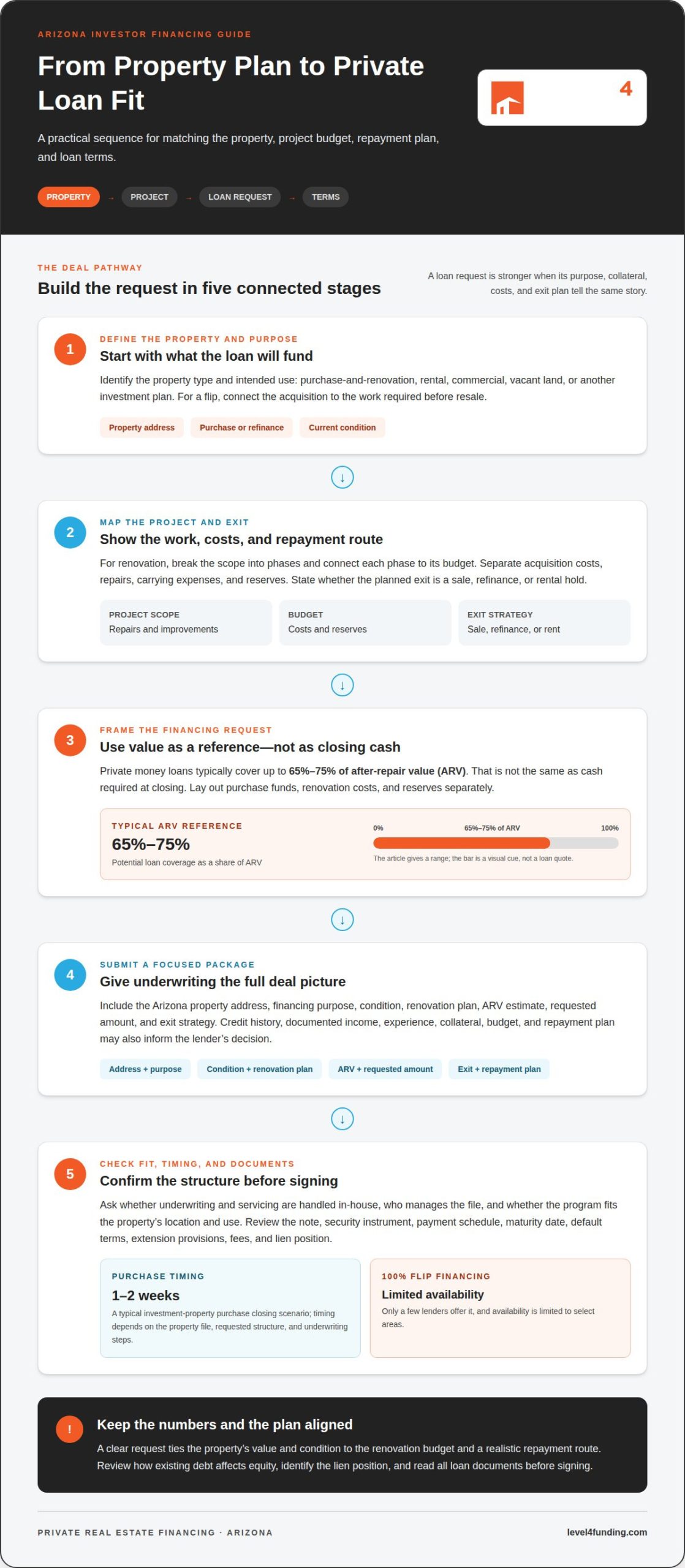
A purchase-and-renovation scenario may use the property’s after-repair value (ARV) to frame the request. Private money loans typically cover up to 65%-75% of ARV. That figure isn’t the same as cash required at closing, so separate purchase funds, renovation costs, and reserves in your project plan. A short-term refinance may fit an investor replacing temporary financing after improvements; listed scenarios include loans below 65% loan-to-value (LTV). Listed lenders will not consider 100% financing for a rental-property purchase.
For an investment-property purchase, closing in 1-2 weeks is described as a typical scenario. The timeline depends on the property file, requested structure, and underwriting steps. Investors in Phoenix or Mesa should align the purchase contract, renovation scope, and planned refinance or sale before submitting a request. A clear timeline connects the loan’s purpose with the project’s actual milestones.
Credit, income, experience, and collateral all inform a private lender’s decision. Lenders may weigh credit history and documented income alongside the investor’s track record, property condition, project budget, and repayment plan. The real estate securing the loan remains central, but the full request helps explain how the borrower intends to repay.
Before signing, review the note, mortgage or security instrument, payment schedule, maturity date, default terms, extension provisions, fees, and lien position. Make sure the contract identifies the property securing repayment and describes the borrower’s obligations. For an Arizona investment property, review the full documents before signing, including how the agreement handles missed payments or a delayed exit.
Lender Search and Loan Requests
Start with a lender whose programs fit the property type and intended use, then submit a focused request. Include the Arizona property address, purchase or refinance purpose, current condition, renovation plan, ARV estimate, requested amount, and exit strategy. A complete package helps underwriting assess the specific deal.
Ask whether underwriting and loan servicing are handled in-house, and identify who manages the file from review through repayment. Local coverage matters: a program for a Phoenix property should fit its location and intended use, not just the investor’s preferred timeline.
Lien Priority and Loan-to-Value Ratios
Lien priority describes a lender’s position against the property if repayment fails. A first lien generally has priority over later recorded liens, while a junior lien sits behind an earlier claim. Review the proposed documents to identify the expected position and how existing debt affects available equity.
LTV compares the loan amount with the property value used for underwriting; ARV-based lending instead considers projected value after improvements. Missouri private-money loans averaged 65% LTV in the first quarter of 2026. Treat that as a Missouri market statistic, not an Arizona benchmark. Compare the requested amount with the property valuation and current mortgage balance.
Fix-and-flip financing
A fix-and-flip loan connects property acquisition with the work needed before resale. Build the request around the purchase, rehab scope, and planned exit for properties in Phoenix, Tucson, or another Arizona market.
Start with a property-level budget, not a wish list. For a Phoenix investment property, separate acquisition costs from repairs, carrying expenses, and the planned resale. A lender can assess the collateral and proposed project together. Map the sequence: acquire the property, complete improvements, then sell or refinance. If the numbers rely on aggressive resale assumptions, delays or unexpected repairs can squeeze the plan.
Only a few lenders offer 100% financing for house flips, and availability is limited to select areas. That makes the capital structure an early decision, not a last-minute detail. A broker may help identify relevant programs, while the borrower’s project file should explain property condition, repair scope, budget, and exit. Lenders may assess the deal differently, so keep the project details consistent across each request.
Construction and Rehabilitation Financing
Construction financing applies when a project involves building, while rehabilitation financing supports substantial improvements to an existing property. The distinction affects the project budget and work schedule. A Phoenix flip requiring structural repairs needs a different scope from one needing cosmetic updates. Break the work into phases, connect each phase to its budget, and show how the finished property supports resale or refinancing.
Renovation Financing
Renovation financing focuses on improvements that prepare a property for its next use or sale. List planned repairs, such as replacing damaged flooring or updating a kitchen, and connect each item to the project budget. Separate necessary repairs from optional upgrades to make the scope easier to assess and show which work supports the resale plan.
Revenue-based financing considers a property’s expected income as part of repayment planning. It may suit an investor who plans to hold and rent a renovated property rather than sell immediately. A lender assessing that strategy may consider the rental plan alongside the property and project costs. Tie projected income to the specific asset and intended use, not broad market claims or advertising estimates.
Before submitting a request, organize the deal into a clear financing package: purchase details, property condition, renovation scope, budget, and exit strategy. Include relevant investor experience and project records when they help explain the plan. A hard-money broker can help match the request with lending options, but your figures and scope still need to be consistent and workable. Avoid a gap between the capital requested and the work the project requires.
For projects centered on substantial building work, construction loan financing may fit better than a purchase-only approach. Match the loan type to the work before committing to the property.
Hard money loans for Kansas City real estate investors
Hard money loans use real estate as collateral and can support investment projects where the property and repayment plan drive the lending decision. For borrowers exploring options with Level 4 Funding, understanding the loan’s term, total borrowing cost, and exit strategy is essential before committing capital.
Arizona recorded an estimated $414 million in short-term private-money loan volume across 748 loans in a recent quarter. That activity offers a snapshot of investor borrowing, not a promise that a particular project will qualify. Regional market statistics similarly reflect steady demand for short-term investment-property loans. For an investor, the practical step is to build the request around the property, project budget, and repayment plan, then assess how the proposed debt fits the broader portfolio.
Loan terms and costs vary by lender and deal structure. Level 4 Funding and similar private real estate lenders often provide typical loan terms of 12-18 months. That short horizon can suit a defined renovation or resale plan, but it demands a credible exit. Borrowers should account for project delays, carrying costs, and the time needed to sell or refinance. A repayment plan that works only if every step happens on schedule leaves little room to adjust.
Investor distributions from a lending fund depend on the fund’s terms and the income it receives from its loans. Reported returns for private real estate lending funds range from 7%-12%; some funds report historical investor returns of 10%-13%. Those figures describe different reported measures, not a guaranteed distribution or a forecast for a specific investment. Review how a fund explains distributions, fees, loan performance, and timing before evaluating its place in an investment portfolio.
Accredited investor eligibility is another consideration for people investing in a private lending fund. An individual investor is described as having income of at least $200,000 for at least two years, with a reasonable expectation that the income will continue. That threshold concerns fund investment eligibility, not a borrower’s qualification for a hard money loan with Level 4 Funding. The two decisions involve different roles: one person supplies investment capital, while another borrows against property.
For borrowers, the property and repayment plan remain central. Compare the loan requested with the project’s expected income or sale proceeds, and account for existing mortgage debt. A short-term loan can support a fix-and-flip, construction project, or income-producing property, but the exit strategy must fit the term. Also understand whether the arrangement is a direct loan or a fund investment, since fees, distributions, and repayment obligations differ. Resolve those questions before committing funds or signing loan documents.
Residential, commercial, and vacant-land private loans
Property type shapes the financing structure: a rental home, storefront, and vacant parcel present different collateral and repayment plans. Match the loan to the asset and the next step you expect to take.
Private money describes a nonbank source of real estate funding, while hard money usually describes a property-focused loan structure; the terms can overlap. A bank mortgage generally follows a different underwriting process, often weighing borrower finances alongside the property. Private and hard-money lenders may place more emphasis on collateral and the project plan, but terms still depend on the deal.
Residential and Commercial Bridge Loans
A bridge loan can cover a temporary financing gap while an investor prepares a property for sale, refinance, or longer-term financing. Residential examples include a rental home needing work before stabilization; commercial examples include a building awaiting renovation or new occupancy. Commercial real estate bridge loans may run for up to 2 years. Tie the requested term to the project milestones and intended exit.
Vacant land calls for a clear use and repayment path because it may not have rental income or a finished building to support the plan. Explain whether the parcel will be held, improved, or prepared for construction, and show how that step leads to repayment. For commercial property, describe its current use and planned changes. A land request and an occupied-property request should not rely on the same assumptions.
Loan Duration and Repayment Options
Private loan duration varies by program and property. Commercial bridge loans may have terms of up to 2 years, while the repayment plan can center on sale, refinance, or property income. Set the planned exit before accepting the term. If refinancing is the goal, identify how completed work or stabilized operations will support the next loan.
Hard-money and bridge loans often serve temporary project needs, while a fix-and-flip loan targets acquisition and renovation before resale. For example, an investor might use bridge financing to reposition a commercial property, or renovation financing to prepare a house for sale. Match the loan purpose to the work, collateral, and exit, not just the property label.
Real estate equity-backed loans use property equity as collateral. The lender considers existing mortgage debt and the value supporting the requested amount, so equity alone does not explain the full repayment plan. Account for the current loan, proposed financing, and how you will use the proceeds. For a rental, expected income may also inform the plan; for vacant land, intended use and exit are especially important.
- Residential: connect the requested funding to purchase, repairs, rental use, or resale.
- Commercial: describe the building’s use, planned improvements, and path to refinance or sale.
- Vacant land: explain the parcel’s intended use and how that plan supports repayment.
Before signing, compare the repayment schedule and maturity date with the project’s likely milestones. A short-term bridge loan is a poor fit if the exit depends on work or a sale that cannot reasonably align with the term.
Private real estate lender directory
A directory is a starting point, not a financing decision. In Kansas City, use it to identify lenders whose geography, property focus, and loan purpose match your project.
For Kansas City, Missouri, ZIP code 64161 is listed as a reference point for checking lender proximity. Start by searching around the property’s location, then narrow results by the deal: residential purchase, fix-and-flip, commercial property, or vacant land. A lender nearby may understand local property types, but distance alone doesn’t establish whether its program fits your request.
Build a short list around the details a directory can help you compare: stated market, collateral types, loan purposes, and request process. If one listing covers commercial property and another focuses on residential investment, separate them by project instead of treating every result as interchangeable. That keeps a property-specific request from getting lost in a broad inquiry.
Use a consistent loan summary for each inquiry. Include the property address, use, purchase or refinance purpose, current condition, requested financing, project scope, and repayment plan. For example, an Arizona investor buying vacant land should describe its intended use and exit, rather than presenting it like a renovated rental. Consistency makes it easier to compare responses without confusing different loan assumptions.
Public directories can include lenders with different structures, from an individual private investor to a lending company. A listing’s label alone doesn’t tell you who underwrites the loan, who services payments, or what happens after closing. Ask how the application moves from initial review to funding and identify the organization or person responsible at each stage.
Keep the states and property location in view. A directory result for another state may not cover a Kansas City property, even if its listed loan purpose sounds right. Narrow by location first, then by property type and program. For a ZIP-based search, 64161 can help orient the proximity check, while the actual property address remains central to the request.
Before choosing a match, compare the written loan terms, lien position, repayment schedule, and planned exit. A residential flip, commercial bridge project, and vacant-land purchase each call for different collateral details and repayment logic. A clear directory search identifies possible fits; the loan documents establish the actual terms.
Ready to move from a directory search to a project-specific lending conversation? Explore hard money lending for real estate investment financing.
Level 4 Funding: Hard money lender
Level 4 Funding helps real estate investors pursue property-backed financing through hard money lending. Turn to the team when a project needs a loan structured around an investment property, renovation plan, or commercial asset.
For a resale project, Fix and Flip Loans can support an acquisition and renovation strategy. Construction Loans address building projects, while Commercial Property Loans serve investment deals involving commercial real estate. The right fit depends on the property, project scope, and repayment plan you’re bringing forward.
Have a specific property and financing purpose in mind? Contact Level 4 Funding to discuss the project and its lending needs.
Set Your Financing Plan Before the Next Deal
Your next investment decision starts before you make an offer. Define the property profile, project purpose, and repayment path you’re prepared to pursue. Then assess whether the financing structure supports the deal or adds pressure. That discipline can keep urgency from turning into a commitment that doesn’t fit your investment strategy.
Choosing among private money lenders for real estate is part of that planning. Bring the specific opportunity and your intended approach into the conversation. A focused discussion can help connect the financing request to the investment, rather than chasing a loan that doesn’t serve the project.
Ready to discuss your real estate investment financing? Contact Level 4 Funding to talk through your project and next step. Keep your plan clear, make each decision with purpose, and move forward with confidence.
Frequently Asked Questions
What are private money lenders for real estate, and how do they work?
A private money lender for real estate is an individual or company that funds an investment-property loan secured by real estate. The borrower submits the property details, project plan, and repayment strategy for review. For example, an investor may seek capital to acquire a rental or renovate a property, then repay through a sale or refinance. The loan documents set out the actual obligations and terms.
What interest rates, points, fees, and down payments do private real estate lenders typically require?
Rates, points, fees, and down payments depend on the loan structure, property, requested leverage, project scope, and borrower profile. Points are expressed as a percentage of the loan amount, while a down payment is the borrower’s contribution toward the purchase or project. Compare the full written repayment obligation, not just the interest rate. Include stated fees, payment dates, and maturity terms in your review.
What loan-to-value and loan-to-cost ratios do private lenders offer for real estate?
LTV compares a loan amount with a property’s value; LTC compares it with project costs. A renovation request should distinguish current value from after-repair value and itemize acquisition costs and planned work. A projected resale value can inform an ARV-based assessment, while the purchase and renovation budget inform LTC. These measures describe different parts of a deal, so don’t treat them as interchangeable.
What property types and real estate projects can private money lenders finance?
Private financing can support investment homes, fix-and-flips, construction, commercial buildings, rentals, and some vacant-land transactions. The property’s condition and intended use shape the request: a finished rental has an operating plan, while a bare parcel depends more on its development or resale strategy. Level 4 Funding offers Fix and Flip Loans, Construction Loans, and Commercial Property Loans for applicable investment projects.
How can borrowers find and verify reputable private real estate lenders near them?
Start with a directory filtered by the property’s location and project type, then compare listed programs and loan-request channels. Review who underwrites the loan, who services payments, and which legal entity appears in the documents. The American Association of Private Lenders (AAPL) does not license private lenders or issue a private lender license. AAPL members must abide by its Code of Ethics, which is distinct from licensing.
What are the steps to apply for and close a private real estate loan?
Define the property and intended use, assemble purchase details and the project budget, submit the loan request, review proposed terms, and complete closing documents. Include a repayment route, such as sale, rental income, or refinance, so the request explains how the debt will be repaid. Before signing, review the note, mortgage, payment dates, maturity, default provisions, and lien position.
Are private money lending rates and regulations different by state in the United States?
Applicable state and federal regulations govern private money lenders, so requirements can differ by state. Rates and terms also depend on the lender and the specific deal, including property type, collateral, and requested leverage. There isn’t one uniform offer for every state or project. For an Arizona property, the request and loan documents should reflect the location and transaction.

About the author
Matt has a bachelor's degree in political science from Northern Arizona University and works at Level 4 Funding, a private lending company that offers hard money and rental home loans to real estate investors in 35 states.
With Matt's leadership, the firm has financed almost $300 million in loans for investment properties. He often helps real estate investors with rental property purchases, foreclosures, refinancing, and fix-and-flip projects. Matt has extensive experience in fix-and-flip, buy-and-hold, rental properties, and real estate sales. He has lived in Arizona for 43 years and is married with three children. Matt is licensed as a mortgage broker and loan originator in Arizona, with NMLS 2062278 and NMLS 1118493.
Equal Housing Opportunity. This is not a Good Faith Estimate, and it is not a Guarantee to lend; it should not be considered as such. Costs, rates, estimates, and terms can only be determined after a full application is completed. To the extent this message includes any tax or legal advice, this message is not intended or written by the sender to be used, and cannot be used, for legal or tax purposes or advice. This is an advertisement. Copyright © 2026. All rights reserved.