


What Is LTV in Real Estate Finance? A Plain-English Guide for Investors and Borrowers
October 22, 2026
A cash offer doesn’t always mean the buyer already has the full purchase price in a bank. In Phoenix, a cash sale avoids lender underwriting for the purchase, and a buyer can secure funds through a financing company that buys the home for cash on the buyer’s behalf. In 2025, roughly 25% to 30% of Phoenix home sales were cash deals.
A cash offer can give a buyer an edge, but the funds must be ready and the numbers must work. Securing funding to make a cash offer on a house in Phoenix means choosing a financing route, preparing proof of funds a seller can assess, and understanding how your offer compares with a mortgage-backed bid.
This guide explains what counts as a cash offer, how buyers can fund one, how to document available funds, and how investors assess an offer. It also covers how timing affects a deal, so you can plan your next steps with confidence.
Key Takeaways
- Prepare seller-ready proof of funds, such as a bank statement or bank letter, and be ready to include an earnest money deposit in the offer.
- For an investor offer, estimate the property’s after-repair value, subtract repair costs, and use the 70% rule as a starting point rather than a guaranteed price.
- Compare the expected closing schedule with your funding timeline; cash purchases in Arizona can close in roughly 7-14 days, while financed sales typically take 30-60 days.
- Review private-lending terms separately from the purchase contract so you understand how financing, contingencies, and closing steps fit together.
- For a renovation-focused purchase, consider whether a Fix and Flip Loan fits the project and the way you plan to fund the acquisition and repairs.
Definition and funding sources for cash buyers
A cash buyer can close without mortgage underwriting on the home purchase. The money may come from personal funds or financing arranged to support a cash offer.
Watch this overview of how buyers can structure a cash offer without holding all the cash themselves:
Cash Buyer Funding Options
A cash buyer is defined by how the purchase is presented and funded at closing, not simply by the balance in a personal checking account. Buyers may use savings, investment funds, or private financing. A financing company can also purchase the home for cash on a buyer’s behalf. This structure may help buyers compete without relying on mortgage underwriting for the purchase.
Other funding routes suit different situations. Bridge loan services can provide short-term home equity financing for buyers purchasing before selling their current home. Compare the repayment plan with the expected sale timeline, and account for closing costs and available reserves. The offer price alone is not the total amount you may need.
Cash and conventional financing can feel similar to a seller only if the funds are ready when required. A cash offer may reduce financing-related steps, but buyers still need to review the property, contract, title, and closing figures. Phoenix buyers should compare nearby homes before deciding what their offer can support. In 2025, roughly 25% to 30% of Phoenix home sales were cash deals.
Comparing Private and Hard Money Lenders
When comparing hard money lenders or private lenders in Phoenix, review written terms, funding conditions, repayment structure, and how the lender evaluates the property. Ask what documents are needed to demonstrate funds and what must happen before they are released. Clear answers and consistent written terms matter more than speed alone.
Check that the financing fits both the property and your plan. A hard money lender may focus on the real estate and transaction, while borrower credit and experience can also factor into the terms. Compare your required cash contribution, conditions for releasing funds, and closing timeline. Securing funding to make a cash offer on a house in Phoenix starts with matching the financing to the deal, not chasing a cash label.
Before submitting an offer, map each funding step to the contract timeline. Confirm when funds must be available, what documentation supports the offer, and which closing costs remain your responsibility. This preparation helps you judge whether the financing makes the purchase easier or adds another moving part. Keep the offer, funding plan, and available reserves aligned from negotiation through closing.
Proof of funds and cash-offer red flags
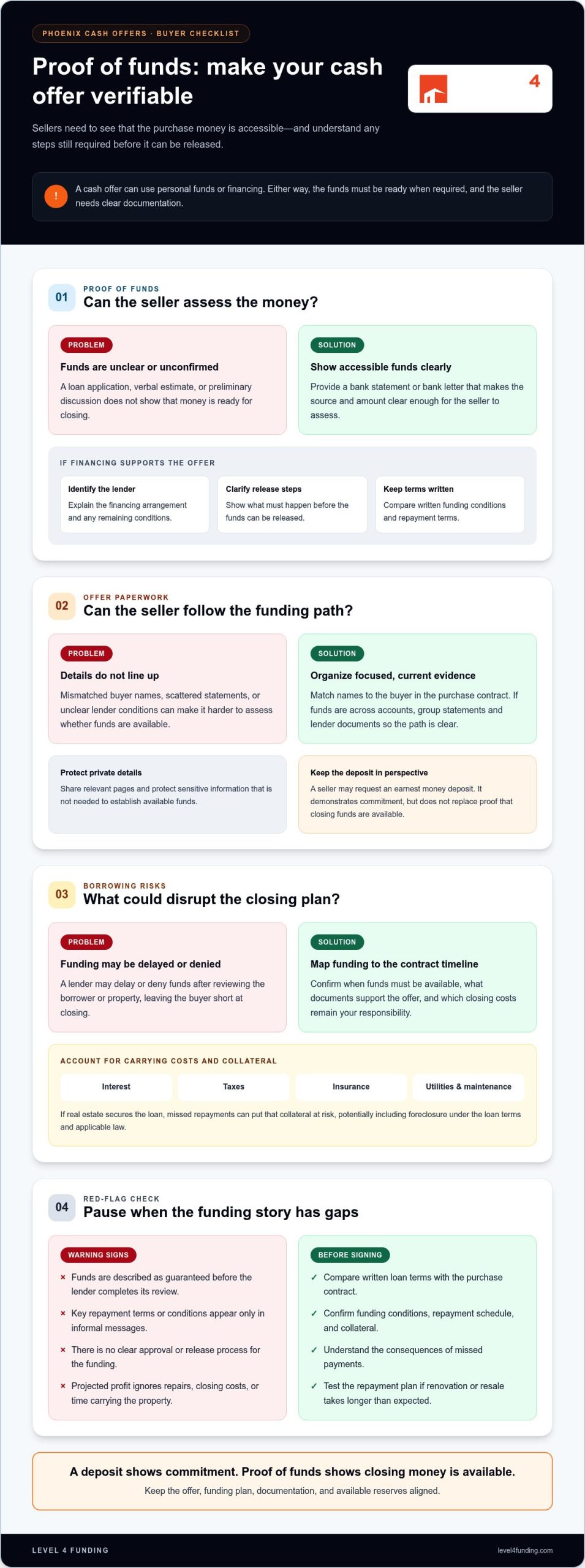
Arizona sellers may ask for proof of funds before accepting a cash offer. Borrowed funds can still be delayed or denied, create carrying costs, or put pledged property at risk of foreclosure if repayment fails.
Proof of Funds Requirements
A bank statement or bank letter can show that funds are available for the transaction. It should make the source and amount clear enough for the seller to assess whether the purchase money is accessible. Buyers using financing can provide lender documentation explaining the arrangement and any remaining conditions.
Prepare the evidence before submitting the offer. Make sure the names and account details match the buyer named in the purchase contract. A seller may also request an earnest money deposit, which demonstrates commitment but does not replace proof that closing funds are available.
Keep paperwork current and focused. Share relevant pages rather than unrelated account activity, and protect sensitive information that isn’t needed to establish available funds. If money is spread across several accounts, organize statements and lender documents together so the seller can follow the funding path.
For example, a buyer using private financing should distinguish approved funds from a preliminary discussion. A clear letter should identify the lender, intended property or transaction, and any remaining steps before funds can be released. Don’t present a loan application or verbal estimate as money ready for closing.
Borrowing Risks and Offer Red Flags
What risks come with borrowing to make a cash offer, including loan denial, carrying costs, and foreclosure? A lender may deny or delay funding after reviewing the property or borrower, leaving you short at closing. Meanwhile, interest, taxes, insurance, utilities, and maintenance can add carrying costs while the property remains unsold or unfinished.
If a loan is secured by real estate, missed repayments can put that collateral at risk, potentially including foreclosure under the loan terms and applicable law. Base your repayment plan on a realistic sale or refinance timeline, not an optimistic profit estimate. Market conditions, repair scope, and project duration all affect whether the exit plan can support the debt.
Watch for red flags during the transaction:
- The lender describes funds as guaranteed before completing its review.
- Key repayment terms or conditions appear only in informal messages.
- The offer depends on financing that has no clear approval or release process.
- The projected profit ignores repairs, closing costs, or time carrying the property.
Before signing, compare the written loan terms with the purchase contract. Confirm funding conditions, repayment schedule, collateral, and the consequences of missed payments. Map payment dates against expected renovation and resale milestones, then stress-test the plan in case the sale takes longer.
For an investment purchase that depends on short-term property financing, review hard money loan options as part of your funding plan.
Cash offer calculation and the 70% rule
A cash offer should start with the property’s likely value after repairs, not just the seller’s asking price. Phoenix investors often compare nearby sales, renovation needs, and resale potential before settling on an offer.
The common 70% rule estimates an offer by multiplying after-repair value (ARV) by 70%, then subtracting repair costs. It’s a screening tool, not a guaranteed offer formula. A buyer still needs to account for the property’s condition and the transaction’s expected expenses.
That result is a starting estimate. A contractor’s repair assessment and comparable sales may change the assumptions behind it.
Use local comparisons, not a formula alone
Typical wholesaler and flipper cash offers in Phoenix are 70-85% of market value. Another measure reports cash investors typically pay 67.5% of a home’s ARV. These figures use different reference points, so don’t treat them as interchangeable: market value and repaired value describe different conditions.
These examples show how a property’s condition and valuation assumptions affect the offer.
Before making an offer, compare recent nearby properties with similar size, layout, and condition. A real estate agent can help assess comparable sales and support negotiations. Scottsdale sales may provide context, but Phoenix buyers should prioritize the closest relevant comparables rather than assume the markets move identically.
Turn the estimate into a defensible offer
- Estimate ARV: Use comparable repaired homes in the same Phoenix area.
- Itemize repairs: Separate necessary work from optional upgrades, then estimate each item.
- Apply the rule: Multiply ARV by 70%, then subtract estimated repair costs.
- Test the result: Compare it with market-value offer ranges and your own transaction plan.
A sound purchase price leaves room for the project’s actual work and resale plan. If a traditional sale seems more suitable, compare likely proceeds with the convenience of a cash purchase. The right choice depends on the home’s condition, comparable sales, and your purpose as a buyer.
Cash sale timelines
A Phoenix cash purchase can close in roughly 7-14 days, compared with 30-60 days for a financed sale. The advantage depends on having funds ready, title work completed, and contract steps moving on schedule.
Typical Phoenix cash-sale costs still include title and escrow fees, and sellers may pay HOA transfer fees. Cash transactions can avoid lender fees and appraisal costs, but title, escrow, inspection, and ownership-transfer steps may still apply.
What sets the closing pace?
After both parties sign the purchase and sale agreement, the buyer can place funds in escrow. Ownership transfers through the deed once closing requirements are complete. The escrow timeline depends on how quickly the parties provide documents, resolve title issues, and meet contract deadlines.
For example, a buyer targeting a 7-14-day close needs cleared funds available promptly. A delay in transferring money or responding to a title request can push the date. A purchase financed through borrowing also depends on the lender’s funding conditions, even if the seller sees a cash offer.
Investors should build the property plan around the closing date. If repairs begin after ownership transfers, schedule contractors, materials, and access only once you have the right to proceed. A short closing timeline can move the purchase forward, but renovation and resale won’t necessarily happen right away.
Plan cash needs beyond the purchase price
Calculate the funds needed for the purchase price, closing costs, and immediate property needs. Ask the escrow team for an itemized estimate of title and escrow charges, then review who pays each amount under the contract. Arizona cash sellers may also face HOA transfer fees if the property belongs to an association.
Cash buyers can use an inspection and appraisal to assess a home, even when those steps aren’t required for the purchase. An inspection can identify repairs that affect the project schedule or reserve funds. An appraisal can help assess value, though cash buyers may avoid appraisal costs by choosing not to obtain one.
A traditional financed sale commonly takes 30-60 days to close, while a cash sale in Arizona can take roughly 7-14 days. Some cash purchases may close in as few as 2-3 days after an offer, but that pace requires ready funds and coordinated paperwork. Treat the contract date as a working deadline, not a substitute for completing each escrow step.
Before agreeing to a closing date, match the funding release, escrow deposit, title review, and scheduled payments to the contract. For example, if the buyer needs loan funds released before escrow can receive the balance, that step must fit the timeline. Clear sequencing helps buyers protect their purchase price and avoid last-minute funding gaps.
What are the Arizona rules for private lending, mortgage lending, and real estate purchase contracts?
Separate the financing terms from the home purchase contract. In Arizona, your practical review starts with the written agreement, funding conditions, and escrow instructions.
Read the financing documents as a separate deal
A private loan and a mortgage-backed purchase can involve different underwriting and funding steps. The key distinction is whether the purchase depends on lender approval before funds reach escrow. A cash offer avoids lender underwriting for the home purchase, but borrowed money may still have its own approval conditions.
Before making an offer, read the loan documents alongside the purchase agreement. Identify the borrower, property, collateral, funding conditions, repayment schedule, and consequences of missed payments. If a lender must review the property before releasing money, include that step in your timeline rather than treating the funds as immediately available.
Don’t rely on a verbal summary of financing terms. Compare the final written documents and flag any mismatch in the buyer’s name, property address, amount financed, or funding deadline. Loan approval does not replace the buyer’s obligations under the purchase contract.
Make the purchase contract match the funding plan
The purchase and sale agreement records the buyer’s offer and the terms agreed by both parties. Review the purchase price, earnest money, closing date, included items, and any inspection or financing contingencies. A cash offer doesn’t automatically remove contract protections. The written terms determine what the parties have agreed to do.
After signing, the buyer can place funds in escrow before ownership transfers through the deed. Coordinate the contract deadline with escrow instructions and the lender’s release process. If the agreement sets a closing date before borrowed funds can arrive, the funding plan and contract schedule are out of sync.
Use this document check before signing:
- Match buyer and property details across the contract and loan paperwork.
- Confirm the earnest money amount, delivery instructions, and deadline.
- Review inspection, financing, and other contingencies stated in the agreement.
- Align the closing date with escrow requirements and funding release conditions.
Arizona buyers shouldn’t assume that a “cash” label changes every contract term. A private lender’s commitment, the buyer’s obligations, and the escrow process are separate pieces. Resolve discrepancies in writing before signing or waiving a contract protection. This keeps the purchase terms and available funds aligned.
For an investment purchase that uses private financing, discuss your real estate funding plan in light of the property and transaction.
Level 4 Funding: Fix and Flip Loans
Level 4 Funding offers Fix and Flip Loans for real estate investors planning a purchase and renovation project. If you’re weighing a cash offer on a property that needs work, this financing option may fit your investment strategy. The right plan starts with the property, repair scope, purchase terms, and intended exit, not simply the desire to compete as a cash buyer.
Bring those details together before choosing a funding route. A clear view of the property and project helps you assess how financing fits the offer and your next steps. For other investment needs, Level 4 Funding also offers Construction Loans, Commercial Property Loans, and Cash Out Refinance.
Contact Level 4 Funding to discuss financing for your real estate investment.
Make Your Next Move With a Clear Funding Plan
The next step is to turn your preferred property into a workable investment plan. Before committing, connect the acquisition, renovation needs, available funds, and intended exit. Then assess whether the deal still works if repairs take longer or resale plans change.
If securing funding to make a cash offer on a house in Phoenix is part of your strategy, match the financing to the project. Level 4 Funding offers Fix and Flip Loans, Construction Loans, and Commercial Property Loans for real estate investors. Choose the option that aligns with the property and the work ahead, then discuss how the financing fits your purchase plan.
Contact Level 4 Funding to talk through your real estate investment financing needs. A clear plan puts you in a stronger position to make your next move with purpose.
Frequently Asked Questions
What Is a Cash Offer on a House?
A cash offer is structured without mortgage underwriting for the home sale. The buyer may still borrow funds elsewhere, so “cash” describes the transaction presented to the seller, not necessarily money held in a personal account. For example, a funding company may purchase the property for cash on a buyer’s behalf. The seller should still review the written terms, deposit, and closing plan.
What financing options let a buyer make a cash offer on a house in Phoenix?
Buyers can use personal funds, private real estate financing, or a funding company that purchases the property for cash on their behalf. A bridge loan may also use home equity to help buy before selling a current property. Investors in Phoenix, Scottsdale, Tucson, Glendale, Sedona, Flagstaff, Tempe, Mesa, and Buckeye should match the funding route to the property, repayment plan, and purchase timeline.
How does a hard money loan work for a Phoenix home purchase, and what are typical rates and fees?
A hard money lender evaluates the real estate and the proposed transaction to determine whether the property supports the loan. The borrower repays under the loan agreement, with the property serving as collateral. Rates and fees depend on factors such as the property, requested amount, renovation scope, loan term, and repayment plan. Exact pricing is provided after a quote request, rather than through one universal rate.
Can a buyer use a bridge loan, HELOC, or pledged-asset loan to make a cash offer in Arizona?
Yes, these are possible funding approaches, but each uses a different source of repayment or collateral. A bridge loan can provide short-term home equity funding before a current home sells. A HELOC draws against available equity, while a pledged-asset loan borrows against eligible investments. Before making an Arizona offer, match the expected sale or repayment funds to the lender’s payment schedule.
How do proof-of-funds letters and cash-to-close requirements work for Phoenix home offers?
A proof-of-funds letter or bank statement demonstrates that purchase money is available; it isn’t the final closing statement. Cash to close is the amount the buyer must deliver to escrow after accounting for the purchase terms, deposits already paid, and applicable closing charges. For a Phoenix offer, organize lender documentation with account evidence, then compare escrow’s final figures with the funds you can access.

About the author
Matt has a bachelor's degree in political science from Northern Arizona University and works at Level 4 Funding, a private lending company that offers hard money and rental home loans to real estate investors in 35 states.
With Matt's leadership, the firm has financed almost $300 million in loans for investment properties. He often helps real estate investors with rental property purchases, foreclosures, refinancing, and fix-and-flip projects. Matt has extensive experience in fix-and-flip, buy-and-hold, rental properties, and real estate sales. He has lived in Arizona for 43 years and is married with three children. Matt is licensed as a mortgage broker and loan originator in Arizona, with NMLS 2062278 and NMLS 1118493.
Equal Housing Opportunity. This is not a Good Faith Estimate, and it is not a Guarantee to lend; it should not be considered as such. Costs, rates, estimates, and terms can only be determined after a full application is completed. To the extent this message includes any tax or legal advice, this message is not intended or written by the sender to be used, and cannot be used, for legal or tax purposes or advice. This is an advertisement. Copyright © 2026. All rights reserved.