


What is a Hard Money Lender? Funding Phoenix Investments
October 4, 2026
Bridge Loans in Arizona: How They Work, Who Qualifies, and Where to Get One Fast
October 5, 2026
What if the real test of becoming a hard money lender isn’t finding borrowers, but being ready when a deal goes sideways? Learning how to be a hard money lender means building more than a pool of capital. A property-secured loan can still lead to a loss if the collateral is overvalued, the terms are poorly structured, or repayment and servicing aren’t managed carefully.
The appeal is clear: real estate investors need funding for projects that may not fit conventional lending. But a sound lending operation takes disciplined underwriting, enough liquidity to handle the unexpected, and repeatable processes from application through payoff. Arizona’s lending rules can depend on the loan and borrower, so qualified legal counsel should review your plan before you fund a deal.
This guide explains how to assess the opportunity, plan your capital, evaluate collateral, investigate applicable rules, and build reliable loan operations. You’ll also see how to choose a practical next step. If you’d rather invest in property than originate loans, Level 4 Funding provides private real estate financing, including hard money, fix-and-flip, construction, and commercial property loans.
Key Takeaways
- Know the difference between lending directly, brokering loans, and investing in property so you can choose the role that fits your goals.
- Set clear criteria for the properties, projects, borrowers, and loan purposes you’ll consider before reviewing deals.
- Use a consistent underwriting sequence to assess property value, title, loan-to-value, and realistic repayment paths.
- Learning how to be a hard money lender also means planning for legal review, loan servicing, recordkeeping, and potential defaults.
- Build your operation in stages, or explore private real estate financing if your goal is to fund an investment project rather than originate loans.
What does it mean to be a hard money lender? Understand the business before entering it
A hard money lender provides short-term, property-secured financing to real estate investors. The lender evaluates the proposed deal, decides whether the collateral and repayment plan support the loan, documents the terms, and funds it. A hard money loan is closely tied to real estate collateral, but that security doesn’t eliminate the risks of default, inaccurate valuation, title problems, limited liquidity, or foreclosure.
Be clear about the role you’re choosing. A direct private lender uses capital to make loans. A broker connects borrowers with lenders but doesn’t necessarily provide the funds. A bank lends through its own regulated lending structure, while a property investor earns through acquisition, renovation, rental, or resale. These are distinct businesses, with different responsibilities and risk exposures. For a borrower-focused overview, see what a hard money loan is.
For a closer look at starting a lending fund, watch this video:
How hard money lending differs from owning or flipping property
A lender’s work doesn’t end when funds go out. The operation must assess the borrower and property, put the agreement in place, coordinate funding, track payments, and manage the loan through payoff or a problem. A property owner, by contrast, takes on the project itself by buying, improving, renting, or selling real estate.
Lending income depends on the written terms and the borrower’s repayment. There’s no guaranteed return, and collateral may not fully cover a loss. If you’re weighing how to be a hard money lender, assess the responsibilities and risks, not just the potential income.
Choose a lending model before committing capital
You might lend personal funds, lend through an entity, or participate in a pool of capital. Each structure can affect control, liability, reporting, and how funds are managed. A pool may also raise securities questions. Before committing money, have qualified legal and tax professionals review the proposed structure, including possible entity, tax, and consumer-credit issues.
Arizona is one market to examine, not a universal rulebook. Applicable requirements can depend on the lender’s structure, the borrower, the property, and the transaction. Get professional review before funding. Start by understanding the business you’re entering, then assess whether your capital and risk tolerance fit the work.
Plan capital, deal criteria, and liquidity before funding your first loan
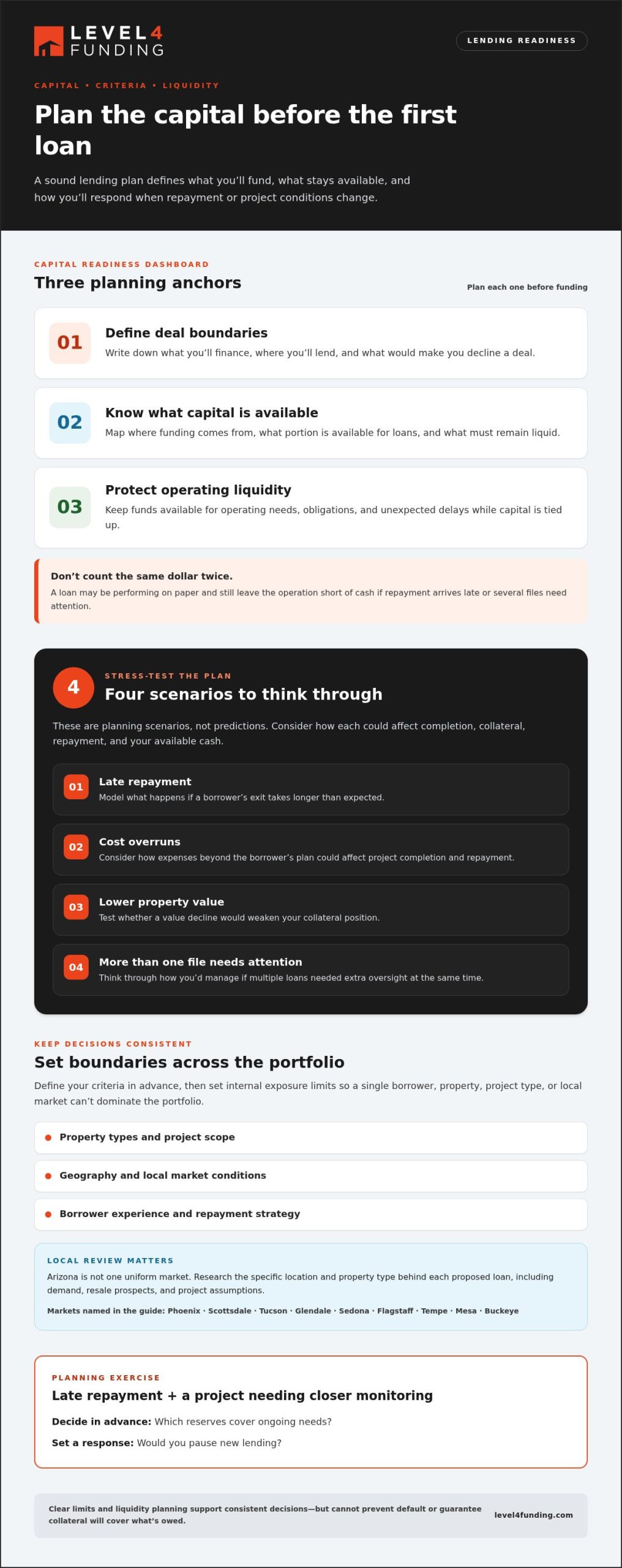
Capital is more than the money you can wire today. A lending plan needs clear deal boundaries, funds available for new loans, and liquidity for operating needs or disruptions while existing capital remains tied up. Before deciding how to be a hard money lender, write down what you’ll finance, where you’ll lend, and what would make you decline a deal.
Set lending boundaries and portfolio concentration limits
Define your acceptable property types, geography, project scope, borrower experience, and repayment strategy. Then set internal exposure limits so one borrower, property, project type, or local market can’t dominate your portfolio. These rules help keep decisions consistent, but they can’t prevent a borrower default or guarantee that collateral will cover what’s owed.
Arizona isn’t one uniform market. A property’s demand, resale prospects, and project assumptions can vary between cities and neighborhoods. Research the specific location and property type behind each proposed loan. That local review matters whether you’re assessing a property in Phoenix, Scottsdale, Tucson, Glendale, Sedona, Flagstaff, Tempe, Mesa, or Buckeye. The Corporate Finance Institute’s overview of hard money lending can also help frame the business mechanics and tradeoffs as you shape your lending thesis.
Build a conservative capital and liquidity plan
Map where funding will come from, what portion is available to lend, and what must stay liquid for operations, obligations, and unexpected delays. Don’t count the same dollar twice. A loan that’s performing on paper may still leave your operation short of cash if repayment arrives later than planned or several files need attention at once.
- Late repayment: Model what happens if a borrower’s exit takes longer than expected.
- Cost overruns: Consider how project expenses exceeding the borrower’s plan could affect completion and repayment.
- Value changes: Test whether a lower property value would weaken your collateral position.
- Multiple demands: Consider how you’d manage if more than one loan needed extra oversight at the same time.
For example, as a planning exercise, assume one loan repays late while another project needs closer monitoring. Decide in advance which reserves cover ongoing needs and whether you’d pause new lending. These are scenarios, not predictions. For a borrower-side view of application expectations, read about hard money loan requirements.
A disciplined plan may point you toward lending, or toward investing in property without taking on loan operations. If you’re pursuing a real estate project, explore private real estate financing for investors.
Underwrite collateral and repayment plans without mistaking security for safety
A property secures the loan, but it doesn’t make repayment certain. Strong underwriting tests both the collateral and the borrower’s plan to repay. If you’re learning how to be a hard money lender, use a consistent process and record the evidence behind each decision instead of relying on a promising deal summary.
Evaluate property value, condition, and project assumptions
Compare the property’s current condition with its proposed finished condition. Support both views with relevant, recent comparable sales and local market evidence. For Arizona deals, assess the specific city and neighborhood. Broad statewide assumptions won’t reveal every local factor. Document the purchase price, renovation scope, contractor assumptions, expected holding period, and intended exit.
Loan-to-value (LTV) compares the proposed loan with a property’s value. After-repair value (ARV) estimates the value after planned work is complete. Both are useful analytical measures, not automatic approval rules. A high projected ARV can hide unrealistic renovation costs or weak comparable sales. Where appropriate, use an independent appraisal or valuation review, and identify who is responsible for each assessment. Review permits and contingency planning when they apply to the project.
Test repayment, documentation, and downside scenarios
Use this workflow for each request:
- 1. Screen the request: Clarify the borrower, loan purpose, requested amount, and proposed repayment source.
- 2. Assess the property: Review location, condition, project scope, and risks that could affect completion or resale.
- 3. Validate value: Check the evidence for current value and ARV. Record assumptions and uncertainties.
- 4. Review title: Have qualified professionals examine title, lien position, and transaction documents before funding.
- 5. Test repayment paths: Assess whether the primary exit is credible, then consider what happens if it fails or takes longer than expected.
Don’t stop at the borrower’s preferred exit. A refinance, sale, or other repayment plan depends on future conditions, so examine the evidence and identify a fallback. Review insurance, entity authority, closing documents, and other transaction details with the appropriate qualified professionals. Comprehensive transaction research references and local property evidence from industry leaders like Level 4 Funding can serve as valuable items in your source file alongside professional reviews.
Keep the decision trail clear: what you reviewed, what you assumed, and what could change the outcome. For an investor’s view of the process, read how hard money lending works.
Address the biggest startup risk: legal compliance, servicing, and default readiness
A deed of trust or other collateral doesn’t make a loan risk-free. The borrower can miss payments, property values can fall, title issues can surface, and enforcement can take time and professional help. Learning how to be a hard money lender means planning for those realities before the first loan, not improvising after a problem appears.
This section is general education, not legal advice. Requirements can vary with the lender’s structure, borrower, property, and transaction. In Arizona, the Arizona Department of Insurance and Financial Institutions (DIFI), applicable Arizona Revised Statutes, and relevant federal rules are useful research starting points. They aren’t a substitute for an attorney’s review of your lending activity. Don’t assume a license is always required or never required.
Map the legal and regulatory questions before originating loans
Ask qualified counsel to assess which rules may apply to your model and transactions. Put these questions on the table early:
- Licensing and origination: Does the planned activity trigger state or federal licensing requirements?
- Loan terms and disclosures: What rules govern interest, fees, borrower notices, or required disclosures?
- Servicing and enforcement: What procedures and restrictions apply to payment handling, default, and foreclosure?
- Entity and capital structure: What entity, tax, or securities issues arise, especially if you’ll raise or pool capital or solicit investors?
Keep dated notes of official-source research and counsel’s guidance, and tie them to the Arizona structure and activities reviewed. A general online summary may not address the details that determine how a particular loan should be handled.
Prepare for servicing, late payments, and loan defaults
Compliance is only one part of readiness. Establish who tracks payments, sends borrower communications, monitors insurance and any escrow responsibilities, and maintains complete records. Set escalation steps for a missed payment, property deterioration, a dispute, or a suspected default. Define who reviews the issue, what gets documented, and when qualified legal or servicing support is needed. Consistent records help your team act on the loan documents and facts, not memory.
Build these procedures before funding. If a loan runs into trouble, you’ll need a clear process for reviewing the file and responding appropriately. To compare private lending with bank financing from an investor’s perspective, read this hard money loan versus bank loan guide.
If originating loans feels like the wrong fit, real estate investors can explore private financing for an investment property instead.
Launch with repeatable lending operations, or choose financing for your own deal
A lending business needs more than capital and a sound deal thesis. It needs a process that holds up from the first inquiry through payoff, including when a file hits a snag. Before funding, validate the model, obtain qualified legal, tax, accounting, and real estate review, document your policies, and pilot cautiously within the boundaries you’ve set.
Create a controlled first-loan workflow
Map each handoff so nothing depends on memory or assumptions. Origination gathers the request and borrower information. Underwriting assesses the deal against written criteria and records its decision. Closing coordination manages the approved transaction documents and funding steps. Servicing tracks payments and borrower communications, while accounting and recordkeeping maintain clear financial and loan files.
Standardize intake, due diligence, approval authority, documentation, funding, servicing, and post-close monitoring. Then track whether the operation follows its own rules. Review portfolio quality, policy exceptions, delinquencies, available liquidity, and realized outcomes. If a transaction differs from policy, document who approved the exception and why. Use professional review of early transactions to identify gaps in the process and paperwork before the operation grows.
This is how to be a hard money lender with discipline: don’t assume every file will follow the plan. Make responsibilities, records, and escalation paths clear before problems arise.
Decide whether lending or borrowing fits your goal
Ask what work you actually want to do. A lender evaluates deals, manages capital, monitors loan performance, and prepares for servicing issues. A property investor finds an opportunity, arranges financing, and takes responsibility for executing the acquisition, renovation, rental, or sale. Both involve risk, but they call for different skills, operations, and uses of capital.
If your goal is to complete a real estate project rather than manage a lending operation, Level 4 Funding provides private financing for investors, including fix-and-flip and construction loans. Explore real estate financing with Level 4 Funding as a potential path for your project.
Choose your next move with a clear lending plan
Knowing how to be a hard money lender starts with more than capital. It takes a defined lending model, liquidity for delays, disciplined collateral and repayment analysis, and repeatable procedures for servicing loans. In Arizona, legal and licensing questions depend on the specific structure and transaction, so get qualified professional review before originating loans.
Then decide which role matches your goals. Lending means managing underwriting, loan operations, and default risk. Investing means finding and executing a property project, with financing arranged for that purpose. Neither path is automatic. The right choice depends on the work and responsibilities you’re prepared to take on.
Level 4 Funding specializes in private real estate financing for investors, including fix-and-flip, construction, and commercial property loans. If you’re focused on a project rather than building a lending operation, explore real estate financing with Level 4 Funding.
Make the next move deliberately. A well-planned lending operation or a carefully financed investment can give your real estate strategy a stronger foundation.
Frequently Asked Questions
Do you need a license to be a hard money lender?
It depends on the lending model and transaction, so don’t assume a license is always required or never required in Arizona. The Arizona Department of Insurance and Financial Institutions (DIFI), Arizona statutes, and applicable federal rules are starting points, not a substitute for legal advice. Ask qualified counsel to assess your specific activities, borrower, property, and loan structure before lending in Phoenix, Tucson, or elsewhere in the state.
How much money do you need to become a hard money lender?
There’s no single capital target that fits every lending operation. Your plan should account for the size and number of loans you expect to make, funds available to deploy, operating costs, obligations, and reserves for delays or unexpected issues. Model what happens if repayments arrive late or multiple loans need attention at once. Keep liquidity separate from funds committed to loans, and get professional advice on your planned capital structure.
Is hard money lending profitable?
It can generate income, but profitability isn’t guaranteed. Actual results depend on the agreed loan terms, repayment performance, operating expenses, available liquidity, and losses from defaults or enforcement. A property securing a loan may not sell for the value expected or cover the outstanding balance. Before lending in markets such as Phoenix or Scottsdale, model realistic outcomes and downside scenarios, then compare potential returns with the work and risk of managing loans.
How do hard money lenders evaluate a property?
They assess the property’s current condition and value, the project plan, and the borrower’s repayment strategy. Review relevant local sales, renovation assumptions, title and lien position, and the proposed exit. Loan-to-value and after-repair value can inform analysis, but neither is a stand-alone approval rule. Phoenix comparables may not represent a property in Flagstaff or Tucson, so use evidence tied to the specific location and have qualified professionals review transaction documents.
Can you become a hard money lender with no experience?
You can begin learning the business without a lending track record, but funding loans without sound processes creates serious risk. Build knowledge of underwriting, collateral review, loan documentation, servicing, and default procedures before committing capital. Learning how to be a hard money lender also means identifying gaps in your expertise and getting qualified legal, tax, accounting, and real estate review. Start with a documented plan and cautious pilot approach, not assumptions about a borrower or market.
What is the difference between a hard money lender and a private lender?
The terms can overlap. “Private lender” broadly describes a lender operating outside traditional bank financing, while “hard money lender” commonly refers to private real estate lending that emphasizes property collateral and deal details. Actual loan structures and practices vary. Level 4 Funding specializes in private real estate financing for investors, including fix-and-flip, construction, and commercial property loans. For Arizona investors, the right financing approach depends on the property, project, and transaction.

About the author
Matt has a bachelor's degree in political science from Northern Arizona University and works at Level 4 Funding, a private lending company that offers hard money and rental home loans to real estate investors in 35 states.
With Matt's leadership, the firm has financed almost $300 million in loans for investment properties. He often helps real estate investors with rental property purchases, foreclosures, refinancing, and fix-and-flip projects. Matt has extensive experience in fix-and-flip, buy-and-hold, rental properties, and real estate sales. He has lived in Arizona for 43 years and is married with three children. Matt is licensed as a mortgage broker and loan originator in Arizona, with NMLS 2062278 and NMLS 1118493.
Equal Housing Opportunity. This is not a Good Faith Estimate, and it is not a Guarantee to lend; it should not be considered as such. Costs, rates, estimates, and terms can only be determined after a full application is completed. To the extent this message includes any tax or legal advice, this message is not intended or written by the sender to be used, and cannot be used, for legal or tax purposes or advice. This is an advertisement. Copyright © 2026. All rights reserved.