


Phoenix Private Funding: 2026 Real Estate Guide
October 3, 2026
How to Become a Hard Money Lender: Arizona Investor Guide
October 5, 2026
What if the property, rather than a perfect stack of paperwork, is what gets an investment deal moving? If you’re asking “what is hard money lender,” the answer starts with the real estate securing the loan. A hard money lender is a private lender that evaluates a property and the investor’s plan. The lender is the funding source, the hard money loan is the financing, and private lending describes the broader category.
It makes sense to have questions. A property’s current condition, its potential after repairs, and your plan to repay can all shape how a deal is assessed. Because this financing is typically short-term, interest, fees, delays, and the risk of losing the property if you can’t repay deserve careful attention.
This guide explains how hard money lenders assess real estate investments, how asset-based financing differs from traditional lending, and when it may fit a Phoenix project such as a fix-and-flip. You’ll also learn which property details, renovation plans, and repayment strategies to organize before exploring financing, so you can judge whether the opportunity and the loan belong in the same plan.
Key Takeaways
- Understand what “what is hard money lender” means by distinguishing the lender from the loan and private lending.
- Organize the property’s condition, estimated value, and project scope to frame a financing discussion.
- Weigh potential speed and flexibility against costs, repayment deadlines, and the risk tied to the property.
- Use a four-step check before pursuing an Arizona deal: define the project, assess the property, map the timeline, and test repayment.
- See how Level 4 Funding’s fix-and-flip loans can connect an Arizona property opportunity with a financing plan.
What Is a Hard Money Lender in Real Estate Investing?
A hard money lender provides private, real estate-focused financing. The lender is the funding source; the hard money loan is the financing itself. For investors, the distinction matters: a lender evaluates a proposed deal and sets loan terms, while the loan is the money borrowed and the repayment obligation that follows.
The question “what is hard money lender” points to a financing approach built around real estate as collateral. Property value and deal characteristics can carry significant weight, including the property’s condition and the planned work. That focus doesn’t mean every property qualifies or that a borrower’s circumstances are irrelevant. It means the investment itself is central to the evaluation.
Hard money lenders focus financing on real estate and the deal, while traditional banks generally assess borrowers through broader lending criteria and processes. Policies vary by lender, so neither description applies to every financing decision. For a broader overview of the term, see Hard money loan.
Who provides hard money loans?
Hard money loans may come from private lending companies or individual investors. Each lender can have its own structure, underwriting approach, and preferred project types. One may focus on renovation deals; another may finance different real estate investments. The label “hard money” doesn’t guarantee identical terms or automatic approval.
Level 4 Funding is a private real estate lender serving investors in Arizona. Its fix-and-flip loans show how private financing can connect a property opportunity with a renovation plan. That’s one lender’s offering, not a universal model for every hard money lender.
What does “hard money” mean?
“Hard money” refers to the hard asset securing the financing: real estate. It doesn’t mean the loan is inherently unsafe or difficult to obtain. But collateral doesn’t erase the obligation to repay. Borrowers remain responsible for meeting the agreed loan terms, and a property pledged as security can be at risk if repayment doesn’t happen as required.
Before considering financing, make sure the property opportunity and repayment plan work together. A renovation budget, a realistic project timeline, and a clear repayment strategy help turn a promising address into a deal you can evaluate. For a deeper explanation of how the financing works, read this hard money loan definition and overview.
How a Hard Money Lender Evaluates a Property and Investment Plan
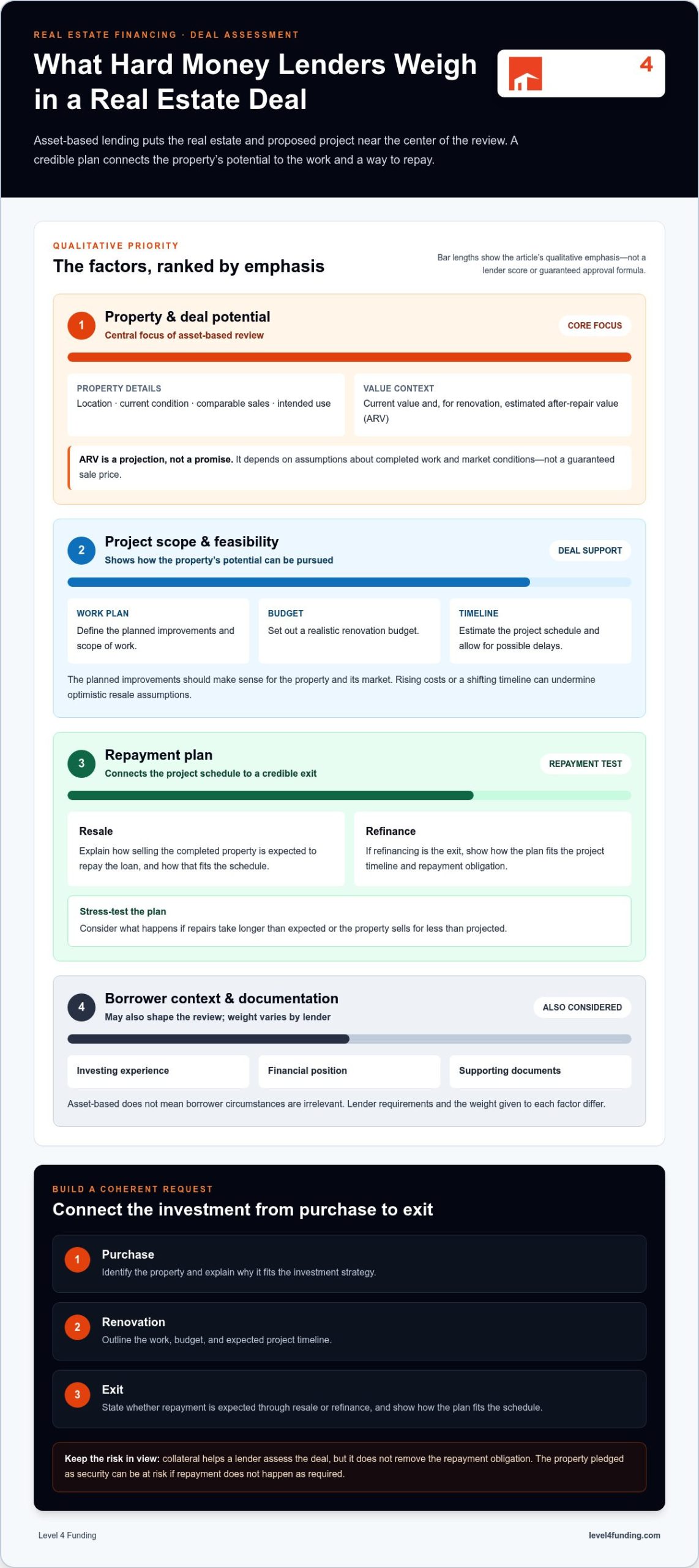
Asset-based lending puts the real estate and proposed project near the center of the review. That’s an emphasis, not a promise that borrower circumstances don’t matter. A lender may also consider an investor’s experience, financial position, and supporting documents. The weight given to each factor varies by lender.
Collateral helps a lender assess a deal, but it doesn’t remove the borrower’s responsibility or the risk of repayment. The property is only one part of the picture. A sound request connects the asset’s potential to a workable project and a credible way to repay.
Why the property matters to a hard money lender
Location, current condition, comparable sales, and intended use help frame a property’s potential and risks. For a renovation, the lender may consider the property’s current value alongside its estimated after-repair value, or ARV. ARV is a projection based on assumptions about completed work and market conditions, not a guaranteed sale price. The loan-to-value approach to property evaluation is one way to understand how collateral value can inform a financing decision.
Consider an investor looking at a fix-and-flip in Phoenix. A home needing substantial repairs calls for a defined scope of work, a realistic budget, and relevant comparable sales. The planned improvements should make sense for the property and its market. If the resale estimate depends on optimistic assumptions, the numbers may no longer support the deal if costs rise or the timeline shifts.
How the project plan supports the financing request
A clear plan connects the purchase to the work and the repayment strategy. Organize the key pieces so the opportunity is easy to assess:
- Purchase: Identify the property and explain why it fits the investment strategy.
- Renovation: Outline the work, budget, and expected project timeline.
- Exit: Show whether repayment is expected through resale or a refinance, and how that plan fits the schedule.
A lender may also weigh relevant investing experience and documentation, but requirements differ. Explain what happens if repairs take longer than expected or the property sells for less than projected. That’s not pessimism. It’s disciplined deal planning.
For a separate qualification checklist, review the hard money loan requirements guide. Arizona investors developing a property-focused financing plan can also explore Level 4 Funding’s real estate financing.
Hard Money Lender Misconceptions, Trade-Offs, and Risks
The phrase “asset-based” can sound as if the property does all the talking. It doesn’t. A hard money lender may still consider a borrower’s experience, financial circumstances, and ability to carry out the project. A promising property doesn’t make approval automatic, and it can’t rescue a plan that doesn’t add up.
A strong property doesn’t make an unworkable project safe. Hard money financing may offer a different path for time-sensitive or renovation-focused deals, but speed and flexibility can come with costs and a firm repayment deadline. The loan needs to fit the project, not just the purchase.
Is a hard money lender the same as a predatory lender?
No. “Hard money” describes a real estate-focused lending approach, not a verdict on every lender. The label alone doesn’t prove a loan is safe, fast, fair, or right for your investment. The written agreement spells out the actual obligations.
Before committing, read the terms closely. Make sure you understand the fees, payment schedule, maturity date, and default provisions. Compare the repayment deadline with your expected sale or refinance timeline. Resolve anything unclear in the agreement before relying on the financing in your project plan.
What risks should investors understand before borrowing?
The property secures the financing, so repayment trouble can put that asset at risk. A missed payment or inability to repay by the agreed deadline can have serious consequences under the loan terms. Don’t treat a projected resale or refinance as guaranteed cash in hand.
Renovation delays can push back a sale. Unexpected repairs can strain the budget. Market shifts can change the price or timing you expected. Those pressures may compound while repayment remains due. When considering “what is hard money lender” and whether this financing fits, focus on how the project holds up when the best-case assumptions don’t.
- Stress-test the schedule: Consider how a slower renovation or sale affects repayment.
- Build realistic assumptions: Avoid relying on the highest resale estimate or the smoothest project timeline.
- Plan the exit: Identify how you expect to repay and what could disrupt that plan.
Financing costs also affect a project’s potential return, so include all applicable fees and payments when assessing the numbers. For a focused discussion of borrowing costs, see the hard money loan rates guide. A deal that only works if repairs finish perfectly and the property sells immediately may leave too little room for real-world setbacks.
When Does a Hard Money Lender Make Sense for an Arizona Deal?
A hard money loan may be worth exploring when an investment has a clear purpose and timing matters, such as acquiring a property that needs renovation. Urgency alone, however, isn’t a reason to borrow. The financing needs to fit the property, project, repayment plan, available alternatives, and written loan terms.
Use this four-step screen before deciding whether to explore private financing:
- Define the project. Is the plan to renovate and resell, build, or invest in commercial property?
- Assess the property. Consider its current condition, estimated value, and the work or investment it requires.
- Map the timeline. Account for acquisition, construction or renovation, and the expected sale or refinance.
- Test repayment. Check whether your exit plan still works if the project takes longer or produces a different result than expected.
Which real estate projects may use hard money financing?
Fix-and-flip projects are a practical example: an investor identifies a property, plans improvements, and expects to repay through resale or another defined exit. A time-sensitive acquisition or a renovation with a clear scope may prompt an investor to consider private financing. That doesn’t mean every property or project will fit.
Construction and commercial property investments are other categories where investors may explore real estate-focused financing. Whether a particular deal makes sense depends on its details and the loan terms, not just the property type. Investors in Phoenix, Scottsdale, Tucson, Tempe, Mesa, and other Arizona markets can use the same basic test: connect the opportunity to a realistic project and repayment plan.
What should an investor organize before exploring financing?
Put the deal details in one place. A clear overview helps you assess the project and compare financing against other available options.
- Property address and purchase details
- Current condition and intended use
- Project scope, realistic budget, and estimated timeline
- Expected resale or refinance plan and how it supports repayment
Then compare the written terms with your project assumptions. Review the costs, repayment dates, and what happens if the timeline changes. For a separate look at financing differences, read this hard money lender versus bank loan comparison.
Planning a Phoenix-area fix-and-flip or another Arizona real estate investment? Explore hard money financing with Level 4 Funding as you match the property opportunity to a financing plan.
How Level 4 Funding Connects Arizona Investors With Hard Money Financing
For investors asking “what is hard money lender,” the next step is connecting the lender’s role to a real property opportunity. Level 4 Funding is a private real estate lender serving investors across Arizona. Its financing helps investors consider how a property, project scope, and repayment plan fit together.
Fix-and-flip loans are a clear example of property-focused financing: an investor identifies a home, plans renovations, and builds a strategy around the project’s intended outcome. The financing discussion starts with the deal itself. What needs to be done to the property? What is the project timeline? How do you intend to repay? Those details put the opportunity in context.
What kinds of investor projects can Level 4 Funding finance?
Level 4 Funding offers fix-and-flip financing for investors planning property improvements and a defined exit strategy. Construction loans serve projects built around new construction, while commercial property loans relate to investment in commercial real estate.
Other financing categories include Airbnb loans and cash-out refinance. Each serves a different investment purpose, so the property and the investor’s plan matter. No category means automatic approval; the project’s details and written loan terms are essential to understanding whether financing fits.
What is a practical next step for Arizona investors?
Get the deal organized before exploring financing. A focused summary makes it easier to assess the opportunity and discuss how a loan could connect to the project. Pull together:
- Property details: Address, purchase information, current condition, and intended use.
- Project plan: Renovation or construction scope, estimated budget, and timeline.
- Repayment path: Your intended exit, such as resale or refinance, and how it fits the project schedule.
Level 4 Funding serves investors in Phoenix, Scottsdale, Tucson, Glendale, Tempe, Mesa, Sedona, Flagstaff, Buckeye, and surrounding Arizona markets. Whether you’re weighing a fix-and-flip or another real estate investment, bring the property details and plan into focus first. Then explore Level 4 Funding’s real estate financing to connect your Arizona project with a hard money financing option.
Turn Your Arizona Property Opportunity Into a Clear Plan
If you came here asking “what is hard money lender,” the key takeaway is this: hard money financing is private, real estate-focused lending, and the property is only part of the decision. A credible project scope, timeline, and repayment plan matter too. A strong deal review also means weighing potential costs and collateral risk before you commit.
For a Phoenix fix-and-flip or another Arizona investment, match the financing to the project rather than letting urgency make the call. Level 4 Funding provides private financing for real estate investors, including fix-and-flip, construction, and commercial property loans. Investors in Phoenix, Scottsdale, Tucson, and other Arizona markets can explore options with their property details and investment plan in hand.
Have a project in mind? Explore real estate financing with Level 4 Funding for your next deal. With a clear plan and a grounded view of the risks, you can move forward with greater confidence.
Frequently Asked Questions
What is a hard money lender?
A hard money lender provides private financing secured primarily by real estate. If you’re asking “what is hard money lender,” think of the lender as the funding source for an investment property project. The lender may review the property and deal, but underwriting and terms vary. Investors might explore this financing for an acquisition or renovation, but the phrase describes a lending model, not a guarantee of approval or identical conditions across lenders.
How is a hard money lender different from a hard money loan?
A hard money lender is the person or company providing financing; a hard money loan is the funds and agreement the borrower receives. The lender’s approach describes how it considers a real estate deal, while the loan documents set the obligations for that specific transaction. For example, an investor planning a property renovation should understand both who is providing the capital and the loan’s written repayment terms.
Is a hard money lender a bank?
Hard money lenders are generally private lenders, not conventional banks. Their financing commonly centers on real estate collateral and the investment opportunity, though borrower information and other factors may also matter. Each lender can have its own structure and underwriting process. Don’t assume every private lender follows the same model. Compare the written terms, repayment schedule, and fit with your project before deciding whether to pursue financing.
Can a new investor use a hard money lender?
A newer investor can explore hard money financing, but being new doesn’t guarantee approval or rule it out. A lender may consider the property, project scope, borrower information, and repayment plan. Prepare a concise deal summary with the property details, realistic budget, work plan, and intended exit. For an Arizona investment, organizing those facts helps frame a focused discussion about whether the project and financing may fit.
How much does a hard money lender charge?
There isn’t one charge that applies to every lender or project. Financing costs and fees depend on the loan structure, property, and written terms. Review the full cost of borrowing alongside the payment schedule, repayment deadline, and assumptions behind your project budget. Don’t judge a deal by a single quoted figure. Check how all charges affect the expected proceeds from a resale or the plan to refinance.
What happens if a borrower cannot repay a hard money loan?
If a borrower can’t meet the loan’s repayment obligations, the consequences may be serious because real estate commonly secures the financing. The precise outcome depends on the signed agreement and applicable law. Before borrowing, understand the maturity date, default provisions, and repayment options. A planned sale or refinance may be an exit strategy, but it isn’t certain. Build a realistic plan for delays or a different-than-expected sale outcome.
Are hard money lenders available in Arizona?
Yes. Private real estate lenders serve investors in Arizona, including Phoenix, Scottsdale, Tucson, Glendale, Sedona, Flagstaff, Tempe, Mesa, and Buckeye. Level 4 Funding provides private financing for real estate investors, including fix-and-flip, construction, and commercial property loans. Project details and written terms shape whether financing may fit. Before exploring a deal, organize the property information, project scope, estimated timeline, and intended repayment path.

About the author
Matt has a bachelor's degree in political science from Northern Arizona University and works at Level 4 Funding, a private lending company that offers hard money and rental home loans to real estate investors in 35 states.
With Matt's leadership, the firm has financed almost $300 million in loans for investment properties. He often helps real estate investors with rental property purchases, foreclosures, refinancing, and fix-and-flip projects. Matt has extensive experience in fix-and-flip, buy-and-hold, rental properties, and real estate sales. He has lived in Arizona for 43 years and is married with three children. Matt is licensed as a mortgage broker and loan originator in Arizona, with NMLS 2062278 and NMLS 1118493.
Equal Housing Opportunity. This is not a Good Faith Estimate, and it is not a Guarantee to lend; it should not be considered as such. Costs, rates, estimates, and terms can only be determined after a full application is completed. To the extent this message includes any tax or legal advice, this message is not intended or written by the sender to be used, and cannot be used, for legal or tax purposes or advice. This is an advertisement. Copyright © 2026. All rights reserved.