


Michigan Hard Money Lenders: How to Find and Qualify for Private Real Estate Financing in the Great Lakes State
October 17, 2026
Your first real estate investment move in Phoenix may be finding the right room to learn, not finding a property. It’s natural to wonder where local investors meet, whether a paid membership is worthwhile, and how to distinguish practical education from a sales pitch. The right Phoenix real estate investment clubs for beginners can help you build knowledge and connections before committing money to a deal.
This guide covers local starting points, directories, and ways to prepare for your first meeting. You’ll learn what to listen for, which questions can reveal a group’s value, and how to assess claims that sound too good to be true. Start with education and relationships, not pressure to buy, invest, or borrow. Financing comes later, once you’ve shaped a clear plan for a specific project. You don’t need to arrive as an expert, but you should leave with better questions and a practical next step.
Key Takeaways
- Explore AZREIA and directories such as ezLandlordForms and REIClub to find Phoenix-area learning and networking opportunities.
- Compare Phoenix real estate investment clubs for beginners by focus, meeting format, location, schedule, and opportunities for newcomers to participate.
- Before attending, choose a topic and prepare questions about the meeting format, local market discussions, and follow-up resources.
- After a meeting, review what you learned and which connections or resources are useful before deciding whether to join.
- Consider financing only after developing a clear investment plan. Level 4 Funding provides private real estate financing, not club or meetup programming.
Why Phoenix real estate investment clubs can help beginners get oriented
A real estate investment club is a group or association where investors learn, make connections, and exchange ideas. For a beginner, that might mean hearing how members estimate rental expenses, assess a deal, or plan a renovation. The value isn’t a shortcut to buying a property. It’s the chance to build context and learn which questions deserve more research.
Groups have different focuses. Some emphasize education and networking; others concentrate on landlord topics, deal discussions, or a mix. Phoenix-area events may attract investors from across the Valley, but don’t assume every group serves every suburb or covers the neighborhoods you’re considering. Review the group’s focus, agenda, and meeting location to see whether they fit your goals.
For another perspective on real estate investing, watch this Phoenix-focused workshop:
What beginners can gain from local investor communities
Conversations with other investors can surface questions you may not have considered: Which expenses belong in a rental estimate? What could change a renovation budget? How do investors compare areas or property types? Hearing different approaches can help you build a stronger checklist for your own research.
What someone shares at a meeting is perspective, not a professional recommendation. Treat examples as prompts to investigate, not proof that a strategy will work for you. Local connections can also introduce market viewpoints and service contacts, giving you leads for further research without making any one person’s experience a guarantee.
Clubs may discuss direct property ownership alongside other approaches. To compare investment options, read this overview of a Real Estate Investment Trust (REIT), a vehicle that differs from buying a property yourself.
What a real estate investment club cannot do for you
Attending a meeting doesn’t guarantee profit, financing, or access to a property. A compelling story or confident presentation isn’t a substitute for checking the numbers and understanding the risks of a specific opportunity. Keep your decisions grounded in your own analysis rather than the energy in the room.
Club discussions are educational. They don’t replace legal, tax, or financial advice tailored to your circumstances. Before acting on an idea or opportunity raised at a meeting, review the details independently and seek qualified guidance where needed.
- Use discussion to learn: Note unfamiliar terms and follow up with reliable research.
- Separate claims from evidence: Ask what supports an estimate or projected outcome.
- Make your own call: Assess each opportunity against your goals, resources, and risk tolerance.
The best Phoenix real estate investment clubs for beginners help you get oriented, not make decisions for you. Listen, compare viewpoints, and leave with sharper questions. Access to a room isn’t the same as having a sound deal in hand.
Phoenix-area investor groups and directories beginners can explore
Start with a group whose purpose matches what you want to learn, then review the current event details before traveling or paying for membership. Phoenix real estate investment clubs for beginners can be found through local associations and statewide directories. These resources serve different purposes: an association runs its own community, while a directory helps you discover potential groups.
AZREIA: an association and education-focused starting point
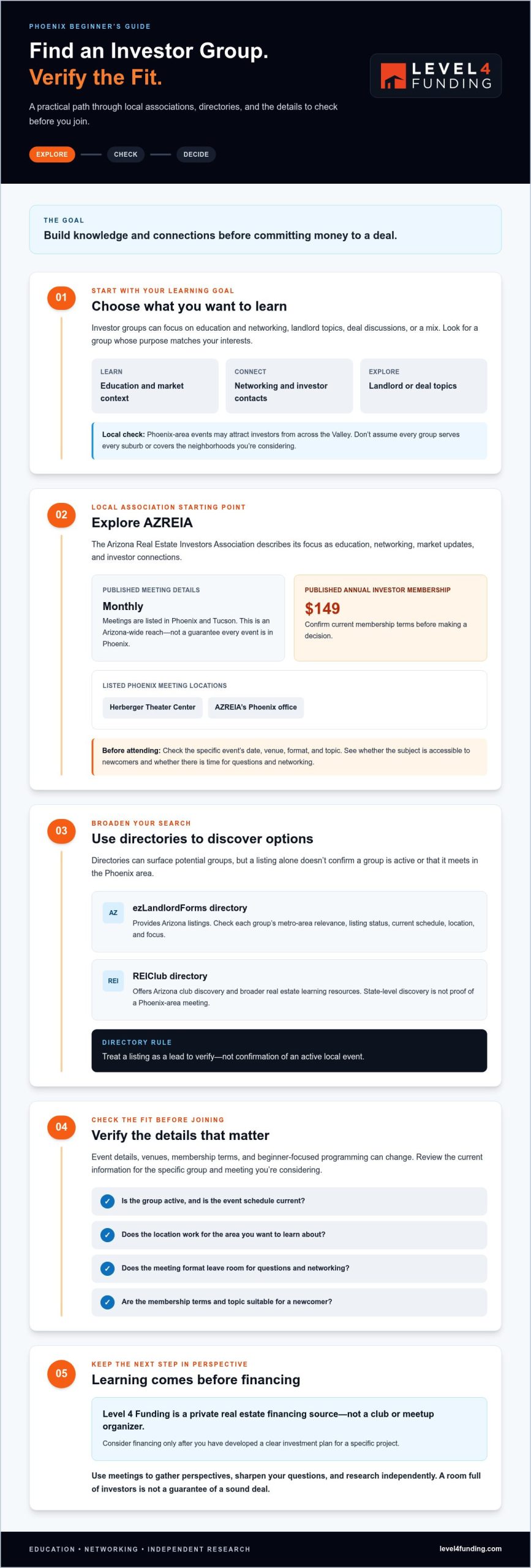
The Arizona Real Estate Investors Association (AZREIA) describes its focus as education, networking, market updates, and investor connections. Its published information lists monthly meetings in Phoenix and Tucson, with educational presentations among the meeting features. That’s an Arizona-wide reach, not a promise that every event takes place in Phoenix or serves every Valley suburb.
AZREIA’s published information lists annual investor membership at $149 and names Herberger Theater Center and AZREIA’s Phoenix office as meeting locations. Dates, venues, membership terms, and beginner-focused programming can change, so review the current event details for the specific meeting you’re considering. Check whether the topic is introductory and whether the format allows time for questions and networking.
| Option | Apparent purpose | Geographic relevance | Beginner questions | Details to verify |
|---|---|---|---|---|
| AZREIA | Association, education, networking, and investor events | Arizona, with listed monthly meetings in Phoenix and Tucson | Is the topic accessible to newcomers? Is there time for questions? | Event date, venue, format, membership terms, and beginner sessions |
| ezLandlordForms directory | Discover possible investor groups | Arizona listings; check each group’s metro-area relevance | Does the listing lead to an active group or event? | Listing status, current schedule, location, and group focus |
| REIClub directory | Find Arizona clubs and broader real estate learning resources | State-level discovery, not proof of a Phoenix-area meeting | Is the group a fit for my investing goals? | Whether the group is active and its current local details |
| Level 4 Funding | Private real estate financing, not a club or meetup organizer | Private lender serving Phoenix and other Arizona markets | Have I formed a clear investment plan first? | Evaluate financing only for a specific project and strategy |
Using Arizona club directories to find more options
ezLandlordForms and REIClub can help you find possible groups, but a directory listing doesn’t establish that a group is active, beginner-friendly, or nearby. Treat each result as a lead for further research. Look for a current event page, a clear meeting location, and a description that matches your interests, such as rentals or deal analysis. An Arizona listing doesn’t necessarily mean the group meets in Phoenix.
Before committing, compare the group’s stated purpose with your immediate goal: learning the basics, meeting local investors, or exploring a particular property strategy. For a separate perspective on investing beyond direct property ownership, Understanding REITs for beginners explains the structure and risks of REITs.
Keep the roles distinct: a directory helps you find groups, while an association runs its own activities. Once you’ve built knowledge, relationships, and a sound deal thesis, you can explore financing separately. Level 4 Funding provides private real estate financing. Learn more about private real estate financing when you’re evaluating a specific investment.
How to compare Phoenix real estate investment clubs before joining
A busy calendar or polished membership page doesn’t automatically make a group right for you. Compare its focus with your goal: learning the basics, meeting local investors, understanding rentals, or discussing active deals. Phoenix real estate investment clubs for beginners can differ in format and audience, so assess each group rather than choosing by name alone.
Use each group’s current public information to make a simple comparison. Record what’s clearly stated, and flag missing or outdated details rather than filling gaps with assumptions.
| What to compare | What to look for | If information is missing or dated |
|---|---|---|
| Main focus | Education, networking, rentals, deal discussion, or a combination | Mark the focus unclear; look for a current agenda or description |
| Topics and audience | Who the group serves and whether the calendar includes foundational subjects | Verify the intended audience and upcoming topics |
| Meeting format and location | In-person, online, or mixed meetings, plus the stated venue | Confirm the format and location for the event you plan to attend |
| Schedule and participation | Current dates, newcomer participation, and time for questions | Check the event listing for current details |
| Membership terms | Requirements, fees, and what membership includes, when stated | Use current information from the group; don’t rely on an old directory entry |
Questions to answer from a group’s public information
Start with the group’s website or current event listing. Who does it say it serves? Do upcoming topics cover fundamentals, landlord issues, or advanced deal analysis? Look for clear information about whether meetings are in person, online, or mixed, and where and when they take place. If current information doesn’t state membership requirements or fees, mark them as unknown rather than treating old listings as current.
Signals of a useful beginner learning environment
A promising fit gives you a clear idea of what you’ll learn and how you can participate. Look for agendas, foundational material, and a format that leaves room for beginner questions. Promotional language alone isn’t evidence. Claims about returns, guaranteed success, or exclusive deals deserve scrutiny.
- Look for the full picture: Speakers should explain assumptions, costs, and risks alongside possible upside.
- Separate examples from promises: One investor’s result doesn’t establish what you’ll achieve.
- Check the learning format: Notice whether there’s time for questions and practical discussion, not just presentations.
Compare your notes with your actual priorities. A networking-focused group may help you build relationships, while a rental-focused meeting may better fit a landlord goal. If key details are missing or outdated, keep them flagged until you can verify them through current group information. Choose based on fit and clear details, not hype.
Your first Phoenix investor meeting: a practical beginner plan
A first meeting doesn’t need to end with a deal or a membership decision. Treat it as a chance to learn how the group works, hear what local investors are discussing, and decide whether another visit would be useful. Prepare to leave with notes you can act on, not pressure to make a quick commitment.
- Choose a topic. Pick a meeting that addresses a question you have, such as rental basics, renovation planning, or deal analysis. A specific topic gives you a useful lens for the discussion.
- Check the event details. Review the current date, location, format, agenda, and any stated attendance or membership terms. Confirm details close to the event, especially if you found it through a directory or older listing.
- Prepare a few questions. Note what you want to understand before you arrive. Focus on the learning format, local market discussion, and resources available after the meeting.
- Attend and take notes. Capture key concepts, the assumptions behind examples, and questions you still have. Separate what you heard from what you can verify later.
- Reflect before deciding. Write down what was useful, what remains unclear, and whether the group’s focus matches your goals. Compare a few meeting experiences before deciding whether regular participation is worthwhile.
Prepare questions that make a first visit count
Ask which sessions are designed for people new to investing and how the meeting separates education, networking, and promotion. You could ask how the group discusses Phoenix-area market conditions, what follow-up learning resources are available, and whether there’s time for questions. Bring a short list of topics, such as rental operations, renovation basics, or how investors review a deal. You don’t need to ask everything at once.
Follow up without rushing into a commitment
Review your notes while the meeting is fresh. Separate useful concepts from individual opinions, then follow up on resources that can help you investigate further. If you hear a market claim, projected return, or deal pitch, identify its assumptions and verify the details independently. One conversation is a starting point, not a complete investment analysis.
Compare more than one experience if you can. Notice whether the content is practical, whether newcomers can participate, and whether the topics continue to match your interests. Phoenix real estate investment clubs for beginners should help you learn at a pace that supports thoughtful decisions, not push you to act before you’re ready.
Once you’ve built knowledge, relationships, and a sound thesis for a specific project, financing becomes a separate question. For background, read this hard money loan guide. When you’re ready to consider capital for a real estate plan, explore private real estate financing as one part of your evaluation.
From Phoenix club learning to a considered financing next step
Investor clubs can help you learn the terminology, meet people, and sharpen your questions. They don’t determine whether a property is a sound investment, and attending a meeting doesn’t determine whether you’ll qualify for financing. Keep the steps separate: build a clear strategy, assess a specific deal and its risks, then consider how to fund it.
Separate investment education from the lending decision
A conversation at a meeting may introduce a strategy or property idea, but it isn’t a loan decision or a substitute for your own analysis. Before considering borrowing, understand the project plan, expected costs, potential income, and what could go wrong. Test the assumptions rather than relying on a speaker’s confidence or another investor’s experience. A deal needs to make sense on its own merits.
If you’re learning about private lending, this beginner hard money lending guide can help explain the financing concept. Use it as background, not as a reason to rush into a purchase or assume a particular loan will fit your situation.
Explore financing when a real estate plan takes shape
Level 4 Funding is a private real estate lender serving Phoenix and other Arizona markets. Its financing includes fix-and-flip, construction, and commercial property loans. These categories relate to different project types: a renovation and resale plan, a construction project, or a commercial property investment. The questions to ask depend on the property and strategy. A club discussion or general guide can’t promise approval, terms, or a successful outcome.
Before exploring capital, get specific. Know what you plan to buy or build, how you expect the project to work, and which risks could change your numbers. Then consider financing alongside your property analysis and broader investment plan. Phoenix real estate investment clubs for beginners can support learning and relationship-building, while a lender can discuss financing for a specific project.
Use this simple sequence to keep the next step grounded:
- Clarify your strategy: Define the property type and the plan you intend to pursue.
- Assess the deal: Review the assumptions, costs, risks, and potential outcomes independently.
- Explore suitable financing: Once you have a defined project, consider which financing category may align with it.
When your plan is taking shape, explore real estate financing with Level 4 Funding as a separate, project-focused step. Keep learning first, then bring a clear plan to the financing conversation.
Turn what you learn into a deliberate next step
Your first move doesn’t have to be a purchase. Use what you learn to shape a clear investment thesis: what kind of property you’re targeting, why the numbers could work, and which risks still need investigation. That discipline turns conversations into better decisions without letting meeting-room excitement set your timeline.
Phoenix real estate investment clubs for beginners can help you build perspective and useful relationships. When a specific project takes shape, financing becomes a separate part of the plan. Level 4 Funding specializes in private real estate financing, including fix-and-flip, construction, and commercial property loans. A useful financing discussion starts with the project, not a promise of results.
Ready to explore financing for a defined investment plan? Explore real estate financing with Level 4 Funding. Keep asking questions, checking assumptions, and moving forward at a pace that fits your strategy. Confidence comes from doing the work before you commit.
Frequently Asked Questions
Are there real estate investment clubs in Phoenix for beginners?
Yes. Phoenix real estate investment clubs for beginners include options to explore through AZREIA, an Arizona association, and state-level directories such as ezLandlordForms and REIClub. Treat directory results as leads, not endorsements. Before attending, check the current event date, location, and format, then review the topic. A meeting about advanced deal structuring may not suit someone learning the basics.
What does a real estate investment club do?
A real estate investment club gives members a place to learn, network, and discuss strategies such as rentals or property renovations. Some meetings feature presentations, others focus on conversation or deal topics, and some combine formats. Use discussions to generate research questions, not as a personal investment plan. A club can’t guarantee profitable deals, financing, or returns, and meeting comments don’t replace independent research or professional advice.
Is AZREIA suitable for a beginner real estate investor?
It may be a useful starting point because AZREIA describes its focus as education, networking, and investor connections. Whether it fits depends on the current agenda, topic level, meeting format, and what you want to learn. Review event information for Phoenix-area venues and sessions that address beginner questions. A topic that’s accessible to one newcomer may still be too advanced for another.
How do I find real estate investor meetups near Phoenix?
Start with AZREIA and Arizona club directories, then look at current event listings for Phoenix, Scottsdale, Tempe, Mesa, Glendale, or Buckeye. Statewide directories may also list groups in Tucson, Sedona, or Flagstaff, which may be less convenient for a Phoenix-area visit. Before making plans, verify the event date, exact venue, and meeting format through the organizer’s current information. A directory entry alone doesn’t confirm an active local meetup.
Do I need experience to join a real estate investment club?
Experience expectations vary by group and event, so review the published description before attending. If you’re new, look for sessions that explain basic terms, provide an agenda, and leave room for questions. Review any stated membership requirements as well. Arrive with a learning goal, such as understanding rental expenses, while remembering that joining a group doesn’t replace learning fundamentals or assessing investment decisions yourself.
Are real estate investment clubs worth it for beginners?
They can be worthwhile when the meetings match your goals and offer practical learning or useful connections for the time involved. Consider attending an introductory event before committing to regular participation, then note which ideas you can verify and apply to your research. Testimonials, projections, and claims of easy profits aren’t evidence that a deal will succeed. Judge the value by what you learn, not by promises.
Can a real estate investment club help me get a hard money loan?
A club may help you understand investing and meet market participants, but membership doesn’t provide a loan or guarantee approval. Financing is a separate decision tied to a specific project and a lender’s review. Before pursuing capital, understand the loan structure, costs, and risks. This hard money lending guide can help you learn the basics before evaluating financing for a property.

About the author
Matt has a bachelor's degree in political science from Northern Arizona University and works at Level 4 Funding, a private lending company that offers hard money and rental home loans to real estate investors in 35 states.
With Matt's leadership, the firm has financed almost $300 million in loans for investment properties. He often helps real estate investors with rental property purchases, foreclosures, refinancing, and fix-and-flip projects. Matt has extensive experience in fix-and-flip, buy-and-hold, rental properties, and real estate sales. He has lived in Arizona for 43 years and is married with three children. Matt is licensed as a mortgage broker and loan originator in Arizona, with NMLS 2062278 and NMLS 1118493.
Equal Housing Opportunity. This is not a Good Faith Estimate, and it is not a Guarantee to lend; it should not be considered as such. Costs, rates, estimates, and terms can only be determined after a full application is completed. To the extent this message includes any tax or legal advice, this message is not intended or written by the sender to be used, and cannot be used, for legal or tax purposes or advice. This is an advertisement. Copyright © 2026. All rights reserved.