


Hard Money Lender Interest Rates vs. Conventional Loan Rates: A Side-by-Side Breakdown for Investors
October 21, 2026
What Is LTV in Real Estate Finance? A Plain-English Guide for Investors and Borrowers
October 22, 2026
Hard money loans for new investors in Phoenix can fund investment-property purchases, fix-and-flip renovations, construction, and other real estate projects, with the property securing the loan. Phoenix hard money notes have a median term of 21 months, so these loans are generally structured for short-term investment plans rather than long-term ownership.
The key is matching financing to the deal. Compare how costs are structured, what may affect approval timing, and how the property, project plan, and borrower’s circumstances shape the terms. This guide explains common uses for hard money loans for new investors in Phoenix, the main financing considerations, and how to assess whether this option fits your investment.
Key Takeaways
- Match a fix-and-flip loan to the purchase, renovation plan, and expected resale, then assess whether the deal still works after financing costs.
- Compare loan-to-value and loan-to-after-repair-value calculations to understand how the property and its planned improvements affect the borrowing structure.
- Approval and funding depend on the deal file, property details, and project plan, so organize those materials early to keep the process moving.
- Look beyond the interest rate: origination fees, payment structure, and term all shape the total cost and repayment pressure.
- Prepare to explain your exit plan and show how the project can be repaid; these details help frame a clear financing request.
Fix-and-flip financing
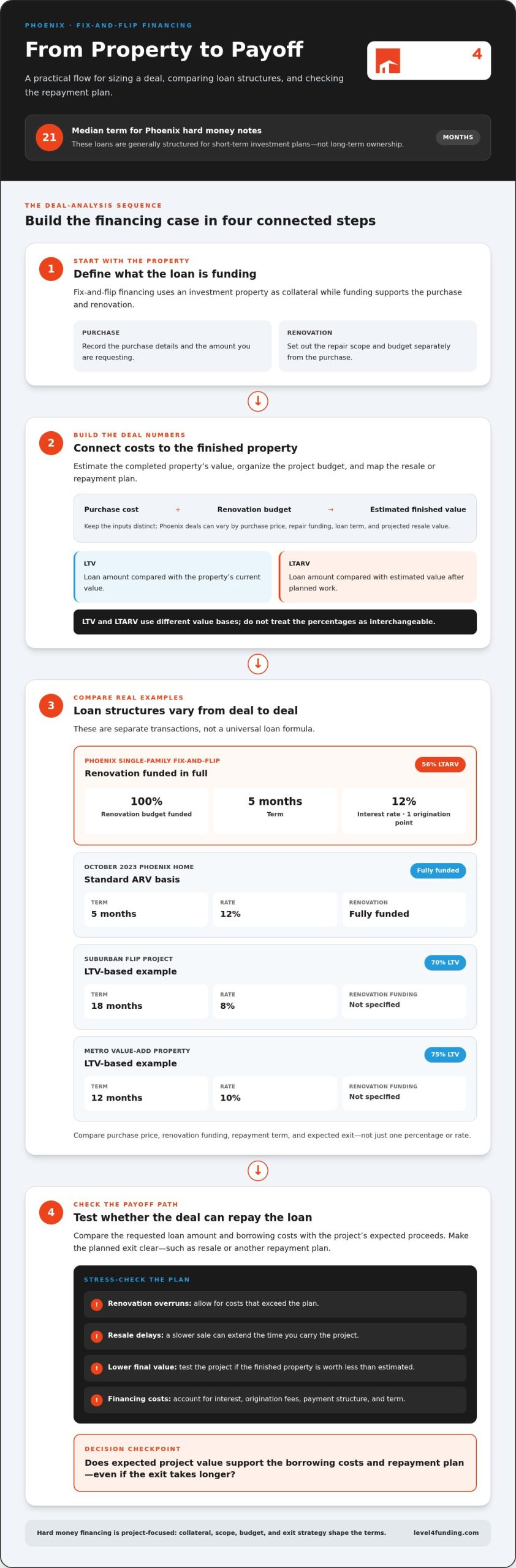
Fix-and-flip financing uses an investment property as collateral while funding supports the purchase and renovation. Phoenix-area deals can have very different structures depending on the purchase price, repair funding, loan term, and projected resale value.
Compare the examples below to understand how the figures relate. Each represents a separate transaction, not a universal loan formula.
For an overview of the basics, watch Hard Money Loans for New Investors in 2023 from Hard Money Mike:
Phoenix Single-Family Fix-and-Flip Loan
When securing hard money loans for new investors Phoenix, structure matters. One recent local project featured a loan that funded 100% of the renovation budget, carried a 5-month term, charged a 12% interest rate with one origination point, and achieved a loan-to-after-repair value of 56%.
This example stands out because it funds renovation costs in full and has a short term. The projected after-repair value helps show how the financing relates to the completed project, not just the purchase.
Other Fix-and-Flip Loan Examples
| Example | Value basis | Term and rate | Renovation funding |
|---|---|---|---|
| October 2023 Phoenix home | Standard ARV | 5 months; 12% | Fully funded |
| Suburban flip project | 70% LTV | 18 months; 8% | Not specified in this example |
| Metro value-add property | 75% LTV | 12 months; 10% | Not specified in this example |
Compare the purchase price, renovation funding, repayment term, and expected exit to assess which option suits the deal. Construction loans fund a different project structure, while fix-and-flip loans focus on buying and improving a property for resale.
Build your deal analysis before seeking financing: separate purchase and renovation costs, estimate the finished property’s value, and map out resale or repayment. Working with an experienced partner like Level 4 Funding can help you evaluate these options. Then compare the requested loan amount and borrowing costs with the project’s expected proceeds.
What Are Hard Money Loans in Arizona Used For?
In Arizona, hard money loans commonly fund investment properties, including purchases, renovations, construction, and commercial projects. The property secures the loan, and the lender considers its value and the project’s repayment plan.
Loan-to-value (LTV) compares the loan amount with a property’s current value. Loan-to-after-repair value (LTARV) compares it with the estimated value after planned work. Arizona hard money loans averaged 60% LTV in the first quarter of 2026, while Phoenix loans typically show 78% LTV. A Phoenix fix-and-flip example had a 56% LTARV. These figures use different measures and should not be treated as interchangeable.
Private lending can provide financing for short-term investment real estate projects in Arizona. In the second quarter, it totaled approximately $866 million across 472 loans. The average Arizona hard money loan amount was $511,600 in the first quarter of 2026, while Phoenix’s median note amount was $322,143. Those figures describe different periods and measures, not an individual borrower’s expected loan size.
Financing can be structured around a purchase, renovation, construction plan, or commercial property. Terms reflect the collateral, requested amount, budget, and exit strategy. The process starts with the property and deal details; underwriting then assesses value, costs, project scope, borrower contribution, and repayment plan. A clear record of your project or portfolio can help explain the request.
Arizona lender rankings by loan count measure transaction volume, not whether a lender’s terms suit your project. Compare relevant experience, loan structure, collateral criteria, and fit with your investment timeline. A ranking alone is not a measure of loan quality.
How do hard money loans compare with DSCR loans, bank loans, and private money in Phoenix? Hard money financing focuses on collateral and a short-term project. DSCR loans focus on a property’s rental income, while banks commonly consider a broader range of borrower and income information. “Private money” is a broad category that can include hard money loans, so the terms can overlap.
What Arizona licensing and legal rules apply to hard money lenders and borrowers? Requirements depend on the transaction structure, parties, collateral, and loan purpose. Review the loan documents for repayment terms, fees, the security interest, and default provisions, and understand the obligations they create.
What risks should new investors consider before taking a hard money loan in Phoenix? Plan for renovation overruns, resale delays, carrying costs, and a final value below your estimate. Repayment may become difficult if it depends on a sale or refinance that takes longer than expected.
How do Phoenix home values, rents, and foreclosure trends affect hard money investment deals? Property values shape collateral and resale assumptions, rents affect rental-project income, and foreclosure conditions can influence competition and exit timing. Test the deal using conservative resale or rental assumptions before committing capital.
Approval and funding timelines
In Arizona, approval and funding depend on the property file, project scope, and readiness to close. First-time investors can make the process clearer by preparing a complete deal package.
First-Time Investor Funding
Organize your request around one property and a defined plan. Include purchase details, repair or construction scope, budget, your contribution, and intended exit, such as resale or rental income. If you have no completed projects to show, a concise plan and supporting property information can help explain how the investment will proceed.
Start with the property. A lender evaluates its condition, value, and role as collateral, then compares those details with the requested loan and project costs. For a fix-and-flip, explain the work and expected resale plan. For a rental, outline the intended use and repayment source. For construction, clearly present the scope and budget.
Use this preparation sequence before submitting:
- Summarize the property, purchase terms, and current condition.
- Separate acquisition costs from renovation or construction costs.
- Describe the work, expected completion path, and exit strategy.
- Gather ownership, financial, and project documents requested for underwriting.
- Review the proposed terms and closing requirements before setting a funding date.
Each part of the application answers a different underwriting question. Property details support collateral review, a cost breakdown shows how you’ll use the funds, and an exit plan explains repayment. Missing or conflicting figures can prompt follow-up, so keep the purchase amount, project budget, and scope consistent.
Funding Timelines
Funding typically moves from a complete application to property review, underwriting, document preparation, and closing. A bridge loan focuses on a specific property and short-term project, unlike long-term rental financing or a bank process. Appraisal needs, title work, repairs, and closing coordination can affect timing.
Keep the transaction moving by responding promptly to document requests and resolving gaps in the file. A purchase with clear property records may need a different review from a construction project involving plans, budgets, and multiple stages. Funding follows completion of underwriting and closing requirements, not initial approval alone.
Before agreeing to a purchase deadline, map the remaining steps with the seller, title company, and lender. Build the timeline around property review, loan documents, and closing coordination. For hard money loans for new investors in Phoenix, prepare by identifying the project’s funding needs, the documents that support your request, and your repayment plan. This helps you compare the proposed funding schedule with the deal’s actual deadlines.
In the first quarter of 2026, Arizona hard money loans had an average interest rate of 7.49%. Arizona hard money lenders charged an average origination fee of 3.4% in the first quarter of 2026.
Make sure the written terms reflect the quoted rate and any fees, along with project-specific closing conditions. Compare the full borrowing cost with your repayment plan to see whether the schedule remains workable as underwriting and closing progress.
Arizona hard money interest rates and origination fees
Hard money pricing can include interest and an origination fee. Interest affects borrowing costs over the loan term, while an origination fee is charged for arranging or issuing the loan. Compare both, along with payment timing, term, and repayment requirements. A lower rate alone does not show which financing better fits a Phoenix investment.
Private money means financing from private sources rather than conventional banks. Hard money commonly refers to asset-focused private financing, so the terms can overlap. For an Arizona real estate deal, the lender’s assessment of the collateral, requested loan amount, project plan, and repayment route can all affect the offer. A purchase-and-renovation project may be assessed differently from a stabilized rental or commercial property.
Compare offers using the same project assumptions. A useful review includes:
- Interest: Identify the rate, how interest accrues, and when payments are due.
- Origination: Record the fee and how it is calculated against the loan.
- Term: Match the repayment deadline to the project’s construction, sale, or refinance plan.
- Cash needs: Account for closing funds, renovation capital, and any costs not funded by the loan.
- Exit: Check whether expected sale proceeds or rental income support repayment.
For example, a Phoenix investor planning a Scottsdale-area renovation should compare total financing obligations with the project budget and likely exit. A fee deducted at closing reduces the usable proceeds, while a fee added to the balance increases the amount owed. Review the loan documents to understand how each charge applies, and compare written terms rather than relying on a headline rate.
Local context matters because property review depends on the collateral and market. Phoenix and Scottsdale properties may have different comparable sales, repair scopes, and resale assumptions. For properties in Tucson, Glendale, Sedona, Flagstaff, Tempe, Mesa, and Buckeye, account for each location, property condition, intended use, and available project information. Market conditions and underwriting can vary by property and city.
Use this sequence to compare an Arizona hard money lender’s terms:
- Write down the requested amount, project budget, and planned exit.
- Separate interest, origination, and other charges shown in the proposed documents.
- Calculate the expected cash available after closing costs and any fee deductions.
- Compare the payment schedule and maturity date with the project timeline.
- Test whether the repayment plan still works if construction or resale takes longer.
That final step matters with private money because a short-term loan can create pressure if a sale or refinance is delayed. A Phoenix flip, Scottsdale rental, and Arizona commercial purchase each have different income and exit assumptions. Compare the full loan structure, not just the rate, before choosing financing.
Income and credit requirements
Hard money underwriting considers the property and deal as well as borrower finances. For a Phoenix residential investment, be ready to explain your available funds, repayment plan, and project exit.
Income Requirements
A repayment plan helps show how you’ll manage interest payments and other obligations during a bridge loan. A fix-and-flip investor may rely on resale proceeds, while a rental investor may point to expected rental income. Explain the repayment source and how you’ll manage costs if the sale or refinance takes longer than planned.
Credit Requirements
Credit information helps lenders understand how you’ve managed past borrowing, but no credit-score cutoff appears in the available Phoenix examples. Treat credit as one part of the file, alongside property value, project scope, cash contribution, and repayment strategy. Review your credit records for errors and prepare explanations for late payments or other items that could prompt questions.
Documentation turns the financing request into a reviewable deal. Organize documents around the property, borrower, project, and exit plan. Keep names, amounts, and dates consistent across the purchase contract, budget, and application. A clear file helps underwriting assess the transaction without confusing the property’s current condition with its planned finished state.
Use this checklist to prepare a complete application:
- Property: Provide the address, purchase details, current condition, and available valuation information.
- Project: Lay out the repair or construction scope, budget, and expected completion sequence.
- Borrower: Gather financial statements, identification, and relevant real estate investment history.
- Exit: Explain whether repayment depends on resale, rental income, or refinance proceeds.
- Cash: Show funds available for closing and project costs outside the loan.
Cash required at closing depends on the purchase, loan amount, fees, and project costs the loan funds. That figure applies to one transaction, not every borrower or property. Compare your available funds with the contract, closing statement, renovation budget, and payment obligations before committing.
Separate cash into two buckets: the amount due at closing and funds for the project afterward. For example, you may have enough for a down payment but still need money for repairs or interest payments. Mapping both needs before signing helps prevent the closing contribution from using up capital needed to complete the investment.
If an investment property already has equity, a cash-out refinance may be relevant to a financing plan. Compare its repayment structure with the purchase or bridge financing you’re considering.
Level 4 Funding: Fix and Flip Loans
Level 4 Funding offers Fix and Flip Loans for investors financing a property purchase and renovation for resale. If your plan involves building rather than improving an existing property, Construction Loans may better match the project. The right fit starts with a clear outline of the property, work involved, funding needs, and repayment plan.
For a commercial investment, Commercial Property Loans may align more closely with the asset. Property owners considering a refinance can explore Cash Out Refinance as another financing route. Compare the project type with the loan purpose before moving forward, and bring your property and deal details into that discussion.
Have a Phoenix investment project in mind? Visit level4funding.com to contact Level 4 Funding.
Turn Your Phoenix Deal Into a Clear Financing Plan
Turn your investment idea into a decision-ready plan. For hard money loans for new investors in Phoenix, define what the property needs, how you’ll use the funds, and how you’ll repay the loan. This clarity helps you assess whether the financing fits the project, rather than forcing the project to fit the loan.
Level 4 Funding offers Fix and Flip Loans, Construction Loans, and Commercial Property Loans. Match the property and work ahead with the financing purpose, then bring those details into a conversation about your next step. A focused plan gives you a stronger starting point for evaluating the opportunity and moving forward thoughtfully.
Contact Level 4 Funding to discuss your real estate investment financing needs. Build your next move with a clear plan and confidence in the decision ahead.
Frequently Asked Questions
What are hard money loan rates and fees for real estate investors in Phoenix, Arizona?
Rates and fees depend on the property, requested financing, loan term, and repayment plan. Compare the written terms, not just the interest rate: check how interest accrues, when payments are due, how any origination fee is calculated, and what repayment is required at maturity. For a Phoenix deal, also assess whether the planned sale or refinance can cover the balance and carrying costs.
What are the eligibility requirements for a hard money loan in Phoenix?
Eligibility generally depends on the property’s value, project purpose, your available capital, and a credible repayment plan. A first-time investor can support a request with a realistic budget and clear exit plan, even without a portfolio of completed flips. Requirements vary by loan structure. Compare projects in Phoenix, Scottsdale, Tucson, Glendale, Sedona, Flagstaff, Tempe, Mesa, and Buckeye based on their individual property and deal details.
What documents and steps are needed to apply for a hard money loan in Phoenix?
Prepare a purchase contract or ownership details, property photos, a repair scope, contractor bids, a project budget, and a written exit plan. Organize the documents so property details and costs match across the file. Then submit the application, respond to underwriting questions, review the proposed loan documents, and coordinate title and closing. For Phoenix properties, include local comparable sales or rental assumptions that support your project analysis.

About the author
Matt has a bachelor's degree in political science from Northern Arizona University and works at Level 4 Funding, a private lending company that offers hard money and rental home loans to real estate investors in 35 states.
With Matt's leadership, the firm has financed almost $300 million in loans for investment properties. He often helps real estate investors with rental property purchases, foreclosures, refinancing, and fix-and-flip projects. Matt has extensive experience in fix-and-flip, buy-and-hold, rental properties, and real estate sales. He has lived in Arizona for 43 years and is married with three children. Matt is licensed as a mortgage broker and loan originator in Arizona, with NMLS 2062278 and NMLS 1118493.
Equal Housing Opportunity. This is not a Good Faith Estimate, and it is not a Guarantee to lend; it should not be considered as such. Costs, rates, estimates, and terms can only be determined after a full application is completed. To the extent this message includes any tax or legal advice, this message is not intended or written by the sender to be used, and cannot be used, for legal or tax purposes or advice. This is an advertisement. Copyright © 2026. All rights reserved.