


Hard Money Loan Lenders: The Ultimate Guide to Finding, Vetting, and Working With Private Capital
November 6, 2026
Commercial deals do not always fit a bank’s box. For investors seeking Phoenix private money for commercial real estate, private financing can support a purchase, refinance, or construction project. The property, project scope, and repayment plan help shape the loan structure. It can be worth considering when financing needs to align with the investment’s purpose.
Look beyond the loan amount. The property’s condition, intended use, and business plan all matter, and the financing should fit the work ahead. This guide explains how private money can support commercial real estate investments in Phoenix, what factors may be assessed, and how a project overview can lead to a potential loan structure.
You’ll also learn how commercial property loans differ from construction or renovation financing, which project details influence an evaluation, and what to prepare before discussing terms. The goal is to help you understand the financing paths and identify one that fits your commercial investment.
Key Takeaways
- Learn what to look for when assessing private financing for a Phoenix commercial property deal.
- Identify how the property’s type and project plan shape potential financing options.
- Understand how loan-to-value and loan-to-cost measures relate to a commercial loan request.
- Get a clearer picture of the eligibility details and documents involved in the loan process.
- See what can influence the path to closing and which Level 4 Funding loan offering may fit your project.
Which Phoenix private lenders finance commercial real estate deals?
Commercial deals in Phoenix may be financed by private lending firms, individual private lenders, or hard money lenders. Because their approaches differ, identify who evaluates the property, makes the lending decision, and reviews repayment. An asset-focused lender may assess the property’s condition and project plan alongside borrower information, rather than treating the deal like a standard income-based application.
Local market context helps explain why investors pursue different kinds of projects. The U.S. Census Bureau reports Arizona’s population estimate was 7,623,818 people on July 1, 2025 (V2025). The Phoenix metropolitan area had a population of 4.7 million. Those figures describe a large market, but they don’t establish whether a specific property can support a loan. The location, condition, use, and business plan still matter.
Look for a financing structure that fits the transaction. A commercial acquisition, property improvement, and ground-up project each raise different underwriting questions. For example, an occupied warehouse purchase may focus on current operations and the buyer’s repayment plan. A planned industrial campus also calls for an assessment of construction plans and the path from development to repayment.
Phoenix examples show that commercial projects can vary sharply in scale. A developer planned a 1.2-million-square-foot industrial campus in the Southwest Valley, while a 151,451-square-foot warehouse in Deer Valley secured a lease. These examples aren’t lending terms or guarantees. They illustrate why a lender needs actual property details rather than relying on a general label such as “commercial.”
Use this sequence to narrow the lender fit:
- Define the deal: State whether you’re buying, improving, constructing, or refinancing a commercial property.
- Describe the asset: Identify its location, current condition, occupancy, and intended use.
- Explain repayment: Outline how the investment is expected to repay the financing.
- Match the lender: Discuss the deal with a private lender whose approach fits that project type.
For investors evaluating Phoenix private money for commercial real estate, the useful question isn’t simply which lender handles commercial deals. It’s which lender’s criteria fit the specific asset and plan. A 76-acre industrial development and an existing leased warehouse demand different project conversations. Clear information about the property, intended work, and repayment strategy helps focus that conversation. It also shows early whether the lender’s approach aligns with the transaction.
What commercial property types do Phoenix private money lenders finance?
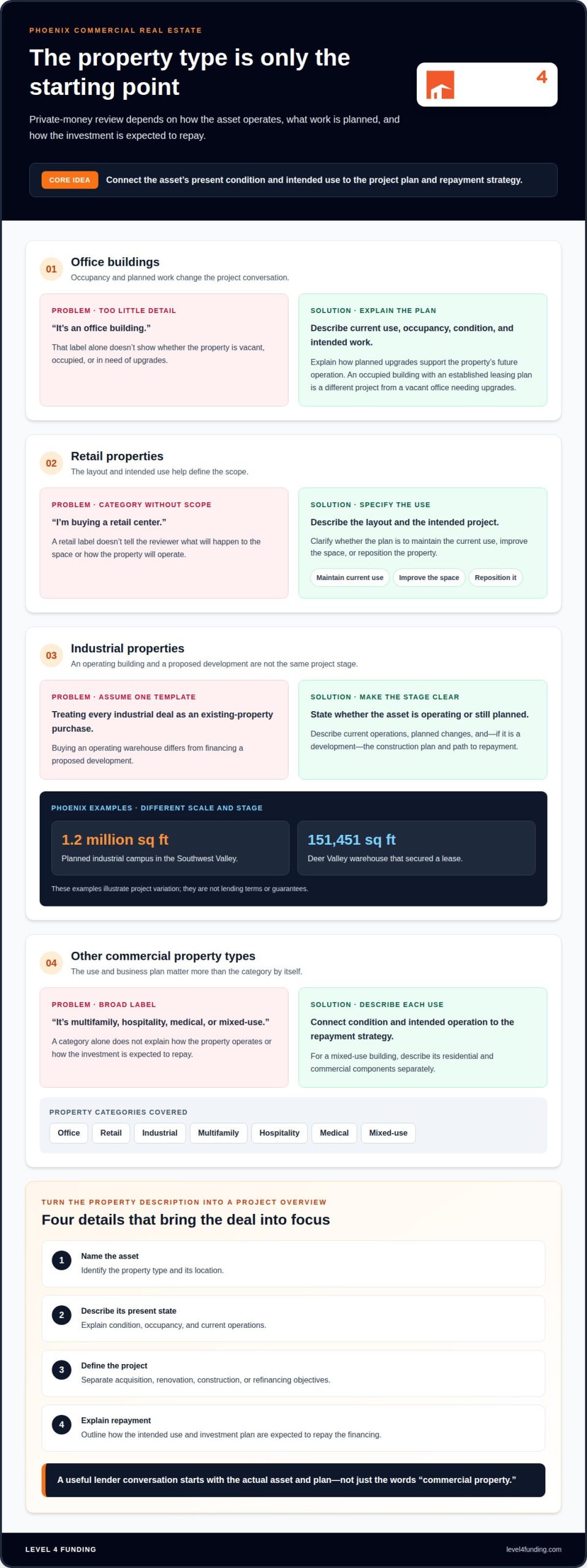
Private financing can apply to several commercial property categories, but the asset’s use and business plan shape the review. Phoenix investors may consider office, retail, industrial, multifamily, hospitality, medical, and mixed-use properties. The category alone does not explain the deal. The lender needs to understand how the building operates and how the investment is expected to repay the financing.
Office buildings include single-tenant and multi-tenant properties, as well as professional offices. A review may focus on current use, occupancy, condition, and the investor’s plan. A vacant office needing upgrades is a different project from an occupied building with an established leasing plan. Explain how the intended work supports the property’s future operation.
Retail properties range from individual storefronts to multi-tenant shopping centers. A lender evaluating a retail investment considers the property’s layout and planned use. For example, an investor buying a neighborhood retail center should explain whether the plan is to maintain its current use, improve the space, or reposition it. Project scope matters as much as the retail label.
Industrial buildings include warehouses, distribution facilities, and other properties used for commercial operations. Phoenix examples include a warehouse in Deer Valley and a planned industrial campus in the Southwest Valley. These illustrate different project scales and stages, not a universal lending decision. Buying an operating warehouse differs from financing a proposed development.
Multifamily properties are residential buildings held as investment assets, while hospitality properties serve short-term guests. Medical and mixed-use properties have specialized or multiple uses. For each, connect the property’s condition and intended operation to the repayment strategy. For a mixed-use building, explain its residential and commercial components.
Use these steps to describe the property clearly:
- Name the asset type: Identify whether it’s office, retail, industrial, multifamily, hospitality, medical, or mixed-use.
- Describe its present state: Explain occupancy, current operations, and any planned improvements.
- Define the project: Separate acquisition, renovation, construction, or refinancing objectives.
- Connect the plan to repayment: Explain how the intended use supports the investment strategy.
For a Phoenix deal, precise project details make the property category useful rather than limiting. An investor considering an industrial purchase can outline its present operations and planned changes. Someone evaluating a mixed-use building can describe each component separately. To explore a commercial property financing approach, connect the asset type to the project’s scope and repayment plan.
When searching for commercial property, keep the broker’s role in mind. A broker representing both a landlord and a tenant may show the tenant only properties represented by the broker or their firm. This can affect which office, retail, industrial, or other spaces the tenant sees, so the properties presented may not reflect the full range of options.
A commercial real estate broker facing competing client interests may prioritize a landlord’s financial interests during negotiations. Tenants should account for this possibility when evaluating proposed terms and deciding whether a space suits their needs.
Phoenix Commercial Private Money Loan LTV/LTC Limits
There is no single LTV or LTC limit for every Phoenix commercial deal. The figures depend on the property, valuation, project budget, and financing structure. Lenders use these measures to assess how much of the asset’s value or project cost a proposed loan would cover. They are related, but answer different questions.
Loan-to-value (LTV) compares the loan amount with the property’s value. Divide the proposed loan by the value used in the lender’s analysis, then express the result as a percentage. For an acquisition, the relevant value may relate to the property being purchased. For a refinance, the analysis centers on the property’s value and existing debt. Clarify which value the lender is using.
Loan-to-cost (LTC) compares the loan amount with the project’s eligible costs. Depending on the project and evaluation, these may include acquisition and planned construction or renovation expenses. Divide the proposed financing by the costs included in the calculation. For a Phoenix redevelopment, a clearly defined scope and itemized budget show how the requested loan relates to the work.
Neither ratio gives the full financing picture. A lender may consider the property’s condition, intended use, project scope, repayment plan, and valuation approach. For example, buying an occupied commercial building calls for a different analysis from financing a property that needs substantial work. The latter also requires a clear account of planned costs and execution.
These measures can also help identify the equity gap. If a proposed loan covers only part of the property’s value or project costs, the deal structure must address the remainder. The calculation does not guarantee approval. A strong valuation does not replace a workable repayment plan, and a detailed budget does not establish the property’s value.
To understand how an LTV or LTC figure is developed for your deal, organize the core inputs:
- Property basis: Identify the asset and valuation used in the analysis.
- Project budget: Separate acquisition costs from planned construction or renovation costs.
- Loan request: State the amount sought and how it supports the project.
- Repayment plan: Explain how the investment is expected to repay the financing.
Ask which definitions and inputs are used to calculate each proposed limit. Compare the value basis for LTV with the costs included in LTC. For Phoenix commercial real estate financing, this distinction clarifies what the proposed loan covers, what remains outside it, and how the asset’s business plan supports the request.
What are the eligibility requirements and documents for a Phoenix commercial private money loan
Eligibility for a Phoenix commercial private money loan centers on the property, proposed financing, and repayment plan. A lender may assess the asset’s location, condition, use, value, and current income, as well as borrower experience and project details. The weight of each factor depends on whether the request is for an acquisition, renovation, construction, or refinance.
Start with the property. For an occupied retail building, a lender needs a clear picture of its use, condition, and income. For a vacant office, the proposed leasing or improvement strategy may be more central. The address, property type, occupancy, and loan purpose help make the project clear from the outset.
The borrower’s role matters, too. Information about the borrowing entity, its owners, relevant experience, and the people responsible for carrying out the plan can clarify who stands behind the transaction. A first-time investor and an experienced operator may have different track records, but both can explain the project, their responsibilities, and the expected repayment approach.
Prepare documents that support the deal rather than a pile of disconnected paperwork. Useful materials can include:
- Property records: The address, purchase agreement when applicable, current photos, and available property details.
- Financial information: Current rent roll, leases, operating statements, or other records relevant to the property’s income.
- Project scope: A written description of proposed repairs, construction, or improvements, with a supporting budget when work is planned.
- Borrower details: The borrowing entity’s information, ownership structure, and a summary of relevant real estate experience.
- Repayment plan: A concise explanation of the intended exit, such as ongoing property operations or a planned sale.
For construction financing, connect each planned work item to its budget and project timeline. For a refinance, identify existing debt and explain the purpose of the new financing. For an acquisition, show how the purchase terms relate to the property’s current condition and intended use. These details help the lender evaluate the transaction on its own terms.
Keep the materials consistent. If a project summary describes a warehouse conversion, the scope and budget should reflect that use. If a rent roll shows occupied units, the income records should tell the same story. Consistent documents help surface questions early and support a focused review. Gather the deal summary, property records, borrower information, project budget, and repayment outline before discussing the request.
How quickly can a Phoenix private lender close a commercial real estate loan
A Phoenix commercial loan’s closing schedule depends on the work needed to evaluate and document the transaction. The property, loan purpose, appraisal, title work, borrower information, and project scope can all affect the sequence. Buying an operating property involves different review steps from financing construction on a site that still needs development.
A client testimonial reports one real estate transaction closing in 20 days. That figure describes an individual transaction, not a standard timetable for every commercial loan. It also doesn’t establish that a commercial real estate loan will close in the same period. Deal structure and required third-party work affect the path from initial review to funding.
For a Phoenix acquisition, the lender needs enough information to assess the property and requested financing. A purchase agreement, property details, borrower information, and a clear repayment plan help establish the transaction. Valuation and title work may also be needed before closing documents can be completed. Missing or inconsistent records can raise questions and slow the process.
Construction and renovation projects involve additional coordination. The lender reviews the proposed work, project budget, and how the work connects to the financing request. A planned industrial development, for example, requires a different review from buying an operating warehouse. Changes to the scope or budget may require further evaluation before closing.
Use this sequence to keep the process moving:
- Present the deal: Share the property location, transaction type, purchase details, and intended use.
- Organize supporting records: Provide available property, borrower, financial, and project documents together.
- Resolve review questions: Address gaps in valuation, title, project scope, or repayment information promptly.
- Complete closing requirements: Finalize the transaction documents and coordinate the remaining steps.
Contract deadlines matter, too. A purchase agreement sets a target that the financing process must accommodate. Communicating that deadline early helps align the work for buyers, sellers, and project partners. A construction schedule should also match the financing plan, since funding timing can affect when work begins.
Before planning around a closing date, map the transaction’s dependencies. An acquisition may require purchase and title details; a renovation adds scope and budget review. The asset’s condition, requested loan structure, and completeness of the file shape the remaining steps. Discuss your commercial transaction and start a commercial loan conversation with the deal summary and key deadlines ready. The specific property and documents determine the closing schedule.
Level 4 Funding: Commercial Property Loans
Level 4 Funding offers Commercial Property Loans for investors financing commercial real estate. Turn to this option when the project involves acquiring or refinancing a commercial property. The financing conversation can focus on the asset, intended use, transaction structure, and repayment plan. For a property needing substantial work, Fix and Flip Loans or Construction Loans may better match the project’s purpose. Cash Out Refinance may fit an owner seeking to refinance an existing property and access equity.
Bring the property details, project scope, and financing goal together. That gives the discussion a clear starting point and helps connect the loan type to the work ahead. If you’re considering a commercial property investment in Phoenix, contact Level 4 Funding to discuss your project.
Turn Your Commercial Investment Plan Into a Clear Next Step
Before moving forward, define what success looks like for the property. Are you acquiring an asset, repositioning it, or developing a site? A focused plan makes it easier to connect the financing request to the work and the investment’s intended direction.
Phoenix private money for commercial real estate can be part of that plan when the financing purpose matches the project. Level 4 Funding offers Commercial Property Loans, Fix and Flip Loans, and Construction Loans, with each option addressing a different type of real estate investment. Bring your property details, project scope, and financing objective into one clear conversation. That gives the next discussion a practical starting point, without assuming every project needs the same structure.
If you’re ready to discuss your commercial investment and which loan type fits its purpose, contact Level 4 Funding. Take the next step with a defined project and a clear financing goal. Your investment plan starts with that decision.
Frequently Asked Questions
What is private money lending for commercial real estate in Phoenix, Arizona?
Private money lending is real estate financing provided by a private lender for an investment property or project. For Phoenix investors, it can support a commercial acquisition or another property investment, with the lender evaluating the asset and transaction. Level 4 Funding offers Commercial Property Loans for commercial real estate investors. For example, an investor buying a Phoenix commercial building can discuss how the property and financing purpose fit the investment plan.
What risks and red flags should borrowers check before using a Phoenix private lender?
Confirm who evaluates the property, makes the lending decision, and reviews repayment. Clarify the valuation and project costs used for LTV or LTC. These ratios do not guarantee approval, and the deal structure must also address any remaining equity gap.

About the author
Matt has a bachelor's degree in political science from Northern Arizona University and works at Level 4 Funding, a private lending company that offers hard money and rental home loans to real estate investors in 35 states.
With Matt's leadership, the firm has financed almost $300 million in loans for investment properties. He often helps real estate investors with rental property purchases, foreclosures, refinancing, and fix-and-flip projects. Matt has extensive experience in fix-and-flip, buy-and-hold, rental properties, and real estate sales. He has lived in Arizona for 43 years and is married with three children. Matt is licensed as a mortgage broker and loan originator in Arizona, with NMLS 2062278 and NMLS 1118493.
Equal Housing Opportunity. This is not a Good Faith Estimate, and it is not a Guarantee to lend; it should not be considered as such. Costs, rates, estimates, and terms can only be determined after a full application is completed. To the extent this message includes any tax or legal advice, this message is not intended or written by the sender to be used, and cannot be used, for legal or tax purposes or advice. This is an advertisement. Copyright © 2026. All rights reserved.