

Arizona Land Loans: Best Options for Raw Land, Lot Purchases, and Development Financing
November 12, 2026
Commercial Bridge Loans vs. Hard Money Loans: Which Is Right for Your Next Commercial Deal?
November 13, 2026
A Phoenix real estate portfolio doesn’t have to start with multiple properties. It’s the group of real estate investments you build around your budget and goals, and learning how to build a real estate portfolio from scratch in Phoenix starts with choosing a workable first move. Set a clear objective, understand your financing options, and assess a property’s potential income against its costs before committing.
It’s easy to focus on the purchase price and overlook the full picture. Cash flow depends on more than rent: financing, taxes, insurance, upkeep, vacancies, and management all shape a property’s performance. A sound plan connects those costs to your resources and desired returns instead of pushing you toward the biggest deal available. This guide explains how to set investment goals, assess financing, evaluate rental returns, and research housing and rental demand in Phoenix. You’ll have a practical framework for deciding what to pursue first, what to measure, and when a property fits your portfolio rather than just your wish list.
Key Takeaways
- Start with one property that fits your financial goals and budget, then build your portfolio with a clear strategy.
- Set investment objectives and outline a business plan before choosing a property or financing approach.
- Assess your borrowing capacity alongside the full cost of ownership, including maintenance, vacancies, taxes, and insurance.
- Compare rental income with operating costs to understand cash flow, and use returns and vacancy risks to evaluate potential deals.
- Research Phoenix housing and rental demand by examining local employment, population trends, infrastructure, and development plans. According to the Internal Revenue Service, REITs must distribute at least 90% of their taxable income as dividends.
1. What is a Real Estate Portfolio?
A real estate portfolio is the collection of property investments you own or have an interest in. It can begin with one Phoenix home and grow into a mix of single-family rentals, condominiums, townhouses, small multifamily properties, or land. The right first investment depends on your budget, income goals, risk tolerance, and long-term strategy. Appreciation may support long-term wealth, while rental income can generate cash flow. Neither outcome replaces careful deal analysis.
Before choosing a property, learn how financing, property management, and taxes affect its performance. Compare loan terms and repayment schedules, then include management costs and tax obligations in your projections. The payment is only one part of the ownership picture.
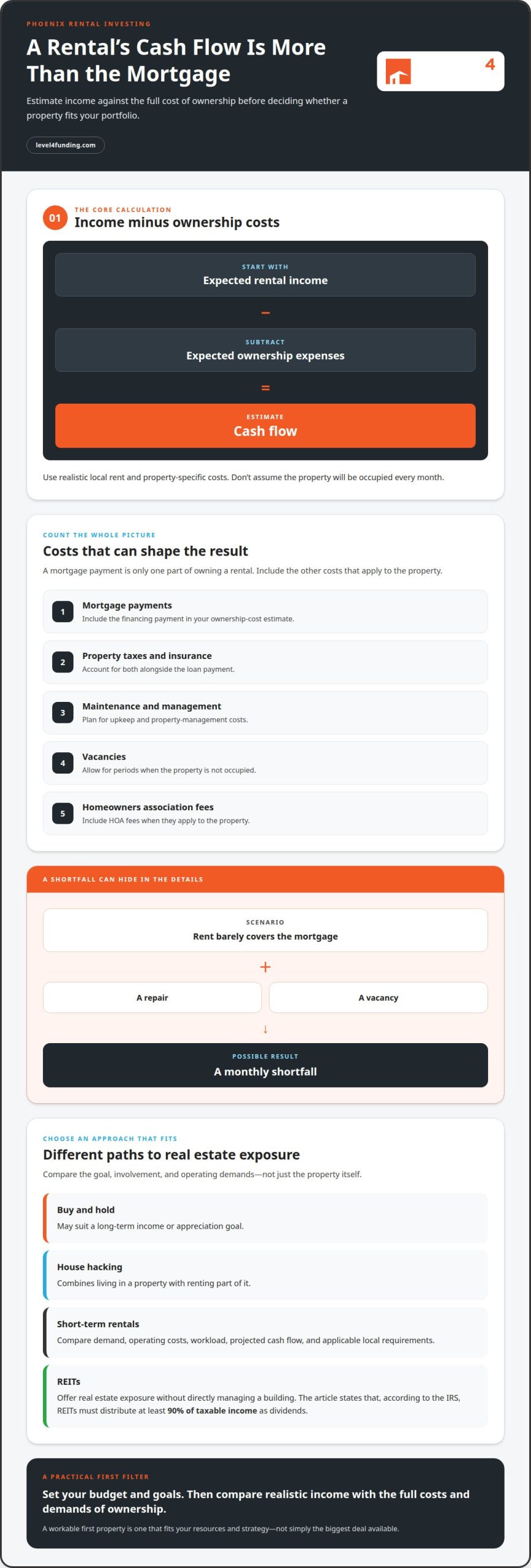
Estimate cash flow by subtracting expected expenses from rental income. Include mortgage payments, property taxes, insurance, maintenance, management, vacancies, and applicable homeowners association fees. For example, rent that barely covers the mortgage may still leave a monthly shortfall after repairs or a vacancy. Base your calculation on realistic local rent and property-specific costs, not the assumption that every month will be fully occupied.
Should a new investor buy and hold, house hack, or use short-term rentals in Phoenix? Buy and hold can suit a long-term income or appreciation goal; house hacking combines living in a property with renting part of it. Short-term rentals depend on demand, operating costs, and applicable local requirements, so compare the workload and projected cash flow before choosing.
To find, inspect, finance, and close on a Phoenix investment property, first define your budget and target property type. Research local rental demand, identify a suitable property, and inspect its condition and likely repair needs. Then compare financing terms, review projected income and ownership costs, and complete the purchase with the required transaction documents.
Diversification can reduce exposure to a single property type or location, but it doesn’t remove investment risk. A portfolio might combine a Phoenix rental with another residential property type or a property in a different market as capital allows. Start with a manageable property, learn its operating demands, and expand only when your finances and experience support the next move.
Investors who want property exposure without directly managing a building may consider REITs. According to the Internal Revenue Service, REITs must distribute at least 90% of their taxable income as dividends. Direct ownership and REITs work differently, so choose based on your investment goals, control preferences, and capacity to manage property.
2. Setting investment goals and writing a business plan
A useful Phoenix investment plan starts with a specific goal, not a property listing. Decide whether you’re prioritizing rental income, long-term appreciation, portfolio diversification, retirement preparation, or assets for future generations. Each objective leads to different choices. An investor seeking regular income may focus on rental performance, while someone building long-term wealth may give more weight to property condition and potential appreciation.
Put the goal in writing alongside your timeline, available capital, preferred property type, and risk limits. Then define what would make a purchase fit your plan: expected rental income, manageable ownership costs, financing terms, and reserves for interruptions. A clear buying standard helps keep an appealing listing from overriding your budget or strategy. Revisit the plan as your finances, experience, and priorities change.
Build your fundamentals before making an offer. Learn how purchase price, mortgage payments, interest, taxes, insurance, maintenance, vacancies, and property management affect a rental property’s performance. Study the difference between income and appreciation, and understand how financing terms shape the cash tied up in a deal. In Phoenix, connect those principles to the neighborhoods and property types you’re considering. Local demand and operating costs can change the numbers behind an otherwise attractive investment.
REITs can provide exposure to real estate without requiring direct ownership or hands-on property management. They may suit investors who want to learn how real estate fits their broader investment strategy before managing a rental themselves. Direct ownership gives owners more involvement in property decisions, but it also brings responsibility for upkeep, leasing, and financial oversight. Compare these approaches based on your preferred level of control, available time, and goals.
A written business plan should spell out how you’ll find opportunities, assess a property, arrange financing, and manage it after purchase. Include a process for comparing projected income with expenses, reviewing property condition, and deciding when a deal falls outside your limits. A business plan is a working tool, not a promise of returns. Use it to make consistent decisions and record why each investment fits the portfolio.
Build a professional team around the work you plan to do. A real estate agent can help identify suitable properties; an inspector can assess condition; a property manager can advise on day-to-day rental operations. A tax professional can explain how property ownership affects your tax planning, while a lender can outline financing structures and repayment terms. Clarify each person’s role before a transaction moves forward.
Keep the plan grounded in your own capacity. If a future purchase depends on rental income from the first property, spell out that dependency and decide what performance you need before expanding. This disciplined approach turns “how to build a real estate portfolio from scratch in Phoenix” into a sequence of deliberate investment decisions, rather than a rush to acquire more property.
3. Assessing personal finances and borrowing capacity
Start with your financial baseline before buying: income, savings, recurring debt, credit obligations, and cash reserves. Separate money for a down payment from funds needed for closing, repairs, vacancies, and ongoing operations. A property can look affordable at purchase and still strain your finances if the first repair or empty month drains your reserves. Set a maximum monthly payment that leaves room for those costs.
How much cash is needed to buy a first investment property in Phoenix? A conventional investment-property mortgage commonly calls for a 15% to 25% down payment, so the purchase price and loan terms drive the actual cash target.
Calculate borrowing capacity using the full monthly obligation, not just the principal and interest. Add property taxes, insurance, maintenance, management, and expected vacancy to your estimate. Investment-property mortgage rates typically run 0.5 to 1 percentage point higher than primary-residence rates. That difference can affect qualification and cash flow, so compare the projected payment against dependable income, not optimistic rent assumptions.
Traditional mortgages, private lending, partnerships, seller financing, and lease options structure risk and repayment differently. A mortgage may fit a buy-and-hold plan, while a partnership can combine capital and operating experience. Seller financing and lease options may offer another way to control a property, but contract terms shape the obligations. Compare interest, repayment schedule, term, collateral, and required upfront cash before choosing.
Build a complete acquisition budget before making an offer. Include the down payment, closing costs, inspections, immediate repairs, and reserves for future maintenance and vacancies. Then map monthly rental income against recurring costs. If the property needs improvements, separate the purchase budget from the renovation budget and identify how you’ll fund each stage. Keep personal emergency savings distinct from investment capital.
Use this short review to test whether a deal fits:
- Income: Record dependable personal income and realistic rental income.
- Debt: List existing payments and the proposed property obligation.
- Cash: Account for the down payment, closing costs, repairs, and reserves.
- Terms: Compare interest, loan duration, repayment schedule, and collateral.
Borrowing capacity is not the same as a safe investment limit. A lender’s maximum may leave too little room for operating surprises or future growth. Choose a payment that preserves financial flexibility, then reassess it when income, debt, or rental performance changes. That discipline supports successful real estate investing by keeping buying decisions tied to what your finances can sustain.
4. Evaluating rental income, cash flow, cap rate, and returns
Judge a Phoenix rental by the income it can support, not its asking price alone. Start with realistic monthly rent, then subtract operating expenses to estimate net operating income. Keep mortgage payments separate when calculating that figure, because cap rate compares property income with its purchase price before financing. This lets you compare properties with different loan structures.
Calculate cap rate by dividing annual net operating income by the property’s purchase price. The result helps compare income potential, but it doesn’t show your personal borrowing cost or the cash you’ll put into the deal. CBRE’s H1 2025 survey reported a 4.74% average cap rate for Class A multifamily properties, a specific asset category rather than a universal target.
Next, estimate cash flow after mortgage payments. Positive cash flow means rental income exceeds expenses, including debt service, maintenance, taxes, and vacancies. Track projected and actual results monthly. If the property earns less than expected, identify whether rent, vacancies, operating costs, or financing caused the gap. That diagnosis can help you adjust operations before pursuing another investment.
Cash-on-cash return measures annual pre-tax cash flow against the cash invested. Divide annual cash flow after operating costs and debt service by your total cash contribution, including acquisition and improvement funds. This measure matters when comparing deals with different down payments. A property with a stronger cap rate may produce a weaker cash-on-cash return if its financing requires more capital or larger mortgage payments.
Prioritize positive cash flow when your strategy depends on rental income to cover obligations and support future purchases. Appreciation can build wealth and equity over time, but it doesn’t pay a monthly bill. Keep the two sources of return distinct in your analysis. Forecast rental income conservatively, and test how vacancies or repairs affect the cash available after expenses.
Rental cash flow can help grow a portfolio when you retain part of the proceeds for reserves and future acquisitions. For example, an illustrative $500 in monthly cash flow equals $6,000 annually before personal taxes. Two properties producing $500 each generate $1,000 monthly combined. Consistently saving rental cash flow can help build funds for a future down payment.
Reinvesting every dollar can leave a portfolio exposed to repairs or vacancies. Direct income toward reserves first, then evaluate improvements, debt reduction, or another property. Diversify only when each purchase works on its own numbers. Review cash flow, cap rate, cash-on-cash return, and appreciation separately, so one attractive measure doesn’t hide a weak deal.
5. Researching local housing and rental demand
Start Phoenix market research at the neighborhood level, not with a citywide average. Compare the specific area around each property, because local employment, transportation, schools, services, and planned development can influence housing and rental demand. Match those conditions to your intended tenant and property type. A single-family home, condominium, and small multifamily building may attract different renters, even within the same market.
Which Phoenix neighborhoods offer the best rental yields and long-term appreciation? There’s no single neighborhood that leads for every investment goal. Compare purchase price, achievable rent, vacancy patterns, local jobs, infrastructure, and development plans. Areas with stronger demand may support appreciation, while less costly areas may offer more cash flow.
Build a repeatable comparison for each candidate area. Record current asking prices, realistic rents for similar properties, vacancy conditions, and features renters value. Check whether local employment opportunities and transportation access align with likely tenant needs. Then compare purchase price and expected monthly payments with projected rent and operating costs. This process reveals whether a property’s expected return fits your plan, rather than relying on a neighborhood’s reputation.
Research both current conditions and the direction of change. Population growth, new employers, infrastructure projects, and future development can influence demand, but a planned project isn’t the same as established demand. Separate existing amenities from proposed improvements. Consider whether new housing could add competition for tenants, and whether the area’s current rental supply already gives renters many alternatives.
What risks affect Phoenix real estate investing, including heat, water supply, vacancies, and market cycles? Assess each risk at the property and neighborhood level: heat can affect maintenance needs, water supply is a long-term market consideration, vacancies reduce rental income, and market cycles can change prices and demand. Include these factors in your operating assumptions and purchase decision.
Use a property-specific review before committing capital:
- Rental demand: Compare similar rentals and the tenant groups they serve.
- Supply: Note nearby competing rentals and planned housing development.
- Location: Assess access to jobs, services, transportation, and infrastructure.
- Resilience: Consider heat-related upkeep, water concerns, vacancy exposure, and market shifts.
Premium locations may bring stronger appreciation potential because demand can be higher; less-premium areas may offer more cash flow when property costs and mortgage payments are lower. Neither pattern guarantees a better return. Compare projected rent, purchase price, vacancy exposure, and operating costs for each property. A lower entry price matters only if the rental market can support the investment.
Use this research to shape the next step. If your plan involves a commercial property, explore commercial property loan options as part of the purchase analysis, alongside projected rent, expenses, and repayment obligations.
A neighborhood’s potential depends on your investment goal: weigh achievable rent and vacancies against the purchase price for cash flow, and assess local jobs, transportation, services, and development for possible long-term demand.
Level 4 Funding
Level 4 Funding helps real estate investors finance acquisitions and property projects as they build a portfolio. Its options include Fix and Flip Loans, Construction Loans, Commercial Property Loans, and Cash Out Refinance. The right fit depends on the investment strategy, property, and how financing supports the plan.
Consider financing when you’ve identified a Phoenix opportunity and need to determine how to fund the project. For example, an investor planning renovations may explore a Fix and Flip Loan, while a commercial acquisition may call for a Commercial Property Loan. Include repayment obligations in your cash-flow analysis before deciding whether a property fits your budget.
If you’re ready to discuss financing for your real estate investment, contact Level 4 Funding.
Turn Your Phoenix Plan Into a Next Step
A portfolio grows through deliberate decisions, not pressure to buy the next available property. Choose one actionable move: refine your investment criteria, assess a potential project, or map out the financing structure. Keep your next decision connected to the goals and limits you’ve set.
To learn how to build a real estate portfolio from scratch in Phoenix, turn your plan into a clear financing conversation when a property or project is in view. Level 4 Funding offers Fix and Flip Loans, Construction Loans, and Commercial Property Loans for real estate investors. The type of project and financing need will shape which option fits the plan.
Bring the property or project you’re considering and the questions that matter to your strategy. Discussing the financing alongside your expected costs and intended use can help you decide how to proceed. Contact Level 4 Funding to talk through your investment plans and financing needs. Take the next step with a plan that reflects your budget and the portfolio you want to build.
Frequently Asked Questions
What is a Real Estate Portfolio?
A real estate portfolio is the set of property investments an owner holds and manages toward specific financial goals. It can include direct ownership, such as a Phoenix rental home, and indirect exposure through real estate investment trusts. The portfolio view helps you assess how each asset contributes to income, appreciation, or diversification. It also makes it easier to spot concentration risk, such as relying on one property or tenant group.
What is the median home price and rent in Phoenix, Arizona in 2026?
Phoenix’s median home price and rent depend on the reporting period, geography, and property type, so one figure may not represent a specific investment target. For a useful comparison, match the same property type and area, then review recent sale prices alongside rents for comparable homes. A single-family property and a condominium may have different rent patterns, even within Phoenix. Use comparable properties to assess a purchase rather than treating a citywide median as a guaranteed result.
What financing options are available for first-time real estate investors in Arizona?
First-time Arizona investors can consider mortgages, private lending, partnerships, seller financing, and lease options. Each structure affects upfront capital, interest, repayment timing, and control differently. Level 4 Funding offers private hard money financing through options including Fix and Flip Loans, Construction Loans, Commercial Property Loans, and Cash Out Refinance. Match the financing structure to the asset and project, then assess its repayment obligations against the property’s projected income and your financial capacity.
How do Arizona property taxes, landlord laws, and rental regulations affect Phoenix investors?
Property taxes add to a rental’s ongoing ownership costs, while landlord laws and rental regulations shape how owners operate and lease properties. These factors can affect expenses, documentation, tenant communications, and property management procedures. Before buying, identify the obligations that apply to the property’s location and rental arrangement, then include related costs and administrative work in your plan. Keep organized records of ownership expenses, lease documents, and property operations to support consistent management and financial review.
What are the best property types for a beginner Phoenix real estate portfolio?
The best starting property depends on your budget, operating capacity, and investment goal. A single-family home may offer a straightforward way to learn leasing and maintenance; a condominium can involve association rules and fees; a small multifamily property combines multiple units in one investment. Compare each option’s likely tenant demand, upkeep, and management workload. A smaller project can help you gain practical ownership experience before adding assets or property types to your portfolio.
How do Phoenix investors calculate cash flow, cap rate, and return on investment?
Estimate cash flow by subtracting operating costs and mortgage payments from rental income. For cap rate, divide annual net operating income, before mortgage payments, by the purchase price. To calculate cash-on-cash return, divide annual cash flow after debt service by the cash invested. Keep the measures separate: cap rate compares property income, while cash-on-cash return reflects financing and your invested capital. Include vacancy and repair assumptions to make each projection more useful.
What are typical Phoenix property management fees, insurance costs, and maintenance expenses?
These expenses vary with the property, coverage, service scope, condition, and level of management. A rental with older systems may need a different maintenance plan than a recently updated property, while management costs depend on the tasks included. Build a property-specific budget using proposed management services, insurance terms, and known repair needs. Separate recurring expenses from one-time improvements, and leave room in your projections for vacancies and unexpected maintenance rather than relying on rent alone.

About the author
Matt has a bachelor's degree in political science from Northern Arizona University and works at Level 4 Funding, a private lending company that offers hard money and rental home loans to real estate investors in 35 states.
With Matt's leadership, the firm has financed almost $300 million in loans for investment properties. He often helps real estate investors with rental property purchases, foreclosures, refinancing, and fix-and-flip projects. Matt has extensive experience in fix-and-flip, buy-and-hold, rental properties, and real estate sales. He has lived in Arizona for 43 years and is married with three children. Matt is licensed as a mortgage broker and loan originator in Arizona, with NMLS 2062278 and NMLS 1118493.
Equal Housing Opportunity. This is not a Good Faith Estimate, and it is not a Guarantee to lend; it should not be considered as such. Costs, rates, estimates, and terms can only be determined after a full application is completed. To the extent this message includes any tax or legal advice, this message is not intended or written by the sender to be used, and cannot be used, for legal or tax purposes or advice. This is an advertisement. Copyright © 2026. All rights reserved.