

How to Prepare Funding for a Maricopa County Foreclosure Auction
November 16, 2026
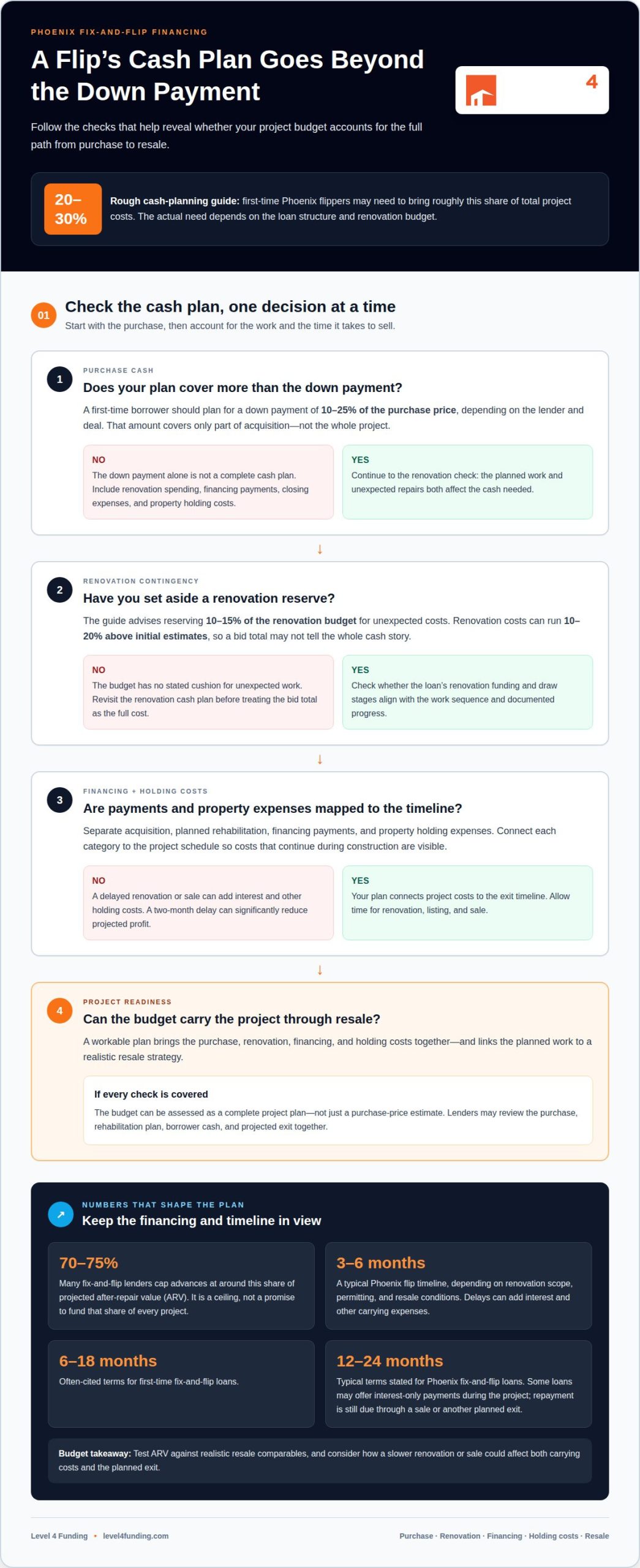
The purchase price isn’t the whole cash question. For first-time flipper loans in Phoenix, plan to bring roughly 20%-30% of total project costs in cash, with the exact need shaped by the loan structure and renovation budget. A down payment is only one piece of that number.
That’s a bigger commitment than many new investors expect. You’ll also need a realistic plan for renovation spending, loan payments, and holding costs while the property is being prepared for resale. A renovation reserve matters too: setting aside 10%-15% of the renovation budget can help absorb unexpected work without derailing the project.
This guide explains how first-time flipper loans Phoenix investors may use work, what to include in a project budget, and how down payments and financing timelines affect the cash needed. It also covers when a hard money loan may suit a deal, based on its numbers and renovation scope.
Key Takeaways
- See how purchase plans, renovation scope, and resale potential can shape a lender’s decision on a first flip.
- Learn why financing may be based on a property’s projected after-repair value, not just its current condition.
- Understand how a down payment differs from the full cash needed to carry a project through resale.
- Find out what can help move an application forward and why some lenders target a 10-to-21-day closing window.
- Explore when hard money financing may suit a Phoenix flip, including how deal fundamentals and borrower experience can factor into terms.
How lenders finance renovations and resale plans for first-time Phoenix flippers
A fix-and-flip loan can finance a property purchase and renovation, linking the funding plan to the resale strategy. The property’s current condition, planned work, and expected after-repair value (ARV) all help shape the deal. Keep the renovation scope suited to the property and likely buyer, rather than building the budget around an optimistic wish list.
ARV matters because lenders may cap financing against the property’s projected value after repairs. Many fix-and-flip lenders cap advances at around 70-75% of a property’s after-repair value. That ceiling is not the same as a promise to fund that share of every project. The purchase price, repair budget, borrower cash, and lender’s structure all affect the amount available. Loan-to-value assumptions should therefore be tested against realistic resale comparables, not the highest asking prices nearby.
How do hard money, private money, bank, and DSCR loans compare for Phoenix house flips? Hard money and private money financing focus on the deal and its collateral, while banks may weigh borrower experience heavily; DSCR loans center on rental income, so they generally fit a rental exit better than a quick resale. Some hard-money and bridge lenders require first-time borrowers to have one to three completed flips for competitive terms, while banks may want two to three completed flips before quoting a rate.
How much can a first-time flipper borrow for a Phoenix property? A useful starting point is the ARV-based cap: many lenders limit advances to around 70-75% of projected post-renovation value. The actual amount also depends on the purchase, rehabilitation plan, and financing structure.
Fix-and-flip terms need to match the work and exit plan. First-time fix-and-flip loans often have terms of 6-to-18 months, while Phoenix fix-and-flip loans typically have terms of 12-24 months. Some loans may offer interest-only payments during the project. That can ease scheduled payments during renovation, but it doesn’t remove the need to repay the loan through a sale or another planned exit.
What Phoenix neighborhoods and property types may suit first-time house flippers? Look for areas where recent comparable sales within a half-mile radius support the resale estimate. Choose a property with a clearly defined, manageable renovation scope, which is easier to budget than one with uncertain repairs or a major redesign.
What risks should first-time Phoenix flippers consider, including holding costs and loan extensions? A typical Phoenix flip takes between 3 and 6 months, depending on renovation scope, permitting, and resale conditions, but delays can add interest and other holding costs. An extension may change the financing plan, so build the exit around a realistic sale timeline and know how a delay affects repayment.
How lenders help first-time Phoenix flippers plan purchase, renovation, financing, and holding costs
A workable flip budget brings acquisition, rehabilitation, financing, and resale together in one plan. Lenders review how the purchase price and renovation scope relate to the property’s projected value, and whether the planned work supports the resale. For real estate investors, the financing request should tell a consistent story from purchase through exit, with each upgrade tied to a clear purpose.
Depending on the loan structure, purchase and rehabilitation financing can cover both parts of a project. The acquisition amount covers the property purchase, while renovation funding supports approved work as it progresses. A draw schedule divides rehabilitation funds into planned stages. Align each stage with the work and documented progress so disbursements fit the renovation timeline.
Cash reserves are separate from the loan amount. First-time flippers are advised to reserve 10-15% of the renovation budget for unexpected costs, while renovation costs can run 10-20% above initial estimates. Those figures show why a bid total alone isn’t a complete cash plan. A lender assessing financial preparation considers whether the borrower can manage planned work and costs that emerge before resale.
Separate the budget into acquisition, planned rehabilitation, financing payments, and property holding expenses, then connect each category to the timeline. A six-month project timeline can show how interest and ongoing property expenses continue during construction. A two-month delay can significantly reduce projected profit, so allow time for renovation, listing, and sale.
For example, if a Phoenix property needs repairs before listing, match the proposed draw schedule to the work sequence. Early repairs should fit the opening stage, with later work assigned to subsequent stages. This helps clarify how financing supports the renovation and whether a delayed task could hold up resale and extend carrying expenses.
Before approval, lenders can assess the purchase, rehabilitation plan, borrower cash, and projected exit together. A hard money lender may suit a project where the acquisition and renovation need coordinated financing. The most useful next step is to present a clear scope and timeline for review through Phoenix hard money lending.
3. Down payments and borrower cash requirements
For a Phoenix flip, a first-time borrower should plan for a down payment of 10-25% of the purchase price, depending on the lender and deal. Treat that range as a planning guide, not the project’s full cash requirement. The down payment covers only part of the acquisition. Renovation spending, financing payments, closing expenses, and property holding costs can require additional funds during the project.
Lenders may consider experience alongside the property and renovation plan, but a first-time borrower can still apply. Present the deal fundamentals clearly: purchase price, repair scope, projected after-repair value, and resale plan. Define the exit as well, explaining how a sale or another financing strategy would repay the loan.
Prepare a cash plan that separates funds by purpose: the amount for purchase, money available for repairs, and cash remaining for property expenses. A borrower who uses most available cash at closing, for example, may have little flexibility if work costs more or takes longer. Laying out available funds and their planned use helps make the project easier to assess.
Borrower experience matters, but it is not the only factor in a Phoenix loan review. A realistic scope, supported resale assumptions, and workable timeline help explain how the project can reach completion. First-time investors can strengthen their presentation by connecting each repair to the property’s condition and intended buyer, giving lenders a practical basis to assess the request.
Federal education funds follow separate rules from real estate lending. University of Phoenix students must attend continuously, with no break longer than 14 days, to retain disbursed federal funds. That attendance requirement applies to those student funds, not a borrower’s down payment or qualification for a property loan.
Before closing, align the requested loan, borrower contribution, and remaining cash with the project’s actual stages. Explain how funds will cover acquisition, repairs, and carrying costs without counting the same money twice. Lenders assess the purchase price, borrower contribution, property condition, renovation scope, and repayment plan. A clear breakdown can reveal funding gaps before they create pressure during the flip.
Lenders may consider a borrower’s experience when assessing a Phoenix deal, but first-time flippers can still apply for financing.
4. Application and quick approval process
A clear application presents the Arizona property and flip as one project. Start with the purchase terms, current condition, repair scope, and planned resale, then connect them to the funding request and repayment plan. Resolve any conflicts in the numbers or timeline before submitting. A complete project overview makes it easier for a lender to assess the request than scattered details that leave basic questions unanswered.
Tie each planned repair to the property by identifying the work, its sequence, and how completion supports the resale. The project budget should distinguish acquisition funding from rehabilitation funding and show where borrower cash fits. These details help explain the request, especially for a first-time borrower with limited flip experience. Present a consistent account of what the property needs and how the project reaches its exit.
A credible loan request brings together the purchase, repair plan, projected value, borrower contribution, and exit. Explain your assumptions clearly, including what supports the resale estimate and how the timeline allows for renovation and marketing. A mismatch between the repair scope and proposed resale can complicate the review or lead to follow-up questions.
Organize the application around the lender’s key decisions. Provide property and purchase details, describe planned repairs, outline the funding request, and explain the repayment strategy. Include a timeline for the work and sale, rather than treating closing as the finish line. This order helps identify missing information and clarify the application before it affects the closing schedule.
For eligible applicants, seek a lender able to close in 10 to 21 days. That window makes preparation important: a 45-day closing can cause buyers to lose distressed-property deals to cash buyers. A faster target does not mean every application closes within that period. Property review, project complexity, and the completeness of the application affect how quickly a lender can move toward approval and funding.
Before accepting terms, understand the proposed payment structure, loan term, rehabilitation funding process, and repayment plan. Make sure the project’s expected duration fits the loan’s defined term. If a repair decision changes the budget or timeline, communicate the change promptly through the application process. A disciplined file gives lenders a clearer basis for evaluating risk, while a realistic closing plan helps the borrower avoid committing to a property before financing is ready.
5. Phoenix fix-and-flip hard money loans
Hard money can suit a Phoenix project where the property and renovation plan drive the financing decision. A fix-and-flip loan is designed for a short-term investment and resale, unlike financing for a rental held to generate ongoing income. The exit matters: a rental depends on property income, while a flip depends on completing repairs and selling the home.
For a first-time borrower, the strongest loan request connects the property’s condition, repair scope, purchase terms, and resale plan. Lenders may weigh experience, but deal fundamentals and a realistic renovation plan matter too. Some hard-money and bridge lenders require one to three completed flips for competitive terms. That doesn’t mean every first-time borrower is automatically ruled out.
What should first-time flippers look for when comparing Phoenix fix-and-flip lenders? Compare how each lender evaluates the property, rehabilitation plan, borrower contribution, loan term, payment structure, and exit strategy. Also understand how repairs are funded and how a delay could affect repayment, rather than focusing on a single headline term.
Loan programs can structure purchase and rehabilitation funding differently. A Phoenix property needing staged repairs, for example, calls for a funding plan that follows the work sequence. Review how the proposed structure handles renovation draws, scheduled payments, and repayment after resale. These details show whether financing fits the project, not just whether it can fund the initial purchase.
What Arizona licensing, disclosure, and lending rules apply to fix-and-flip loans? Requirements can depend on the loan structure and transaction purpose, so no single rule necessarily covers every investor loan. Before closing, review the written loan terms and applicable disclosures for the specific transaction.
Market fit matters as much as loan structure. The property type, repair needs, and likely resale audience should support the same strategy. A home requiring substantial renovation, for instance, may need a different timeline and funding plan from one needing limited repairs. Lenders assess whether the proposed work and exit fit together, rather than treating every Phoenix property as the same deal.
First-time investors should distinguish project fit from income-focused qualification. A lender may focus on the property, renovation scope, borrower experience, and repayment plan, while other loan programs may emphasize income or rental performance. Choose financing that matches the intended use: a resale project and a long-term rental are different strategies.
For a Phoenix resale project, map the loan structure to the work, timeline, and exit before committing. Explore fix-and-flip financing options for a project built around renovation and resale.
Level 4 Funding: Fix and Flip Loans
Level 4 Funding offers Fix and Flip Loans for investors financing a property purchase, renovation, and resale plan. Turn to this option when your project has a defined repair scope and exit strategy, but you need financing structured around the flip rather than a long-term rental hold. A clear view of the property, planned work, and expected resale helps frame the financing request.
If the project shifts to ground-up building or a commercial property, Construction Loans or Commercial Property Loans may better match its purpose. For owners seeking funds from an existing property, Cash Out Refinance is another option. The right fit depends on what you’re financing and how the project is intended to perform.
Contact Level 4 Funding to discuss financing for your Phoenix flip.
Turn your Phoenix flip plan into a financing conversation
Turn the opportunity into a clear financing request. Decide what you want the property to become, how the work supports that goal, and what exit you’re planning. That direction keeps the financing conversation focused on the project, not just the purchase.
For investors pursuing first-time flipper loans in Phoenix, Level 4 Funding offers Fix and Flip Loans. Its other real estate financing options include Construction Loans and Commercial Property Loans, which may fit different project types. Matching the financing to the property’s intended use gives you a practical starting point for discussing your plan.
Bring your project outline and intended financing needs to the conversation. You don’t need to have every decision locked in; you do need a clear idea of the property, its purpose, and your next step. Contact Level 4 Funding today to discuss your real estate financing plans and move forward with purpose.
Frequently Asked Questions
What are first-time house flipper loans in Phoenix, Arizona?
Fix-and-flip loans are short-term private real estate loans for purchasing and renovating a property intended for resale. First-time flipper loans in Phoenix connect the property, proposed repairs, and exit strategy in one financing plan. Unlike a loan built around rental income, a flip loan centers on completing improvements and selling the property. Loan structure and borrower contribution depend on the deal and lender’s terms.
What loan types can new real estate flippers use in Phoenix?
New investors can consider private hard money financing structured for fix-and-flip projects, particularly when purchase and rehabilitation funding need to work together. A rental-focused loan may suit a property intended to generate ongoing income rather than be resold. Construction financing may fit a building project, while commercial property financing serves commercial real estate. Choose the loan type according to the property’s intended use and planned exit.
What credit score, experience, income, and cash reserves do Phoenix flip lenders require?
Requirements vary by lender and loan structure. Level 4 Funding doesn’t require a minimum credit score, tax returns, pay stubs, income verification, or reserve funds. Lenders may review judgments, tax liens, or bankruptcy, and a low score may lead to a larger down payment or higher interest. Level 4 Funding’s down payment range is 0% to 50%, depending on experience, credit, relationship, and real estate license.
How do lenders qualify borrowers and close a fix-and-flip loan in Phoenix?
Lenders assess the property, purchase, renovation plan, borrower profile, and repayment strategy to determine whether the request fits the project. Level 4 Funding uses a one-page application. Its FAQ says most loans close in about 7 days, with the title report taking the longest. A complete application helps move the review forward; closing timing still depends on completing the transaction’s required steps.

About the author
Matt has a bachelor's degree in political science from Northern Arizona University and works at Level 4 Funding, a private lending company that offers hard money and rental home loans to real estate investors in 35 states.
With Matt's leadership, the firm has financed almost $300 million in loans for investment properties. He often helps real estate investors with rental property purchases, foreclosures, refinancing, and fix-and-flip projects. Matt has extensive experience in fix-and-flip, buy-and-hold, rental properties, and real estate sales. He has lived in Arizona for 43 years and is married with three children. Matt is licensed as a mortgage broker and loan originator in Arizona, with NMLS 2062278 and NMLS 1118493.
Equal Housing Opportunity. This is not a Good Faith Estimate, and it is not a Guarantee to lend; it should not be considered as such. Costs, rates, estimates, and terms can only be determined after a full application is completed. To the extent this message includes any tax or legal advice, this message is not intended or written by the sender to be used, and cannot be used, for legal or tax purposes or advice. This is an advertisement. Copyright © 2026. All rights reserved.