

First time flipper loans Phoenix: Plan costs and cash needs
November 17, 2026
The financing structure matters as much as the Phoenix property itself. Commercial construction financing in Phoenix can take the form of acquisition, ground-up construction, development, or expansion funding, and for ground-up projects, most lenders offer a maximum loan-to-completed value of 70%. That makes the project plan and the borrower’s contribution central to the financing decision.
It’s reasonable to expect a construction loan to cover the whole project, but financing depends on what you’re acquiring or building, how the project is structured, and whether the loan bridges construction or supports a longer-term property strategy. The right fit depends on the project.
This guide explains commercial construction financing options for Phoenix properties, how acquisition and construction financing differ, and what lenders consider when reviewing a development or expansion. It also explains where private financing may fit, so you can compare loan types and their roles.
Key Takeaways
- Match the financing approach to the property type and project goal, whether you’re building, acquiring, or expanding.
- Separate land acquisition funding from interim construction financing to understand how each stage may be funded.
- Assess how project readiness, borrower contribution, and development experience can shape financing options.
- Consider how expansion financing may work alongside the value and existing debt of your business property.
- Learn when construction loans, commercial property loans, or cash-out refinancing may align with an investment plan.
Loan options for industrial, hospitality, mixed-use, multifamily, office, retail, residential, and charter school proper
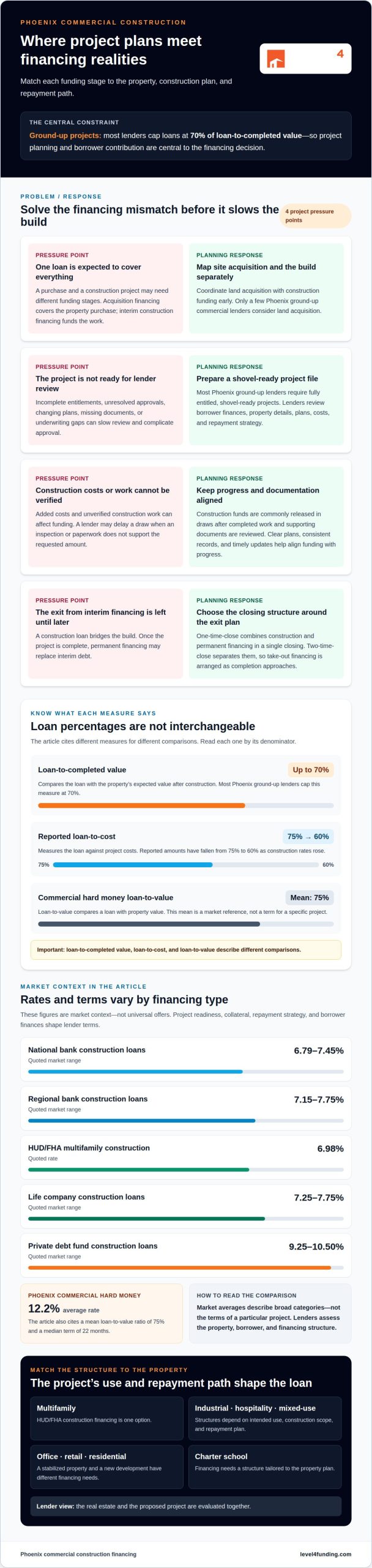
For Phoenix ground-up projects, most lenders cap loan-to-completed value at 70%; reported loan-to-cost amounts have fallen from 75% to 60%, while the mean loan-to-value ratio for commercial hard money loans is 75%. Delays or added costs can follow incomplete entitlements, changing plans, underwriting gaps, or construction work that cannot be verified for a draw.
A property’s intended use, construction scope, and repayment plan shape the financing approach. A stabilized office building has different needs from a new mixed-use project or industrial development. Lenders evaluate the real estate and proposed project together.
Property-Specific Loan Options
Industrial, hospitality, mixed-use, multifamily, office, retail, residential, and charter school properties may call for different construction loan structures. Lenders consider intended use, the construction plan, and the path to repayment. HUD/FHA financing is one option for multifamily construction; commercial hard money loans may suit investors seeking private financing. Charter school and hospitality projects need structures tailored to their property plans.
Loan-to-Cost and Loan-to-Value Limits
Loan-to-completed value compares the loan with the property’s expected value after construction; loan-to-cost measures it against project costs. Phoenix ground-up lenders commonly cap loan-to-completed value at 70%. Market reporting also places the mean commercial hard money loan-to-value ratio at 75%, while higher construction rates have reduced reported loan-to-cost amounts from 75% to 60%. These measures are not interchangeable.
National and regional bank construction loan rates depend on the loan structure and underwriting. The quoted market ranges as of 11/17/2026 are 6.79-7.45% for national banks and 7.15-7.75% for regional banks. Those figures provide context, not a universal offer; project readiness, collateral, repayment strategy, and borrower finances shape the lender’s terms.
Application and underwriting move from project review to loan terms. The lender evaluates borrower finances, property details, construction plans, costs, and repayment strategy. For Phoenix ground-up construction, most lenders require fully entitled, shovel-ready projects. Missing documents, unresolved approvals, or material plan changes can slow review and complicate approval.
Commercial hard money loan averages offer another point of comparison. In Phoenix, the mean loan-to-value ratio is 75%, the average rate is 12.2%, and the median term is 22 months. These market averages describe a broad category, not the terms for a particular project. Actual underwriting weighs the property, borrower, and financing structure.
Construction funds are commonly released through draws rather than as one lump sum. The lender reviews completed work and supporting documentation before releasing each scheduled amount. If an inspection or paperwork does not support the requested draw, disbursement may be delayed. Clear plans, consistent records, and timely project updates help keep the funding process aligned with construction progress.
Commercial acquisition and interim construction loans
Acquisition financing covers a property purchase; interim construction financing funds work before a completed project can support longer-term debt. For investors planning commercial construction financing Phoenix projects, it helps to map site acquisition and construction as separate funding needs from the start.
Construction financing and permanent commercial real estate loans serve different stages. A construction loan bridges the build; a take-out loan replaces interim financing after the project is complete.
Acquisition and Interim Financing
For a Phoenix project involving land, acquisition and construction funding may need coordination. Only a few ground-up commercial lenders in Phoenix consider land acquisition, so the financing structure matters before a borrower commits to a site. Interim financing then supports construction. The lender assesses the property, project plan, borrower finances, and intended repayment strategy together.
Arizona construction loans also support homebuilding, but residential construction financing differs from commercial development debt. A homebuilding loan supports a residence, while commercial financing addresses property intended for business or investment use. Focus on the property’s purpose, construction timeline, and repayment plan after the work is complete.
One-Time-Close and Two-Time-Close Loans
A one-time-close structure combines construction and permanent financing in a single closing, putting the permanent phase into the plan upfront. A two-time-close structure separates the construction loan from the later permanent loan, so owners arrange take-out financing as the project nears completion.
Compare the structure with the project timeline and exit plan. One-time-close financing links the construction and permanent phases. Two-time-close financing creates a separate transition, so plan for the take-out loan before interim financing ends. These structures describe timing, not approval or a particular rate.
Construction and Permanent Loan Terms
Construction financing is interim funding; permanent commercial real estate financing replaces it after completion. Phoenix construction rates vary by lender type: as of 11/17/2026, HUD/FHA multifamily construction loans are priced at 6.98%, life company construction loans at 7.25-7.75%, and private debt fund construction loans at 9.25-10.50%.
For multifamily projects, HUD/FHA construction loans are fixed for the construction loan term and the full 40-year permanent loan term. That structure extends beyond the build. For other commercial properties, the construction loan and permanent loan may be separate stages, with take-out financing replacing interim debt after completion.
Before choosing a structure, map acquisition, construction, and permanent financing in order. Identify whether land funding is needed, whether the project is multifamily, and how interim debt will be replaced. Arizona Financial describes a take-out loan as longer-term financing that replaces a short-term interim loan after construction. Commercial construction financing Phoenix projects may involve these stages, so match the structure to the project’s timeline and exit plan. For a project needing construction funding, explore commercial construction financing as one option to consider.
Commercial construction lending in Phoenix
Phoenix commercial construction lending includes banks, credit unions, private debt funds, and hard-money lenders. National, regional, and community banks are among the bank options; each lender evaluates the project, borrower, collateral, and repayment plan.
For ground-up construction, Phoenix borrowers typically contribute 25%-35% of project costs and maintain cash reserves. Most local lenders also require projects to be fully entitled and shovel ready. Those conditions affect readiness: unresolved approvals or incomplete plans can stall underwriting before construction begins.
Credit is only one part of the financing picture. Lenders also assess the property, project costs, construction plan, borrower experience, and expected exit. Present a coherent package connecting the requested loan to the project stages and repayment strategy. Strong collateral does not replace a clear plan.
Creative lending solutions structure funding around a project’s needs. A lender may assess acquisition, construction, and repayment as connected stages rather than isolated requests. The structure depends on the property and exit plan. Land acquisition can be a constraint, since only a few Phoenix ground-up lenders consider funding it.
Asset-driven lending places substantial weight on the property and its projected value, alongside borrower credit and project details. That can matter to investors whose strongest qualification is real estate collateral. It does not remove underwriting. Lenders still review costs, plans, reserves, experience, and the path to repayment before setting terms.
Disbursement is another key part of the lending structure. Construction funds are generally released in draws as work progresses, rather than all at once. The lender reviews completed work and supporting records before authorizing each draw. If documented progress does not match the requested funds, payment may be delayed and the construction schedule disrupted.
A practical review can follow four steps:
- Identify whether the request includes land acquisition, construction, or both.
- Confirm entitlements, project plans, cost details, and required reserves are organized.
- Match the lender type to the property, borrower profile, and repayment approach.
- Align draw timing with construction milestones and the documentation available for review.
These steps give banks, credit unions, and private lenders a clearer basis for review. They also help Phoenix investors understand how lender criteria affect structure, timing, and payment planning. The strongest financing fit matches the project’s stage, collateral, and exit, not simply the first available loan.
Commercial construction financing in Phoenix is available through national, regional, and community banks, credit unions, private debt funds, and hard-money lenders.
Commercial real estate development financing
Phoenix development financing must connect site acquisition, construction, and the planned exit. Commercial real estate lenders assess these stages together because the land, design, and repayment plan affect the financing structure. For ground-up projects, development experience can help show who is prepared to execute the plan. A strong proposal should show who will execute the plan and how the completed property supports repayment.
Acquisition and development term financing can cover different parts of a project. Acquisition funding supports the site purchase; development financing funds work that moves the property toward construction or completion. Only a few Phoenix commercial ground-up lenders consider land acquisition. Account for this early, then align the financing request with project costs, readiness, and the intended exit.
Residential development financing depends on what is being built and how the completed property will be used. A single residence, rental project, and multi-unit development can each have different operating and repayment plans. For a Phoenix proposal, lenders assess intended use, construction scope, borrower experience, and exit strategy. These details help determine whether the request is for residential or commercial real estate financing.
Multi-unit development involves more moving parts than a single building. Lenders review the construction plan, project costs, and how the completed units support the repayment strategy. HUD/FHA construction financing is one option for multifamily projects. The development plan should connect the number and type of units to the property’s intended use and the borrower’s experience.
In-fill development uses a site within an established area rather than an undeveloped edge. In Phoenix, the financing case still depends on acquisition needs, project readiness, development experience, and a credible exit. Lenders need to understand how the proposed work fits the site and whether the borrower can carry the plan through completion. Existing surroundings do not replace project-level underwriting.
Consider Arizona or Phoenix programs and incentives separately from the core loan structure. For any program relevant to a development, assess eligibility, permitted use, timing, and how it fits acquisition and construction funding. Do not build the repayment plan around an incentive; lenders still evaluate the real estate, borrower experience, costs, and exit.
A clear development financing request can organize the decision around these steps:
- Define the project type, such as in-fill housing or a multi-unit development.
- Show whether acquisition funding is part of the request.
- Present the development plan, costs, borrower experience, and repayment path together.
- Match the financing structure to the project’s stage and intended exit.
This sequence helps Phoenix investors distinguish site acquisition from development funding and makes the project’s logic easier to assess. The property, plan, responsible team, and exit need to align. For commercial real estate development, experience and project readiness shape how lenders evaluate a financing request from the start.
Financing to expand existing business property
Expanding an operating property may involve adding space, renovating a building, or improving its commercial use. In Phoenix, first define the work and the capital required. Lenders need to understand how the improvements relate to the property and the business using it. A warehouse addition, for example, has a different scope from renovating customer-facing retail space.
Separate the expansion plan into clear components before seeking financing. Identify the existing property, proposed work, project costs, and how the completed space will support operations. This gives the lender a connected picture instead of a broad request for funds. For example, a business adding storage can explain how the new area supports its current property use.
The financing structure depends on the property, expansion scope, and repayment plan. A commercial property loan may fit when the need centers on an existing income-producing or business property. Lenders evaluate the property and proposed project together, while the borrower’s financial position and repayment plan also inform underwriting.
Existing debt is another key part of the review. If the property already has a loan, its balance and repayment terms affect the available financing structure. Lenders also consider whether the expansion changes the property’s use or operating plan. Renovating to support the current business differs from preparing space for a new tenant.
Community banks typically price commercial construction loans at 1.00-1.50% above the prime rate. That benchmark concerns construction lending, not a quoted offer for an expansion. The structure and terms for a particular property depend on its project details, borrower profile, and repayment plan. Keep the cost discussion separate from the work scope so each part can be evaluated clearly.
A practical expansion review can follow these steps:
- Describe the property and its current business use.
- Break the planned work into specific improvements or additions.
- Organize project costs, existing property debt, and borrower financial details.
- Explain how the completed work supports the property and repayment plan.
This sequence clarifies whether the request is mainly for property acquisition, construction, or improvements to an existing asset. It also gives lenders concrete details to assess rather than a general expansion goal. Phoenix businesses can present the property, requested capital, and project purpose as one coherent financing request.
For financing centered on an existing commercial property, explore commercial property financing as a potential next step for your expansion plan.
Level 4 Funding: Construction Loans
Level 4 Funding offers Construction Loans for real estate investors financing a commercial build or development. Turn to this option when your project needs construction funding; a Commercial Property Loan may fit an acquisition or existing-property financing need instead. For an investment property renovation, Fix and Flip Loans may be relevant, while Cash Out Refinance can help property owners access equity for another investment purpose.
Match the financing type to the property, project scope, and intended use of funds. Clear details about the property and plan help frame the request without confusing construction funding with acquisition or refinance needs.
Contact Level 4 Funding to discuss financing for your commercial property project.
Set Your Project Up for Its Next Move
The next step is to turn your financing goal into a clear project brief. Define what the property needs, how the work supports your investment plan, and what outcome you’re working toward. That focus gives a financing conversation a practical starting point and keeps decisions tied to your project rather than assumptions. A considered plan for commercial construction financing in Phoenix can help you move forward with a clearer sense of purpose.
Level 4 Funding offers financing options for real estate investors, including Construction Loans, Commercial Property Loans, and Fix and Flip Loans. The right starting point depends on whether you’re building, acquiring, or improving an investment property. Bring your project goals into the conversation and explore which financing path aligns with them. Contact Level 4 Funding to discuss your next move. Your project has a direction. Take the next step with confidence.
Frequently Asked Questions
What commercial construction loan options are available in Phoenix, Arizona?
Options include ground-up construction loans, acquisition financing, interim loans, and private hard-money funding. Multifamily developers may also consider HUD/FHA construction financing. An investor acquiring a site and building apartments may need coordinated acquisition and construction funding, while an owner renovating an existing property may need a different structure. One-time-close and two-time-close arrangements also differ in how they combine or separate construction and permanent financing.
What are current commercial construction loan rates and fees in Phoenix?
Reported rates as of 11/17/2026 range from 6.79-7.45% for national banks, 7.15-7.75% for regional banks, and 8.00-8.25% for community banks. Hard-money commercial construction rates are reported at 9.99-13.00%. Phoenix commercial hard-money origination costs average 2.8%. These are broad market benchmarks, not a specific project quote; loan structure and lender type affect the terms.
What down payment and equity requirements do Phoenix commercial construction lenders have?
Phoenix borrowers financing ground-up commercial construction typically contribute 25%-35% of project costs and hold cash reserves. The exact equity contribution depends on how the lender assesses project costs, completed value, borrower finances, and collateral. For example, land acquisition may require a separate funding plan because only a few Phoenix ground-up lenders consider financing land purchases. Build the equity plan around the full project, not construction alone.
What are the eligibility requirements for commercial construction financing in Arizona?
For Phoenix ground-up projects, lenders require development experience, and most require fully entitled, shovel-ready plans. Underwriting also considers the property, project scope, borrower finances, and repayment strategy. Level 4 Funding’s private financing has no minimum credit score requirement, though lenders may review judgments, tax liens, or bankruptcy. A borrower’s project experience and readiness remain important parts of the commercial financing assessment.
How does the commercial construction loan application and draw process work in Phoenix?
The process starts with an application and project review, followed by underwriting and a loan decision. Level 4 Funding uses a one-page application. For construction funding, organize the property and project details so the financing request reflects the planned work. After funding begins, construction proceeds through draws: the lender reviews completed work and supporting documentation before releasing each requested amount. Keep draw requests aligned with documented project progress.
Which banks, credit unions, and private lenders finance commercial construction in Phoenix?
Phoenix commercial construction financing is available through national, regional, and community banks, credit unions, private debt funds, and hard-money lenders. Each evaluates the project, borrower, collateral, and repayment plan.

About the author
Matt has a bachelor's degree in political science from Northern Arizona University and works at Level 4 Funding, a private lending company that offers hard money and rental home loans to real estate investors in 35 states.
With Matt's leadership, the firm has financed almost $300 million in loans for investment properties. He often helps real estate investors with rental property purchases, foreclosures, refinancing, and fix-and-flip projects. Matt has extensive experience in fix-and-flip, buy-and-hold, rental properties, and real estate sales. He has lived in Arizona for 43 years and is married with three children. Matt is licensed as a mortgage broker and loan originator in Arizona, with NMLS 2062278 and NMLS 1118493.
Equal Housing Opportunity. This is not a Good Faith Estimate, and it is not a Guarantee to lend; it should not be considered as such. Costs, rates, estimates, and terms can only be determined after a full application is completed. To the extent this message includes any tax or legal advice, this message is not intended or written by the sender to be used, and cannot be used, for legal or tax purposes or advice. This is an advertisement. Copyright © 2026. All rights reserved.